
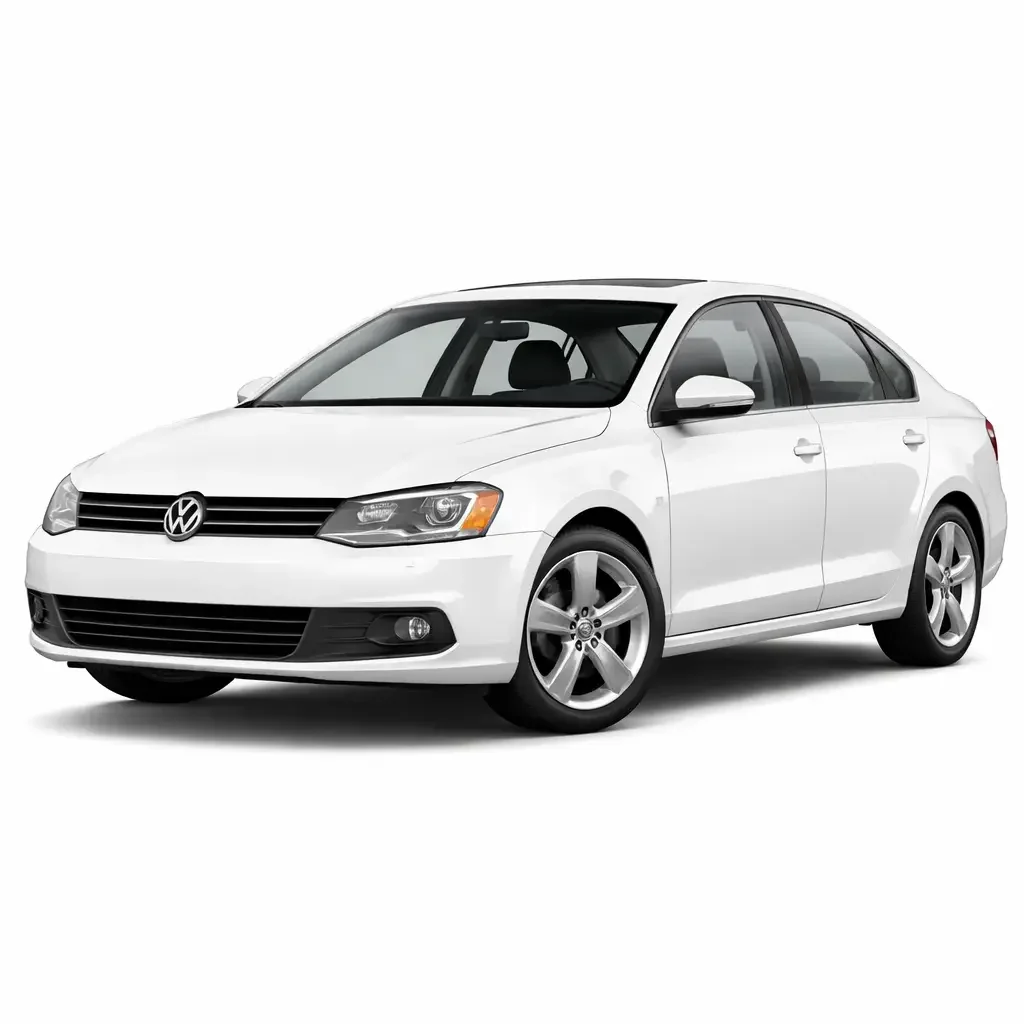
Volkswagen Jetta 2011-2018 (MK6/A6): Fitment Guide for the North American Dedicated-Body Sedan
Written by Arthur Simisian | PartsAdvisory
The Volkswagen Jetta MK6, designated A6 and internally codenamed NCS (New Compact Sedan), represents a fundamental departure from every prior Jetta generation in one catalog-defining way: it does not share any exterior body panels with any Golf. From the MK1 through the MK5, every Jetta shared at minimum its front body structure with the Golf of the same generation. The MK6 was designed from scratch with a dedicated body, longer wheelbase, and architecture developed primarily by Volkswagen Mexico under German supervision. This makes the MK6 Jetta the first generation in which the Golf cross-reference — the primary catalog tool for every prior generation — produces no body component results at all. All MK6 Jetta exterior body panels are Jetta-specific with no cross-market Golf equivalent.
The MK6 is partly based on the PQ35 platform of the Golf Mk6, sharing chassis geometry principles, engine mounting, and drivetrain architecture, but the body is longer, wider, and independently engineered. The MK6 Jetta was announced in North America in June 2010 and went on sale as a 2011 model, assembled at the Puebla, Mexico facility throughout the full production run. It was replaced by the MK7 A7 Jetta for the 2019 model year.
The MK6 generation is notable for several cost-reduction decisions made to move the Jetta downmarket and compete with the Toyota Corolla and Honda Civic at a sub-$16,000 base price. The most catalog-relevant of these decisions is the rear suspension: most base MK6 Jetta trims reverted to a torsion beam semi-independent rear axle despite the MK5's full multi-link independent rear across all trims. This reversion creates the primary parts boundary in the generation and is the single most important fact to establish before selecting any rear suspension component for the MK6.
Platform: Modified PQ35, Front Engine, Front-Wheel Drive, Dedicated Body
The MK6 Jetta uses modified PQ35 underpinnings — a stretched version of the A5 platform, with a longer wheelbase of 2,651 mm, growing 101 mm over the MK5. Despite sharing platform origins, the MK6 Jetta shares no exterior body panels, no front fenders, no hood, no doors, and no rear body components with any Golf Mk6 or Golf Mk5 variant. No exterior body component from any Golf applies to the MK6 Jetta.
Front suspension is MacPherson strut independent, carried forward from the prior generations. Front strut assemblies, springs, lower control arms, and wheel bearings share specifications with the Golf Mk6 at matching trim and year, confirmed at the part number level.
Rear suspension splits across trim levels as described below. The GLI always uses multi-link independent rear. Standard trims 2011-2013 use torsion beam. The SEL Premium added multi-link from introduction. The 1.8T models introduced in 2014 received multi-link. Base S trim retained the torsion beam through 2018.
No all-wheel-drive MK6 Jetta sedan was sold in North America.
ABS with four-wheel disc brakes is standard on all MK6 Jetta applications.
The Rear Suspension Split: The Generation's Primary Parts Boundary
The rear suspension on the MK6 Jetta is the most consequential catalog variable in the generation, because the split runs by trim level and engine — not by model year alone — and persists through the entire production window.
The torsion beam rear applies to the base S trim (2.0L and later 1.4T engines) throughout 2011-2018. Torsion beam rear springs, shock absorbers, and axle beam components confirmed for the torsion beam application must not be applied to multi-link equipped trims.
The multi-link independent rear applies to the GLI from its introduction for the 2012 model year and across all years through 2018. It also applies to the SE, SEL, and SEL Premium trims once the 1.8T engine was introduced for 2014. The SEL Premium carried multi-link from 2011 even before the 1.8T arrived. Multi-link rear control arms, springs, shock absorbers, and wheel bearings confirmed for the GLI or MK5 Jetta multi-link application are trim-specific and must not be applied to torsion beam applications.
The 2014 model year is the most complex rear suspension year because it introduced the 1.8T engine on SE and higher trims alongside multi-link rear suspension, while the base S trim retained the 2.0L or 2.5L engine and torsion beam. Within a single model year, the rear suspension type depends on trim and engine. A parts listing for 2014 that does not specify trim and engine for rear suspension components is incomplete.
Any catalog entry that applies a single rear suspension specification to all MK6 Jetta trims without distinguishing torsion beam from multi-link is generating wrong listings for the majority of the field population.
Steering: Hydraulic and Electromechanical Split
The MK6 reversed the MK5's introduction of electromechanical steering for most trim levels. Standard and S trim MK6 Jettas with the torsion beam rear use hydraulic power steering — a hydraulic pump, hydraulic rack, and power steering fluid reservoir are present on these cars. The MK5's EPS was not carried forward for base trims.
The 1.8T models introduced in 2014 on SE and higher trims received electromechanical steering, eliminating the hydraulic pump on those applications. The GLI also uses electromechanical steering.
This creates a steering system split within the generation: hydraulic steering components — pump, fluid, hydraulic rack — apply to base S trim throughout and to all non-1.8T, non-GLI trims. Electromechanical steering components apply to 1.8T SE and higher from 2014, and to the GLI throughout. A hydraulic power steering pump listed for the GLI is assigning hardware from a system that does not exist on that car. An EPS rack listed for the base 2.0L S trim is equally wrong.
Engine Families: Five Configurations With Two Mid-Window Replacements
The MK6 Jetta in North America used five distinct engine configurations across the 2011-2018 window, with the standard petrol lineup changing twice — once in 2014 for the mid-grade and once in 2015 for the base — creating multiple within-generation engine boundaries.
The 2.0-litre naturally aspirated 8-valve SOHC four-cylinder is the base petrol engine used in S trim from 2011 through approximately 2015. This is the same ABA-family engine used in the MK3 Jetta and MK4 Jetta, continued here as the entry-level option. It produces 115 hp. It uses a timing belt, it is non-interference, and it uses hydraulic steering. This engine was phased out in favor of the 1.4T for the S trim around 2015. Any component listing for the 2.0L naturally aspirated engine confirmed for the base S trim in this era crosses to the MK4/MK3 Jetta 2.0L ABA family at matching specification.
The 2.5-litre inline-five-cylinder carried over from the MK5 was used in SE trim and higher through 2013. Engine codes CBTA and CBUA apply. The 2.5L was discontinued for 2014 when the 1.8T replaced it across mid and upper trims. Any 2.5L service component listing for MK6 applications must be bounded to 2011-2013; no 2.5L MK6 Jetta exists for 2014 onward.
The 1.8T EA888 turbocharged four-cylinder was introduced for 2014 as the new standard engine for SE and higher trim levels, replacing the 2.5L inline-five. Engine code CPKA applies. It produces 170 hp and uses a timing chain — no timing belt applies to the 1.8T. The 1.8T is the same EA888 engine family used in the Golf Mk7 and other contemporary VW Group applications, making it one of the most widely documented engines in the current aftermarket. The 1.8T introduction coincided with the addition of multi-link rear suspension and electromechanical steering on the trims that received it.
The 2.0T TSI EA888 turbocharged four-cylinder is the GLI engine, available from the 2012 model year when the GLI joined the MK6 lineup. This engine uses a timing chain, produces 200 hp in earlier production and 210 hp in later production. It is the same EA888 platform as the 1.8T but in a higher state of tune with a different turbocharger and different engine management calibration. A 1.8T CPKA engine component does not cross to the GLI 2.0T without individual part number confirmation.
The 2.0L TDI clean diesel was available throughout the production window in TDI trim but was discontinued after 2015 due to the emissions scandal. Two distinct TDI injection systems exist within this window: the EA189 common-rail engines using codes CBEA and CJAA were used from 2011 through 2014; the EA288 engine using code CVCA replaced them for the 2015 model year only before all diesel sales in North America were suspended following the September 2015 Dieselgate revelation. The CBEA/CJAA and CVCA use different injection system architectures; no CBEA/CJAA injector, high-pressure pump, or fuel rail component crosses to the CVCA. The TDI uses a timing belt in both the EA189 and EA288 applications, and both are interference engines.
A 1.4T turbocharged four-cylinder replaced the 2.0L naturally aspirated base engine in S trim for approximately 2015 onward, completing the transition of the naturally aspirated base engine out of the lineup. The 1.4T in this application uses a timing chain.
The 2013 Mid-Cycle Facelift
A mid-cycle exterior refresh arrived for a 2013 mid-model-year production cutover, most visibly changing the headlamp assemblies from round projector-style units to a swept-back design. The 2013 facelift also brought trim level reorganization and interior updates.
For catalog purposes the 2013 facelift creates a headlamp and front fascia parts boundary. Headlamp assemblies confirmed for pre-facelift 2011-2012 production do not cross to post-facelift 2013.5-2018 production. Front bumper cover details also changed at the facelift. Any front exterior lighting or fascia component listing that spans 2011 through 2018 without acknowledging this boundary is likely generating wrong applications for one side of the facelift.
The facelift was introduced mid-model-year 2013, meaning early 2013 production retains the pre-facelift appearance and later 2013 production carries the facelift styling. Production date within the 2013 model year is necessary to determine which body specification applies.
The 2015 Facelift and Engine Changes
A second exterior refresh arrived for 2015 with revised front styling, updated grille design, and revised taillamp treatment. This facelift coincided with the engine changes described above — the 2.0L base naturally aspirated engine being phased toward the 1.4T, and the TDI being updated from EA189 to EA288 before being discontinued entirely. The 2015 facelift creates additional front and rear exterior body component boundaries: a front bumper or taillamp confirmed for the 2014 model year does not cross to the 2015-2018 post-facelift body.
The 2015 model year is the most complex in the window because it simultaneously carries a facelift exterior, an engine transition in base trim, a TDI engine code change, and the eventual discontinuation of diesel sales mid-year following the September 2015 Dieselgate announcement.
The GLI: Always Multi-Link, Always Electromechanical, Sport-Tuned
The GLI joined the MK6 Jetta lineup for the 2012 model year. It is distinguished from all other MK6 Jetta trims by its multi-link independent rear suspension (present from launch throughout 2012-2018), electromechanical steering, larger brakes, sport suspension tuned 15 mm lower than standard, and the 2.0T EA888 engine.
The GLI uses the DSG dual-clutch automatic or a six-speed manual. No conventional torque-converter automatic was offered with the GLI. No five-speed manual applies to the GLI.
GLI rear suspension components — rear control arms, rear springs, rear shock absorbers — do not cross to torsion beam applications. GLI front and rear brake rotors, which are larger than standard trim specification, do not cross to standard SE/S trim applications.
The GLI front fascia uses a honeycomb grille and a different front bumper design from the standard Jetta SE and S trim. A front bumper confirmed for the standard SE does not fit the GLI, and a GLI front bumper does not fit the standard SE.
The TDI and Dieselgate
The 2.0L TDI was available in TDI trim with six-speed manual or DSG for 2011 through the 2015 model year. The 2011-2014 TDI uses EA189 common-rail engines (CBEA or CJAA). The 2015 TDI uses the EA288 (CVCA).
In September 2015, the US EPA announced that Volkswagen had installed defeat device software in the 2.0L TDI engines — software that detected when the vehicle was undergoing emissions testing and adjusted engine operation to produce lower NOx during testing than during normal driving. VW suspended diesel sales in the US immediately. The affected 2011-2015 Jetta TDI models were subject to a buy-back and recall program. The defeat device was present in the EA189 engines (CBEA/CJAA) used in 2011-2014 and in early production EA288 (CVCA) for 2015.
For catalog purposes, the Dieselgate recall is relevant in that it means many affected vehicles were bought back and destroyed, reducing the field population of 2011-2015 TDI Jettas. However, a significant number remained in private ownership after the recall period closed. Emissions control components — particularly the NOx storage catalyst and DPF — on these vehicles may have been modified as part of the recall remediation program. Service component listings for emissions hardware on affected TDI models should note this history.
No diesel Jetta was sold in North America from 2016 through 2018. Any diesel catalog entry for 2016, 2017, or 2018 is a catalog error.
No Golf Cross-Reference for Exterior Body Components
This is the first Jetta generation for which the Golf cross-reference produces no exterior body results. The MK6 Jetta has a dedicated body with no panel sharing with the Golf Mk6 or any other VW model. Front fenders, hood, front doors, rear doors, rear quarter panels, trunk lid, bumpers, and all exterior glass are MK6 Jetta-specific. No Golf component applies to any of these positions.
Engine and drivetrain components continue to cross between the MK6 Jetta and Golf Mk6 at matching engine and specification. Front suspension components cross at matching geometry specification. But for body and glass, the MK6 Jetta catalog stands alone.
Common ACES/PIES Catalog Mistakes
The first error is applying a single rear suspension specification across all MK6 Jetta trims. The torsion beam applies to S trim throughout and to most trims through 2013; multi-link applies to GLI throughout, SEL Premium throughout, and to 1.8T SE and higher from 2014. A single rear spring or shock absorber listing for all 2011-2018 Jettas is wrong for a significant portion of the field.
The second error is applying hydraulic steering components — pump, fluid, rack — to a GLI or 1.8T-equipped application. The GLI and 1.8T SE and higher from 2014 use electromechanical steering with no hydraulic pump.
The third error is applying electromechanical steering components to base S trim applications. The torsion-beam S trim with 2.0L or 1.4T engine uses hydraulic steering throughout.
The fourth error is applying 2.5L engine service components for 2014 or later. The 2.5L was discontinued after 2013. No 2.5L MK6 Jetta exists for 2014 onward.
The fifth error is applying a timing belt to the 1.8T or 2.0T GLI engine. Both EA888 applications use a timing chain. The naturally aspirated 2.0L and the TDI use timing belts; the turbocharged petrol engines use chains.
The sixth error is applying EA189 TDI (CBEA/CJAA) components to the EA288 TDI (CVCA), or vice versa. The two TDI systems are architecturally different with different injectors, high-pressure fuel pumps, and fuel rails.
The seventh error is creating a diesel catalog entry for 2016, 2017, or 2018. No diesel Jetta was sold in North America for any of those years.
The eighth error is applying pre-2013-facelift headlamp assemblies to a post-facelift car or vice versa. The 2013 mid-year facelift changed the headlamp design fundamentally, and the transition occurred within the 2013 production run, requiring production date confirmation.
The ninth error is applying pre-2015 front or rear exterior body components to a 2015-2018 car, or post-2015 components to a pre-2015 car. The 2015 facelift changed front bumper, grille, and taillamp components.
The tenth error is applying a GLI front bumper to a standard SE or S trim, or a standard bumper to the GLI. The GLI uses a distinct front fascia design with a honeycomb grille that differs from all other MK6 Jetta trim front ends.
The eleventh error is applying any Golf Mk6 exterior body panel — fender, hood, door, quarter panel, trunk — to the MK6 Jetta. The generation shares no exterior body panels with any Golf. The Golf cross-reference is invalid for all body components.
The twelfth error is applying GLI multi-link rear suspension components to standard S or SE trim torsion beam applications. The geometries are completely different and the components are not interchangeable.
Pre-Listing Checklist for the 2011-2018 MK6 Jetta
Platform confirmed as MK6/A6 NCS; no Golf exterior body cross-reference applies.
Trim confirmed as S (torsion beam, hydraulic steering, 2.0L or 1.4T), SE (torsion beam through 2013, multi-link from 2014 with 1.8T, EPS from 2014 with 1.8T), SEL/SEL Premium (multi-link throughout), GLI (multi-link always, EPS always, 2.0T EA888), or TDI.
Rear suspension type confirmed as torsion beam or multi-link from trim and engine before any rear suspension component is selected.
Steering type confirmed as hydraulic (S trim throughout; SE and others with 2.0L or 2.5L through 2013) or electromechanical (GLI throughout; 1.8T SE and higher from 2014).
Engine confirmed as 2.0L naturally aspirated (2011-2015 S trim, timing belt, non-interference), 2.5L (2011-2013 mid trims, timing belt), 1.8T CPKA EA888 (2014-2018 SE and higher, timing chain), 2.0T EA888 GLI (2012-2018, timing chain), 1.4T (2015-2018 S trim, timing chain), or 2.0L TDI EA189 CBEA/CJAA (2011-2014) or EA288 CVCA (2015 only).
For TDI applications: engine code confirmed as CBEA/CJAA or CVCA before injection system components selected; diesel applications confirmed as absent for 2016, 2017, and 2018.
Body facelift generation confirmed as pre-2013 facelift, mid-2013-facelift (2013.5-2014), or 2015-facelift (2015-2018) for all exterior body, headlamp, and bumper components.
GLI-specific components confirmed: GLI front fascia, GLI multi-link rear, GLI larger brake rotors, GLI EPS — none cross to standard trim applications.
No Golf Mk6 exterior body component applied; all exterior body components confirmed as MK6 Jetta-specific.
Final Take
The MK6 Jetta has more internal catalog complexity than any prior Jetta generation. The rear suspension trim split, the steering system split, five engine families with two mid-window replacements, two exterior facelifts creating body component boundaries at both 2013 and 2015, and the TDI discontinuation mid-2015 are all active variables that must be resolved simultaneously. The generation's attempt to be everything to everyone — base entry-level with torsion beam, mid-grade with multi-link, performance GLI with sport suspension, diesel with clean diesel — created the widest specification spread of any Jetta generation, and the catalog must reflect that spread with equal precision.
The absence of the Golf cross-reference for exterior body work is the most important single fact to communicate to catalog teams working this generation. It is counterintuitive given every prior generation's reliance on that cross-reference, and the temptation to apply Golf Mk6 body panels to the MK6 Jetta will remain as long as database tools route by platform without flagging the dedicated-body exception.
For the complete Volkswagen Jetta generations and fitment summary covering all platforms, engine families, and catalog rules from 1980 to present, see the Volkswagen Jetta Generations and Fitment Guide (1980 to Present).
Disclaimer
This guide is intended for catalog research, fitment analysis, and parts advisory reference. Production specifications, option availability, and regulatory compliance requirements vary by model year, regional market, and assembly date within any given window. Always confirm application data against vehicle identification number decoding, factory build sheets, and OEM parts documentation before finalizing a listing or parts recommendation. PartsAdvisory and its contributors are not responsible for fitment errors arising from catalog data that has not been independently verified against physical vehicle inspection or official OEM sources.