
Volkswagen Jetta 2019-2026 (MK7/A7): Fitment Guide for the North American MQB Sedan
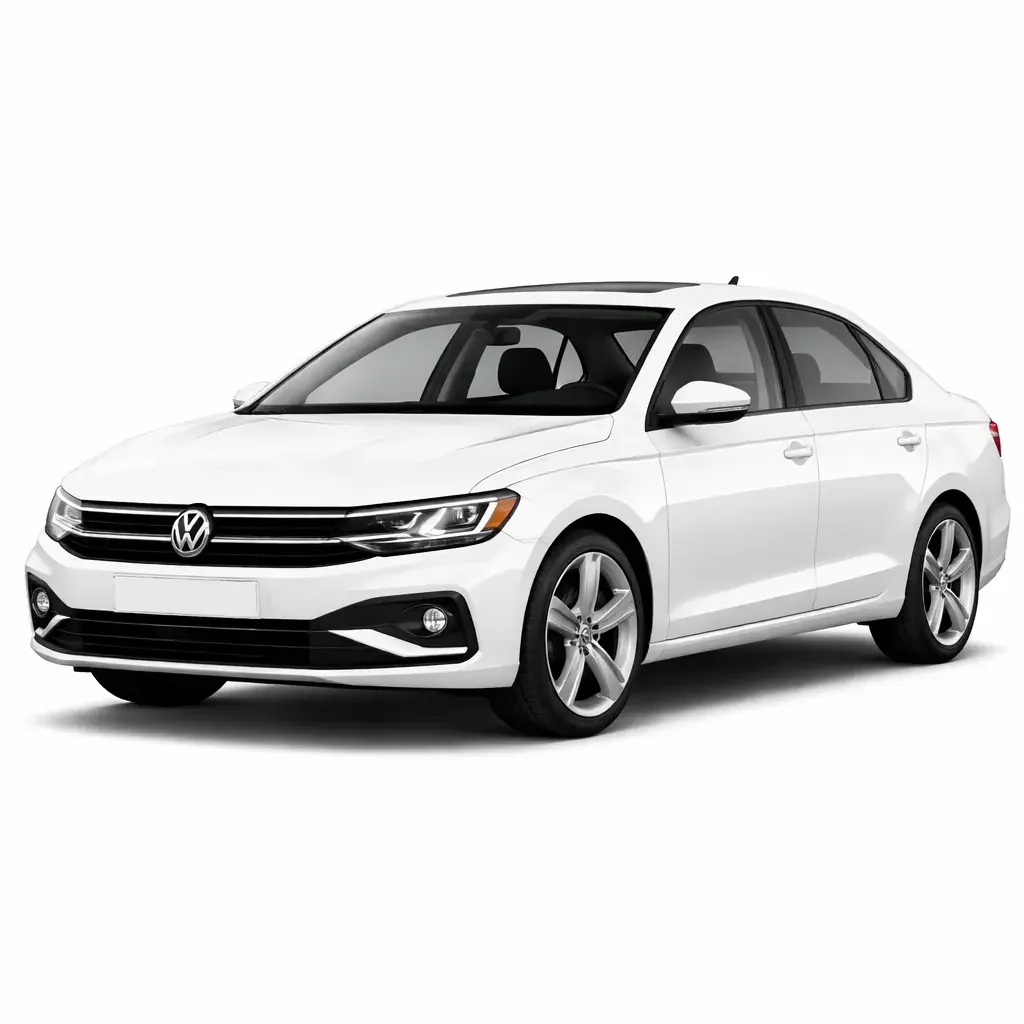
Written by Arthur Simitian | PartsAdvisory
The Volkswagen Jetta MK7, designated A7 and sold in North America from the 2019 model year onward, represents the first full MQB implementation in the Jetta nameplate's history. Where the MK6 rode a modified and stretched version of the PQ35 architecture developed primarily under Volkswagen Mexico's direction, the MK7 moves to the full MQB A1 platform, the same transverse modular architecture underpinning the contemporary Golf, Tiguan, and Taos. That shift is not a catalog footnote. It means the MK7 shares no body panels, no suspension geometry, no powertrain mounting architecture, and no structural underbody components with the MK6 Jetta or any prior Jetta generation. The assumption that successive Jetta generations carry forward mechanical commonality ends definitively at the MK6 to MK7 transition.
Like the MK6, the MK7 continues without any exterior body panel sharing with any Golf. The dedicated sedan body that was introduced as a notable departure in the MK6 carries forward here, and no Golf MK7 or Golf MK8 exterior component applies to the MK7 Jetta at any position. The body is physically larger than the MK6 in every dimension, with a longer wheelbase, greater overall length, and increased width consistent with the MQB architecture's dimensional envelope. Production remained at Volkswagen's Puebla, Mexico assembly plant throughout the generation, as it had for the MK6. No SportWagen or wagon derivative was offered for the MK7 in North America, a meaningful contrast to the MK5 generation and a point that eliminates the body style split that complicated the MK5 window.
The MK7 generation spans two distinct facelift boundaries that divide it into three mechanical and visual sub-populations. The first facelift arrived for the 2022 model year, revealed in August 2021. It introduced a revised front and rear fascia, replaced the 1.4T engine with the 1.5T unit across all non-GLI trims, restructured the trim lineup, and updated the infotainment system. The second facelift arrived for the 2025 model year, announced in June 2024, with a more substantial exterior revision including a new grille, redesigned LED headlights, a full-width rear light bar integrated into the trunk lid, and a comprehensively reworked dashboard featuring a standard 8-inch floating touchscreen and capacitive HVAC controls replacing the previous rotary dials. Those two boundaries divide the generation into three sub-populations for catalog work: 2019 through 2021, 2022 through 2024, and 2025 through the current 2026 model year. A part confirmed for one sub-population should not be applied to another without individual part number verification.
Platform: Full MQB A1, Front Engine, Front-Wheel Drive, Dedicated Body
The MK7 Jetta uses the MQB A1 platform in its full implementation, not a modified or stretched derivative of a prior architecture. MQB A1 standardizes firewall position, engine mounting angle, and front axle placement across all vehicles built on the platform, while allowing wheelbase, track, and external dimensions to vary. The Jetta's wheelbase on MQB A1 is 105.7 inches, longer than the MK6's 104.4 inches.
No exterior body panel from any Golf, Tiguan, or other MQB vehicle crosses to the MK7 Jetta body. The Jetta's dedicated body dimensions, door structures, front fenders, hood, trunk lid, and bumpers are specific to this model. The absence of the Golf cross-reference that was established in the MK6 continues and extends further here — the MQB platform affiliation does not restore any body component commonality.
Front suspension is MacPherson strut independent, consistent with MQB A1 practice across the platform. Electromechanical power steering is standard across the entire generation on all trims, replacing the hydraulic steering split that existed in the MK6. There is no hydraulic power steering pump, no hydraulic steering rack, and no power steering fluid reservoir on any MK7 Jetta application, standard or GLI.
No all-wheel-drive MK7 Jetta sedan was sold in North America.
The Rear Suspension Split: Torsion Beam Standard, Multi-Link GLI
Rear suspension architecture is the single most consequential fitment variable in the MK7 generation and produces the same catalog risk as it did in the MK6, though with a simpler split structure. Every standard Jetta — meaning every non-GLI trim at every model year from 2019 through 2026, across the S, SE, R-Line, Sport, SEL, and SEL Premium trim designations — uses a torsion beam semi-independent rear axle. This is a regression from the MK5, which offered multi-link independent rear suspension across all trims, and it surprised catalog teams who assumed MQB adoption would bring IRS universally to the generation. It did not.
The GLI uses a multi-link independent rear suspension throughout the generation, along with a sport-tuned suspension calibration sitting approximately 15 millimeters lower than the standard car. Multi-link rear components — control arms, rear springs, rear shock absorbers, wheel bearing carriers, and rear brake assemblies — are not interchangeable between the standard Jetta and the GLI. The fact that both vehicles share the MQB A1 platform code does not change this. The rear architecture split is fundamental, not cosmetic, and it runs by model designation rather than by trim level or model year. Every GLI is multi-link; every non-GLI is torsion beam.
Unlike the MK6, there is no within-generation point at which standard non-GLI trims were upgraded to multi-link. The torsion beam is the correct rear specification for all standard Jetta production from 2019 through the 2026 model year without exception.
Engine Families: Two Configurations With One Mid-Window Replacement
The MK7 Jetta uses two distinct engine families across the generation window, with the standard non-GLI engine changing at the 2022 facelift.
The 1.4-litre EA211 turbocharged four-cylinder producing 147 horsepower was used in all standard non-GLI trims from the 2019 model year through the 2021 model year. This is the same EA211 family used in contemporary MQB-based Volkswagen and Audi applications globally, though the specific displacement and tune are Jetta-specific in this market. The 1.4T uses a timing chain. It pairs to either a six-speed manual or an automated gearbox depending on trim and year.
Beginning with the 2022 model year facelift, the 1.4T was replaced by the 1.5-litre EA211 Evo unit. Both engines belong to the EA211 family and share the same basic architecture and block layout, but they are not the same engine. Displacement-specific components including pistons, connecting rods, cylinder head dimensions, and select ancillaries differ between the 1.4T and the 1.5T. A catalog entry that collapses 2019 through 2026 standard Jetta fitment into a single EA211 application without distinguishing the 1.4T from the 1.5T will generate return traffic for any displacement-specific part. The model year boundary of 2022 is the reliable split point for most purposes, but engine code confirmation from the VIN decode is preferable to model year assumption alone, particularly for late 2021 and early 2022 production that may sit near the transition.
The Jetta GLI uses the 2.0-litre EA888 turbocharged four-cylinder producing 228 horsepower throughout the generation. This is the same engine family used in the Golf GTI of the same era, though calibrated differently. The EA888 uses a timing chain. No timing belt applies to any GLI application. The GLI received the same facelift cadence as the standard car at the 2022 and 2025 model year boundaries, but the engine family and output rating remained consistent throughout.
A 1.4T or 1.5T engine component does not cross to the GLI's 2.0T EA888 without individual part number confirmation. The two engine families are distinct in displacement, turbocharger specification, fuel system calibration, and a significant number of service components. Catalogers who treat the GLI as a variant of the standard Jetta for engine parts purposes will generate incorrect listings across a wide range of applications.
No diesel engine was offered in the MK7 Jetta at any point in North America. The TDI nameplate does not appear in the US or Canadian MK7 lineup for any model year from 2019 through 2026. This is a direct consequence of the Dieselgate settlement that effectively ended Volkswagen diesel passenger car sales in North America after the MK6 generation. Any diesel-related catalog entry — TDI fuel filter, diesel particulate filter, high-pressure diesel injection component, diesel exhaust fluid system — applied to an MK7 Jetta is a catalog error.
Transmission: Three Configurations With a 2025 Automatic Transition
Transmission fitment in the MK7 generation requires attention to both the model designation split and the 2025 model year change to the standard car's automatic specification.
From 2019 through 2024, the standard non-GLI Jetta was available with either a six-speed manual or an automatic transmission depending on trim. The base S trim offered the six-speed manual as standard, and the Sport trim also offered the manual from its introduction at the 2022 facelift. Higher trims used an automatic as standard.
The 2025 model year facelift removed the manual transmission from the standard Jetta lineup entirely for non-GLI trims. The 2025 and 2026 standard Jetta pairs the 1.5T exclusively to an eight-speed Aisin conventional automatic — a torque converter unit, not a dual-clutch gearbox. This is a meaningful catalog distinction. Torque converter automatics and dual-clutch transmissions use different filter specifications, different fluid types, and different service component families. A catalog entry listing a single automatic transmission filter or fluid specification for all 2019 through 2026 standard Jetta automatics without identifying the Aisin 8-speed as a distinct 2025-and-newer application is incorrect for one side of that boundary or the other.
The GLI uses either a seven-speed DSG dual-clutch automatic or a six-speed manual throughout the generation. Neither GLI transmission is shared with the standard Jetta at any point in the window. The GLI retains the six-speed manual option through the 2025 facelift and into the 2026 model year, making the GLI the only MK7 Jetta application for which the manual remains available after the 2025 change. Any listing for a manual transmission component on a 2025 or 2026 Jetta must be confirmed as GLI-specific; no manual applies to any 2025 or 2026 standard Jetta trim.
The 2022 Facelift: Engine, Trim, and Exterior Boundaries
The 2022 model year facelift is the first of two within-generation boundaries that affect exterior body component fitment. It introduced revised front and rear fascia styling, updated front lighting, and interior technology changes alongside the engine transition from 1.4T to 1.5T and the trim restructure. The R-Line trim was replaced by the Sport trim. The SEL Premium was discontinued, leaving SEL as the top non-GLI grade. In the United States, the GLI base S variant was discontinued, simplifying the GLI to a single well-equipped specification.
For catalog purposes, front bumper covers, grille assemblies, headlamp housings, and associated front fascia brackets confirmed for 2019 through 2021 pre-facelift production do not cross to 2022 through 2024 post-facelift production. Rear bumper and taillamp components are similarly bounded. Any front or rear exterior lighting or fascia component listed across the full 2019 through 2026 window without acknowledging the 2022 boundary is generating wrong applications for one side of that boundary.
The 2022 facelift also affected the GLI with a revised front and rear bumper, meaning GLI body components carry the same 2022 boundary as the standard car.
The 2025 Facelift: Exterior, Interior, and Feature Boundaries
The 2025 model year facelift was the more substantial of the two within-generation revisions. The exterior received a new front fascia with a narrower upper grille, redesigned LED headlights with an available full-width light bar on Sport trim and above, and restyled LED taillights with a full-width light bar integrated across the trunk lid. These changes mean that front bumper covers, grille assemblies, headlamp housings, trunk lid assemblies, and taillamp units confirmed for 2022 through 2024 production do not cross to 2025 and 2026 production. The 2025 exterior revision is visually and dimensionally distinct from both prior sub-populations.
Internally, the 2025 facelift introduced a redesigned dashboard with a free-floating 8-inch touchscreen standard across all trims and capacitive HVAC controls replacing conventional rotary dials. Any HVAC control panel or interior trim component specific to the pre-2025 dashboard architecture does not cross to the 2025-and-newer interior.
IQ.Drive, Volkswagen's active safety suite including adaptive cruise control, lane keeping, and emergency braking systems, became standard on all trims at the 2025 facelift. Camera and radar sensor components associated with that suite are present on all 2025 and 2026 cars regardless of trim level. On 2019 through 2024 production, driver assistance feature availability varied by trim, and ADAS sensor component fitment must not be assumed from model year alone for pre-facelift cars.
The GLI: Always Multi-Link, Always EA888, Sport-Tuned Throughout
The GLI joined the MK7 lineup as a 2020 model year vehicle, revealed at the Chicago Auto Show in February 2019. It is distinguished from all standard MK7 Jetta trims by its multi-link independent rear suspension, the 2.0T EA888 engine, the seven-speed DSG or six-speed manual transmission, larger front brake rotors, and a sport suspension calibration 15 millimeters lower than the standard car. The GLI also carries a distinct front fascia with a honeycomb grille design different from all standard Jetta trim front ends throughout the generation.
GLI rear suspension components — rear control arms, rear springs, rear shock absorbers, rear wheel bearing carriers — do not cross to standard torsion beam applications. GLI front and rear brake specifications, which use larger rotors than standard trim, do not cross to standard S, SE, or SEL trim brake applications. GLI transmission components do not cross to standard Jetta applications. GLI engine service components do not cross to 1.4T or 1.5T standard Jetta applications without individual part number confirmation.
The GLI received the 2022 facelift with a revised front and rear bumper, and the 2025 facelift with the same exterior revision applied to the standard car. GLI body components therefore carry the same three sub-population boundaries as the rest of the generation: pre-2022, 2022 through 2024, and 2025 onward.
Common ACES/PIES Catalog Mistakes
The first error is treating the GLI as a trim variant of the standard Jetta rather than as a mechanically distinct vehicle. The GLI and standard Jetta share a platform code and a model name. They do not share a rear suspension architecture, an engine family, a transmission, or a brake specification. Any catalog entry that applies a single suspension, engine, or transmission specification to all MK7 Jetta applications without separating the GLI produces incorrect fitments across a wide range of positions.
The second error is applying torsion beam rear components to a GLI or multi-link rear components to a standard Jetta. The split is by model designation, not by trim level or model year, and it is absolute. No standard non-GLI Jetta in this generation uses multi-link rear; no GLI uses torsion beam rear.
The third error is collapsing the 1.4T and 1.5T into a single EA211 application without noting the 2022 engine change. For any displacement-specific component — pistons, connecting rods, cylinder-specific service parts — the 1.4T and 1.5T are different engines despite sharing a family designation.
The fourth error is applying the Aisin 8-speed automatic service components to pre-2025 standard Jetta automatics, or applying pre-2025 automatic service components to 2025 and later standard Jetta applications. The 2025 model year introduced a different automatic transmission type, and fluid, filter, and service components differ accordingly.
The fifth error is listing a manual transmission application for a 2025 or 2026 standard Jetta. No manual transmission was offered on any non-GLI MK7 Jetta trim from the 2025 model year onward. A manual component listing for a 2025 standard Jetta is assigning hardware to a configuration that was not produced.
The sixth error is applying pre-2022 exterior body or lighting components to a post-2022 car, or post-2022 components to a pre-2022 car. The 2022 facelift changed the front and rear fascia, and components confirmed for one side of that boundary do not fit the other.
The seventh error is applying pre-2025 exterior body or lighting components to a post-2025 car, or post-2025 components to a pre-2025 car. The 2025 facelift was a more substantial exterior revision than the 2022 refresh, and the taillamp design change alone — from the prior discrete units to the full-width light bar — creates an unambiguous parts boundary at the rear.
The eighth error is applying GLI front fascia components to a standard Jetta or standard Jetta front fascia components to the GLI. The GLI uses a distinct front bumper and honeycomb grille design that differs from the standard car throughout the generation.
The ninth error is creating any diesel catalog entry for the MK7 Jetta. No TDI, no diesel particulate filter, no diesel fuel filter, and no diesel exhaust fluid component applies to any MK7 Jetta application for any model year.
The tenth error is applying any MK6 body, structural, or suspension component to an MK7 Jetta based on the assumption that body style continuity implies parts continuity across the generation boundary. The MK6 and MK7 use entirely different platforms with different underbody architecture, different suspension geometry, and different body structure. No MK6 exterior body panel, suspension component, or structural bracket crosses to the MK7.
The eleventh error is applying any Golf MK7 or Golf MK8 exterior body panel to the MK7 Jetta based on MQB platform affiliation. The Jetta has a dedicated body with no panel sharing with any Golf. MQB platform commonality does not imply body panel interchangeability.
Pre-Listing Checklist for the 2019-2026 MK7 Jetta
Model confirmed as standard Jetta or GLI, because the two share a platform and a nameplate but differ in rear suspension, engine, transmission, and brake specification.
Model year sub-population confirmed as 2019-2021 (pre-facelift, 1.4T), 2022-2024 (first facelift, 1.5T), or 2025-2026 (second facelift, 1.5T, Aisin 8-speed automatic standard) before any exterior body, lighting, or transmission service component is selected.
Engine confirmed as 1.4T EA211 (2019-2021 standard Jetta), 1.5T EA211 Evo (2022-2026 standard Jetta), or 2.0T EA888 (GLI throughout), with engine code from VIN decode preferred over model year assumption alone for components sensitive to displacement.
Rear suspension confirmed as torsion beam (all standard non-GLI trims throughout the generation) or multi-link (GLI only throughout the generation) before any rear suspension, rear bearing, or rear brake component is selected.
Transmission confirmed as six-speed manual (standard Jetta S and Sport 2019-2024 only; GLI throughout), seven-speed DSG (GLI throughout), or eight-speed Aisin automatic (standard Jetta 2025-2026), with transmission type confirmed before any fluid, filter, or service component is listed.
For 2025 and 2026 cars, manual transmission application confirmed as GLI-only; no manual component listed for any standard trim.
Steering confirmed as electromechanical throughout the generation for all trims; no hydraulic steering component applies to any MK7 Jetta application.
Facelift sub-population confirmed for all exterior body, bumper, grille, headlamp, and taillamp components using 2022 and 2025 as boundaries.
GLI-specific components confirmed as non-crossing to standard trim: GLI front fascia, GLI multi-link rear suspension, GLI larger brake rotors, GLI EA888 engine, GLI DSG or manual transmission.
No Golf exterior body component applied; no MK6 Jetta component forward-applied on the basis of nameplate or body style continuity; no diesel component applied to any application.
Final Take
The MK7 Jetta is a generation with a narrow set of catalog variables once those variables are clearly defined. There are two engine families separated by a clean model year boundary. The rear suspension splits by model designation rather than by the more complex trim-and-engine matrix that governed the MK6. The facelift boundaries are well-documented and visually obvious. And the absence of diesel eliminates an entire engine family from the application set entirely.
The errors that occur in this generation are almost entirely preventable. They stem from treating the GLI as a trim rather than as a distinct vehicle application, from ignoring the 2022 engine transition when listing displacement-specific components, from carrying forward assumptions built on MK6 behavior, or from failing to identify the 2025 automatic transmission change before listing any automatic service part. Resolve the GLI split, identify the model year sub-population, confirm the engine code, and confirm the transmission type, and the MK7 Jetta catalogs with considerably less complexity than the generation it replaced.
For the complete Volkswagen Jetta generations and fitment summary covering all platforms, engine families, and catalog rules from 1980 to present, see the Volkswagen Jetta Generations and Fitment Guide (1980 to Present).
Disclaimer
This guide is intended for catalog research, fitment analysis, and parts advisory reference. Production specifications, option availability, and regulatory compliance requirements vary by model year, regional market, and assembly date within any given window. Always confirm application data against vehicle identification number decoding, factory build sheets, and OEM parts documentation before finalizing a listing or parts recommendation. PartsAdvisory and its contributors are not responsible for fitment errors arising from catalog data that has not been independently verified against physical vehicle inspection or official OEM sources.