
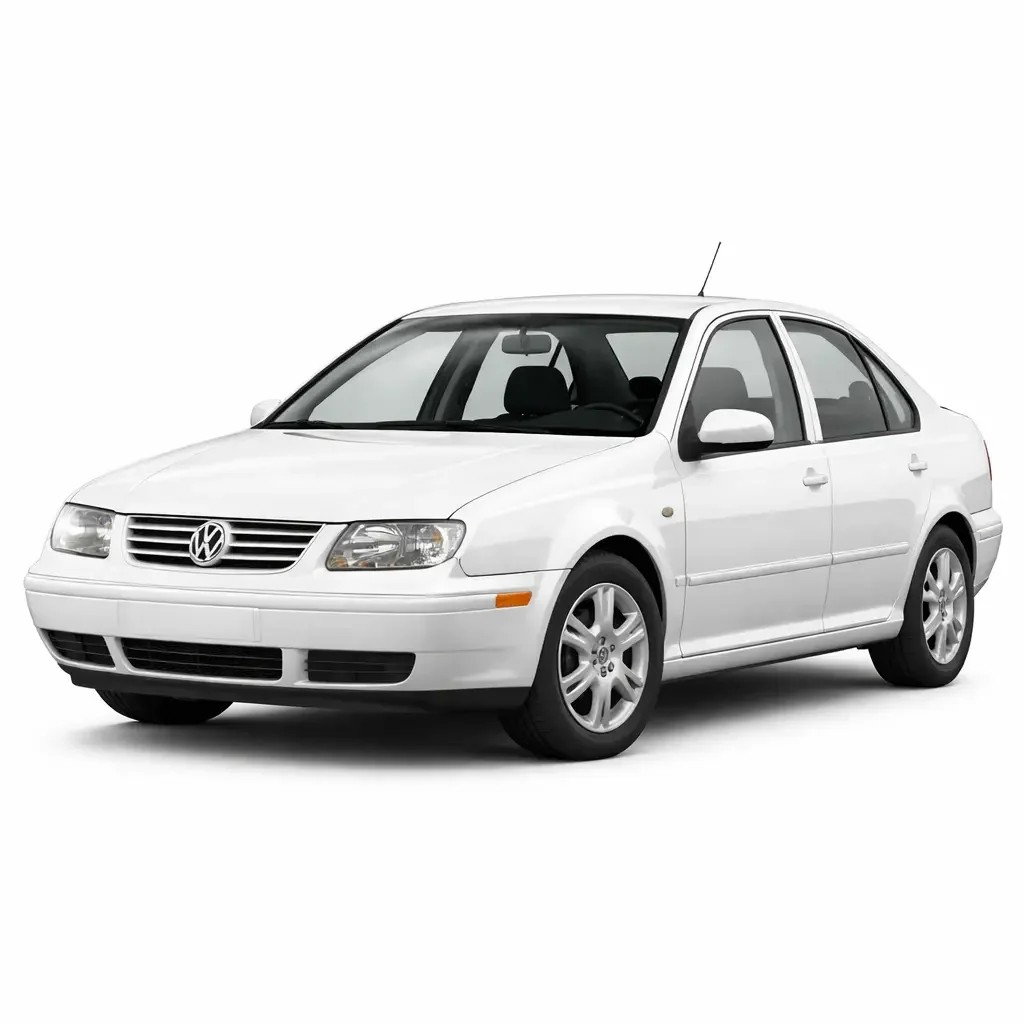
Volkswagen Jetta 1999.5-2005 (MK4/A4): Fitment Guide for the North American Sedan and Wagon
Written by Arthur Simitian | PartsAdvisory
The Volkswagen Jetta MK4, designated A4 and Typ 1J, entered the North American market as a mid-year 1999 release — typically called the 1999.5 model — and continued through a truncated run in the 2005 model year before the MK5 Jetta replaced it. The generation is significant in several respects for catalog work: it introduced the Jetta Wagon body style to North America for the first time, brought the turbocharged 1.8T and the upgraded 24-valve VR6 as new engine options alongside the carry-over 2.0L and TDI, and ended with a split model year in which two completely different Jettas — the MK4 and the MK5 — were simultaneously sold as 2005 models. This guide addresses the MK4 A4 platform Jetta only.
In most of the world this car was sold as the Volkswagen Bora; in North America and South Africa the Jetta name was retained. All North American MK4 Jettas were assembled at the Puebla plant in Mexico, the same facility that produced the MK3.
The MK4 Jetta shares its platform with the Golf Mk4, New Beetle, and — at the front fascia level — with the Golf Mk4 Variant wagon sold in Europe. The front bumper, fenders, hood, grille, and headlights are interchangeable between the Mk4 Golf and the MK4 Jetta. This front-body interchangeability is a meaningful cross-reference that distinguishes the MK4 from earlier generations where the Golf and Jetta shared no exterior body panels at all.
Platform: A4/PQ34, Front Engine, Front-Wheel Drive
The A4 platform uses the designation PQ34 in Volkswagen's revised nomenclature. It is a transversely mounted front-engine, front-wheel-drive layout. No all-wheel-drive Jetta was sold in North America on the MK4 platform. The 4Motion AWD system using the Haldex coupling was available on some European Mk4 Golf and Bora variants, but not on the North American Jetta at any point during this window.
Front suspension is MacPherson strut independent with a lower control arm and ball joint. The front subframe carries over from the A3 generation. Front strut assemblies, front springs, front lower control arms, front wheel bearings, and front sway bar components confirmed for the Golf Mk4 at matching specification cross to the MK4 Jetta without restriction.
Rear suspension is a torsion beam semi-independent axle, carrying over the same design from the MK1 through MK4 generations. Rear springs, rear shock absorbers, and rear axle beam components confirmed for the Golf Mk4 torsion beam cross to the MK4 Jetta. This torsion beam rear continues to distinguish the MK4 from the contemporary Passat and Audi A4, both of which use fully independent multi-link rear suspension. No multi-link rear component from the Passat or A4 applies to the MK4 Jetta.
ABS with four-wheel disc brakes was standard on all North American MK4 Jettas from the beginning of production. This is the first Jetta generation in North America with ABS and four-wheel discs as standard equipment across the entire range, not as a trim-level option. No drum rear brake application exists for the North American MK4 Jetta.
The wheelbase is 2,514 mm, extended 44 mm from the MK3, contributing to the increased interior space that moved the car further upmarket. The MK4 body is dimensionally incompatible with MK3 body components. No door, fender, or quarter panel from the MK3 applies to the MK4.
The 1999.5 Mid-Year Launch
The MK4 Jetta arrived in North American showrooms as a mid-year 1999 model, meaning the 1999 calendar year saw both the final MK3 production models (selling off remaining stock) and the new MK4 models in dealerships simultaneously. Catalog entries for "1999 Volkswagen Jetta" therefore potentially refer to two different vehicles: the MK3 A3 platform Jetta sold throughout the 1999 model year from the preceding generation, and the MK4 A4 platform Jetta launched mid-1999 as a 1999.5.
The 1999.5 designation is not an official Volkswagen model year designation but is universally used in the service and parts industry to distinguish the MK4 from the MK3 1999 production. Any catalog entry that uses "1999" alone without confirming MK3 vs MK4 platform affiliation is ambiguous and potentially wrong for either the early or late 1999 production.
Body Styles: Sedan and Wagon
The MK4 Jetta is the first North American Jetta generation to offer a wagon body style alongside the sedan. The Jetta Wagon — sold as the Jetta SportWagen in some references — was introduced for the 2001 model year as a four-door estate with a folding rear seat and a substantially larger luggage area than the sedan.
The wagon body shares the MK4 Jetta's front body structure from the A-pillar forward, including the front doors, front fenders, hood, bumper, headlights, and windscreen. All underbody, engine, transmission, front suspension, and front brake components cross freely between the sedan and wagon. The C-pillar rearward structure, the rear quarter panels, the rear hatch, the rear bumper, the taillamp clusters, and the cargo area floor are wagon-specific and do not cross to the sedan. A rear quarter panel confirmed for the sedan does not fit the wagon.
The European Mk4 Golf Variant wagon shares its rear body structure with the North American Jetta Wagon. This creates an additional cross-reference source for wagon rear body panels: European Golf Mk4 Variant components at matching specification may cross to the Jetta Wagon rear body, subject to individual part number confirmation. This distinguishes the Jetta Wagon from all earlier Jetta generations where no wagon body existed and no such cross-reference was possible.
The GLX trim was available on both sedan and wagon through 2002, but the wagon GLX was discontinued before the sedan GLX. For 2003, the GLX was sedan-only. For 2004, the GLX trim was discontinued entirely across both body styles. A catalog entry creating a GLX wagon for 2003 or later is listing a configuration that was not offered.
Engine Families: Five Distinct Applications Across the Window
The North American MK4 Jetta offers more engine variety than any preceding generation, with five distinct engine families available across the production window and several significant mid-window changes.
The 2.0-litre 8-valve SOHC naturally aspirated petrol engine is the base unit used in GL and base GLS trim throughout the full 1999.5-2005 window. Engine codes within this application include AEG (early production) and AVH and AZG (later production), all producing 115 hp. The AEG, AVH, and AZG share the same displacement, bore, and stroke but differ in minor calibration and emission equipment details. For most service component applications — spark plugs, ignition coil, coolant thermostat, water pump, timing belt, oxygen sensor, and fuel injectors — these codes cross freely. The 2.0L is non-interference; a broken timing belt does not cause valve damage. The timing belt requires scheduled replacement regardless.
The 1.8-litre turbocharged 20-valve engine, universally called the 1.8T, was introduced for the 2000 model year as a GLS option. The 1.8T uses a five-valve-per-cylinder 20-valve cylinder head with a turbocharger. North American engine codes include AWD (150 hp, 2000-2001) and AWM (180 hp, 2002-2005). The AWD and AWM differ in turbocharger, intake manifold, fuel system calibration, and ECU mapping. Service components — spark plugs, ignition coils, turbocharger, intercooler, and diverter valve — must be confirmed against the specific engine code before selecting. The 1.8T is an interference engine; timing belt failure causes serious valve damage. The ignition coil pack on the 1.8T was subject to a widespread failure pattern and recall; any catalog entry for ignition components on the 1.8T should note this history.
The 2.8-litre 24-valve VR6 was the top petrol option in the GLX and, from 2000, in the GLS with VR6. The 24-valve VR6 (engine codes AFP for early production, BDF from approximately 2002) produces 174 hp at launch and 200 hp from 2002. Like all VR6 engines, this unit uses a timing chain rather than a timing belt. No timing belt applies to the VR6. The 24-valve VR6 is specifically not the 12-valve VR6 used in the MK3 Jetta GLX; it differs in cylinder head design, valve count, and ignition system. A 12-valve VR6 component confirmed for the MK3 GLX does not cross to the MK4 VR6 without individual part number verification. The GLX trim using this engine was discontinued after the 2003 model year; the VR6 was no longer available in any Jetta configuration from 2004 onward.
The 1.9-litre TDI direct-injection turbodiesel carries two distinct injection system architectures within this window. From 1999.5 through 2003, the TDI uses the ALH engine code rotary injection pump producing 90 hp. From 2004 through the end of MK4 production in 2005, the TDI was updated to the Pumpe-Düse (PD) unit-injector system with engine code BEW, producing 100 hp and requiring Volkswagen 505.01 specification motor oil — a stricter oil specification than the ALH. This is a hard injection system boundary within the TDI engine family: the ALH uses a conventional rotary injection pump with a single high-pressure pump feeding all cylinders through a common fuel line; the BEW uses individual unit injectors integrated into each rocker arm, operating at substantially higher injection pressures. No ALH injection pump, ALH injector, or ALH fuel line component crosses to the BEW, and vice versa. The BEW's oil specification requirement is not optional — using non-505.01 oil on the BEW causes camshaft and injector damage.
The 3.2-litre VR6 24-valve R32 was sold in North America as a very limited 2004 model year run, sharing its powertrain with the Golf R32. The R32 uses AWD and a 6-speed DSG dual-clutch transmission. It is cataloged separately from the standard MK4 Jetta and is noted here only to flag that R32 components — drivetrain, AWD system, DSG — do not apply to any standard Jetta MK4 application.
Transmission Changes Within the Window
Transmission options evolved significantly across the window, creating parts boundaries within model years.
The five-speed manual and four-speed automatic (01M transaxle) were the standard offerings at launch in 1999.5. The four-speed automatic applies to 2.0L and early TDI applications. The 01M service components — fluid, filter, solenoid — confirmed for the Golf Mk4 cross to the Jetta at matching specification.
For the VR6 from 2002, a six-speed manual replaced the five-speed as the standard manual option, and a new five-speed Tiptronic automatic (09A transaxle) with manual shift gate replaced the four-speed. The 09A is a different unit from the 01M and uses different fluid and internal components. A transmission service component confirmed for the 01M does not cross to the 09A.
For the 1.8T from 2002, the five-speed Tiptronic (09A) was also offered as an option. A 1.8T with the 09A automatic and a 2.0L with the 01M automatic require separate transmission service component listings.
The TDI was available only with the five-speed manual throughout the MK4 window in North America. No automatic transmission was offered with the TDI. A TDI automatic transmission component is a catalog error for the North American MK4.
No DSG dual-clutch transmission was offered on the standard MK4 Jetta in North America. The DSG was limited to the R32 in this generation. Any DSG fluid, filter, or mechatronic component listed for a standard MK4 Jetta application is assigning hardware from a transmission that was not installed.
Trim Structure: GL, GLS, GLX, GLI, and the 2004 Consolidation
The MK4 Jetta launched with GL, GLS, and GLX trims. The GLI performance trim — equivalent in concept to the MK2 and MK3 GLI but now using the 1.8T rather than a high-revving naturally aspirated unit — was added as a distinct offering.
The GLX using the VR6 was discontinued for 2004, which consolidated the petrol range significantly. From 2004, the highest VR6 output was no longer available in any Jetta configuration. The 1.8T GLI continued as the performance sedan. This is a genuine catalog boundary: a VR6 component cannot be applied to a 2004 or 2005 standard Jetta application because the VR6 was not offered in those years.
The GLI used a sport suspension with firmer springs and larger sway bars compared to the standard GL and GLS. GLI suspension components — springs and sway bars — differ from standard GL/GLS items and must not be cross-applied without confirmation. The GLI also uses larger brakes than the GL and GLS, particularly at the front, with larger diameter rotors. A GLI front brake rotor confirmed as GLI-specific does not cross to the GL/GLS application.
ABS is standard on all trim levels from 1999.5 onward — this is the first Jetta generation where ABS is not optional equipment but universal standard fitment. No non-ABS MK4 Jetta application exists for North America.
The Split 2005 Model Year
The 2005 model year is the most significant catalog complexity in the MK4 window. The MK5 Jetta was introduced as a mid-year 2005 replacement, meaning that Volkswagen sold two generations of Jetta simultaneously as 2005 models. Early 2005 production continued the MK4 A4 platform. Mid-2005 production switched to the all-new MK5 A5/PQ35 platform, which uses a completely different suspension architecture (multi-link independent rear replacing the torsion beam), different engines, different body dimensions, and different electrical systems.
A catalog entry for a "2005 Volkswagen Jetta" that does not distinguish MK4 from MK5 is applying either the wrong platform components to half the field population or creating one ambiguous entry that is wrong for all of it. The VIN and production date are the definitive tools for distinguishing MK4 from MK5 within the 2005 model year. The MK4 carries the PQ34 platform; the MK5 carries the PQ35. Any rear suspension component, particularly, must be confirmed against platform before being listed for a 2005 application.
The MK4 Jetta and the Golf Mk4: Cross-Reference Scope
The Golf Mk4 cross-reference family is the primary mechanical parts source for the MK4 Jetta, as in all prior generations. Engine, transmission, front suspension, rear suspension, and brake components confirmed for the Golf Mk4 at matching engine and specification cross to the MK4 Jetta.
The MK4 generation introduces a front body cross-reference that did not exist in prior generations: front bumper, front fenders, hood, grille, and headlights are interchangeable between the Mk4 Golf and the MK4 Jetta. This is a significant and well-documented cross-reference used widely in the repair industry. A front fender confirmed for the Golf Mk4 fits the MK4 Jetta, and vice versa.
The rear body does not cross. The MK4 Jetta sedan's trunk lid, rear quarter panels, rear bumper, rear taillamps, and rear interior trim are sedan-specific with no Golf equivalent. The MK4 Jetta Wagon's rear body from the C-pillar rearward may cross to the European Golf Mk4 Variant at matching specification, confirmed at the part number level.
The New Beetle uses the same A4/PQ34 platform and is an additional cross-reference source for engine and drivetrain components, particularly for the 2.0L AEG/AVH, the 1.8T, and the TDI. Beetle-specific body components do not apply to the Jetta.
Common ACES/PIES Catalog Mistakes
The first error is treating all 1999 Jetta applications as MK4. Early 1999 models are MK3 A3 platform cars; mid-1999 onward are MK4 A4 platform cars. The 1999.5 designation distinguishes them; a 1999 entry without platform confirmation is ambiguous.
The second error is applying MK3 body or suspension components to the MK4, or MK4 components to the MK3, on the basis of shared model name and adjacent model years. The platforms are different and dimensionally incompatible.
The third error is applying ALH TDI injection components to a BEW PD TDI application, or vice versa. The injection architectures are fundamentally different — rotary pump vs unit injector. No injection pump, injector, or high-pressure fuel line crosses between ALH and BEW.
The fourth error is not flagging the BEW 505.01 oil specification requirement. The BEW requires specific motor oil not required by the ALH or any petrol engine in the lineup. A generic oil filter or oil recommendation for the TDI that does not distinguish ALH from BEW may lead to improper oil use causing camshaft and injector damage.
The fifth error is applying the 12-valve VR6 from the MK3 to the MK4's 24-valve VR6. The valve counts, cylinder heads, ignition systems, and many service components differ between the two VR6 generations.
The sixth error is applying a timing belt kit to the VR6. The VR6 uses a timing chain. No timing belt applies to any VR6 application.
The seventh error is applying the TDI with an automatic transmission for the North American market. The TDI was manual-only in North America throughout the MK4 window. Any automatic transmission component for a North American TDI is a catalog error.
The eighth error is creating a VR6 GLX sedan or wagon application for 2004 or 2005. The GLX trim was discontinued after 2003. No GLX is available for 2004 or 2005 in any body style.
The ninth error is applying GLI sport suspension springs or larger GLI front brake rotors to a GL or GLS application. The GLI sport suspension and brake upgrade are GLI-specific. Standard GL/GLS spring and rotor specifications differ from the GLI.
The tenth error is treating "2005 Volkswagen Jetta" as a uniform application. The 2005 model year contains both MK4 PQ34 and MK5 PQ35 production. Platform must be confirmed from VIN before any component is selected for a 2005 application.
The eleventh error is applying DSG components to any standard MK4 Jetta. The DSG was not available on any standard MK4 Jetta in North America. Any DSG fluid or mechatronic component for a standard MK4 is assigning hardware from a transmission that was not installed.
The twelfth error is applying AWM (180 hp) 1.8T components to an AWD (150 hp) application or vice versa. The two 1.8T engine codes differ in turbocharger, intercooler, intake manifold, and ECU calibration. Engine code must be confirmed before selecting turbo, intercooler, or ECU-adjacent service components.
Pre-Listing Checklist for the 1999.5-2005 MK4 Jetta
Platform confirmed as A4/PQ34 MK4; production date confirmed to resolve 1999 MK3 vs 1999.5 MK4 ambiguity; for 2005, production date confirmed to resolve MK4 vs MK5 ambiguity.
Engine confirmed as 2.0L AEG/AVH/AZG (base petrol), 1.8T AWD (150 hp, 2000-2001) or AWM (180 hp, 2002-2005), 2.8L VR6 24V AFP/BDF (1999.5-2003 GLX/GLS), or 1.9L TDI ALH rotary (1999.5-2003) or BEW PD (2004-2005); engine code confirmed before selecting injection, ignition, or turbo components.
For BEW TDI: 505.01 oil specification confirmed as required; oil filter and oil recommendations confirmed as BEW-appropriate.
For VR6: timing chain confirmed as present; no timing belt component applies.
For 1.8T AWD vs AWM: turbocharger, intercooler, and engine management components confirmed against specific engine code.
Transmission confirmed as five-speed manual (all engines), four-speed 01M automatic (2.0L and early TDI), six-speed manual or five-speed 09A Tiptronic (VR6 from 2002 and 1.8T option from 2002); no DSG applies to any standard MK4; no TDI automatic applies.
Body style confirmed as sedan or wagon; rear body components confirmed as body-style-specific; front body components confirmed as crossing between sedan and wagon, and also between Golf Mk4 and Jetta MK4.
Trim confirmed as GL, GLS, GLX (1999.5-2003 only), or GLI; for GLI, sport suspension and upgraded front brake specification confirmed as GLI-specific; for 2004-2005, GLX confirmed as discontinued.
ABS confirmed as standard on all applications; no non-ABS MK4 Jetta exists for North America.
Golf Mk4 cross-reference confirmed as applicable for all mechanical and drivetrain components at matching specification; front body panels confirmed as also crossing between Golf Mk4 and Jetta MK4; rear body panels confirmed as Jetta-specific with no Golf hatchback equivalent.
Final Take
The MK4 Jetta is the most mechanically varied Jetta generation in North American history up to this point, and the catalog complexity reflects that variety. Five engine families, two transmission architectures, two injection system generations within the TDI, a hard VR6 timing chain vs timing belt distinction, a new wagon body, and a split model year at each end of the window create more active variables than any preceding generation.
The practical tools for managing this complexity are the same as always — the Golf Mk4 cross-reference resolves the mechanical catalog, and the engine code resolves the within-family component boundaries. The front body cross-reference between Golf and Jetta is a genuine new benefit this generation that did not exist before and expands the effective cross-reference family to include Golf Mk4 body panels for the front of the car. The rear body remains Jetta-specific, and the mid-2005 MK4/MK5 split remains the sharpest single boundary in the window and the one most likely to produce wrong applications if it goes undetected.
For the complete Volkswagen Jetta generations and fitment summary covering all platforms, engine families, and catalog rules from 1980 to present, see the Volkswagen Jetta Generations and Fitment Guide (1980 to Present).
Disclaimer
This guide is intended for catalog research, fitment analysis, and parts advisory reference. Production specifications, option availability, and regulatory compliance requirements vary by model year, regional market, and assembly date within any given window. Always confirm application data against vehicle identification number decoding, factory build sheets, and OEM parts documentation before finalizing a listing or parts recommendation. PartsAdvisory and its contributors are not responsible for fitment errors arising from catalog data that has not been independently verified against physical vehicle inspection or official OEM sources.