
Volkswagen Jetta 1985-1992 (MK2/A2): Fitment Guide for the North American Sedan
Written by Arthur Simitian | PartsAdvisory
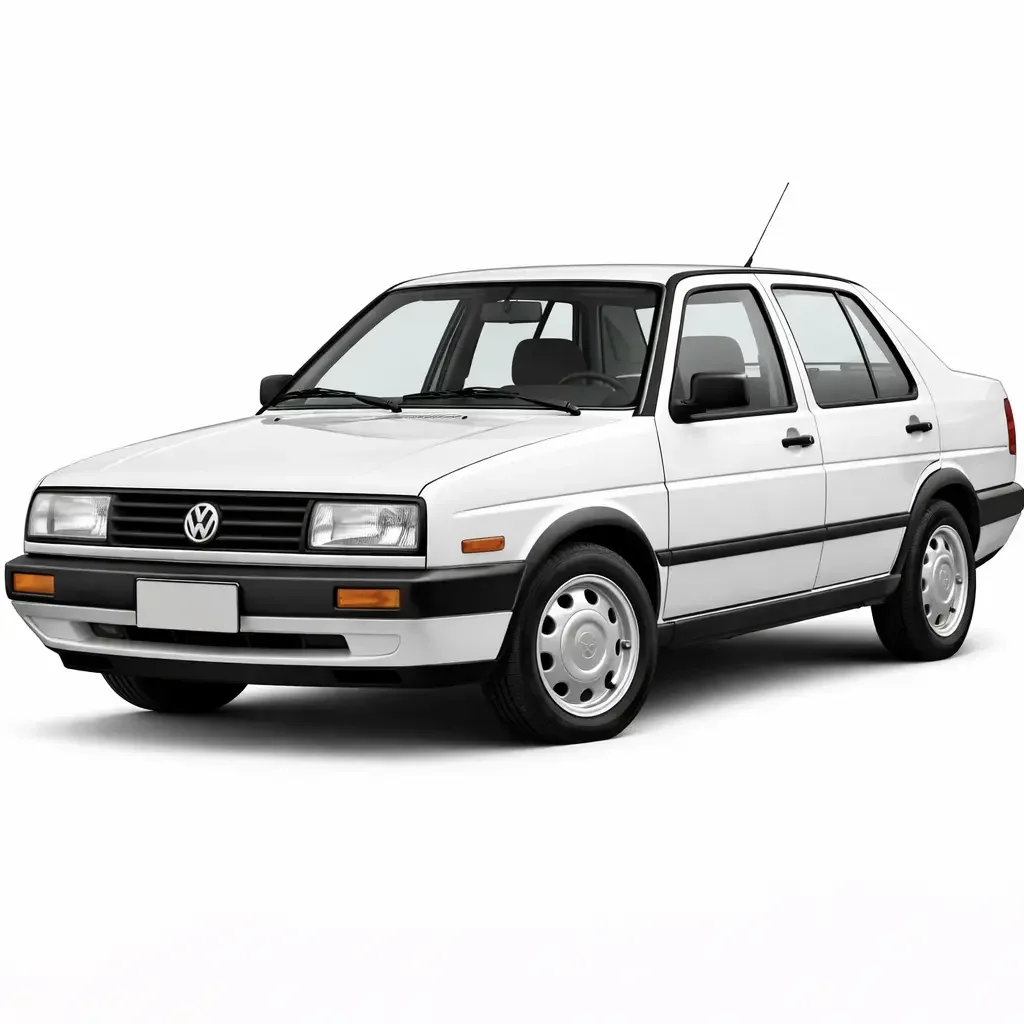
The Volkswagen Jetta MK2, designated A2 internally and Typ 19E through the 1991 model year and Typ 1G thereafter, entered the North American market for the 1985 model year and remained in production through 1992. It replaced the MK1 A1 Jetta and was built on the second-generation Golf platform, sharing its entire mechanical architecture with the Golf Mk2 just as the MK1 had shared with the Golf Mk1. The A2 is larger than the A1 in every exterior dimension — the wheelbase grew 66 mm, overall length grew 100 mm, and width grew 53 mm — and the interior was reclassified by the EPA from subcompact to compact as a result. The Jetta outsold the Golf two-to-one in North America throughout this generation and became the best-selling European car in the United States, a position it has held since 1986.
For catalog purposes, the MK2 Jetta is architecturally a three-box sedan variant of the Golf Mk2. Every underbody, suspension, drivetrain, and engine component has a direct Golf Mk2 cross-reference at matching year, engine, and specification. The Golf Mk2 cross-reference family is the primary tool for service parts, and the limits of that cross-reference are the same as for the MK1: the Jetta's trunk lid, rear quarter panels, rear bumper, rear taillamps, and rear interior trim are body-specific and have no Golf equivalent.
The A2 production window spans three distinct exterior body treatments, four petrol engine configurations, two diesel variants with a complex US/Canada availability split, and a fundamental fuel injection system change partway through the run. Getting the window right for catalog work means treating each of these as an independent variable rather than a single uniform application.
Early German-built Jettas were produced at Wolfsburg's Assembly Hall 54. From 1987 onward, North American Jettas began rolling out of the Westmoreland, Pennsylvania assembly plant, with the exception of the GLI which remained German-built throughout the production run. The Westmoreland plant closed in July 1988 due to declining sales and rising production costs, after which all North American MK2 Jettas returned to German production.
Platform: A2/Golf Mk2, Front Engine, Front-Wheel Drive
The A2 platform uses a transversely mounted front engine driving the front wheels through a combined gearbox and transaxle. There is no all-wheel-drive application on any North American MK2 Jetta. No AWD component applies. A VW Syncro AWD system was available on the Golf Mk2 in Europe but was never offered on the North American Jetta.
The front suspension is MacPherson strut independent, refined from the A1 design by the addition of a separate front subframe to which the lower control arms attach, improving NVH isolation. This subframe is an A2-specific component and does not cross to the MK1 Jetta. Front struts, front springs, front wheel bearings, and front sway bar components confirmed for the Golf Mk2 at matching year and specification cross to the MK2 Jetta without restriction.
The rear suspension is a torsion beam semi-independent axle, unchanged in design from the MK1. Rear springs, rear shock absorbers, and rear axle beam components confirmed for the Golf Mk2 torsion beam cross to the MK2 Jetta.
The wheelbase is 2,470 mm. The MK2 Jetta is dimensionally incompatible with MK1 Jetta body components despite sharing the same platform lineage. No exterior body panel, door, or glass from the MK1 crosses to the MK2.
Body Style and Exterior Changes: Three Boundaries Across the Window
The MK2 Jetta is offered as a two-door sedan and a four-door sedan throughout the window, with a critical US market restriction: the two-door was discontinued in the US after the 1991 model year but continued in Canada through 1992. A two-door US catalog application for 1992 is listing a configuration that was not sold in the US.
Three exterior styling changes created parts boundaries within the 1985-1992 window.
The 1985-1987 body carries the original MK2 exterior with small front-quarter windows in the front doors, a period-correct grille design, and narrow body-colored bumpers. US-market 1985 models do not have the centre high-mount brake light required from 1986 onward; that light is absent on the 1985 body.
For 1988, the front doors received a redesign eliminating the front quarter windows, producing what the community calls the "big doors." This change was accompanied by a revised grille and updated door trim. The 1988-and-later front door assembly differs from the 1985-1987 front door in glass configuration, door skin dimensions, and door seal profile. A front door glass or door seal confirmed for a 1985-1987 application does not apply to a 1988-or-later car.
For 1990, the exterior received larger body-colored bumpers and lower body side skirts, updating the appearance for the final three model years. The 1990-and-later bumper assemblies are larger and differently shaped from the 1985-1989 bumpers. A front or rear bumper confirmed for a pre-1990 car does not apply to a 1990-or-later car.
These three body generations — 1985-1987, 1988-1989, and 1990-1992 — define the exterior body component application structure. For all underbody and mechanical components, the full 1985-1992 window is the appropriate family, with year splits driven only by engine and fuel system changes.
Petrol Engines: Four Configurations Across the Window
The North American MK2 Jetta used four petrol engine configurations across the production window. All are 1.8-litre or 2.0-litre inline-four-cylinder units from the EA827 counterflow engine family, but they differ in valve count, fuel system, engine management, and output in ways that create genuine parts-catalog boundaries.
The standard 1.8-litre 8-valve engine was the base petrol unit used in standard, GL, and Carat trim from 1985 through 1991. This engine is mechanically shared with the Golf Mk2 standard engine at matching year specification. Within its production run it underwent the fuel system transition described in the next section, shifting from Bosch CIS-E continuous fuel injection to Digifant II fully electronic injection for the 1988 model year. Engine service components — spark plugs, oxygen sensor, distributor cap and rotor, coolant thermostat, water pump, timing belt — confirmed for the Golf Mk2 standard 1.8 8-valve at matching year and fuel system cross to the Jetta without restriction.
The 1.8-litre 16-valve twin-cam engine in the GLI was introduced from mid-1987 as the PL engine code variant, producing 123 hp. This engine uses a DOHC 16-valve cylinder head on the EA827 block. The 16-valve head, camshafts, valve train components, and fuel system hardware are specific to the 16V engine and do not cross to the 8-valve application. The 16V is an interference engine; a broken timing belt causes valve damage. The 8-valve is a non-interference engine; a broken timing belt does not cause valve damage. Any timing belt kit listing must correctly specify whether it is for the 8-valve non-interference or the 16-valve interference application.
The 2.0-litre 16-valve engine replaced the 1.8 16V in the GLI for 1990 through 1992 in North America. This 2.0 16V is specific to the North American market; outside North America the 2.0 16V was only used in the Passat and Corrado. It produces 134 hp and uses a KE-Motronic fuel injection system introduced with this engine. KE-Motronic components — the ECU, the fuel distributor, the frequency valve, and the lambda sensor — are specific to the 2.0 16V and differ from the Digifant II components of the 1.8 8V standard engine and the CIS or Digifant components of the 1.8 16V GLI. A fuel injection component confirmed for the 1.8 8V Digifant II does not apply to the 2.0 16V KE-Motronic application.
The 1.8-litre 8-valve Digifant engine continued in standard and GL trim through the 1991 model year. For 1992, the last year of US production, the standard petrol engine in the base US Jetta was the 1.8 8V Digifant, while the GLI used the 2.0 16V KE-Motronic.
The CIS-to-Digifant Transition: 1988 Fuel System Boundary
From introduction in 1985 through the 1987 model year, the 1.8 8-valve standard engine uses Bosch CIS-E (Continuous Injection System with Electronic control), a mechanical fuel injection system using a continuous flow fuel distributor with an electronic frequency valve for correction. CIS-E components are specific to the mechanical injection architecture: fuel distributor, flow sensor plate, warm-up regulator, cold start injector, and thermo-time switch.
From the 1988 model year onward, the 1.8 8-valve standard engine uses Digifant II, a fully electronic sequential injection system that eliminated the mechanical fuel distributor entirely. Digifant II uses individual solenoid injectors fired simultaneously, a mass airflow sensor, and an integrated ECU controlling both fuel and ignition. No CIS component exists on a Digifant II car, and no Digifant II component exists on a CIS car. This is a hard and complete fuel system boundary at the 1988 model year.
A fuel distributor, flow sensor plate, warm-up regulator, or cold start injector confirmed for a 1985-1987 Jetta does not apply to a 1988-or-later Jetta. A Digifant II ECU, Digifant II mass airflow sensor, or Digifant II injector confirmed for a 1988-or-later car does not apply to a 1985-1987 car. This boundary affects not only the injection components themselves but also the oxygen sensor specification (different sensor types for the two systems), the ignition system integration, and the fuel pressure regulator design.
California-specification cars within the Digifant II era received a variant with on-board diagnostics capability through a "blink code" system, different from the 49-state Digifant II calibration. A California Digifant II ECU is not interchangeable with a 49-state ECU of the same model year.
Diesel Engines: A Complex US/Canada Availability Split
The 1.6-litre naturally aspirated diesel and the 1.6-litre Turbodiesel were offered on the MK2 Jetta, but their availability differed significantly between the US and Canadian markets in ways that create market-specific catalog boundaries.
In Canada, both the naturally aspirated diesel (approximately 52 hp) and the Turbodiesel (68 hp) were available for all years from 1985 through 1992 without interruption. The diesel application in Canada is a continuous, uniform availability across the full window, making it the most straightforward diesel catalog entry.
In the United States, diesel availability was interrupted. The US had both diesel variants for 1985, 1986, and 1987. For 1988, no diesel was offered in the US at all — a complete gap year in US diesel availability. For 1989 and 1990, only the naturally aspirated diesel returned to the US market; the Turbodiesel was absent. From 1991 onward, both variants were again available in the US, with the introduction of the ECODiesel variant, a Turbodiesel using a standard non-turbo injector pump that produces approximately 59 hp, positioned between the naturally aspirated and the full Turbodiesel.
A US catalog entry that treats the diesel as a continuous application from 1985 through 1992 is generating wrong entries for 1988 (no diesel at all) and for 1989-1990 (Turbodiesel absent, naturally aspirated only). Any diesel component listing for the US market Jetta must account for this interrupted availability.
The naturally aspirated diesel and the Turbodiesel share the same 1.6-litre indirect-injection block but differ in turbocharger, intercooler, and injection pump calibration. A turbocharger, intercooler, or turbo-specific vacuum component from the Turbodiesel does not apply to the naturally aspirated diesel. The injection pump calibration differs between aspirated and turbocharged applications and must not be interchanged. The ECODiesel uses a non-turbo injector pump despite its turbocharger, creating a third distinct calibration that must not be confused with either the standard aspirated pump or the standard Turbodiesel pump.
Brakes: Solid Disc, Ventilated Disc, and the GLI Distinction
The standard and GL trim MK2 Jetta uses solid front discs and rear drums throughout the production window. This front disc, rear drum specification applies to non-GLI petrol applications and to diesel applications. The solid front disc on the standard Jetta confirmed for the Golf Mk2 standard application crosses to the Jetta at matching specification.
The GLI uses ventilated front disc brakes, matching the Golf Mk2 GTI specification. The ventilated front disc rotors are larger in diameter than the solid discs on standard applications and use a different caliper bracket. A ventilated front disc confirmed for the GLI or GTI does not apply to a standard or GL Jetta. A standard solid front disc does not apply to the GLI.
Some special edition Jetta configurations — including the 1987 Wolfsburg Edition coupe — were equipped with front ventilated and rear disc brakes as well. These configurations are exceptions within the standard brake structure and must be confirmed from the vehicle's build specification rather than assumed from model name alone.
ABS was available as an optional extra on the GLI 16V from its introduction. ABS was not standard on any trim through most of the production window but was optionally available on GLI equipment. A Jetta with the ABS option carries ABS wheel speed sensors, an ABS hydraulic modulator, and an ABS control unit not present on non-ABS cars. Any ABS component listing for the MK2 Jetta must confirm that the specific vehicle has the ABS system fitted, as most MK2 Jettas in the field do not.
Transmission
The five-speed manual gearbox is the standard transmission across the majority of the MK2 Jetta's production run and trim levels. A three-speed automatic was available as an option on most petrol configurations. No four-speed automatic, no five-speed automatic, and no DSG applies to any MK2 Jetta application.
The GLI uses a close-ratio five-speed gearbox with different internal ratios from the standard wide-ratio five-speed in base and GL trim. A close-ratio gearbox component confirmed for the GLI or GTI crosses to the Jetta GLI at matching specification but does not cross to a standard GL five-speed application, where the ratio set differs.
The three-speed automatic transmission available on standard and GL trim is the 010 transaxle. Automatic transmission fluid, filter, and internal service components confirmed for the 010 in the Golf Mk2 cross to the Jetta at matching specification.
US vs Canada Market Differences
Beyond the diesel availability split described above, several other US/Canada differences affect catalog work.
Canadian base Jettas were equipped to a higher standard than US base cars, generally matching US GL specification. Canadian GL cars were similarly better-equipped than US GL equivalents. The Carat trim was available in Canada and carried a GLI engine with an optional automatic transmission and heated velour seats; a Carat in Canada is engine-wise identical to a GLI despite not carrying the GLI badge, and its engine components cross to the GLI at matching specification.
The two-door body continued in Canada through the 1992 model year; in the US it ended after 1991. A US catalog entry for a 1992 MK2 Jetta two-door is listing a configuration that was not sold domestically.
Canada had full diesel availability from 1985 through 1992 without the US gaps described above.
Color and trim differences between the two markets exist but do not affect mechanical component applications. Market-specific passive restraint systems and seat belt configurations may create US vs Canada differences for interior restraint components in specific model years and trim combinations.
The MK2 Jetta and the Golf Mk2: Cross-Reference Scope
All mechanical and drivetrain components on the MK2 Jetta cross to the Golf Mk2 at matching year, engine, and specification. Front struts, front lower control arms, rear axle beam components, engine service parts, transmission components, brakes (noting the GLI ventilated vs standard solid split), and cooling system components all cross freely within the Golf Mk2/Jetta MK2 family.
The subframe added at the A2 generation for the front lower control arm mounting is shared with the Golf Mk2. Subframe bushings and mounting hardware confirmed for the Golf Mk2 cross to the MK2 Jetta.
Body components do not cross from the Golf to the Jetta for rear panels, trunk lid, rear bumper, rear taillamps, and rear interior trim. The MK1 Jetta body components do not cross to the MK2 despite the shared platform lineage — the two Jetta generations are dimensionally incompatible. No door, fender, or quarter panel from the MK1 applies to the MK2.
The Scirocco Mk2, which shares the A2 platform, is an additional source for engine-specific components at matching specification, particularly for the 1.8 16V engine which was used in the Scirocco 16V in the same period.
Common ACES/PIES Catalog Mistakes
The first error is applying a single fuel injection specification across the full 1985-1992 window. CIS-E components apply through 1987; Digifant II components apply from 1988. Fuel distributor, mass airflow sensor, ECU, and injector specifications are entirely different between the two systems.
The second error is applying a petrol engine component to a diesel application, or vice versa. Glow plugs, injection pump components, and diesel fuel filter are diesel-specific. Spark plugs, distributor, and ignition coil are petrol-specific.
The third error is applying a Turbodiesel turbocharger or injector pump to the naturally aspirated diesel, or vice versa. The two diesel variants use different injection pump calibrations and the Turbodiesel adds hardware the naturally aspirated diesel does not carry.
The fourth error is applying the ECODiesel injection pump to a standard Turbodiesel application. The ECODiesel uses a non-turbo pump despite its turbocharger; the standard Turbodiesel uses a turbo-calibrated pump. These are not interchangeable.
The fifth error is creating a US diesel application for 1988. No diesel Jetta was sold in the US for the 1988 model year. Any US diesel entry for 1988 is a catalog error.
The sixth error is creating a US Turbodiesel application for 1989 or 1990. The Turbodiesel was absent from the US for those two model years; only the naturally aspirated diesel was available.
The seventh error is applying a ventilated front disc to a standard or GL Jetta, or a solid front disc to the GLI. The brake specification splits between GLI (ventilated) and all other petrol trims (solid front, rear drum).
The eighth error is applying ABS components to a non-ABS Jetta. ABS was an option, not standard, and the majority of field cars do not carry it. Component listings should confirm ABS fitment from VIN or inspection rather than assuming it.
The ninth error is applying a 1988-or-later big-door front door glass or seal to a 1985-1987 small-door application. The front door design changed in 1988 with the elimination of the quarter window, making pre-1988 and post-1988 front door components incompatible.
The tenth error is applying 1989-or-earlier bumper assemblies to a 1990-or-later car, or large 1990-style bumpers to a pre-1990 car. The bumper assemblies changed in 1990 and are not interchangeable across the boundary.
The eleventh error is applying a 1992 two-door body component to a US-market application. The two-door was discontinued in the US after 1991; a 1992 two-door is a Canadian-market-only application.
The twelfth error is applying a close-ratio GLI/GTI transmission component to a standard GL wide-ratio application. The internal ratios differ between the close-ratio and wide-ratio five-speeds and the components are specific to each ratio set.
The thirteenth error is applying a 2.0 16V KE-Motronic fuel injection component to a 1.8 8V Digifant or 1.8 16V CIS application. Three separate injection system architectures exist within the petrol engine range and none crosses to the others without individual part number confirmation.
The fourteenth error is applying a California-spec Digifant II ECU to a 49-state car, or vice versa. California Digifant II cars from 1987-1990 carry an OBD-capable ECU not present on 49-state cars of the same year.
Pre-Listing Checklist for the 1985-1992 MK2 Jetta
Market confirmed as US or Canada; diesel availability, two-door body year availability, and trim equipment level confirmed by market.
Engine confirmed as 1.8 8V (CIS-E through 1987, Digifant II from 1988), 1.8 16V GLI (1987-1989), 2.0 16V GLI (1990-1992), 1.6D naturally aspirated diesel, or 1.6TD Turbodiesel (noting US gap years); engine code confirmed before selecting fuel system components.
For Digifant II cars: California vs 49-state specification confirmed for ECU and OBD-related components.
Transmission confirmed as five-speed manual (close-ratio GLI or wide-ratio standard), or three-speed automatic (010); no four-speed auto, no DSG applies.
Body year generation confirmed as 1985-1987 (small door, quarter window), 1988-1989 (big door, no quarter window), or 1990-1992 (big bumper, side skirts) for all exterior body components.
Body style confirmed as two-door or four-door; for US market, two-door confirmed as not applicable for 1992.
Brake specification confirmed as ventilated front disc (GLI), solid front disc with rear drum (all other petrol and diesel trims), or confirmed exception (Wolfsburg Edition or other special configuration with rear disc).
ABS fitment confirmed from vehicle inspection or VIN; ABS components not applied without confirmation.
Golf Mk2 cross-reference confirmed as applicable for all mechanical and drivetrain components at matching year and specification; Jetta-specific rear body components confirmed as having no Golf cross-reference.
Final Take
The MK2 Jetta is a more complex catalog application than the MK1 largely because of the fuel system transition in 1988 and the diesel market availability split. The three exterior body changes add further structure but are cleanly bounded by model year and straightforward to manage. The GLI engine progression — from 1.8 16V to 2.0 16V at the 1990 body change, with three distinct injection system architectures across the petrol range — is where most catalog errors concentrate.
The Golf Mk2 cross-reference remains the primary practical tool for mechanical components, and it works as reliably for the MK2 Jetta as the Rabbit cross-reference worked for the MK1. The limit of the cross-reference is the same: rear body, trunk, and Jetta-specific exterior trim have no Golf equivalent. Everything beneath the body and ahead of the C-pillar shares freely across the Golf Mk2 and Jetta MK2 family within matching year and specification.
For the complete Volkswagen Jetta generations and fitment summary covering all platforms, engine families, and catalog rules from 1980 to present, see the Volkswagen Jetta Generations and Fitment Guide (1980 to Present).
Disclaimer
This guide is intended for catalog research, fitment analysis, and parts advisory reference. Production specifications, option availability, and regulatory compliance requirements vary by model year, regional market, and assembly date within any given window. Always confirm application data against vehicle identification number decoding, factory build sheets, and OEM parts documentation before finalizing a listing or parts recommendation. PartsAdvisory and its contributors are not responsible for fitment errors arising from catalog data that has not been independently verified against physical vehicle inspection or official OEM sources.