
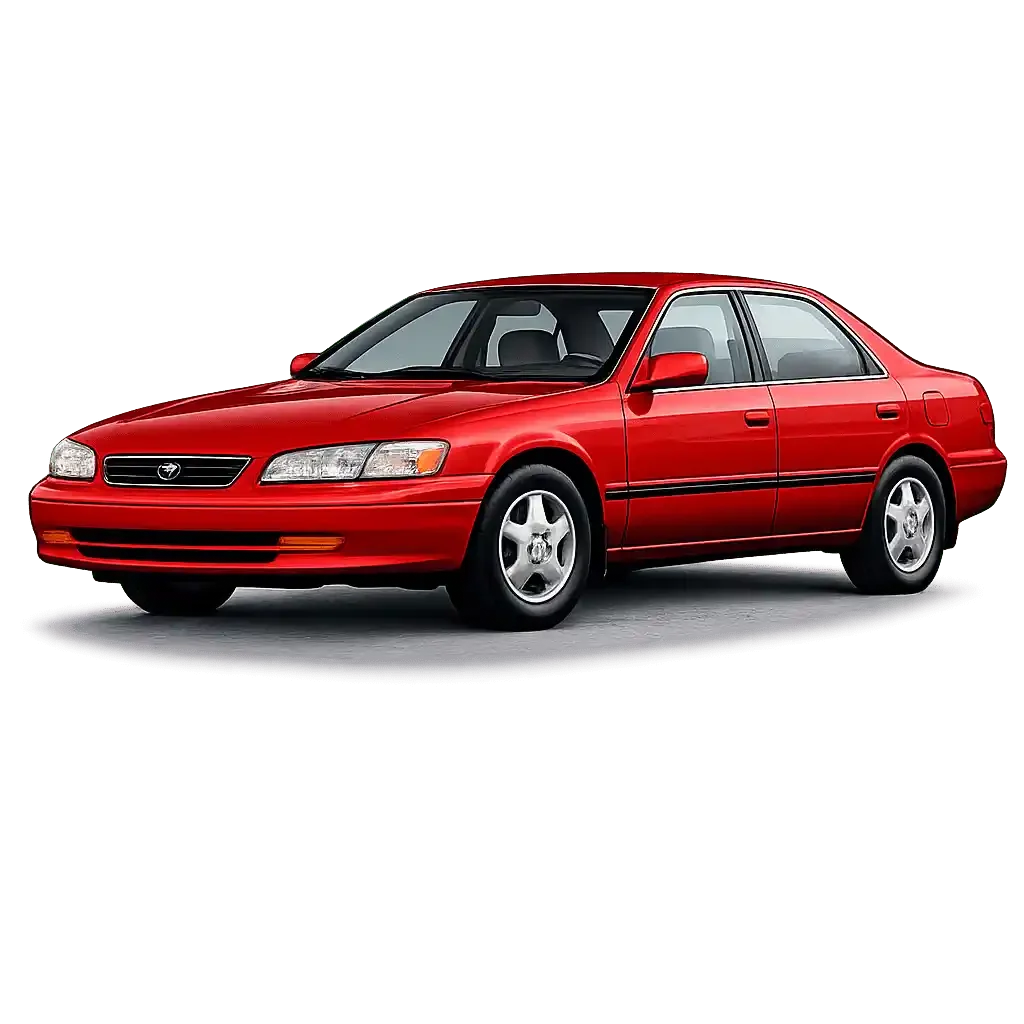
The XV20 Camry is the generation that made the Camry the best-selling passenger car in the United States. It is also the generation that introduces one of the cleanest facelift splits in the entire Camry lineage: the 2000-2001 facelift changed the headlamp system from a two-bulb to a four-bulb configuration, reshaped the tail lamps, and revised the grille and bumper fascia. That change alone drives a high volume of returns on lighting and front-end parts. On top of that, you still have the four-cylinder versus V6 engine split, two different manual transmissions depending on engine, and trim-level differences that affect suspension and brake components.
Use this page as a practical ruleset for parts listings and for buying parts online without gambling.
What XV20 covers
This guide covers Toyota Camry 1997 to 2001, fourth generation XV20. It does not cover the Camry Solara coupe and convertible, which share the XV20 platform but use unique body panels and have their own facelift schedule.
Depending on market and build, you will see these broad configurations:
Front wheel drive only (no AWD option on this generation)
4-door sedan only in North America (no wagon or coupe for the Camry sedan line)
2.2-liter inline four-cylinder engine (5S-FE, 133 hp)
3.0-liter V6 engine (1MZ-FE, 194 hp)
5-speed manual transmission: S51 for four-cylinder, E153 for V6 (limited trim availability)
4-speed automatic transmission (standard on most trims)
Trim levels: CE (base), LE, XLE
If you are building catalog logic, XV20 is simpler than XV10 in body style terms because it is sedan-only in the US. But the facelift split and the Solara confusion create catalog traps that require strict year enforcement.
Step 1: Split pre-facelift versus facelift, this is the number one issue on XV20
The XV20 received a facelift in August 1999 for the 2000 model year. The exterior changes are significant enough that front and rear lighting parts, bumper covers, and grille components do not interchange between the two groups.
Key facelift changes for 2000-2001:
Headlamp assemblies changed from a two-bulb H4 system to a four-bulb system with separate low and high beam bulbs
Headlamp housing shape and size changed
Front grille separated from the bumper cover and gained a chrome surround
Front bumper cover redesigned
Tail lamp assemblies enlarged and reshaped
Body-side moldings widened
Minor interior trim updates
For catalog purposes, the split is clean:
1997-1999 (pre-facelift)
2000-2001 (facelift)
This is not a subtle change. The headlamps use entirely different bulb types and wiring. A 1997-1999 headlamp will not bolt into a 2000-2001 car without bumper and fender modifications, and vice versa.
High return categories affected by the facelift split:
Headlamp assemblies and headlamp bulbs
Front turn signal and corner lamp assemblies
Front grille and grille surround
Front bumper cover, bumper reinforcement bar, and bumper absorber
Fog lamp housings and fog lamp brackets
Tail lamp assemblies and tail lamp bulbs
Rear bumper cover
Body-side protective moldings
Fender liners (front bumper attachment points differ)
Rule to publish fitment:
Never publish exterior lighting, bumper, or grille fitment without pre-facelift (1997-1999) versus facelift (2000-2001) selection
Buyer prompts that reduce returns:
Count your headlamp bulbs: two bulbs per side means 1997-1999, four bulbs per side means 2000-2001
Check your front grille: if it is integrated into the bumper cover it is pre-facelift, if it is a separate piece with a chrome border it is facelift
Compare your tail lamp size: the 2000-2001 lamps are visibly larger
Step 2: Confirm engine family, four-cylinder versus V6
XV20 carries over both engines from the later XV10 years, so the four-cylinder versus V6 split is straightforward but still critical for underhood parts.
2.2-liter inline four-cylinder (5S-FE): all years 1997-2001, 133 hp
3.0-liter V6 (1MZ-FE): all years 1997-2001, 194 hp
Unlike XV10, there is no mid-generation engine swap. The 1MZ-FE runs across all V6 years. This makes catalog logic simpler, but the four-cylinder and V6 still share almost nothing in the engine bay.
Categories where you must enforce engine selection:
Serpentine belt, belt tensioner, and idler pulley
Power steering pump and power steering hose
A/C compressor, A/C clutch, and compressor bracket
Radiator and radiator hoses (different size and hose routing)
Valve cover gaskets (the V6 has two valve covers, access to the rear cover is limited)
Oxygen sensors and catalytic converter assemblies
Exhaust system from manifold to tailpipe
Engine wiring harness and ECU
Motor mounts (different count and placement)
Intake manifold gaskets and throttle body
Practical rule:
If the part mounts to the engine or connects to the engine bay, require four-cylinder or V6 selection
How to confirm quickly:
VIN decode: SXV20 chassis code is four-cylinder, MCV20 is V6
Visual check: the V6 is immediately identifiable by its wider valve cover layout and transverse V-configuration
Step 3: Transmission type matters for specific categories
Manual transmissions on XV20 had limited availability. For 1997-1999, the manual was initially offered only on the CE V6. For 2000-2001, it was offered on the CE four-cylinder and the LE V6. The four-cylinder manual uses the S51 gearbox. The V6 manual uses the E153 gearbox. Most XV20 Camrys are automatic.
Transmission rule:
If the part touches the driveline, pedal box, or shift mechanism, require manual versus automatic selection
High risk categories:
CV axle shafts (different for manual versus automatic, and different between four-cylinder and V6)
Transmission mount and rear engine mount
Flywheel versus flexplate
Clutch master cylinder and clutch slave cylinder (manual only)
Brake pedal assembly (manual cars use a narrower brake pedal to fit alongside the clutch pedal)
Shift cables and console trim (automatic uses a gate shifter, manual uses a boot and knob)
Speedometer sensor configuration
A simple buyer prompt:
Confirm manual or automatic, and four-cylinder or V6, before ordering driveline or pedal components
Step 4: Trim level affects suspension, brakes, and appearance parts
XV20 trim levels in the US were CE, LE, and XLE. The differences between trims are less dramatic than on XV10 (which had the SE sport trim with unique suspension), but they still affect specific categories.
Key trim-level differences:
Wheel and tire size: CE typically ran 14-inch wheels, LE and XLE ran 15-inch
Brake rotor diameter may differ by wheel size package
XLE received leather seat surfaces, wood grain interior trim, power driver seat, and sunroof as standard
CE had manual windows and locks on some configurations
Fog lamps were standard on LE and XLE but not always on CE
High risk categories where trim matters:
Brake rotors and brake pads (confirm wheel and rotor size)
Seat covers, seat cushions, and seat track mechanisms (power versus manual seat, leather versus cloth)
Interior door panels (power window switch cutouts versus manual crank)
Sun visor and overhead console (sunroof-equipped cars differ)
Alloy wheels versus steel wheels and hubcaps
Fog lamp assemblies and wiring (not present on all CE models)
Practical rule:
For brake, seat, and interior trim parts, confirm trim level or confirm the specific feature (power windows, leather, sunroof) before ordering
Do not confuse Camry sedan parts with Solara parts
The Camry Solara (coupe and convertible) launched on the XV20 platform for the 1999 model year. It shares the same engines and many mechanical underpinnings, but the body panels, lighting, and interior trim are unique to the Solara.
The Solara also has its own facelift schedule. The Solara received its front and rear fascia update for the 2002 model year, not the 2000 model year like the Camry sedan. This misalignment causes confusion in catalogs that group "Camry platform" parts together.
Parts that are commonly confused between Camry sedan and Solara:
Headlamp assemblies (completely different shape and mounting)
Tail lamp assemblies (different shape and configuration)
Front and rear bumper covers (different profile)
Door panels, door glass, and window regulators (the Solara coupe has longer doors with frameless glass)
Trunk lid and trunk hinges
Rear quarter panels
Rule for catalog teams:
Always list Camry sedan and Solara as separate vehicles, never combine body and lighting fitment
If your catalog groups them under one platform code, enforce body type selection at the listing level
The biggest return traps on XV20 and how to stop them
1) Headlamp assemblies and headlamp bulbs
Why they get returned:
Pre-facelift uses a two-bulb H4 system, facelift uses a four-bulb system with separate low and high beam
The housings are different shapes and do not physically interchange
Buyers order based on generation rather than facelift year
Bulb type confusion: H4 for 1997-1999, separate 9006/9005 or similar for 2000-2001
How to stop returns:
Require pre-facelift (1997-1999) or facelift (2000-2001) selection
List the bulb type in the listing description
Ask the buyer to confirm bulb count per headlamp: one combo bulb or two separate bulbs
2) Front bumper cover and grille
Why they get returned:
The grille is integrated into the bumper on 1997-1999 and separate on 2000-2001
Bumper cover mounting points changed at the facelift
Fog lamp cutouts differ between trims and between facelift years
How to stop returns:
Require facelift status
Confirm if the car has fog lamps
Add a buyer check: is your grille part of the bumper or a separate piece?
3) Tail lamp assemblies
Why they get returned:
The 2000-2001 tail lamps are larger than the 1997-1999 lamps
Different mounting points and gasket profiles
Buyers assume all XV20 tail lamps are the same because the car looks similar from a distance
How to stop returns:
Require pre-facelift (1997-1999) or facelift (2000-2001) selection
Ask the buyer to measure or photograph the lamp for comparison
Remind buyers that the 2000-2001 lamps are visibly larger and not interchangeable with 1997-1999
4) Valve cover gaskets and spark plug tube seals
Why they get returned:
The four-cylinder has one valve cover gasket, the V6 has two
The V6 rear valve cover requires significant labor to access due to the engine tilt
Kits that include the wrong number of gaskets or wrong spark plug tube seal count get returned
How to stop returns:
Require engine selection: 5S-FE or 1MZ-FE
List the gasket count and spark plug tube seal count in the listing
For V6 kits, note that both front and rear gaskets should be included
5) Brake rotors and pads
Why they get returned:
Rotor diameter can differ based on wheel package and trim
Four-cylinder and V6 models may use different front rotor sizes
Buyers guess based on year without confirming the size currently on the car
How to stop returns:
Require engine selection
Ask the buyer to measure the outer diameter of the existing rotor or count the lug bolts and measure the hub pattern
Note the specific rotor diameter in the listing (do not use "fits all XV20")
6) CV axle shafts
Why they get returned:
Different for four-cylinder versus V6
Different for manual versus automatic
Spline count and shaft length vary across these combinations
How to stop returns:
Require engine and transmission selection
If possible, include spline count and overall length in the listing
Add a buyer check: confirm four-cylinder or V6 and manual or automatic before ordering
A clean XV20 fitment rules block you can paste into listings
Use this exact checklist in your product pages or internal SOP.
Required attributes for Toyota Camry XV20 1997-2001:
Model year
Facelift status: pre-facelift (1997-1999) or facelift (2000-2001)
Engine: 2.2-liter 5S-FE four-cylinder or 3.0-liter 1MZ-FE V6
Transmission: manual or automatic (and if manual, confirm engine for correct gearbox code)
Trim level: CE, LE, or XLE (relevant for brakes, seats, interior, and fog lamps)
Confirm Camry sedan versus Solara (do not cross-list body and lighting parts)
For brake parts: confirm rotor diameter or wheel size
For electrical and lighting parts: match bulb type and connector configuration
Buyer confirmation prompts:
Headlamps: count your bulbs per side, confirm pre-facelift or facelift
Front bumper and grille: confirm whether grille is integrated or separate
Tail lamps: compare size and shape, confirm facelift status
Engine gaskets and seals: confirm four-cylinder or V6
Serpentine belt and accessories: confirm four-cylinder or V6
Brake rotors and pads: confirm rotor diameter or measure the installed rotor
CV axle shafts: confirm engine and transmission type
Seats and interior trim: confirm trim level and power versus manual seat
Quick identification guide for buyers
If you want a fast way to reduce wrong orders, tell readers to gather these items before shopping:
Year on registration
Photo of the front end, straight on (immediately reveals facelift status by headlamp and grille design)
Photo of the rear end, straight on (reveals tail lamp size for facelift identification)
Underhood photo showing engine (distinguishes four-cylinder from V6)
VIN or underhood emissions label (chassis code SXV20 is four-cylinder, MCV20 is V6)
Transmission type: manual or automatic
Trim level: CE, LE, or XLE
For brake orders: measure the rotor outer diameter or note the wheel size
Confirm this is a Camry sedan, not a Solara
If they cannot answer these, they are not ready to order the parts that typically get returned.
What to do if you are unsure
When the buyer cannot confirm facelift status, engine, or trim level, do not force a guess. Use one of these safer options:
Ask for a front-end photo (fastest way to confirm facelift status on XV20)
Ask for the VIN and decode the build information
Ask for a photo of the underhood emissions label
Ask for a photo of the existing part showing the mounting configuration
Ask the buyer to count the headlamp bulbs per side
That extra minute prevents a return that costs shipping, labor, and trust.
Bottom line
On XV20 Camry, the facelift is the dominant fitment issue. It changes the headlamp system, grille design, bumper fascia, and tail lamps all at once. Get that split right and most exterior part returns disappear.
The critical checks are:
Facelift status first: 1997-1999 or 2000-2001
Engine next: four-cylinder (5S-FE) or V6 (1MZ-FE)
Manual versus automatic for driveline and pedal parts
Trim level for brakes, seats, and interior components
Camry sedan versus Solara: never cross-list body and lighting
If you build your listings and your buying decisions around those five checks, XV20 becomes clean and returns drop fast.
For the full year, engine, trim, and body style breakdown across every Camry generation, read my Complete Toyota Camry Generations Guide 1983 to Present.
Disclaimer: This guide is based on publicly available specifications, Toyota press materials, and independent research. Part interchangeability should always be confirmed via VINand OEM part number lookup. Specifications may change without notice. This document does not constitute official Toyota parts catalog data. Visuals and illustrations in this article were generated using AI for representative purposes and may not reflect exact technical schematics.