
Toyota Camry 2002-2006 5th Generation XV30 Parts Fitment Guide
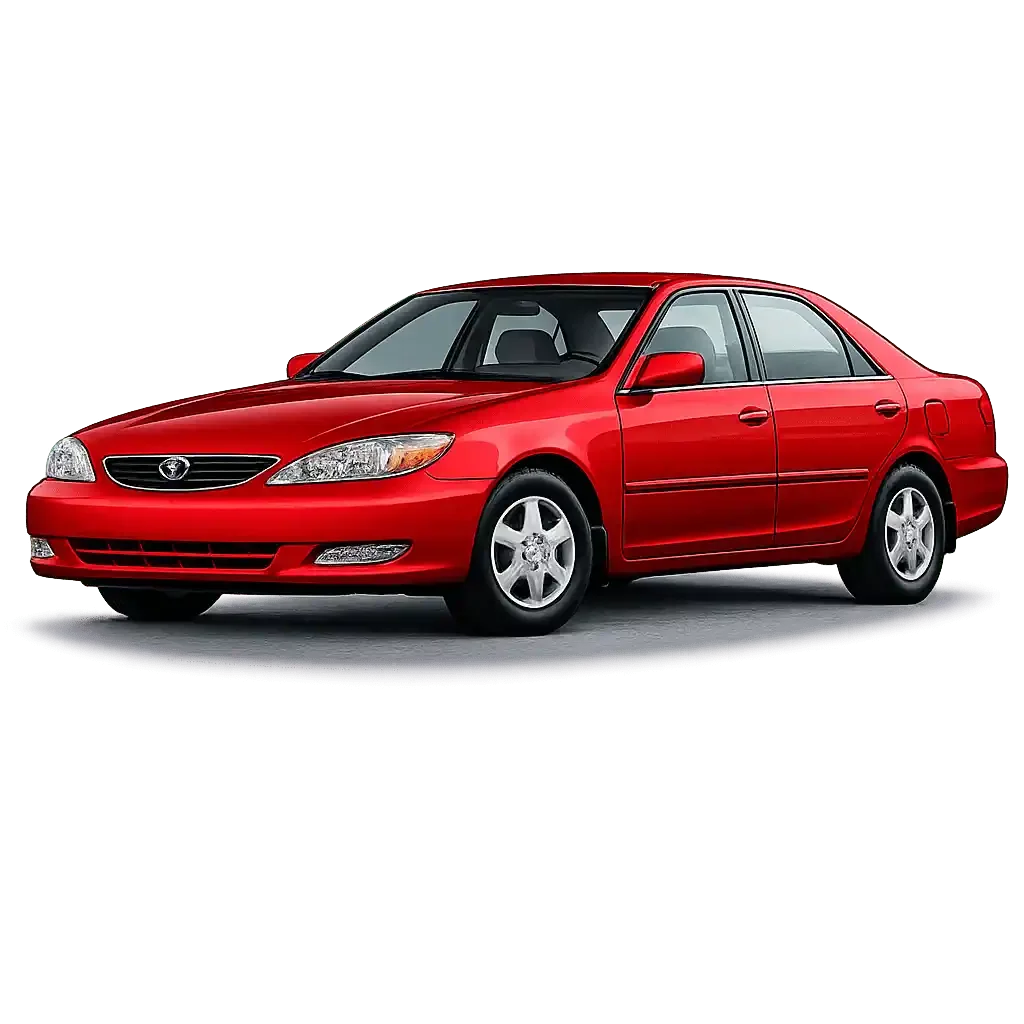
The XV30 Camry is the generation where Toyota moved the Camry onto a completely new platform (the K platform, shared with the Highlander), dropped the wagon and coupe from the sedan lineup, introduced an all-new four-cylinder engine, swapped the V6 mid-generation, and delivered a significant facelift that changed the headlamp layout, grille, tail lamps, instrument cluster, and transmission. That is a lot of change packed into one generation. For parts sellers, XV30 has more hidden splits than it appears on the surface because the car looks similar across all years until you compare the details.
Use this page as a practical ruleset for parts listings and for buying parts online without gambling.
What XV30 covers
This guide covers Toyota Camry 2002 to 2006, fifth generation XV30. It does not cover the second-generation Camry Solara (2004-2008), which moved to the XV30 platform but uses its own body panels and has a separate facelift schedule.
Depending on market and build, you will see these broad configurations:
Front wheel drive only in North America (no AWD on this generation in the US)
4-door sedan only (no wagon, no coupe in the Camry sedan line)
2.4-liter inline four-cylinder engine (2AZ-FE) across all years
3.0-liter V6 (1MZ-FE with VVT-i, 190 hp) for 2002-2003
3.0-liter V6 (1MZ-FE with VVT-i, 210 hp) for 2004 LE and XLE
3.3-liter V6 (3MZ-FE, 225 hp) for 2004 SE, and all V6 trims 2005-2006
4-speed automatic for 2002-2004, 5-speed automatic for 2005-2006
5-speed manual (limited availability, primarily on four-cylinder LE and SE)
Trim levels: LE, SE, XLE (2002-2004); Standard/base, LE, SE, XLE (2005-2006)
If you are building catalog logic, XV30 looks simple because it is a sedan-only car, but the V6 engine swap and the facelift create year-level splits that trip up sellers who list parts as fitting "all 2002-2006."
Step 1: Split pre-facelift versus facelift for exterior and electrical parts
The XV30 received a facelift for the 2005 model year. The exterior changes affect lighting, grille, bumper, and wheel fitment. Interior changes affect the instrument cluster, steering wheel, and center console.
Key facelift changes for 2005-2006:
Headlamp assemblies redesigned with a new four-bulb layout (the 2002-2004 uses a three-bulb arrangement with a different side marker position)
Front grille redesigned with chrome surround (SE received a unique blackout grille)
Front bumper cover redesigned
Tail lamp assemblies redesigned with new lens pattern and different wiring connector configuration
New wheel designs across all trims (SE V6 gained available 17-inch alloys)
Optitron electroluminescent gauges made standard across all trims
New steering wheel with standard audio controls on all trims
Chrome interior door handles and shift knob button
Rear center headrest added
ABS became standard on all trims (it was not standard on all 2002-2004 models)
For catalog purposes, the split is:
2002-2004 (pre-facelift)
2005-2006 (facelift)
High return categories affected by the facelift split:
Headlamp assemblies and headlamp bulbs (different bulb count and side marker placement)
Front grille insert (chrome on LE/XLE versus blackout on SE for 2005-2006)
Front bumper cover and fog lamp housings
Tail lamp assemblies and tail lamp wiring connectors (different plug configuration between pre-facelift and facelift)
Alloy wheels and wheel covers
Instrument cluster (Optitron for all 2005-2006 versus trim-dependent on 2002-2004)
Steering wheel (2005-2006 has standard audio controls)
Rule to publish fitment:
Never publish exterior lighting, bumper, grille, or instrument cluster fitment without pre-facelift (2002-2004) or facelift (2005-2006) selection
Buyer prompts that reduce returns:
Count the bulb positions in your headlamp: the 2005-2006 arrangement differs from 2002-2004
Check your grille: the 2005-2006 grille has a chrome surround on LE/XLE or blackout on SE
Check the tail lamp wiring connector: 2002-2004 and 2005-2006 use different plugs even though the lamps bolt up similarly
Check your instrument cluster: Optitron gauges on all 2005-2006 trims, but only on some 2002-2004 trims
Step 2: Identify the correct engine, three engine codes across the generation
XV30 introduced the 2AZ-FE four-cylinder and carried the 1MZ-FE V6 forward, but then swapped the V6 mid-generation. This creates three engine tracks:
2.4-liter inline four-cylinder (2AZ-FE): all years 2002-2006, 157 hp (2002-2004), 154 hp (2005-2006, SAE net rating change)
3.0-liter V6 (1MZ-FE with VVT-i): 2002-2003 all V6 trims, 2004 LE and XLE V6 only, 190-210 hp
3.3-liter V6 (3MZ-FE): 2004 SE V6, and all V6 trims 2005-2006, 225 hp
The V6 transition in 2004 is messy. The 2004 SE received the new 3MZ-FE, but the 2004 LE and XLE retained the 1MZ-FE. By 2005, all V6 models used the 3MZ-FE. This means that within a single model year (2004), two different V6 engines were installed depending on trim level.
Categories where you must enforce engine selection:
Serpentine belt routing and belt tensioner
Exhaust manifold, catalytic converter, and exhaust system components
Oxygen sensors and air/fuel ratio sensors (different count and placement between engines)
Motor mounts and transmission mounts
Intake manifold and throttle body
Engine wiring harness and ECU
Power steering pump and hose routing
Radiator and cooling hoses
A/C compressor and bracket
Practical rule:
If the part mounts to the engine or lives in the engine bay, require engine family: 2AZ-FE, 1MZ-FE, or 3MZ-FE
For 2004 V6 models, require trim level to determine which V6 is installed
How to confirm quickly:
VIN decode: ACV30 is four-cylinder, MCV30 is 3.0 V6, MCV31 is 3.3 V6
Underhood emissions label shows the engine family
For 2004, confirm SE (3MZ-FE) versus LE/XLE (1MZ-FE)
Step 3: Transmission split matters more on XV30 than on XV20
XV30 introduced a transmission change at the facelift:
2002-2004: 4-speed automatic on most models
2005-2006: 5-speed automatic replaced the 4-speed on all automatic models
The 5-speed manual was available on select four-cylinder trims across the full run.
This transmission change affects more than just internal gearbox parts. It can affect:
Transmission mounts and crossmember brackets
Transmission cooler lines and fittings
Shift cable routing and console trim
ECU and transmission control module calibration
CV axle shaft specifications (spline and length)
Transmission rule:
For driveline, mount, and axle parts, require year range (2002-2004 versus 2005-2006) and manual versus automatic
Do not list automatic transmission parts as fitting "all 2002-2006" without verifying 4-speed versus 5-speed compatibility
Step 4: Trim level affects more categories on XV30 than on prior generations
XV30 trim levels in the US were LE, SE, and XLE for 2002-2004. For 2005-2006, an unbadged base model was added below the LE.
Key trim-level differences that affect parts fitment:
SE trim received sport-tuned suspension (springs, struts, stabilizer bars) borrowed from the Lexus ES 300, unique wheels, a rear spoiler, and fog lamps
SE was the first trim to receive the 3MZ-FE V6 in 2004
SE had a unique blackout grille for 2005-2006 (different from the chrome grille on LE/XLE)
XLE included leather seating, JBL premium audio, and sunroof as standard, with optional side airbags and Vehicle Stability Control (VSC)
2005-2006 base model had unpainted side mirrors and minimal equipment
High risk categories where trim matters:
Front strut assemblies and rear shock absorbers (SE sport suspension differs from LE/XLE)
Stabilizer bar and stabilizer bar links (SE uses different diameter)
Front grille (SE blackout versus LE/XLE chrome on 2005-2006)
Rear spoiler (standard on SE, optional on others)
Side mirrors (unpainted on 2005-2006 base, painted or color-keyed on LE/SE/XLE)
Audio system head unit and speakers (JBL premium on XLE versus standard on other trims)
Seat assemblies and seat covers (leather on XLE versus cloth on others)
Airbag modules (side and curtain airbags were optional, not standard on all trims for 2002-2004)
Practical rule:
For suspension parts, require trim level: SE sport suspension does not cross with LE/XLE
For grille parts on 2005-2006, require SE or non-SE
For audio and interior parts, confirm trim level
Do not confuse Camry sedan parts with second-generation Solara parts
The second-generation Camry Solara (2004-2008) moved to the XV30 platform. Like the previous generation, it shares engines and many mechanical underpinnings with the Camry sedan, but the body panels, lighting, and interior are completely unique.
The Solara's facelift landed for the 2007 model year, well after the Camry sedan's 2005 facelift. This timing mismatch continues to cause catalog problems.
Rule for catalog teams:
Always list Camry sedan and Solara as separate vehicles
Never combine body, lighting, or interior fitment between them
The biggest return traps on XV30 and how to stop them
1) Headlamp assemblies
Why they get returned:
2002-2004 uses a three-bulb arrangement, 2005-2006 uses a four-bulb arrangement with different side marker placement
The housings bolt up to similar fender mounting points but the wiring and bulb layout differ
People attempt to swap 2005-2006 headlamps onto 2002-2004 cars and discover the wiring does not match without splicing
How to stop returns:
Require pre-facelift (2002-2004) or facelift (2005-2006) selection
Note the bulb count difference in the listing
Add a buyer check: count the bulb sockets in your current headlamp
2) Tail lamp assemblies and wiring
Why they get returned:
The lens patterns changed at the facelift and the wiring connectors are different between 2002-2004 and 2005-2006
The lamps can physically bolt into place across years but they will not plug in without rewiring
Sellers list "fits 2002-2006" and buyers get a lamp that bolts up but does not connect
How to stop returns:
Require pre-facelift (2002-2004) or facelift (2005-2006) selection
Note the connector type difference in the listing
Remind buyers that even if the lamp bolts on, the plug must match
3) V6 engine accessories and exhaust components
Why they get returned:
The 2004 model year has two different V6 engines depending on trim (1MZ-FE on LE/XLE, 3MZ-FE on SE)
Sellers list by year and displacement without specifying engine code
Catalytic converters, exhaust manifolds, and sensors differ between the 1MZ-FE and 3MZ-FE
How to stop returns:
Require engine code: 1MZ-FE or 3MZ-FE, not just "V6" or "3.0/3.3"
For 2004 V6 orders, require trim level to determine engine
Add a buyer check: look at the underhood emissions label for the engine code
4) Suspension struts and shock absorbers
Why they get returned:
SE sport suspension uses different spring rates and damper tuning than LE/XLE
Sellers list "fits all XV30" without noting the SE difference
Buyers install LE struts on an SE car and notice the ride height and handling change
How to stop returns:
Require trim level for suspension parts: SE versus non-SE
Note in the listing whether the part fits sport suspension or standard suspension
Add a buyer check: does your car have the SE sport suspension package?
5) Automatic transmission related parts
Why they get returned:
2002-2004 uses a 4-speed automatic, 2005-2006 uses a 5-speed automatic
Transmission cooler lines, shift cables, and related brackets differ
Sellers list "fits 2002-2006 automatic" without specifying 4-speed or 5-speed
How to stop returns:
Require year range: 2002-2004 or 2005-2006 for all automatic transmission related parts
Note 4-speed versus 5-speed in the listing
Add a buyer check: confirm your model year and whether you have a 4-speed or 5-speed automatic
6) Front grille
Why they get returned:
2002-2004 grille design differs from 2005-2006
Within 2005-2006, the SE gets a unique blackout grille while LE/XLE get a chrome grille
Buyers order by year but not trim
How to stop returns:
Require pre-facelift or facelift
For 2005-2006, require SE or non-SE
Add a photo in the listing showing both grille options for the facelift years
A clean XV30 fitment rules block you can paste into listings
Use this exact checklist in your product pages or internal SOP.
Required attributes for Toyota Camry XV30 2002-2006:
Model year
Facelift status: pre-facelift (2002-2004) or facelift (2005-2006)
Engine family: 2.4-liter 2AZ-FE four-cylinder, 3.0-liter 1MZ-FE V6, or 3.3-liter 3MZ-FE V6
For 2004 V6 models: confirm trim to determine which V6 (SE gets 3MZ-FE, LE/XLE retain 1MZ-FE)
Transmission: 5-speed manual, 4-speed automatic (2002-2004), or 5-speed automatic (2005-2006)
Trim level: base (2005-2006 only), LE, SE, or XLE
For suspension parts: SE sport versus standard
For grille on 2005-2006: SE blackout or LE/XLE chrome
Confirm Camry sedan versus Solara (do not cross-list body and lighting parts)
Buyer confirmation prompts:
Headlamps: count bulb positions, confirm pre-facelift or facelift
Tail lamps: confirm facelift status and check the wiring connector
Grille: confirm year range and SE versus non-SE
Engine accessories and exhaust: confirm engine code (2AZ-FE, 1MZ-FE, or 3MZ-FE), not just displacement
Suspension: confirm SE sport or standard
Transmission parts: confirm 4-speed or 5-speed automatic
Seats and audio: confirm trim level
Quick identification guide for buyers
If you want a fast way to reduce wrong orders, tell readers to gather these items before shopping:
Year on registration
Photo of the front end, straight on (reveals facelift status by headlamp design and grille style)
Photo of the rear end, straight on (reveals tail lamp style for facelift identification)
Underhood photo showing engine (distinguishes four-cylinder from V6 and shows emissions label with engine code)
VIN decode (ACV30 is four-cylinder, MCV30 is 3.0 V6, MCV31 is 3.3 V6)
Transmission type: manual, 4-speed automatic (2002-2004), or 5-speed automatic (2005-2006)
Trim level: base, LE, SE, or XLE
For suspension orders: confirm if the car has SE sport suspension
Confirm this is a Camry sedan, not a Solara
If they cannot answer these, they are not ready to order the parts that typically get returned.
What to do if you are unsure
When the buyer cannot confirm engine code, facelift status, or trim level, do not force a guess. Use one of these safer options:
Ask for the VIN and decode the build information (chassis code directly confirms engine family)
Ask for a front-end photo (fastest way to confirm facelift status and grille type)
Ask for a photo of the underhood emissions label (confirms engine code)
Ask the buyer to check the tail lamp wiring connector (fastest way to confirm facelift for rear parts)
Ask for a photo of the instrument cluster (Optitron on all 2005-2006 trims helps confirm facelift)
That extra minute prevents a return that costs shipping, labor, and trust.
Bottom line
On XV30 Camry, the combination of a mid-generation V6 swap, a facelift that changes the transmission and lighting, and trim-specific suspension creates more splits than the sedan-only body style suggests. The car looks straightforward but the details matter.
The critical checks are:
Facelift status first: 2002-2004 or 2005-2006
Engine family next: 2AZ-FE four-cylinder, 1MZ-FE V6, or 3MZ-FE V6 (watch 2004 trim overlap)
Transmission: 4-speed automatic versus 5-speed automatic, or manual
Trim level for suspension and grille: SE sport differs from LE/XLE standard
Camry sedan versus Solara: never cross-list body and lighting
If you build your listings and your buying decisions around those five checks, XV30 becomes manageable and returns drop fast.
For the full year, engine, trim, and body style breakdown across every Camry generation, read my Complete Toyota Camry Generations Guide 1983 to Present.
Disclaimer: This guide is based on publicly available specifications, Toyota press materials, and independent research. Part interchangeability should always be confirmed via VINand OEM part number lookup. Specifications may change without notice. This document does not constitute official Toyota parts catalog data. Visuals and illustrations in this article were generated using AI for representative purposes and may not reflect exact technical schematics.