
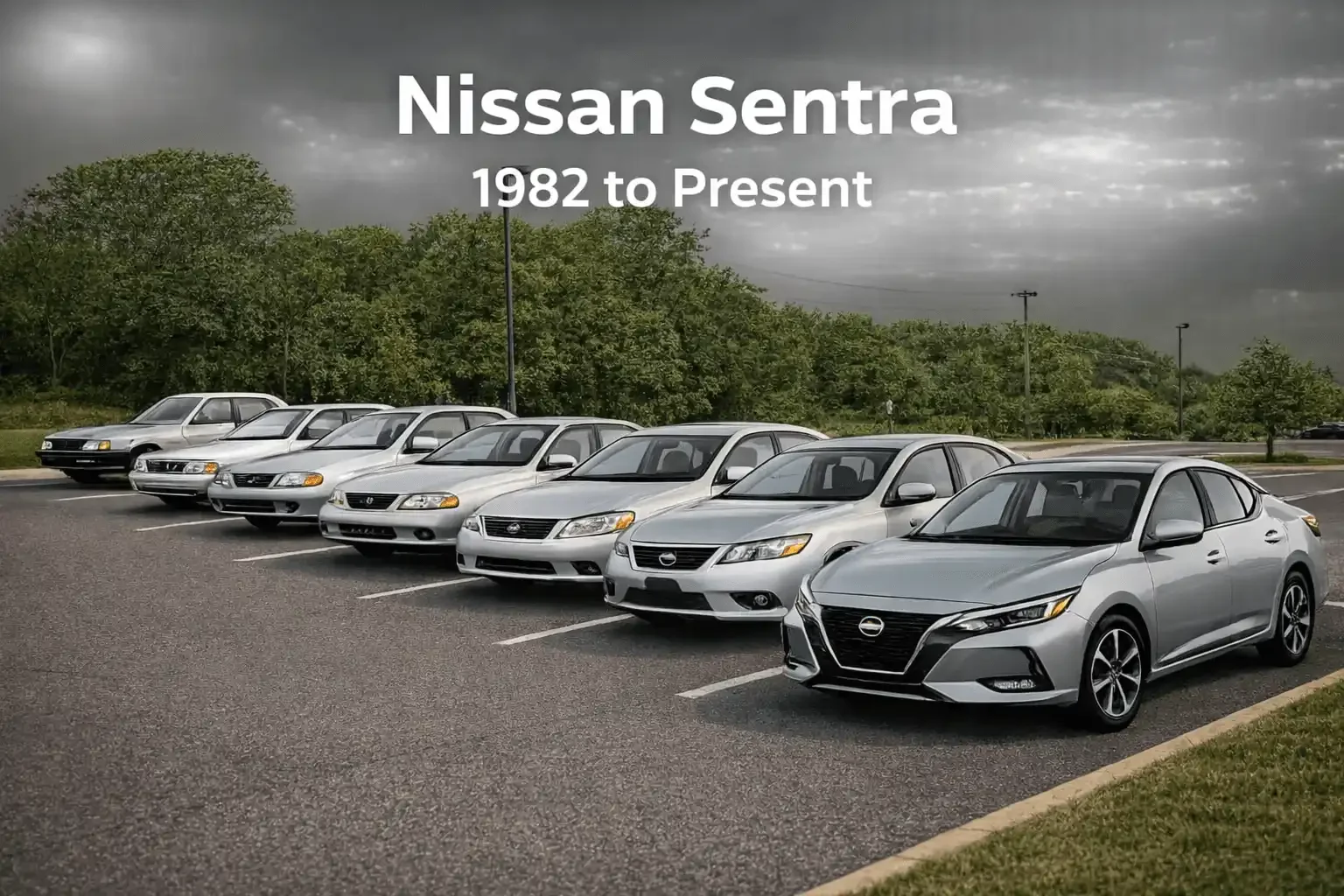
This is a single, practical summary of your Sentra year, trim, fuel, engine designation, body type, and door data, organized by generation. Use it as a platform guide for catalog rules, listing accuracy, and fitment breakpoints.
Generation map
The short rule that prevents most wrong orders
Start every Sentra fitment decision with three questions:
What generation is it (B11 to B19)
What engine designation is on the vehicle
What body type and doors does it have
If you skip any of these, you get “almost fits” returns, especially on exterior, lighting, mounts, cooling, brakes, and driveline.
1st Generation B11 (1982 to 1986)
What your data shows
Body types and doors
Sedan: 2 door and 4 door
Hatchback: 2 door
Wagon: 4 door
Fuel types
Gas
Diesel (CD17 appears starting 1983)
Engine designations by year
1982: E15S (gas)
1983: E15S and E16 (gas), plus CD17 (diesel)
1984 to 1985: E16 (gas), plus CD17 (diesel)
1986: E16S (gas), plus CD17 (diesel)
Submodels present
Base, DX, SE, XE (varies by year)
Fitment notes for B11
1982 is a clean break because it is heavily E15S.
1983 is mixed and needs engine enforcement because E15S and E16 both appear.
Diesel CD17 exists across multiple body types, so diesel must be treated as its own track for underhood, cooling, exhaust, and mounts.
Body type drives exterior. Hatch and wagon parts are not casual swaps with sedans.
2nd Generation B12 (1987 to 1990)
What your data shows
Body types and doors
Sedan: 2 door and 4 door
Hatchback: 2 door
Wagon: 4 door
Coupe: 2 door
Fuel types
Gas dominates
Diesel CD17 appears in early B12 data, notably 1987
Engine designations by year
1987: E16I and E16S (gas), plus CD17 (diesel)
1988: E16I (gas)
1989: GA16I (gas)
1990: GA16I (gas), and a specific 4x4 wagon entry appears
Submodels present
Base, E, GXE, SE, XE, plus a 4x4 wagon entry for 1990
Fitment notes for B12
1987 is a mixed year in your data, both E16I and E16S exist, plus diesel. Engine selection is mandatory.
1989 to 1990 introduces GA16I, which is a hard underhood split from the earlier E16 family.
Wagon fitment needs extra care, and the 4x4 wagon listing in 1990 should be treated as a separate driveline track when you build suspension, axle, and rear component logic.
Coupe vs sedan matters for exterior and many interior pieces.
3rd Generation B13 (1991 to 1994)
What your data shows
Body types and doors
Sedan: 2 door and 4 door entries are present in the data
Fuel types
Gas
Engine designations
GA16DE is the main engine across trims
SR20DE appears under SE-R
Submodels present
Classic, E, GXE, SE, SE-R, XE, Limited Edition
Fitment notes for B13
SE-R is the primary performance split. Treat SR20DE as a separate bucket for cooling, exhaust, mounts, driveline, and brakes.
GA16DE dominates the base lineup, so most wrong orders come from mixing SE-R parts into GA16DE cars or skipping door count on body related items.
4th Generation B14 (1995 to 1999)
What your data shows
Body types and doors
Sedan: 4 door only in your data
Fuel types
Gas
Engine designations
GA16DE is the base engine
SR20DE appears in performance oriented trims, including GSS and SE
Submodels present
Base, GLE, GXE, GST, GSX, GSS, SE, XE
Fitment notes for B14
This generation is clean on body style in your data, but not clean on engine.
SR20DE trims must be isolated from GA16DE for underhood and driveline categories.
Because everything is sedan 4 door in your dataset, most of your exterior fitment risk is engine and trim related, not body style.
5th Generation B15 (2000 to 2006)
What your data shows
Body types and doors
Sedan: 4 door
Fuel types
Gas
Engine designations
2000 shows a transition year with GA16DE and SR20DE still present, and QG18DE appearing on GXE and XE.
2001 to 2006: QG18DE dominates most trims.
2002 to 2006: QR25DE appears for SE-R and SE-R Spec V.
2004 has both S with QG18DE and S with QR25DE in your data, so submodel alone is not enough.
Submodels present
CA, GXE, GXE Sport, XE, SE, SE-R, SE-R Spec V, LE, Limited Edition, S, Base
Fitment notes for B15
Treat 2000 to 2001 as a transition period in your data because engine designations vary more.
2002 and newer introduces the performance track: QR25DE for SE-R and SE-R Spec V. Do not mix this with QG18DE underhood parts.
Because 2004 includes S with different engines, you must enforce engine designation, not just trim name.
6th Generation B16 (2007 to 2012)
What your data shows
Body types and doors
Sedan: 4 door
Fuel types
Gas
Engine designations
MR20DE is the standard engine across most trims
QR25DE is used for SE-R and SE-R Spec V
Submodels present
Base, S, SL, SR, Custom, Emotion, Premium, Luxury, Elite, SE-R, SE-R Spec V
Fitment notes for B16
This generation is a clean two track system in your data: MR20DE vs QR25DE.
Most wrong orders happen when listings do not force trim selection for SE-R and Spec V and do not force engine selection for mechanical parts.
7th Generation B17 (2013 to 2019)
What your data shows
Body types and doors
Sedan: 4 door
Fuel types
Gas
Engine designations
MRA8DE is the base engine across most trims
MR16DDT appears for SR Turbo and Nismo (2017 to 2019 in your data)
Submodels present
S, SV, SR, SL, Sense, Advance, Exclusive, FE+S, FE+SV, plus SR Turbo and Nismo later
Fitment notes for B17
Turbo trims must be separated. MR16DDT should be its own underhood, cooling, intake, exhaust, and mount bucket.
Even within MRA8DE cars, trim and equipment create the real return traps on exterior, lighting, mirrors, and electronics.
8th Generation B18 (2020 to 2025)
What your data shows
Body types and doors
Sedan: 4 door
Fuel types
Gas
Engine designations
MR20DD across all trims in your data
Submodels present
S, SV, SR, Sense, Advance, Exclusive, S Plus, SR Premium, SR Platinum, SR Midnight Edition
Fitment notes for B18
Engine is consistent, but trim and equipment drive returns.
Your biggest risks are bumper covers, grilles, headlights, mirrors, and any sensor related parts because trims like SR Premium, Platinum, and Midnight often imply equipment differences.
9th Generation B19 (2026 to Present)
How to treat it in a catalog
Even if the model year is clear, new generation fitment is equipment driven. Treat these as required fields:
Trim
Lighting tech
Sensor and camera equipment
Connector and pin confirmation for electrical parts
Because this generation is new, avoid broad universal listings until you have confirmed internal part breaks by trim and equipment.
One paste ready fitment checklist for all Sentra generations
Use this checklist in listings and in internal SOP:
Confirm model year
Confirm generation bucket (B11 to B19)
Confirm engine designation
Confirm fuel type if diesel exists for that generation and year
Confirm body type and doors
Confirm trim and performance track (SE-R, Spec V, Turbo, Nismo where applicable)
For exterior, lighting, mirrors, and electronics: confirm equipment and connectors
Quick engine timeline
1982: E15S
1983 to 1986: E16 and E16S, plus diesel CD17
1987 to 1988: E16I and E16S, plus early diesel
1989 to 1990: GA16I
1991 to 1999: GA16DE, with SR20DE performance trims
2000 to 2006: QG18DE base, QR25DE for SE-R and Spec V, with early carryover engines in 2000
2007 to 2012: MR20DE base, QR25DE for SE-R and Spec V
2013 to 2019: MRA8DE base, MR16DDT for SR Turbo and Nismo
2020 to 2025: MR20DD across trims
2026 to Present: treat as equipment driven until validated splits are confirmed
Disclaimer: This guide is based on publicly available specifications, Nissan press materials, and independent research. Part interchangeability should always be confirmed via VINand OEM part number lookup. Specifications may change without notice. This document does not constitute official Nissan parts catalog data. Visuals and illustrations in this article were generated using AI for representative purposes and may not reflect exact technical schematics.