
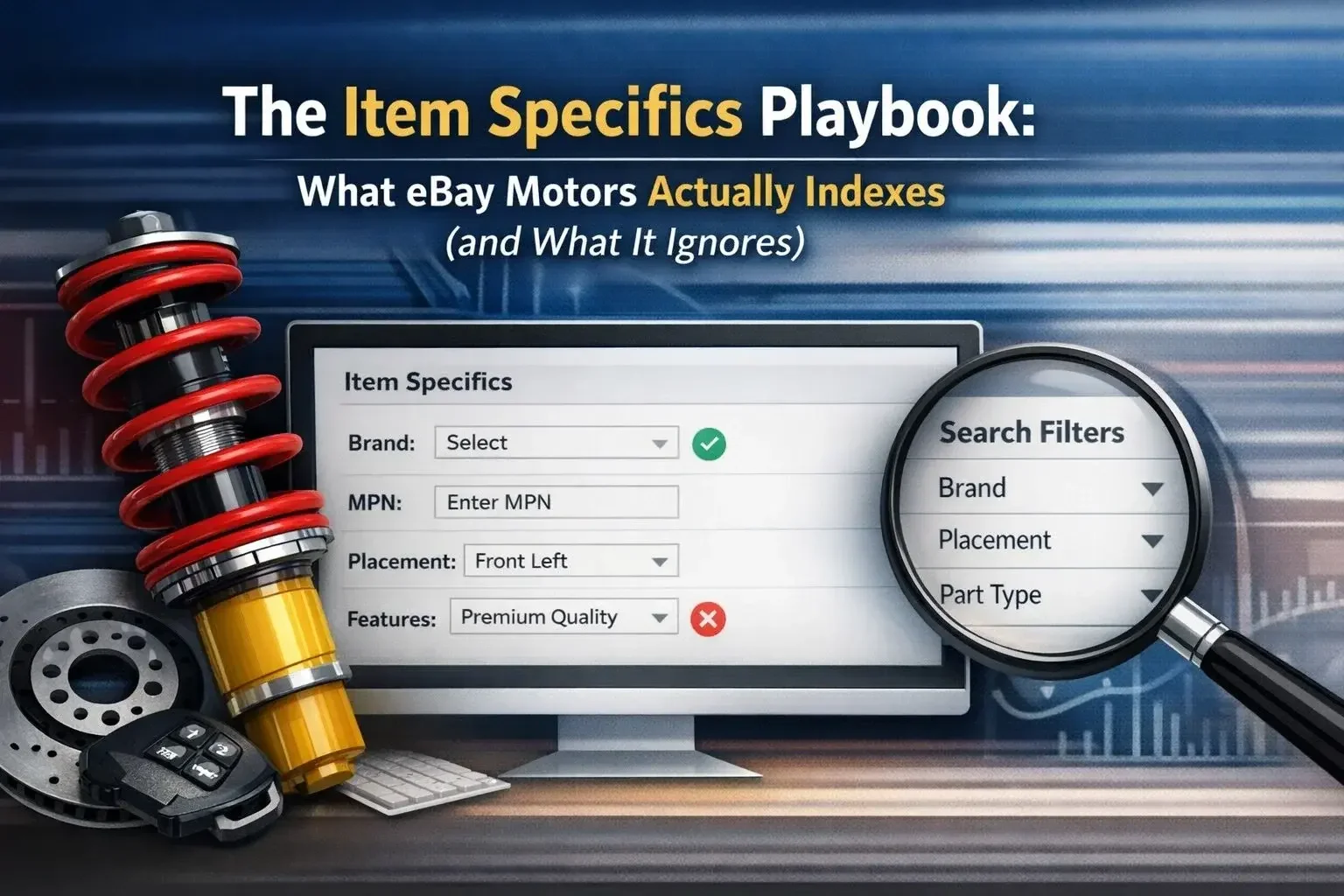
What eBay Motors Actually Indexes (and What It Ignores)
Most sellers treat Item Specifics like optional metadata.
On eBay Motors, they’re not.
Item Specifics are how eBay:
decides which listings appear in filtered search
determines search relevance
builds buyer confidence before a click even happens
If your specifics are incomplete, inconsistent, or filled with noise, eBay has less confidence in your listing - and buyers do too.
This playbook breaks down:
which Item Specifics actually matter
which ones eBay mostly ignores
how to structure specifics so they help ranking and reduce returns
The First Rule: Item Specifics Are a Search Engine, Not a Form
Think of Item Specifics as:
filters buyers actively use
confirmation fields buyers check before buying
signals eBay uses to route traffic
They are not:
a dumping ground for marketing copy
a place to repeat the title
optional fields to fill “later”
If a buyer can filter by it, or uses it to confirm fitment, it matters.
The Item Specifics That Actually Drive Visibility
These are the fields that consistently affect ranking, filtered exposure, and conversion across most Motors categories.
1) Brand
This one is non-negotiable.
Required for most filters
Drives buyer trust
Helps eBay cluster similar listings
Rules:
Use one consistent brand name (no variations)
Avoid stuffing (“Brand: OEM Style Replacement”)
If private label, be consistent everywhere
2) Manufacturer Part Number (MPN)
MPN is one of eBay’s strongest indexing fields.
Used to group identical items
Impacts relevance and comparability
Reduces buyer confusion
Rules:
Always populate when it exists
Use “Does not apply” only when truly necessary
Never invent an MPN
3) Interchange Part Number
This field matters more than many sellers realize.
Helps eBay understand equivalency
Supports buyer cross-checking
Reduces “wrong part” returns
Best practice:
Include OE numbers and major aftermarket cross-refs
Use consistent formatting
Don’t overload with unrelated numbers
4) Part Type
This controls category relevance and filtering.
Common mistakes:
Too generic (“Suspension Part”)
Too creative (“Premium Front Suspension Arm”)
Correct approach:
Use the exact part type buyers expect
Match the category leaf definition
Keep it consistent across similar SKUs
5) Placement on Vehicle
This is one of the highest-impact specifics for Motors.
Always include when applicable:
Front / Rear
Left / Right
Upper / Lower
Inner / Outer
Why it matters:
Buyers filter by it
Wrong placement = instant return
Inconsistency kills trust
Use one naming standard everywhere (example: Front Left, not “Left, Front” sometimes).
6) Fitment Type
When applicable, this helps eBay and buyers instantly classify risk.
Direct Fit vs Universal Fit
Mislabeling this creates wrong expectations and returns.
The Item Specifics eBay Mostly Ignores (or Buyers Don’t Use)
These fields rarely help ranking and often add noise:
Marketing adjectives (“Premium”, “High Quality”)
Redundant repeats of the title
Vague feature lists with no buyer meaning
Fields filled inconsistently across SKUs
If a field:
isn’t filterable
isn’t used to confirm fitment
doesn’t reduce buyer uncertainty
…it’s probably low impact.
Consistency Beats Completeness
A listing with 15 consistent, meaningful specifics will outperform one with 40 messy ones.
eBay rewards:
consistency across similar listings
clean values (not variations of the same phrase)
predictable structure
This is why category-level standardization matters more than SKU-by-SKU perfection.
The “Must-Have Specifics Pack” (Use This Everywhere)
Before a listing goes live, confirm these are filled correctly:
Brand
MPN
Interchange Part Number
Part Type
Placement on Vehicle
Fitment Type
Quantity / Included Items
Manufacturer Warranty
If these are clean and consistent, you’ve done 80% of the work.
If you’re preparing to scale on eBay Motors, I can review your Item Specifics standards and build a simple category-specific required fields pack your team can apply consistently. Contact me for a free review.