
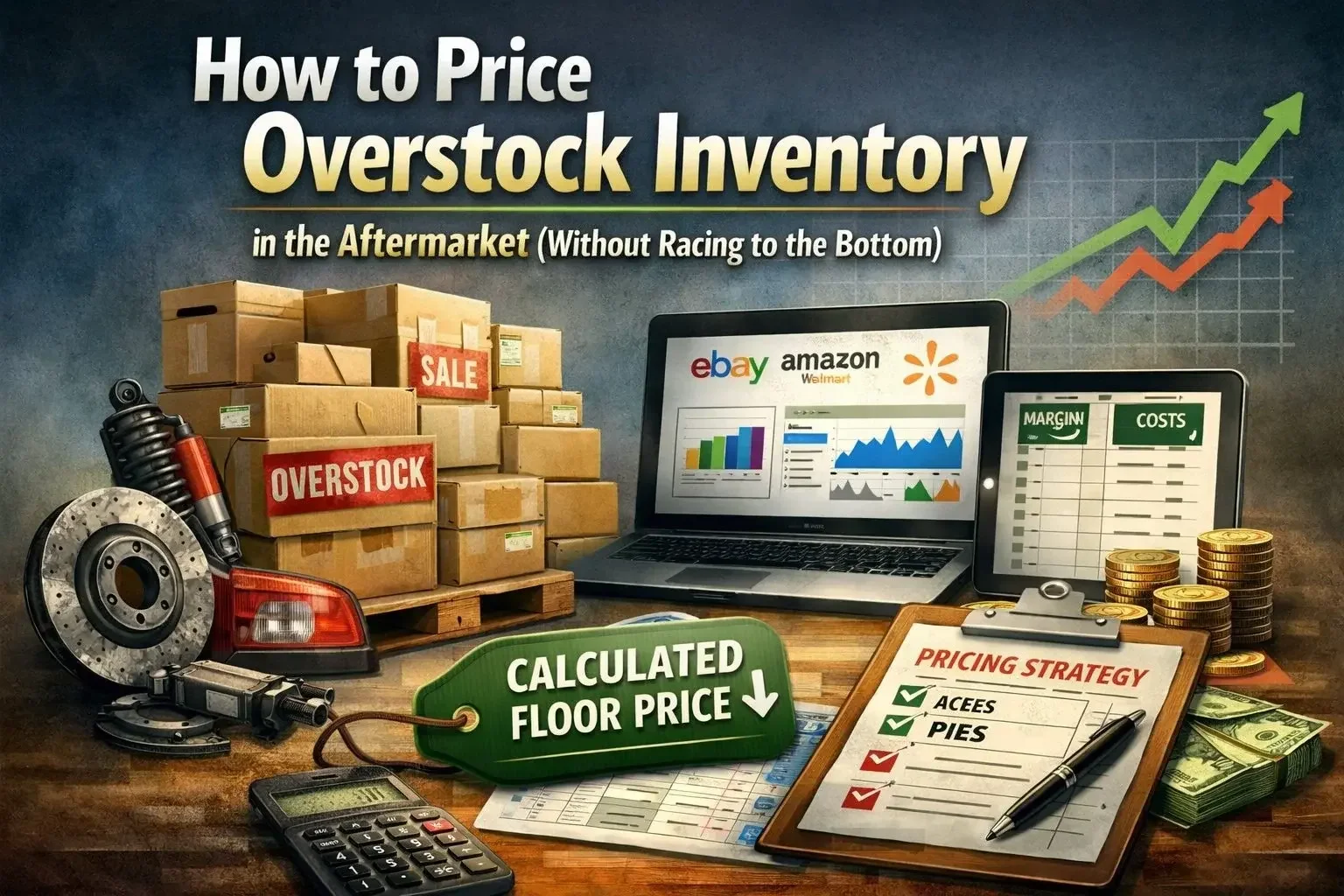
Price Overstock Inventory in the Aftermarket (Without Racing to the Bottom)
Overstock is not just “too much inventory.” In the automotive aftermarket, overstock is usually a symptom.
Sometimes it’s a buying mistake. Sometimes it’s a forecasting miss. But a lot of the time, it’s something uglier and more expensive:
A catalog problem (wrong fitment, wrong attributes, wrong interchange)
A channel problem (you’re priced right for your site… wrong for eBay/Amazon/Walmart)
A conversion problem (the listing is technically live, but practically invisible)
A returns problem (you’re selling it… and getting it all back)
If you price overstock the lazy way-slash prices until it moves-you’ll create new problems: MAP issues, brand damage, marketplace suppression, or negative unit economics that burn cash faster than storage ever did.
Here’s the playbook I use when I’m brought in for aftermarket inventory pricing consulting: a simple framework that works whether you sell on eBay Motors, Amazon, Walmart, Shopify, or your own site.
The two goals that matter: cash + contribution
When inventory is overstocked, your job is to balance two things:
Cash recovery (free up dollars and space)
Contribution margin (don’t lose money “moving” product)
Profit is great. But with aged inventory, the real enemy is pretending you’re profitable while the business leaks through fees, shipping subsidies, and returns.
Overstock pricing is not “what price can I get?”
It’s “what price can I get in this channel after all variable costs?”
Step 1: Segment the overstock (don’t price everything the same)
Before you touch pricing, split your overstock into buckets. I keep it simple:
A) High-demand, wrong quantity
These can be moved with controlled discounting and better placement.
B) Medium-demand, slow movers
These need promotions, bundles/kits, and channel-specific pricing.
C) Low-demand / dead stock
These require aggressive moves: liquidation lanes, wholesale, or strategic write-down.
D) “Looks like overstock” but it’s actually broken data
Wrong fitment, wrong product type, wrong brand mapping, missing ACES/PIES attributes, poor titles, missing item specifics-these don’t need a price cut. They need a catalog fix.
If you skip segmentation, you’ll discount winners and still won’t move the losers.
Step 2: Build the real floor price (the one finance won’t hate)
Your floor price is not your cost. Your floor price is:
Floor Price = Landed Cost + Variable Costs + Risk Reserve
In aftermarket auto parts, variable costs usually include:
Marketplace fees (eBay/Amazon/Walmart differ a lot)
Payment fees (if applicable)
Pick/pack labor
Packaging materials
Shipping cost (and how much you subsidize)
Return reserve (returns are a pricing input, not a surprise)
Damage/defect allowance (especially for bulky or fragile car part categories)
If you want a clean way to think about it:
Contribution = Selling Price − (Landed Cost + Fees + Fulfillment + Shipping Subsidy + Return Reserve)
If contribution is negative, you’re paying customers to take your overstock. Don’t do that by accident.
Important aftermarket reality:
Two SKUs with the same cost can have completely different floors based on dimensional weight and return rate. Wiper blades don’t behave like bumpers.
Step 3: Pick your channel strategy (not “list everywhere”)
Overstock pricing fails when you use one price across every channel.
Each channel has different fee stacks, customer expectations, and conversion levers:
eBay Motors: price sensitivity is high; titles and fitment data matter; shipping strategy matters a lot
Amazon: you might win with speed/Prime (or lose to fees/returns if you’re not careful)
Walmart: pricing pressure is real; content quality + performance score matters
Your site (Shopify/Squarespace/Custom): more control, but you need traffic and trust
A good overstock plan assigns roles:
One channel is your cash recovery lane
One channel is your margin protection lane
One channel is your long-tail lane (slow but steady)
If everything is “priority,” nothing is.
Step 4: Choose your move plan (price is only one lever)
Here are the four levers that move overstock in auto parts:
Lever 1: Price ladders (controlled, scheduled cuts)
Don’t randomly discount. Create a ladder tied to age buckets:
0-60 days: hold price, fix content, improve placement
61-120 days: light promo (5-10%), test elasticity
121-180 days: meaningful move (10-20%), expand channels
181+ days: exit strategy (bundles, wholesale lane, liquidation)
The point is discipline. Overstock gets worse when teams “try stuff” every week.
Lever 2: Bundles / kits / sets (my favorite lever)
In aftermarket, bundling is a cheat code-when done correctly.
Pair slow mover + fast mover
Create left/right sets where it makes sense
Build service kits (filters + gaskets + small add-ons)
Bundle by job type (front end refresh components)
You’re not just moving units-you’re changing the customer’s comparison set, which protects margin.
Lever 3: Placement and listing quality (catalog fixes beat discounts)
Before you cut price, ask:
Is fitment correct (ACES) and complete?
Are item specifics filled to the max for the marketplace?
Is the title structured for real search terms (“aftermarket”, “auto parts”, make/model/year ranges, key attributes)?
Are images clean, consistent, and category-appropriate?
Is the part typed correctly in the catalog?
I’ve seen “overstock” disappear because the SKU finally became searchable. That’s not pricing. That’s catalog execution.
Lever 4: Suppression / restriction (stop the bleeding)
Some inventory creates more cost than profit when it sells (high return rate, high damage rate, poor fitment confidence).
In those cases, you either:
tighten fitment rules,
restrict channels, or
only sell in bundles with better economics.
Not every sale is a good sale.
Step 5: Fix the root cause (or you’ll recreate the overstock)
If you’re serious, overstock pricing has to connect back to your catalog and buying process.
Common root causes I see in aftermarket operations:
Buying based on supplier “deals” instead of demand signals
Missing / incorrect application data (ACES) driving low conversion
Incorrect attributes (PIES) driving mismatch and returns
Channel pricing not accounting for fee differences
Promotions applied without profit guardrails
No aging policy (inventory just… sits)
A clean catalog and disciplined pricing policy is what stops the overstock machine from reloading.
A quick example (numbers you can actually use)
Let’s say you have an overstock SKU:
Landed cost: $42
Average marketplace fees: 13%
Pick/pack/materials: $3
Shipping cost: $11
You subsidize shipping by $6 (customer pays $5)
Return reserve (based on category history): $4
If you price at $79.99, your contribution is roughly:
Price: 79.99
Fees (13%): −10.40
Landed cost: −42.00
Pick/pack: −3.00
Ship subsidy: −6.00
Return reserve: −4.00
Contribution ≈ $14.59
That’s workable.
If you panic-discount to $59.99:
Fees (13%): −7.80
…same costs…
Contribution ≈ −$5.81
Now you’re losing money per order while celebrating “sell-through.”
This is exactly why overstock inventory pricing needs a real floor price, not vibes.
The Overstock Pricing Checklist (print this)
Segment overstock into demand + data buckets
Verify fitment and attributes (ACES/PIES) before discounting
Compute contribution margin per channel (fees + shipping + returns)
Set floors and guardrails (don’t allow accidental negative contribution)
Assign channel roles (cash lane vs margin lane vs long-tail)
Use price ladders tied to aging, not random discounting
Use bundles/kits/sets to change the comparison set
Fix listing quality (titles, specifics, images) to unlock conversion
Restrict or suppress SKUs that generate costly returns
Feed learnings back into buying and catalog governance
If you want help (the real kind)
If you’re sitting on aged aftermarket inventory and you want a practical, channel-by-channel overstock pricing plan, this is exactly the type of work I do-pricing guardrails, catalog fixes, marketplace execution, and a repeatable playbook your team can run weekly.
If you want me to look at your situation, reach out through PartsAdvisory.com and tell me:
which channels you sell on (eBay/Amazon/Walmart/your site),
your biggest overstock categories,
and what “aged” means in your business (90/180/365+ days).
Need a channel-by-channel overstock pricing plan?
I can build you a simple pricing floor model (fees + ship + returns) and a weekly move plan by age bucket-so you clear inventory without racing to the bottom.
Contact PartsAdvisory →