

The Cost of Silence: When Bad Data Quietly Eats Your Margin
There is a question that rarely makes it onto the quarterly review slide: how much of your marketing budget is actually subsidizing bad product data?
Most ecommerce teams never ask it, because the symptoms look indistinguishable from ordinary performance friction. Traffic is up. Conversion stays flat. Returns creep higher. Customer service queues get longer. The approved response is predictable: cut price, increase ad spend, launch a promotion, test new creative.
That cycle is what we call the cost of silence. It is what happens when a catalog is quietly wrong, incomplete, or inconsistent, and the organization treats it as a marketing problem rather than a data problem. The result is that you pay for the same shopper twice: once to acquire them, and again to convince them that your product actually fits, works, and is the right one.
The Zombie SKU Problem
Before we get into the mechanics, consider a concept that rarely gets named but costs businesses real money every month: the zombie SKU. These are listings that accumulate impressions, rack up ad spend, and generate zero sales. They appear alive in your catalog, but they are commercially dead.
The cause is almost always a missing differentiator. A grille assembly that does not specify "with camera" versus "without camera." A mirror that omits blind spot monitoring compatibility. A headlamp that fails to distinguish LED from halogen. The listing shows up in search results, the shopper clicks, the ad budget gets charged, and then the buyer bounces because the page cannot confirm whether the part actually fits their vehicle. The SKU keeps eating budget while producing nothing. Multiply that by dozens or hundreds of listings across your catalog and the waste becomes significant.
The Hidden Tax on Every Click
After years of working with parts businesses, the same pattern surfaces with remarkable consistency.
Product descriptions lack critical differentiators. Fields that should specify "with camera" versus "without camera," "LED" versus "halogen," "diesel" versus "gas," or "front" versus "rear" are left vague or omitted entirely.
Attribute values are inconsistent. One listing reads "w/," another reads "with," a third leaves the field blank. To a database, these are three different values. To a filter, they are noise.
Fitment data is technically present but practically unhelpful. Coverage is too broad, submodel and engine variants are missing, and critical differentiators like bed length, brake type, or sensor configuration are absent.
Titles are doing the job that attributes should be doing. Instead of structured, filterable data, the business stuffs keywords into the product title and hopes the shopper can parse it.
When any combination of the above is in play, your advertising is still doing its job. It is delivering qualified traffic to the site. But the product detail page is not closing the sale, because it cannot answer the shopper’s most basic question: is this the right part for my vehicle?
The organization then reaches for the familiar toolkit: deeper discounts, free shipping thresholds, flash promotions. These interventions can move short-term numbers. They also condition the business to solve data problems with margin.
Why Price Cuts Are the Most Expensive Form of Data Quality
A site-wide discount feels measurable and fast, which is precisely why it gets approved. It is also a blunt instrument with consequences that compound quickly.
Consider the math: a business operating at 35% gross margin that runs a 20% discount has not reduced profit by 20%. It has surrendered more than half of the gross margin dollars on every affected order, often more once freight, handling, and return costs are factored in.
That margin did not evaporate because the product was overpriced. It evaporated because the shopper was not confident, and the business chose to buy confidence with a lower price instead of building it with better data.
Confidence comes from clarity. Clarity comes from attributes. When the right attributes are present, visible, and consistent, the shopper can self-select the correct part without needing a discount as a safety net.
Diagnosing the "High Traffic, Low Conversion" Pattern
When a client reports strong traffic but weak conversion, the diagnostic does not start with the ad account. It starts with five questions: Are shoppers running multiple searches or repeatedly adjusting filters before clicking? Are visitors landing on product pages and leaving without adding to cart? Are shoppers toggling between nearly identical SKUs, unable to distinguish them? Is the team fielding a disproportionate number of "does this fit my car" inquiries? Are certain product categories generating significantly higher return and cancellation rates?
If the answer to several of these is yes, the business is looking at an attribute problem, not an acquisition problem. Marketing has done its job. The catalog is failing to finish it. Every incremental ad dollar spent in that environment is funding the confusion that the product data created.
Proof Point: One Attribute Can Outperform a 20% Discount
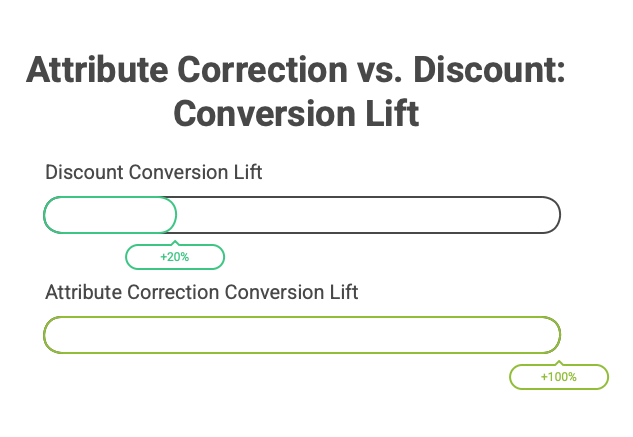
This is the finding that tends to shift the conversation: in many cases, adding or correcting a single critical attribute delivers a larger conversion lift than a significant price reduction. The reason is straightforward. The discount addresses a symptom (hesitation), while the attribute eliminates the root cause (doubt).
The fixes that move the needle fastest tend to follow a common pattern. On sensors and grille components, it is "with adaptive cruise" versus "without adaptive cruise." On headlamps, it is "LED" versus "halogen." On mirrors, it is "with blind spot monitoring" versus "without." On brakes, shocks, and hubs, it is simply "front" versus "rear." On intake, cooling, and gasket components, it is "turbo" versus "non-turbo." On drivetrain parts, it is "AWD" versus "FWD" when the same model name hides major mechanical differences.
The truck segment deserves its own mention here, because the landmines are especially costly. Bed length and cab configuration are well-known differentiators, but two others cause disproportionate damage: wheelbase and fifth wheel prep package. A wrong part shipped on a heavy truck component is not just a return, it is often a $200-plus shipping error in both directions. When the listing fails to capture wheelbase or fifth wheel prep status, those errors become a recurring line item.
On engine-specific parts, the classic fitment landmine remains the engine code or emissions variant when two engines exist in the same model year. These are the errors that generate the most frustrated customer service calls and the most expensive returns.
When the correct attribute is added and made filterable, consistent, and visible on the product detail page, three outcomes follow quickly. Shoppers self-select accurately. Comparison behavior becomes productive rather than circular. Customer service contacts and returns begin to decline. That is conversion improvement, margin protection, and operating cost reduction from a single data change, with no promotional spend required.
The Financial Model Nobody Puts on the Slide
The damage from incomplete data extends well beyond the conversion rate metric. It surfaces across every function that touches the customer journey, but because each team only sees their own slice, the total cost is rarely calculated.
In paid media, it shows up as higher CPCs, lower ROAS, and escalating spend required to maintain flat revenue. In returns, it manifests as "didn’t fit" claims that are expensive, predictable, and almost entirely preventable. In customer service, it drives higher contacts per order, longer handle times, and lower satisfaction scores. On marketplaces, it produces suppressed listings, fitment mismatches, and elevated defect rates. In inventory management, incorrect listings move the wrong SKUs, creating demand distortion that the business then chases with pricing. And in brand trust, the customer who received the wrong part simply does not come back for a second order.
Marketing sees declining ROAS. Merchandising sees flat conversion. Operations sees rising return rates. Customer service sees escalating call volume. Each team optimizes their own metric in isolation. Nobody totals the bill. That is the silence.
The Strategic Fix: Treat Attributes Like Revenue Infrastructure
If the goal is to break the cycle permanently rather than patch it quarterly, the approach requires six structural changes.
First, identify your "money attributes." Not every attribute carries equal weight. In most auto parts categories, 5 to 15 attributes explain the vast majority of "wrong part" outcomes. These are the ones that determine selection, and they should be treated accordingly.
Second, make those attributes mandatory. Not recommended. Not "nice to have." Mandatory. If a value is unknown, it should be flagged, routed, and resolved before the listing goes live. An unknown attribute value is not neutral. It becomes a return.
Third, normalize every value. If "w/" and "with" and "yes" all represent the same attribute state, your filters are producing noise instead of clarity. Standardize the values so that every filter, every search result, and every marketplace feed speaks the same language.
Fourth, surface data where shoppers decide. Attributes need to be visible in four places: search results for quick orientation, filters for self-selection, product detail pages for final confidence, and data feeds for marketplace matching. If the attribute exists in the database but is not surfaced to the buyer, it is not doing its job.
Fifth, measure the right KPIs. The metrics that reveal the true cost of data quality are conversion rate by attribute completeness, return rate by attribute completeness, and support contacts per order by attribute completeness. Once leadership sees those curves plotted side by side, the business case for "band-aid discounts" collapses.
Sixth, build continuous auditing into the process. Product data is not a one-time project. New model years introduce new variants. Manufacturers update part numbers. Fitment databases evolve. A catalog that was clean six months ago can quietly drift back into inaccuracy if there is no recurring audit cycle in place. Treat data quality the way you treat inventory counts: schedule it, assign ownership, and measure compliance. The businesses that build this discipline into their operations do not find themselves back in the same cycle twelve months later.
The Real Question
If your business is experiencing high traffic and low conversion, the instinct to scrutinize the ad account is understandable. But before adjusting bids, testing new creative, or approving another promotion, look at the catalog.
The cost of silence is not theoretical. It is a line-item reality, compounding every day that the business continues buying traffic to a product catalog that cannot answer basic buyer questions. The fix is not more spend. The fix is better data.
Ready for a Fast Diagnostic?
Pick one high-volume category and we’ll identify the missing attributes that are blocking
buyer confidence, then prioritize the fixes that move conversion without sacrificing margin.