
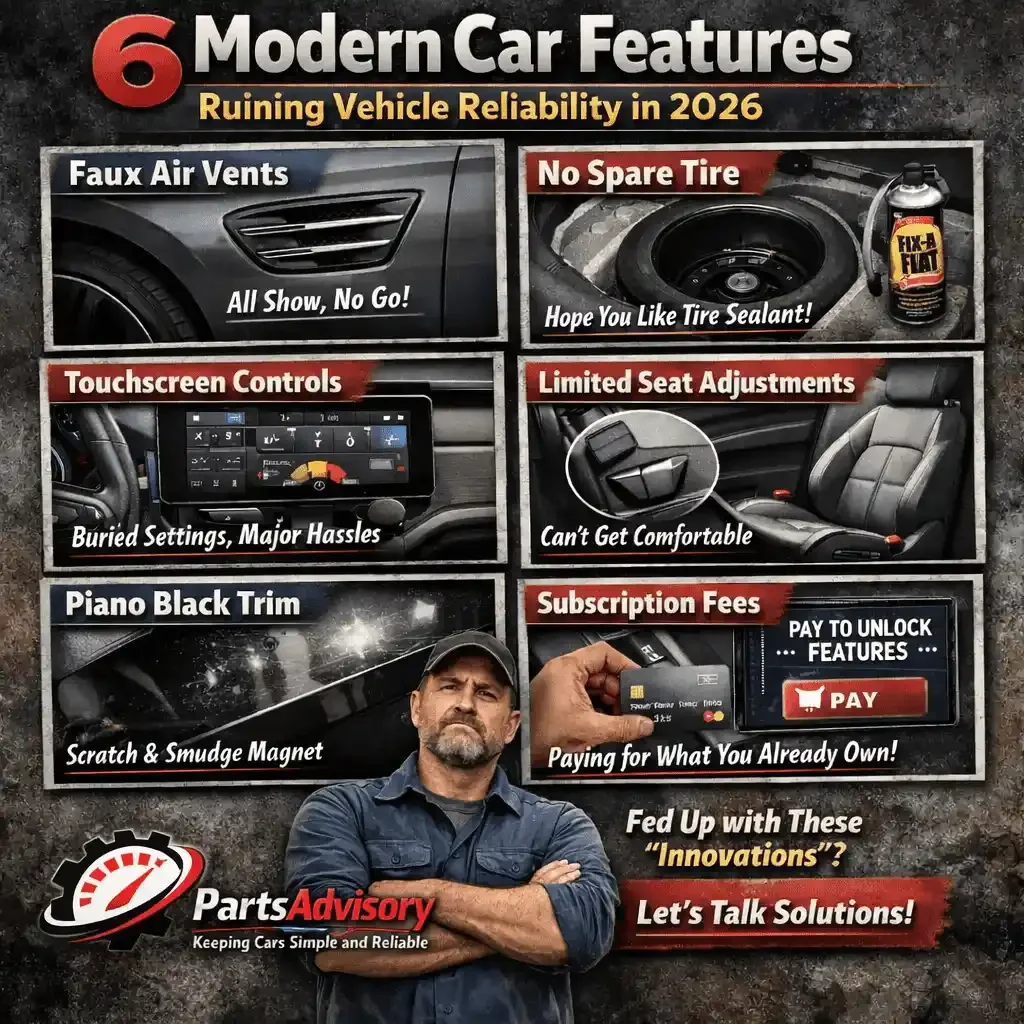
I’ve been under the hood for decades, and these 2026 car trends are making me scratch my head.
After decades of wrenching on cars, advising owners, and watching the industry evolve, I’ve seen the best and worst of what automakers have to offer. Today’s vehicles are engineering marvels, packed with safety tech, convenience features, and powertrains that would’ve seemed like science fiction twenty years ago. But somewhere along the way, a handful of decisions crept into production that make those of us who actually live with these machines scratch our heads. We at PartsAdvisory put together a list of modern car features that, frankly, have no business existing in 2026.
Faux Air Vents
Let me be blunt: fake air vents are an insult to anyone who knows what a functional aerodynamic element looks like. Whether they’re stamped into a bumper or glued onto a fender, they cheapen the entire design of the car. Worse, when they’re bolted onto sheet metal, you’ve just introduced another potential rust entry point for absolutely zero functional benefit.
What really gets me are the ones positioned to suggest brake cooling ducts. You’ve already committed to the tooling for that trim piece, so would it really have cost more to punch actual holes and route some air? If anything, you’d be using less material. It’s all show and no go, and anyone with a trained eye sees right through it.
Honorable mention: exhaust tip cutouts that don’t connect to any actual exhaust piping. That’s not styling, that’s deception.
Fix-a-Flat Kits Instead of Spare Tires
This one is pure cost-cutting dressed up as innovation, and everyone in the industry knows it. Dropping the spare tire saves manufacturers money on the tire, the jack, and the cargo space engineering, but it leaves the owner stranded with a can of sealant and a prayer.
I’ve been in the business long enough to know what happens in practice: most of those kits end up collecting dust in a garage, replaced by an actual spare that the owner bought out of pocket. Ask yourself honestly, do you want to be crouched on the shoulder of I-10 outside Phoenix in July, squinting at the instructions on a can of fix-a-flat for the first time? A compact spare weighs next to nothing relative to the peace of mind it provides. This was never a smart trade-off.
Honorable mention: the shredded sidewall scenario. If you’ve ever seen a tire that blew out at highway speed, you know no sealant kit on earth is saving that. You needed a spare, full stop.
Burying Controls in the Infotainment System
Here’s the irony that drives me crazy: the same manufacturers who plaster their owner’s manuals with warnings about distracted driving are the ones burying critical controls five menu layers deep in a touchscreen. Climate controls, heated seats, drive modes, all functions you should be able to adjust by feel without ever taking your eyes off the road, now require navigating a glowing slab of glass that’s barely within arm’s reach.
Not every manufacturer does this, and credit to the ones that still give you proper knobs and switches for the essentials. But the brands that went all-in on screen-only interfaces did it to project a “tech-forward” image, not because it’s better for the driver. And here’s the kicker: when that touchscreen glitches (and they do), you’re stuck at whatever temperature, fan speed, or setting it froze on. A physical knob doesn’t crash. In my experience, tactile controls for HVAC and volume are non-negotiable.
Inadequate Seat Adjustments
Cars are bigger than ever. Today’s compacts are the size of yesterday’s midsize sedans, and that growth is largely driven by crash safety regulations, which is understandable. But here’s what doesn’t make sense: you’ll equip a vehicle with rear cross-traffic alerts, automatic emergency braking, and a dozen parking sensors, yet skimp on the seat adjustment range that actually lets the driver see and reach properly.
Proper seat adjustment isn’t a luxury, it’s a safety fundamental. It directly affects your field of vision, your ability to operate the pedals correctly, and your fatigue level on long drives. The hardware costs a fraction of a single sensor module. People come in different shapes and sizes. Two words: body proportions. You can preach ideal driving position all day long, but if the seat won’t get the driver there, none of that advice matters.
Piano Black Trim
I’ve lost count of how many owners and journalists have voiced this complaint, and the industry still hasn’t gotten the message. Piano black trim looks stunning on the showroom floor for about ten minutes. In the real world, it’s a magnet for fingerprints, dust, and micro-scratches that turn a sleek surface into an eyesore within months.
Here’s what most people don’t realize: piano black isn’t a premium material. It’s cheap plastic with a glossy clear coat, and manufacturers love it because it’s far easier and less expensive to mold than textured surfaces, brushed aluminum, or real wood veneer. It looks like luxury on the lot, but it’s actually a cost-saving measure dressed up as a design choice. That’s the part that stings. You’re not getting a premium finish. You’re getting the cheapest surface that photographs well.
Whether it’s on the center console, the B-pillar, or the grille surround, this finish simply does not hold up to daily use. Sure, you can protect it with paint protection film, but that’s an added expense the owner shouldn’t have to bear, especially if they’re leasing. Of all the trim materials available to designers, piano black is objectively the worst performer in real-world conditions.
Honorable mention: chrome trim in high-touch areas. Slightly more durable, but still a fingerprint magnet.
Cylinder Deactivation
On paper, cylinder deactivation is elegant engineering: shut down half the cylinders under light load, save fuel, and the driver barely notices. In practice? It’s been one of the most problematic technologies to roll out across the industry.
Nearly every manufacturer that’s implemented some form of cylinder deactivation has dealt with reliability issues, some severe enough to trigger class-action lawsuits. Honda’s legendary J35 V6, one of the most dependable engines ever built, developed well-documented problems once Variable Cylinder Management was added. That should tell you something.
Even the best implementations (Volkswagen’s Active Cylinder Management comes to mind) carry trade-offs: costlier maintenance, uneven wear on the cylinders that repeatedly deactivate, and increased NVH that erodes refinement. This technology exists primarily to meet EPA targets, and I’d argue there are far better paths to fuel efficiency that don’t compromise long-term durability. Miller and Atkinson cycle engines, improved transmissions, mild hybridization, the alternatives are proven and less risky.
Subscription-Locked Features
Since we’re talking about features that have no business existing in 2026, we’d be negligent not to mention the elephant in the room: paying a monthly fee to unlock hardware that’s already installed in your car. The heated seats are physically in the chair you’re sitting on. The performance chip is already wired into the ECU. But the software says no until you swipe your credit card, again, every single month.
BMW drew massive backlash for subscription-gating heated seats in certain markets, and Mercedes tested the waters with an “acceleration increase” package that charged owners to unlock performance their engine was already capable of delivering. Let that sink in. You paid for the car. The hardware is there. And now you’re renting access to it.
This isn’t innovation, it’s monetization of ownership. And if the industry keeps pushing it, we’re heading toward a future where the car in your driveway is only as capable as your subscription tier allows. That’s a line that, once crossed, is very hard to walk back.
The Bottom Line
None of these features exist in a vacuum. Each one adds cost to the vehicle, cost that gets passed to you, the buyer, and that cost doesn’t always translate to genuine value. Some of you will agree with every point here; others might think I’m being too hard on the industry. That’s fair. But after years of living with, repairing, and advising on these machines, I can tell you this much: the best car features are the ones you never have to think about because they just work. The ones on this list? They make you think, and not in a good way.
Your Turn
I’ve given you my top seven, but I know I missed some. Is it the gear-shifter buttons?
The auto start-stop that jerks the whole car? Drop a comment below and tell me which “modern” feature makes you want to sell your car.
If any of these features are making your catalog builds harder or creating returns, let us know.
We’ll help you catalog the right parts and skip the headaches.