
7 Marketplace Levers That Drive Auto Parts Sales
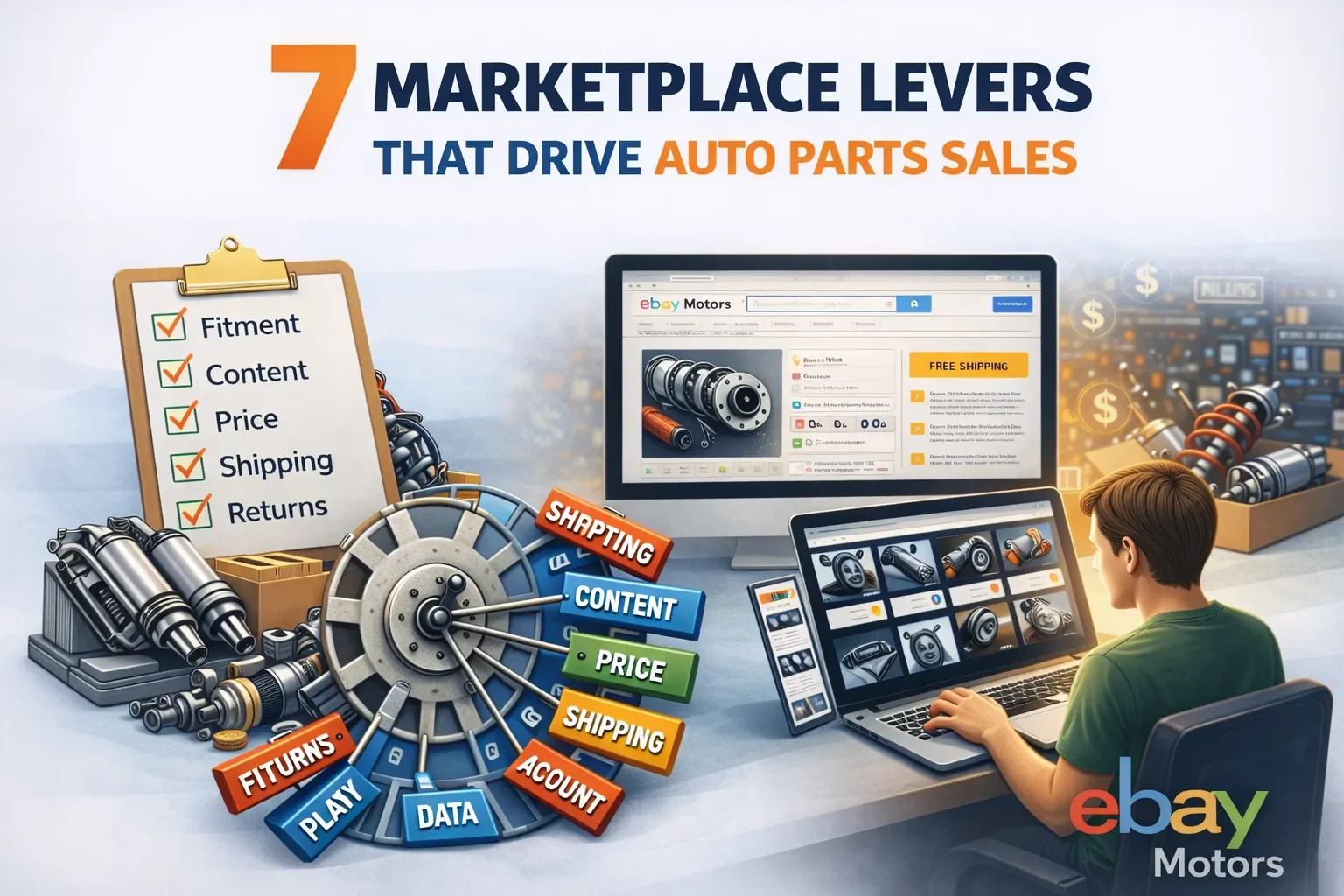
Marketplaces don’t reward the “best product.” They reward the most reliable listing.
That reliability is a mix of: fitment confidence, content quality, price competitiveness, in-stock reality, shipping speed, return rates, and account health. When those inputs are strong, the platform gives you more visibility. When they’re weak, you get suppressed-sometimes without any obvious warning.
Below are seven levers you can actually control. Pull the right ones and you don’t just sell more-you sell with fewer returns, fewer defects, and better margin.
Lever 1) Fitment Accuracy (Sales + Profit)
Fitment is the fastest way to lose money on marketplaces-and the fastest way to build trust.
If your catalog fitment is wrong (or incomplete), the customer experience looks like this:
buyer orders confidently
part doesn’t fit
return + negative feedback
your defect metrics climb
listings lose ranking or get throttled
What good looks like:
fitment is precise enough to prevent “almost fits” (engine/submodel/position where needed)
kit/set fitments match the bundle logic (not just each component)
notes are used to clarify edge cases (ex: “without tow package”, “with sport suspension”)
Quick win: start by auditing your top 100 SKUs by sales and your top 50 SKUs by returns. Fixing fitment on those alone usually moves the needle more than adding 10,000 new SKUs.
Lever 2) Listing Content That Converts (and Prevents Returns)
Marketplaces rank listings partly by conversion, and conversion depends on clarity.
Auto parts content has two jobs:
Get the click (title + main image + price)
Prevent the return (bullets + specs + fitment notes + images)
Minimum content that actually matters:
Title structure: Part Type + Key qualifier + Position/Side + Make/Model/Years (if platform allows)
Bullets: what it fits, what it includes, what it replaces, what it doesn’t fit
Attributes/specs: material, finish, connector type, dimensions, interchange numbers
Images: clean hero + angle shots + connector close-up + what’s included (for kits)
Quick win: add a single bullet called “Fitment Notes” and put the 1-2 most common “gotchas” that drive returns.
Lever 3) Item Specifics That Actually Rank
On eBay Motors, Item Specifics are your second SEO engine (after title). They drive:
search visibility
filter inclusion
buyer confidence
lower “doesn’t fit” returns
What good looks like:
Part Type / Placement on Vehicle / Brand / Manufacturer Part Number (MPN) / Interchange
Material, Finish/Color (where relevant)
Quantity, Included Components (especially for sets/kits)
Fitment notes when the platform supports it
Quick win: take your top SKUs and make sure Placement on Vehicle and Interchange Part Number are filled consistently. Those two alone improve filter exposure and reduce confusion.
Lever 4) Fitment Mapping That’s “Marketplace-Ready”
Many sellers have fitment data, but it’s not structured in a way eBay can use well.
Marketplace-ready fitment means:
correct Year/Make/Model coverage
correct “gates” (engine, submodel, drivetrain, body, position) where needed
no overbroad “fits all trims” claims that trigger returns
Quick win: create a rule:
If the part has left/right, front/rear, or engine-dependent variations → require that attribute before publishing fitment.
That single rule prevents a huge chunk of “wrong part ordered” returns.
Lever 5) Shipping Promise and Handling Time (Visibility Lever)
eBay rewards listings that feel “easy” for buyers:
fast handling time
reliable delivery dates
low cancel rate due to OOS
Even if your price is competitive, slow handling can push you down.
Quick win: don’t guess delivery. Pick one shipping posture and execute:
same-day/1-day handling for your best sellers
realistic handling for long-tail SKUs
separate profiles for drop-ship vs stocked items
Consistency beats optimism.
Lever 6) Return Rate + Defects (The Silent Suppressor)
On eBay, bad metrics don’t just cost money - they cost impressions.
What usually drives returns in auto parts:
fitment ambiguity
missing “what’s included”
low-quality images (buyers misinterpret)
wrong cross reference (MPN/interchange)
Quick win: add a short section in the description or a bullet:
“Before You Buy:” verify trim/engine + placement
And show:connector close-up (electronics)
mounting points (body parts)
what’s included (sets/kits)
This reduces “arrived different than expected” returns.
Lever 7) Scale Strategy: Start With the 20% That Proves the Model
Most marketplace failures come from scaling too early:
too many SKUs
messy variations
thin specifics/content
“publish everything” feeds
The better approach (eBay Motors):
launch the top categories where you can win (images/specs/fitment)
focus on SKUs with stable supply + low return risk
expand only after you’ve validated:
conversion rate
return rate
defect rate
shipping reliability
Quick win: scale by proven vehicles and proven part types, not by “all inventory.”
If you’re selling on eBay Motors and growth feels capped, it’s usually not “demand.” It’s one of these levers holding you back-most often fitment + specifics + shipping promise.
If you want, I can run a quick Marketplace Readiness Audit and tell you the top 10 fixes that will increase visibility and reduce returns-before you spend time adding more SKUs.