
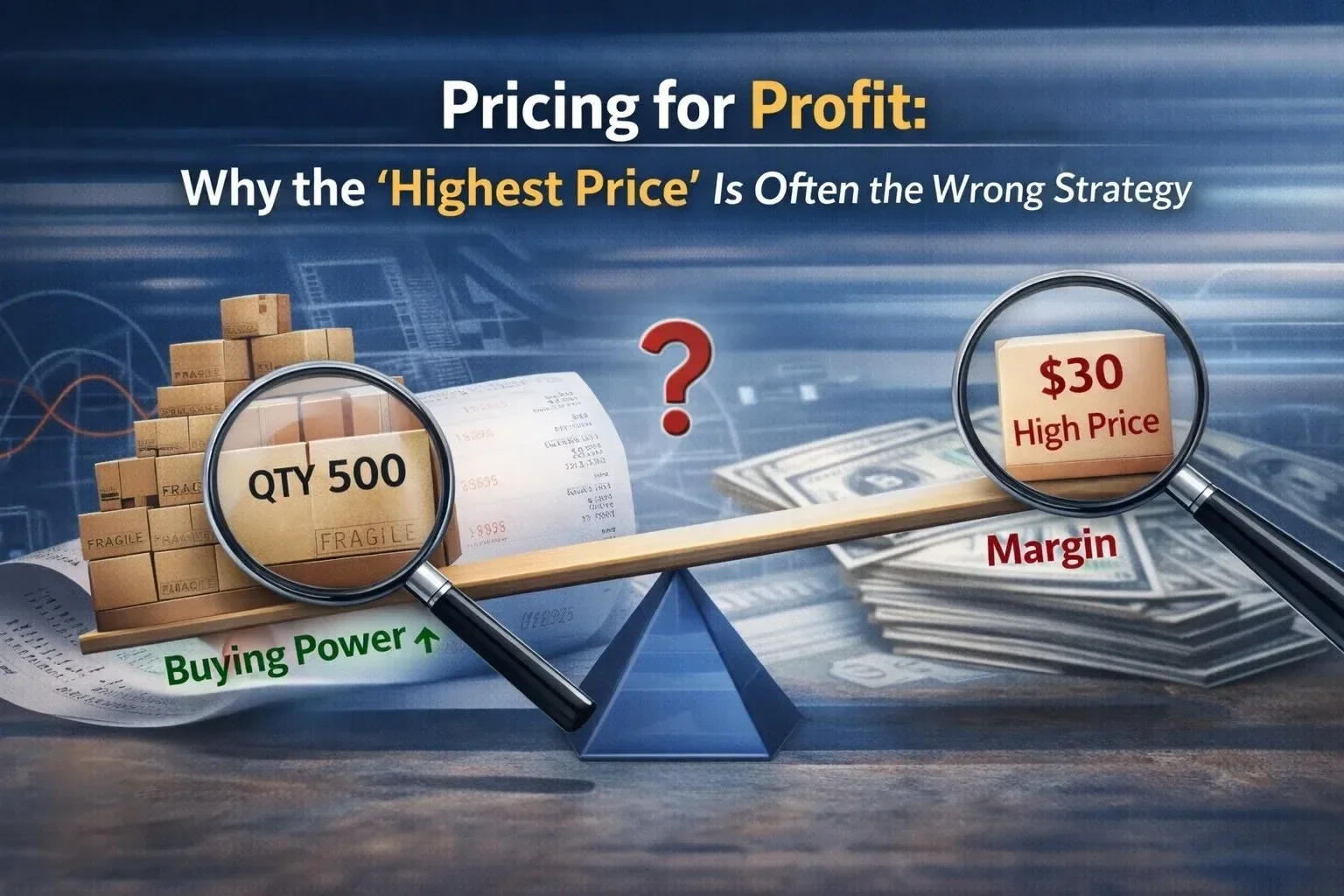
Why the “Highest Price” Is Often the Wrong Strategy
One of the most common pricing questions I hear in aftermarket is deceptively simple:
If a part costs you $1 landed, should you sell a few units at $30 + shipping…
or sell many units at $10 + shipping?
On paper, the $30 sale looks smarter.
In reality, that mindset often caps growth, slows cash flow, and creates hidden risk.
The right answer depends on velocity, operational cost, and marketplace behavior - not just margin per unit.
The Margin Trap: High Price, Low Velocity
Selling a few units at a high price feels safe:
higher margin per unit
fewer orders to manage
lower apparent operational complexity
But here’s what usually happens:
low sales velocity creates weak marketplace signals
impressions decline over time
inventory sits longer → capital is trapped
forecasting becomes unreliable
you’re exposed if demand shifts or competitors enter
High margin doesn’t help if inventory isn’t moving.
Velocity Creates Traffic That Sells Your Other Items
There’s another hidden cost to slow-moving, high-price listings: you lose buyer sessions.
Every click on a marketplace is a chance to:
sell a second SKU
expose the buyer to your brand
drive future repeat purchases
When a listing doesn’t convert-because it’s overpriced, unclear, or uncompetitive-you don’t just lose that sale. You lose the entire visit.
Fast-moving SKUs generate:
more listing views
more store traffic
more algorithmic trust
Over time, those SKUs become traffic engines that lift the rest of your catalog.
Volume Creates Supplier Buying Power (and Better Cost)
Velocity doesn’t just change revenue-it changes who you are to your supplier.
When you go from buying a few units per month to buying hundreds:
your unit cost improves
terms get better
allocation priority increases
replenishment becomes more predictable
That buying power often reduces landed cost over time-meaning you can protect margin while staying competitive.
This is how large aftermarket sellers widen the gap:
they don’t start with the best cost - they earn it through scale.
Velocity Wins on Marketplaces (But Requires Maturity)
Marketplaces like eBay don’t just reward price - they reward momentum.
Listings that sell consistently benefit from:
higher search visibility
stronger conversion history
better trust signals
faster ranking recovery
That said, velocity is not free.
The honest counterpoint: velocity requires operational maturity
Higher volume means:
more picks and packs
more boxes, tape, and labor
more opportunities for damage or error
tighter SLA requirements
If your operations aren’t ready, velocity can expose weaknesses fast.
The answer isn’t avoiding volume - it’s earning volume responsibly by:
standardizing packaging
tightening pick accuracy
automating replenishment
suppressing SKUs that can’t scale cleanly
Velocity rewards sellers who are operationally prepared.
The Real Math Most Sellers Ignore
Let’s simplify with more realistic numbers:
Scenario A: High Price
Cost: $1
Sell price: $30
Units/month: 5
Gross profit: ~$145 (after fees)
Inventory turns: slow
Cash tied up longer
Scenario B: Velocity Pricing
Cost: $1
Sell price: $10
Units/month: 60
Gross profit: ~$300 (after fees)
Inventory turns: fast
Cash recycles quickly
And this still doesn’t include:
traffic lift to other SKUs
algorithmic exposure
bundling opportunities
supplier cost improvements from volume
The lower-priced SKU often builds a stronger, more defensible business.
Cash Conversion Cycle (CCC): The Metric That Actually Matters
What velocity really improves is your Cash Conversion Cycle (CCC):
inventory moves faster
cash returns sooner
capital can be reinvested
Shorter CCC means:
less risk
more flexibility
faster scaling
Many sellers focus on margin per unit while ignoring how long their cash is locked up. That’s a mistake marketplaces punish over time.
Shipping, Fees, and Reality
This isn’t a call to race to the bottom.
You still must account for:
marketplace fees
shipping cost (actual + dimensional)
handling and packaging
return exposure
The goal isn’t the lowest price - it’s the highest sustainable velocity at a healthy margin.
That’s where most pricing strategies break.
When High Price Does Make Sense
Premium pricing is valid when:
parts are unique or hard to source
competition is limited
urgency is high
applications are specialty or B2B
Even then, pricing should be tested, not assumed.
Marketplaces give feedback quickly if you let them.
The Right Question to Ask
Instead of asking:
“How much can I sell this for?”
Ask:
“At what price does this SKU move fast enough to optimize cash flow, visibility, and long-term profit?”
That shift changes pricing, inventory planning, and supplier strategy.
Final Thought
Aftermarket pricing isn’t about extracting the most margin from one order.
It’s about building repeatable velocity with operational discipline, improving your cash conversion cycle, and creating leverage across suppliers, marketplaces, and inventory.
That’s how small SKUs turn into real businesses.
If you want help finding the right pricing and velocity balance, I offer a free SKU-level pricing and velocity review. I’ll look at your cost, sell-through, and marketplace position and tell you where margin or volume is being left on the table.
Contact me to get started.