
3D-Printed Auto Parts On-Demand
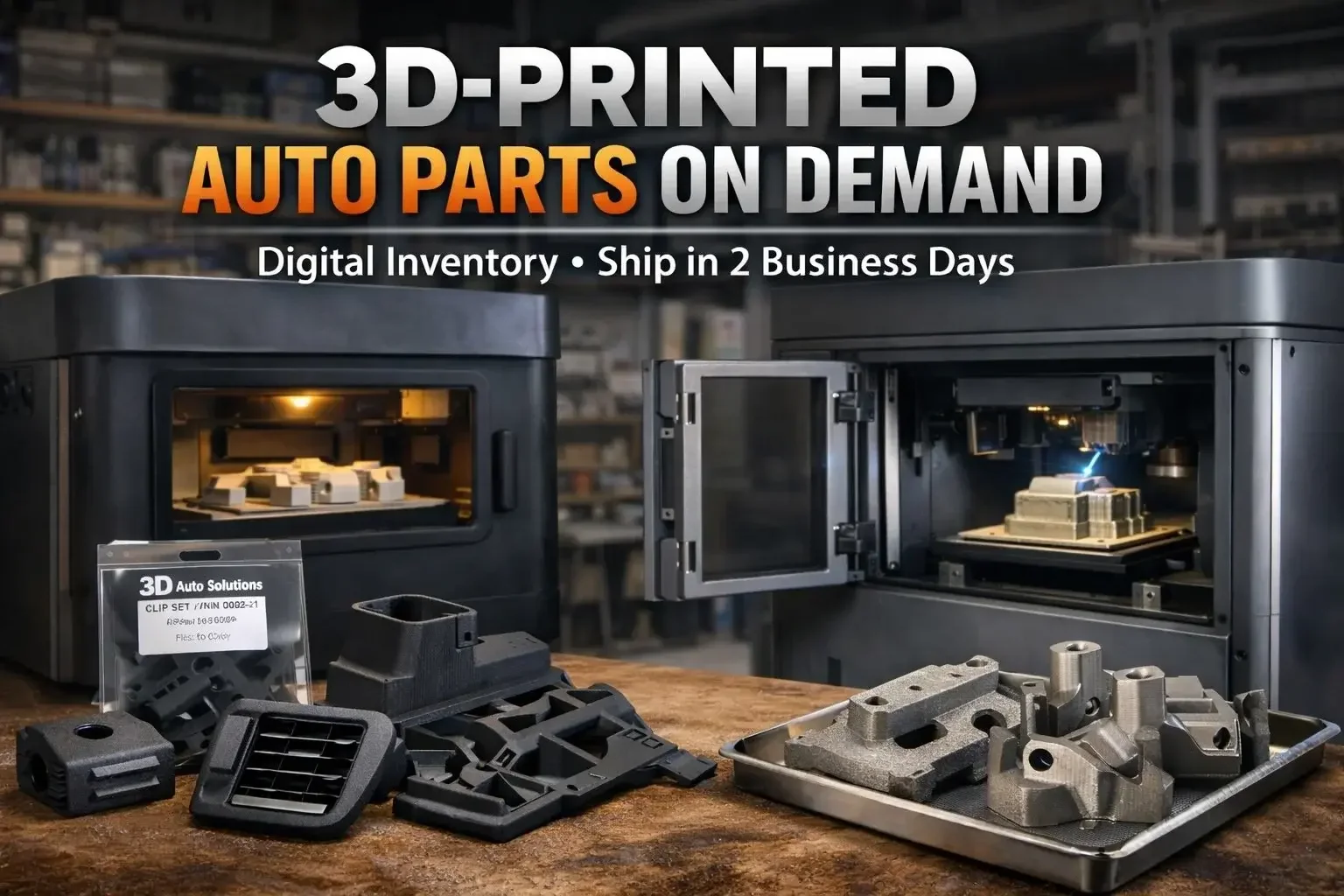
How to Build “Digital Inventory” That Ships in 2 Days (B2C + B2B)
3D printing on-demand sounds like the perfect aftermarket business:
No dead inventory. No tooling. No warehouse full of slow movers.
Just a library of parts that customers can buy today - and you manufacture and ship in the next 48 hours.
That part is real.
But the companies that win aren’t “printing parts.” They’re running a controlled product system: catalog + fitment + QA + capacity + policy.
If you treat this like a fun manufacturing hack, it turns into high returns, customer distrust, marketplace issues, and constant exceptions.
If you treat it like an aftermarket catalog business with digital inventory, it scales.
The business model: Digital inventory (SKU exists, shelf doesn’t)
A print-on-demand part still needs everything a normal SKU needs:
a defined product (spec + quality target)
controlled fitment logic
strong listing content
predictable fulfillment
returns/warranty policy that matches the promise
The only difference is where the inventory lives.
Traditional inventory:
part sits on shelf
ships immediately
Digital inventory:
CAD file + print recipe + QC checklist sits on shelf
raw materials sit on shelf
part is manufactured when ordered
ships within a defined SLA (ex: 2 business days)
This is why print-on-demand in auto parts is not a “printing play.”
It’s a catalog manufacturing play.
Where on-demand 3D printing actually works (and where it doesn’t)
Best categories to start (high ROI, low liability)
Start with non-safety, small, high-annoyance parts:
trim clips and retainers (structured into kits or platform families)
brackets that don’t carry load (wire looms, sensor mounts, interior mounts)
plastic ducts/vents for older vehicles
restorations / NLA pieces (no longer available)
adapters (non-critical)
install aids (jigs, guides, protective caps)
These parts win because customers care more about:
“Does it fit and solve my problem?” than “Is this OE?”
Where this usually fails (and why)
Avoid anything:
safety-critical (brakes, steering, suspension, load-bearing)
heat/chemical exposure without proven material performance
sealing/mating surfaces that require machining-level precision
high-variation parts where options cause constant wrong orders
Even if you can print it, your business will die if:
the part warps
it cracks after install
or your fitment logic creates “two options” confusion
The hard part: How do you claim “fits this make/model” if it isn’t stocked?
This is the center of gravity.
To confidently say:
“I don’t stock it - I print it - and it ships in 2 business days”
You need 3 layers of control:
Layer 1: A real part definition (not just a file)
Every part needs:
CAD version control (rev history)
material spec (not generic “plastic”)
print settings locked (orientation + supports + infill where relevant)
post-processing steps (cleaning, finishing, curing, deburring)
a QC checklist (2-5 measurement points)
That’s your “manufacturing recipe.”
Layer 2: Fitment logic (ACES mindset, even if you don’t publish ACES)
In aftermarket, “fits Camry” is not enough.
You must control options:
engine
trim/submodel
body style
production split years
connector/mount variants
The #1 failure mode is fitment confusion.
A POD program cannot survive “maybe fits.”
Layer 3: A customer selection method (choose one per category)
You reduce wrong orders using one of these:
Option A - Compatibility table + filters (best for eBay POD scale)
structured compatibility (eBay Motors table)
strict item specifics
Option B - VIN/photo validation (best for B2B + higher-risk B2C)
customer provides VIN or photo of mount/connector
you confirm before printing
Option C - Measured fitment (best for restorers and NLA parts)
publish 2-3 critical dimensions and mounting geometry notes
customer matches before purchase
For shops/restorers, measured fitment is a cheat code.
Channel reality: eBay vs Amazon vs B2B
eBay: easiest for POD
you can set 2 business day handling
“made to order” messaging is accepted
compatibility + item specifics reduce returns
Amazon: possible, but requires discipline
Amazon is less forgiving on shipping metrics.
Start with:
MFN (merchant fulfilled) with 2-day handling
keep items non-Prime until performance is proven
avoid listing promises you can’t hit during spikes
B2B (shops/restorers): the smartest launch lane
B2B is often the best place to start because:
they value fitment certainty and consistency
they forgive POD lead times if reliability is high
they become your fitment validation engine
Investment structure: three ways to build this without blowing up
1) Outsource manufacturing (lowest risk, fastest)
You own:
brand, CAD, fitment logic, listing, QC spec
A partner prints and ships (to you or direct).
Pros:
minimal capex
fast launch
easy scaling
Cons:
you must lock process control or quality will drift
2) Hybrid (recommended)
outsource metal
bring plastic in-house once volume is predictable
This is the practical path:
plastic: scalable manufacturing cell
metal: partner network until demand justifies complexity
3) Fully in-house (later)
Only when:
utilization is high
you understand demand patterns
you have QC and post-processing dialed in
How you actually ship in 2 business days (the operational SLA)
You can’t “hope” your way into a 2-day promise.
A working 48-hour system looks like this:
Day 0: Order received
automatic fitment rules run
if flagged → request VIN/photo within 2 hours
Day 0-1: Print queued
daily cut-off time for queue
print overnight or same-day depending on cycle time
Day 1: Post-process + QC
clean/finish/cure
check the critical points (go/no-go)
pack in branded packaging
Day 1-2: Ship
label discipline
tracking uploaded
customer messaging aligned to promise
Key rule:
You need capacity buffer.
If you run 100% utilization, you will miss SLA during spikes.
Premium rules apply here even harder (packaging + policies)
If you’re building a premium on-demand brand:
Packaging matters
You cannot sell premium in a white or brown box.
Unboxing is part of trust. Premium needs:
branded packaging
consistent labeling
protection to prevent shipping damage
insert card: install notes + warranty + support
The Premium Promise (how to justify higher price)
If you want premium pricing, you must reduce customer risk:
faster shipping promise
longer return window
better warranty
easier exchange process
clear support channel
Example premium policy stack:
ships in 2 business days
60-day hassle-free returns (with guardrails)
2-year minimum warranty (category-based)
replacement-first for clear defects (controlled)
Premium isn’t price. It’s a risk bundle.
Metal printing: where it fits (and where it’s a trap)
Metal printing can work for:
niche brackets/housings for restorations or motorsport
NLA components where the customer expects specialty pricing
But it often requires secondary operations:
machining, finishing, tolerances
So treat metal as:
higher ASP
lower volume
stronger fitment validation (VIN/photo or measured)
Critical compliance note: avoid emblems, nameplates, and branded items
This is where many teams get killed.
If you’re printing anything that contains:
OEM logos
brand emblems
nameplates
trademarks
copyrighted brand marks or design elements
…you’re inviting takedowns, legal issues, and marketplace enforcement.
Rule of thumb:
Don’t reproduce emblem/nameplate items, branded marks, or anything designed to look “official OEM.”
Focus on:
functional parts
non-branded components
your own design language
your own brand identity
If the “product” is the brand badge, don’t touch it.
The clean listing promise you can publish (and survive)
For eBay/Amazon MFN/B2B:
Made to order. Manufactured within 1 business day and ships within 2 business days. Fitment is controlled by vehicle configuration - please confirm your exact year/trim/engine before purchase.
For higher-variation parts:
VIN or photo confirmation may be required before production.
This protects your SLA and reduces wrong orders.
How to start: the first 30-SKU play (what actually scales)
Start narrow, learn fast:
20 - 50 plastic SKUs in one tight family (clips/brackets/ducts)
5 - 10 metal SKUs only where demand and ASP justify complexity
pick platforms with:
high pain
NLA gaps
low safety risk
low shipping cost
high online search intent
Then build a weekly operating loop:
returns → root cause → fitment/content/process fix.
That’s how POD becomes a catalog business.
What I’ll do:
Deep dive your sales history (B2C + B2B) to identify the best first POD categories
Recommend your first 20-50 plastic SKUs and 5-10 metal SKUs (or tell you not to touch metal yet)
Define the fitment strategy (compatibility vs VIN/photo vs measured fitment) to prevent “two options” disasters
Build a practical 2-day ship operating model (capacity, QA checkpoints, exception rules)
Review your listing/policy stack so the “premium promise” holds price without becoming a profit leak
Flag brand/IP risk areas (avoid emblems/nameplates, branded marks, and other takedown magnets)