
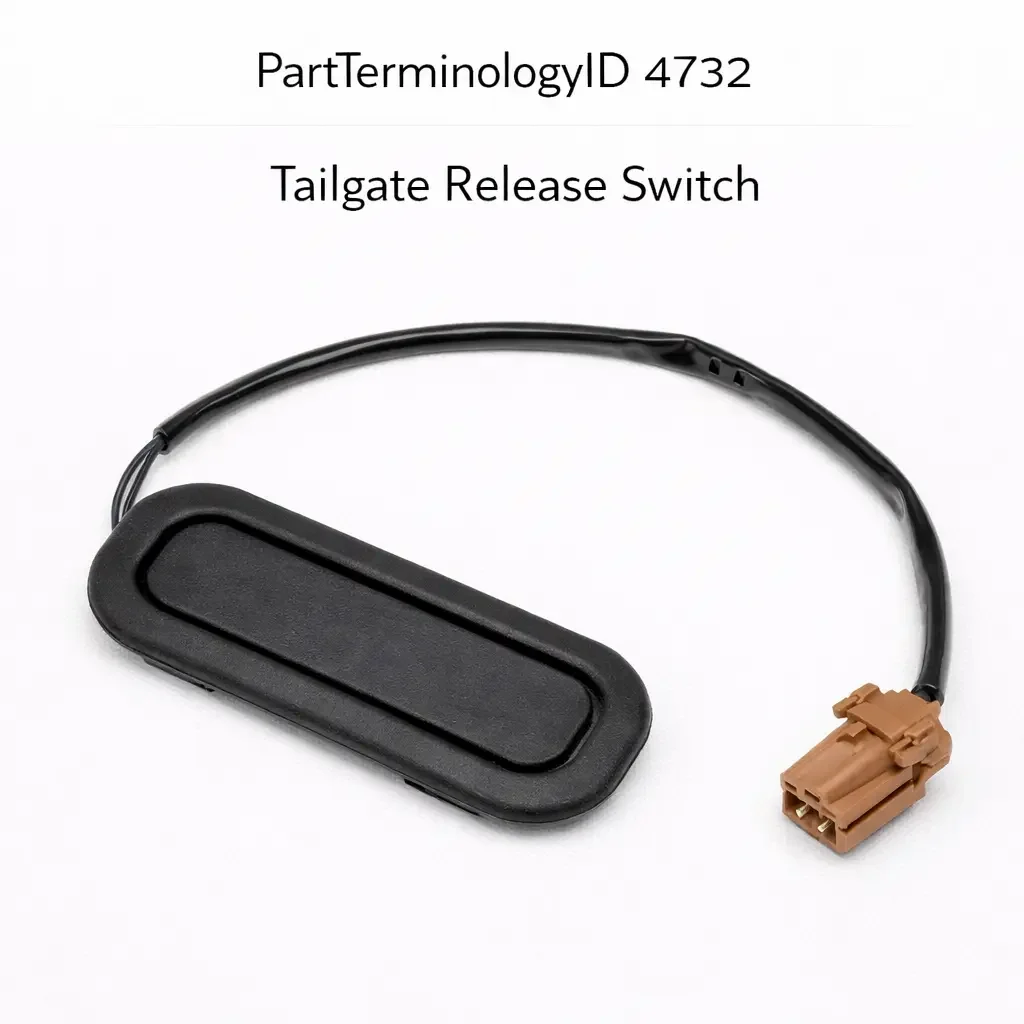
Tailgate Release Switch (PartTerminologyID 4732): Actuator Circuit Type, Latch Compatibility, and Body Control Module Integration
Written by Arthur Simitian | PartsAdvisory
Introduction
The tailgate release switch is the driver or passenger-operated control that commands the tailgate latch to release, allowing the tailgate to be opened. On vehicles ranging from pickup trucks to SUVs, hatchbacks, and minivans, the tailgate release switch is the primary interface between the occupant and the power latch or solenoid mechanism that holds the tailgate closed. When it fails, the tailgate cannot be released from inside the vehicle or from the key fob, depending on the system architecture, and the driver must resort to a mechanical override or a manual latch release to access the cargo area.
The tailgate release switch generates returns when it is selected without confirming the actuator circuit type, whether the switch drives the release solenoid directly or signals a BCM or tailgate control module, and whether the switch is compatible with the passive entry and vehicle security integration on the specific platform. These attributes vary across trim levels and production periods on many platforms and are frequently omitted from catalog listings.
What the Tailgate Release Switch Does
Latch Release Command
The tailgate release switch sends a release command to the tailgate latch mechanism when pressed. On basic systems the switch supplies current directly to the tailgate release solenoid, which retracts the latch bolt and allows the tailgate to be opened. On module-controlled systems the switch sends a signal to the BCM or a dedicated tailgate control module, which verifies that the conditions for release are met before commanding the solenoid.
The conditions the BCM may verify before permitting release include vehicle speed (preventing release while the vehicle is moving on applications with a speed lockout), gear selector position (preventing release in Drive on some applications), and security system status (preventing release when the anti-theft system is armed without a valid key fob present). A switch that produces the correct release command signal but connects to the wrong circuit architecture will not produce a release even if all other system conditions are met.
Interior versus Exterior Switch Positions
Tailgate release switches are located in multiple positions depending on the vehicle design. The interior release switch is typically mounted in the instrument panel, door panel, or center console within reach of the driver. An exterior release switch may be located on the tailgate handle or in the license plate recess. On some platforms a hidden or recessed exterior button is used as a secondary release without a key, while the primary release is through the key fob or the interior switch.
The interior and exterior switch positions may use different circuit architectures on the same vehicle. The interior switch may send a BCM signal while the exterior switch activates the solenoid directly, or vice versa. Confirming the specific switch position being replaced is required before selecting a replacement.
Power Tailgate Integration
On vehicles with a power-operated tailgate that opens and closes automatically using an electric drive mechanism, the release switch also initiates the power open cycle rather than simply releasing a latch. The switch signal in this architecture triggers the tailgate control module to command the drive mechanism through its full opening travel. A switch that produces only a latch release signal in a power tailgate application will release the latch but not initiate the power open cycle, leaving the tailgate unlatched but closed until manually pushed open.
Security and Passive Entry Integration
On vehicles with passive entry, the tailgate release function is linked to the passive entry system. Pressing the tailgate release switch or button may require key fob proximity before the BCM permits the release. A replacement switch that does not include the capacitive touch or proximity sensing element required for the passive entry integration will disable the passive entry tailgate release function even if the basic latch release function works correctly.
Design and Construction
Momentary Push Button Design
The most common tailgate release switch design is a momentary push button that sends a brief release command when pressed. The button returns to its rest position immediately after release. The latch solenoid is energized only for the duration of the button press or for a defined time period triggered by the button press, depending on the system design.
Rocker or Toggle Design
Some vehicles use a rocker or toggle switch for the tailgate release, particularly on older platforms where the release function is combined with other tailgate functions such as a rear wiper control or a rear defrost control on a shared switch panel. The rocker design provides tactile feedback that distinguishes the tailgate release position from adjacent switch positions.
Illuminated Switches
Many interior tailgate release switches include illumination so the switch is visible at night. Illuminated switches have additional terminals for the lamp circuit. On BCM-monitored lamp circuits, a non-illuminated replacement will generate a lamp circuit fault. The illumination type (backlight, status indicator, or both) must match the original.
Integrated Handle Switches
On SUVs and hatchbacks where the tailgate release is integrated into the exterior door handle, the switch is part of the handle assembly. The handle-integrated switch may include a capacitive touch element for passive entry integration in addition to the mechanical switch contact for the release signal. Replacement of a handle-integrated switch typically requires replacing the complete handle assembly rather than a standalone switch component on these designs.
Common Failure Modes
Contact Wear from Frequent Use
On vehicles where the tailgate is opened and closed multiple times daily, such as delivery vehicles and commercial applications, the release switch contacts accumulate wear faster than on passenger vehicles. Worn contacts produce a high-resistance closure that may not produce sufficient current to energize the release solenoid directly on direct-wired systems, or may produce a signal level below the BCM's valid command threshold on module-controlled systems.
Solenoid Circuit Overload
On direct-wired systems where the switch carries full solenoid current, an intermittent short in the solenoid wiring can cause the switch contacts to carry overcurrent, producing contact arcing and accelerated wear. A switch replacement in this scenario without identifying and correcting the solenoid circuit fault will result in rapid failure of the new switch.
Connector Corrosion on Exterior Positions
Exterior tailgate release switches are exposed to weather, washing, and road contamination. The switch connector on exterior positions is subject to moisture intrusion and terminal corrosion that produces intermittent or absent release commands. A switch complaint on an exterior release position should always include connector inspection before switch replacement is ordered.
Passive Entry Element Failure
On switches with an integrated capacitive touch element for passive entry, the capacitive sensing circuit can fail independently of the mechanical switch contact. A failed capacitive element produces a specific symptom: the key fob releases the tailgate correctly but the touch-based passive entry release does not respond. The mechanical switch contact may still work correctly, but the passive entry function requires the capacitive element.
Symptoms of a Failing Tailgate Release Switch
Tailgate Does Not Release from Interior Switch
If the tailgate does not respond to the interior release switch but releases correctly from the key fob, the fault is isolated to the interior switch circuit. Confirm supply voltage at the switch connector and test the switch contact directly. If the contact closes correctly but the BCM still does not command the release, the BCM input circuit for the tailgate release command may have a fault.
Tailgate Does Not Release from Any Input
If the tailgate does not respond to the interior switch, the exterior switch, or the key fob, the fault is in the latch mechanism, the release solenoid, or the solenoid power supply circuit rather than in the switch. A solenoid that does not receive power from any input source or does not retract when powered directly has failed. Confirm solenoid function by applying power directly to the solenoid terminals before condemning any switch.
Tailgate Releases Unintentionally
A tailgate that releases without any switch input points to a switch contact stuck in the closed position, a short in the release switch wiring, or in rare cases a BCM fault that is issuing a release command without a valid input. This symptom is a security and safety concern on moving vehicles and should be diagnosed promptly.
Power Tailgate Does Not Complete Open Cycle
On power tailgate applications, if the tailgate unlatches but does not proceed through the power open cycle, the switch is producing only a latch release signal rather than a power open command. This points to a switch signal format mismatch or a module configuration issue rather than a failed switch contact.
Diagnostic Process
Step One: Isolate by Input Source
Determine whether the failure affects only the switch being replaced or all release inputs. A failure that affects only the specific switch points to the switch or its circuit. A failure that affects all inputs points to the solenoid, its power supply, or the latch mechanism.
Step Two: Test the Solenoid Directly
Apply battery voltage directly to the tailgate release solenoid terminals to confirm the solenoid retracts the latch. A solenoid that releases the latch when powered directly confirms the latch mechanism is functional and the fault is in the switch or its circuit.
Step Three: Confirm Supply Voltage at the Switch
With the switch connector disconnected and the ignition on, confirm supply voltage is present at the switch power terminal. Absent supply voltage points to a fuse or wiring fault upstream of the switch.
Step Four: Test the Switch Contact
With the switch disconnected from the harness, test continuity between the switch terminals while pressing the switch. A contact that does not close during actuation confirms a switch fault.
Step Five: Scan for BCM Faults
On BCM-controlled systems, retrieve DTCs from the BCM referencing the tailgate release switch input or the tailgate latch output. A DTC indicating the switch input is open circuit or out of range confirms the switch circuit as the fault. A DTC indicating the solenoid output is open circuit or shorted points to the solenoid circuit rather than the switch.
Cataloging Attributes: What to Confirm Before Listing
Actuator circuit type: State whether the switch directly activates the release solenoid or sends a signal to a BCM or tailgate control module. This is the most consequential attribute. A direct solenoid switch carries solenoid current through its contacts. A BCM signal switch carries only signal current. They are not interchangeable.
Interior versus exterior position: State the switch mounting position explicitly. Interior and exterior switches for the same tailgate may use different circuit architectures and different connectors.
Power tailgate compatibility: State whether the switch is compatible with a power-operated tailgate and whether it produces only a latch release signal or a full power open command.
Passive entry integration: State whether the switch includes a capacitive touch element or other passive entry interface. A switch without passive entry integration installed in a passive entry application will disable that function.
Illumination: State whether the switch includes illumination and the lamp circuit type.
Connector pin count: State the pin count. Tailgate release switches range from two pins on basic direct solenoid designs to six or more pins on switches with BCM signal input, passive entry, and illumination circuits.
Common Cataloging Mistakes
The most common mistake is listing tailgate release switches without stating the actuator circuit type. On platforms that transitioned from direct solenoid activation to BCM-controlled release during the production run, both circuit types share the same vehicle application range. A listing without the circuit type designation will route direct solenoid switches to BCM-controlled applications and vice versa.
The second mistake is omitting passive entry integration. On platforms where passive entry is a common option, a significant portion of buyers have the passive entry feature. A listing that does not state whether passive entry integration is included or excluded will generate returns from passive entry buyers who receive a switch without the capacitive touch element.
The third mistake is not distinguishing interior from exterior switch positions. On vehicles where both positions are cataloged, failure to specify the position routes interior switches to exterior applications where they are not weatherproofed for external use, and vice versa.
Status in New Databases
PIES/PCdb: PartTerminologyID 4732, Tailgate Release Switch
PIES 8.0 / PCdb 2.0: No change in PartTerminologyID or terminology label
Summary
The tailgate release switch is a latch activation interface whose return rate is driven by actuator circuit type mismatch, missing passive entry integration data, and failure to distinguish interior from exterior switch positions. Every listing for PartTerminologyID 4732 must state the actuator circuit type, the switch position, power tailgate compatibility, passive entry integration status, and connector pin count. These attributes determine whether the replacement restores complete tailgate release function across all input sources. A listing that relies on vehicle fitment alone without these attributes will generate returns from every buyer whose vehicle has a non-default tailgate control configuration.