
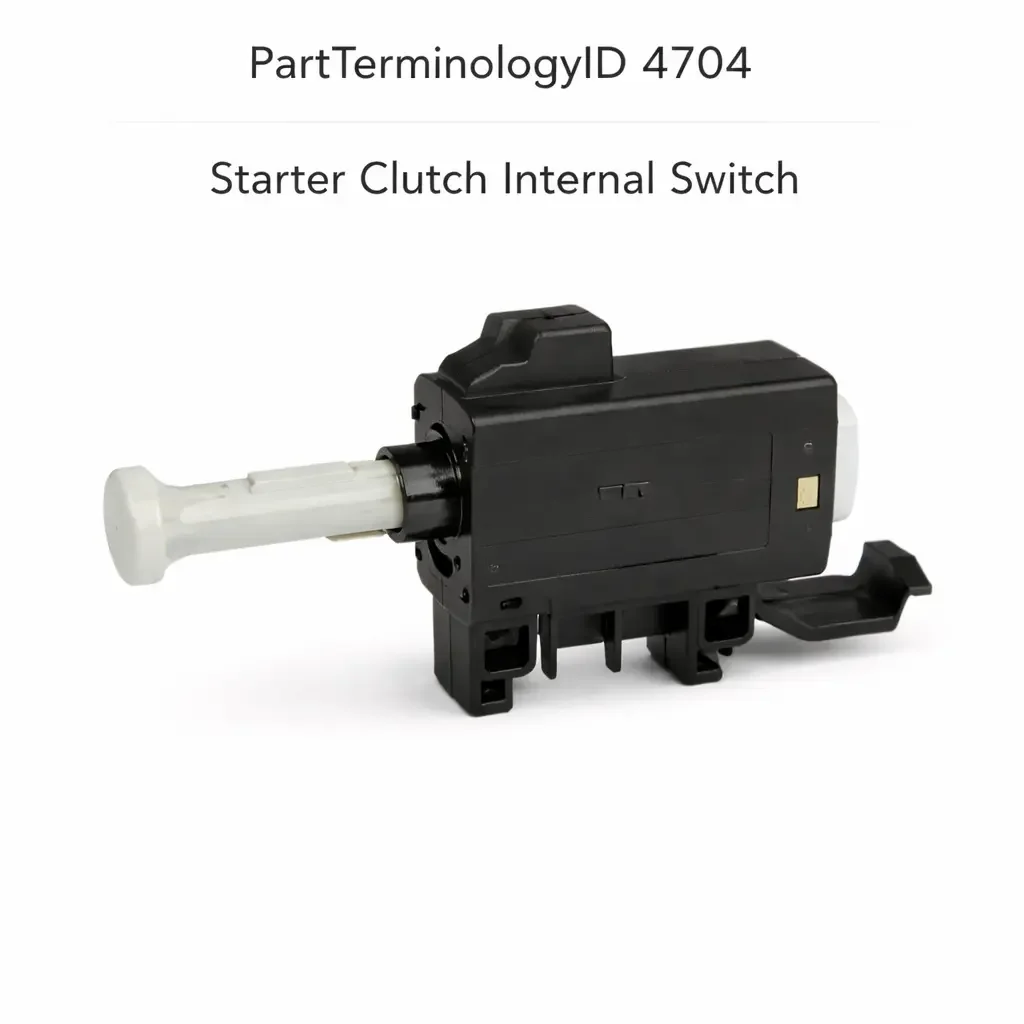
Starter Clutch Internal Switch (PartTerminologyID 4704): Contact Output Type, Engagement Threshold, and Starting Circuit Compatibility
Written by Arthur Simitian | PartsAdvisory
Introduction
The starter clutch internal switch is a position-sensing electrical switch integrated within the starter clutch or overrunning clutch assembly that detects whether the clutch mechanism is in the engaged or disengaged state. Its primary function is to signal the starting circuit control system when the starter clutch has reached the fully engaged position, providing an input that prevents starter re-engagement while the engine is running and in some applications confirms clutch engagement before the main starter circuit is permitted to close. When it fails or is replaced with an incorrectly specified part, the result is either a starter that cannot be activated because the control system never receives the engagement confirmation signal, or a starter that can be re-engaged against a running engine because the disengagement confirmation is absent.
What the Starter Clutch Internal Switch Does
The switch monitors the mechanical position of the overrunning clutch within the starter motor drive assembly. When the solenoid engages and shifts the drive pinion toward the ring gear, the overrunning clutch mechanism moves through its engagement travel. The internal switch is actuated at a defined point in that travel, producing an electrical output that signals the starting circuit that engagement has occurred.
On applications where the switch provides an engagement confirmation input to the ECM or starter control module, the module uses this signal to confirm that the pinion has reached the ring gear before permitting the main contacts to close and apply full motor current. This sequencing prevents the motor from spinning at full speed before the pinion is in mesh, which would cause the pinion to slam against the ring gear at high speed and damage both components.
On applications where the switch provides a disengagement confirmation, the signal is used to confirm that the overrunning clutch has released and the pinion has retracted after the engine starts. The starting circuit uses this confirmation to prevent re-engagement of the starter while the engine is running, protecting both the starter pinion and the ring gear from the catastrophic damage that results from engaging the starter against a spinning ring gear.
What Makes This Part Generate Returns
Contact output type is the primary return driver. The starter clutch internal switch is available in normally open and normally closed configurations depending on the circuit architecture of the starting system. A normally open switch closes its output when the clutch reaches the engagement position. A normally closed switch opens its output at engagement. Installing the wrong type inverts the engagement signal, causing the control module to interpret the engaged state as disengaged and vice versa, preventing normal starter operation.
Clutch engagement threshold is the second return driver. The switch is calibrated to change state at a specific point in the clutch travel, corresponding to the mechanical position at which the pinion is fully in mesh with the ring gear. A switch that changes state too early will signal engagement before the pinion has fully meshed, potentially allowing motor current before full mesh is achieved. A switch that changes state too late will delay the engagement confirmation past the designed timing, causing a hesitation in the cranking sequence.
Starting circuit compatibility is the third return driver. On applications where the switch signal is processed by an ECM or starter control module rather than used in a simple switched circuit, the signal output voltage level and format must match the module's input expectations. A switch that produces the correct contact state but at an incorrect voltage level will not be recognized as a valid engagement signal by the module.
Cataloging Attributes: What to Confirm Before Listing
Contact output type: State normally open or normally closed explicitly. This is the most consequential attribute and must be confirmed from the OE specification. Do not assume the default type from a generic description.
Engagement threshold position: State the clutch travel position at which the switch changes state, expressed as a linear dimension or as a percentage of total clutch travel if the specification is available. This attribute is less commonly listed but is the attribute that determines whether the sequencing of the starting circuit matches the original design.
Signal output voltage: For ECM or module-controlled applications, state the output voltage level of the switch signal. Confirm whether the module input is a direct switched circuit or a signal that must fall within a defined voltage window.
Physical dimensions and mounting: State the switch body dimensions and the mounting configuration. Starter clutch internal switches are installed within the starter assembly housing and must fit the specific space envelope of the housing cavity. An incorrectly dimensioned switch will either not fit the housing or will not be correctly positioned relative to the clutch travel path.
Connector type and pin count: State the connector body type and pin count. This switch is internal to the starter assembly and its connector mates with the internal harness of the starter housing.
Common Cataloging Mistakes
The most common mistake is omitting the contact output type. On starter assemblies where both a normally open and a normally closed internal switch were used across production variants, a listing that does not state the output type will generate returns from buyers whose assembly uses the non-default type.
The second mistake is treating the starter clutch internal switch as interchangeable with an external starter position switch or a neutral safety switch. These are distinct components with different mounting locations, different circuit functions, and different contact specifications. A listing that cross-references these components as equivalent will route the wrong part to the buyer.
Status in New Databases
PIES/PCdb: PartTerminologyID 4704, Starter Clutch Internal Switch
PIES 8.0 / PCdb 2.0: No change in PartTerminologyID or terminology label
Summary
PartTerminologyID 4704, Starter Clutch Internal Switch, is a position-sensing component integrated within the starter assembly that confirms clutch engagement and disengagement status to the starting circuit control system. Its return rate is driven by contact output type mismatch, incorrect engagement threshold calibration, and signal voltage incompatibility with the module input circuit. Every listing must state the contact output type, the engagement threshold, the signal voltage specification for module-controlled applications, and the physical dimensions and connector type. Do not conflate this component with external starting circuit switches or neutral safety switches.