
Starter Switch (PartTerminologyID 4700): Circuit Architecture, Current Rating, and Neutral Safety Integration Compatibility
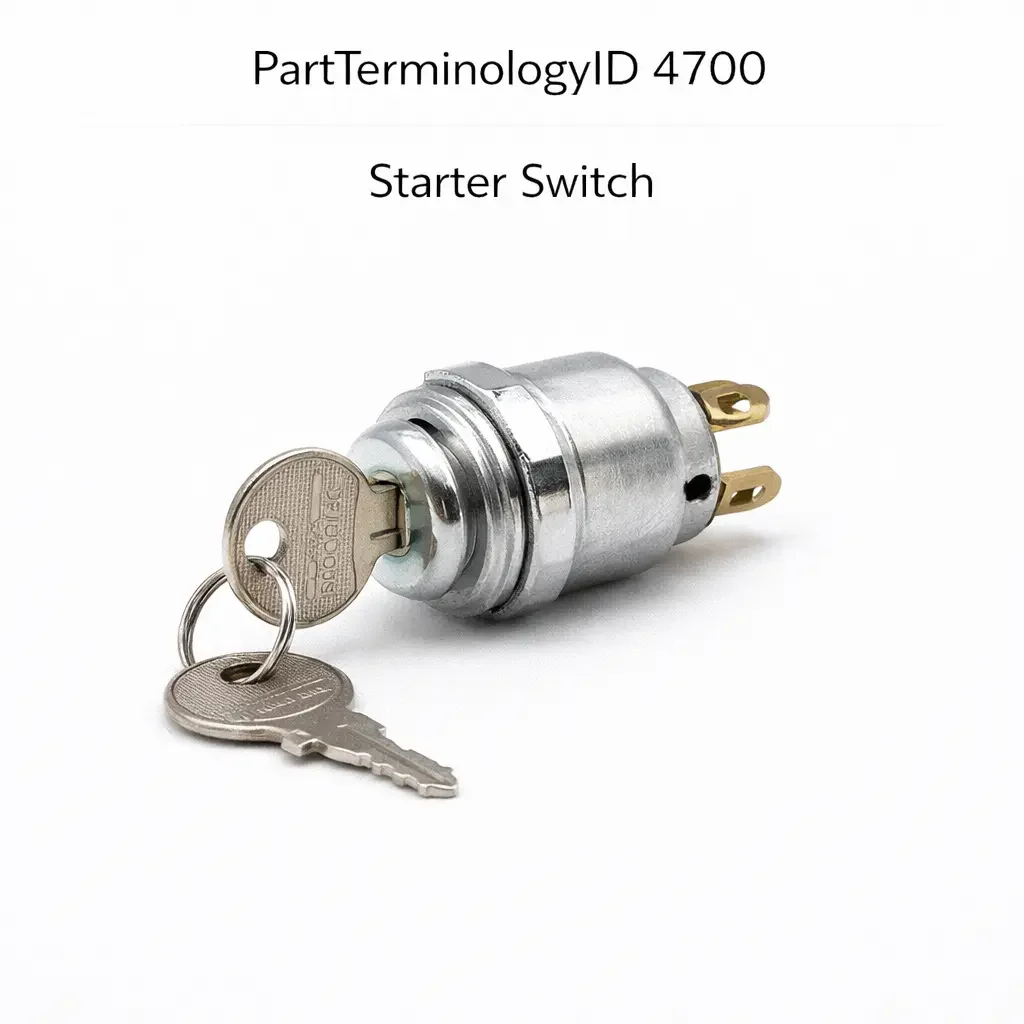
Written by Arthur Simitian | PartsAdvisory
Introduction
The starter switch is the electrical component that initiates the engine cranking sequence by completing the circuit between the ignition system and the starter solenoid. On conventional keyed ignition systems it is the contact set within the ignition switch assembly that closes when the key is rotated to the start position. On push-button start systems it is the dedicated start button that sends a signal to the powertrain control module or body control module to initiate the start sequence. On heavy commercial vehicles it may be a separate heavy-duty switch mounted on the dashboard or console, independent of the ignition switch.
The starter switch sits at the beginning of the starting circuit. Every component downstream of it, the neutral safety switch, the starter relay, the solenoid, and the motor itself, depends on receiving the correct signal from the starter switch to function. A failed or incorrectly specified starter switch produces a no-start condition that can be misdiagnosed as a neutral safety switch fault, a starter relay fault, or a solenoid fault if the starter switch circuit is not tested first.
Understanding what distinguishes a correctly specified starter switch from an incorrectly specified one requires understanding the circuit architectures in which it operates, the current demands it may be required to carry, and the integration points with the neutral safety interlock and anti-theft systems that determine whether the switch can be replaced as a standalone component or only as part of a larger assembly.
What the Starter Switch Does
Direct Solenoid Activation
On older vehicles and many current commercial applications, the starter switch connects the battery or ignition voltage supply directly to the starter solenoid S terminal when the start position is activated. The switch carries the solenoid coil current, which is typically 5 to 15 amperes depending on the solenoid design. The switch contacts must be rated for this current and must produce a clean, low-resistance closure to ensure the solenoid receives adequate voltage at the S terminal.
A switch with high contact resistance in this circuit produces a voltage drop that reduces the voltage available to the solenoid coil. If the coil voltage drops below the threshold needed to generate sufficient magnetic force, the solenoid pull-in winding cannot draw the plunger to the engaged position reliably. The symptom is a solenoid that clicks intermittently or fails to engage under cold conditions when battery voltage is already depressed by temperature.
Signal to BCM or PCM for Smart Start Systems
On modern vehicles with a body control module or powertrain control module managing the start sequence, the starter switch does not carry solenoid current directly. It sends a low-current signal to the BCM or PCM that requests a start event. The module verifies that the neutral safety switch input, the anti-theft system status, the brake pedal switch input on push-button start systems, and other preconditions are met before it commands the starter relay and solenoid through its own output circuit.
In this architecture the starter switch carries milliampere-level signal current only. The contact rating is not a limiting factor in the same way it is for direct solenoid activation, but the signal output format must match what the BCM or PCM expects. Some systems use a switched ground input. Others use a resistor-coded input where the start request is communicated through a specific resistance value on a shared input wire. The replacement switch must match the signal format of the original.
Push-Button Start Function
Push-button start switches communicate a start request to the BCM when the brake pedal is depressed and the button is pressed. The BCM verifies the passive entry key fob is within range, the brake pedal is depressed, the transmission is in Park or Neutral, and the anti-theft system is not armed before initiating the start sequence. The push-button switch itself carries only the button press signal. Its contact configuration, signal output type, and illumination circuit must all match the BCM's input expectations.
Push-button start switches also typically provide a stop engine function when the vehicle is running: pressing the button once stops the engine. On some systems a long press is required to stop. The contact configuration must support the operating mode the BCM is calibrated for.
Anti-Theft System Integration
On vehicles with a transponder-based anti-theft system, the starter switch or ignition switch assembly communicates the transponder signal to the immobilizer module as part of the start sequence. If the transponder in the key is not recognized, the immobilizer module prevents the BCM or PCM from initiating the start sequence regardless of the starter switch state. This integration means that a replacement ignition switch assembly that does not include the transponder reader coil, or includes one that is not compatible with the vehicle's immobilizer module, will produce a no-start condition even when the switch itself is functioning correctly.
On push-button start vehicles with passive entry, the transponder function is handled by the passive entry antennas and the passive entry module rather than by the starter switch itself. The starter switch on these systems has no direct anti-theft interface.
Design Variations
Ignition Switch Integrated Starter Contact
On conventional keyed ignition systems the start function is one of four or five positions in the ignition switch. The switch assembly contains separate contact sets for the Accessory, On, and Start positions, and the starter contact set is the one that closes only when the key is rotated to the maximum clockwise position against spring tension. Releasing the key allows the spring to return the key to the On position.
On many platforms the ignition switch assembly is replaceable as a complete unit that includes all contact sets. On others the electrical contact module at the back of the ignition switch housing is separable from the mechanical lock cylinder and is replaceable independently. Confirming which portion of the ignition switch assembly covers the starter contact function is necessary before ordering.
Standalone Start Button on Commercial Vehicles
Heavy trucks, buses, and construction equipment frequently use a dedicated start push button mounted on the dashboard or instrument panel, separate from the ignition switch. This button is a heavy-duty momentary push button rated for the solenoid coil current or in some cases the full starter relay coil current. These switches are subject to greater mechanical wear and environmental stress than interior automotive switches and are built to more robust specifications.
Push-Button Start Switch
The push-button start switch on modern passenger vehicles is typically a momentary illuminated push button integrated into the instrument panel or center console. It communicates with the BCM through a signal input circuit and performs no direct switching of high-current circuits. The switch includes illumination that may indicate ignition state, engine running status, or both depending on the platform.
Inhibitor Switch Integration
On some platforms the starter switch circuit passes through an inhibitor switch that prevents starter activation when the engine is already running. The inhibitor function monitors the alternator output or a dedicated oil pressure signal and opens the starter circuit when engine operation is confirmed, preventing engagement of the starter against a running engine. A replacement starter switch that does not include the inhibitor interface will allow starter engagement against a running engine on these applications.
Common Failure Modes
Contact Wear in Ignition Switch Starter Position
The start position contact set within an ignition switch assembly is used every time the engine is started. On high-mileage vehicles or vehicles with frequent start-stop cycles, the start contact set develops increased resistance from contact wear and oxidation before the other ignition switch contact sets fail. The symptom is a start position that is intermittent, requiring multiple key rotation attempts before the solenoid activates, while the Accessory and On positions continue to function correctly.
Mechanical Lock Cylinder Wear
On ignition switch assemblies where the lock cylinder and the electrical contact module are integrated, mechanical wear in the lock cylinder can prevent the key from reaching the full start position. The electrical contacts may be in perfect condition, but the mechanical path to the start position is blocked by a worn or binding lock cylinder. This failure is sometimes misidentified as an electrical starter switch fault.
Push-Button Contact Contamination
Push-button start switches are located in high-traffic areas of the interior and are subject to contamination from hand oils, spilled liquids, and debris. Contaminated contacts can produce a high-resistance closure that the BCM interprets as an absent or invalid start request. Cleaning the contact surfaces sometimes restores function temporarily, but a switch with deeply contaminated or corroded contacts requires replacement.
Wiring Connector Damage
The multi-pin connector on an ignition switch assembly is disconnected and reconnected during column disassembly for steering column service, airbag service, and lock cylinder replacement. Each reconnection cycle risks terminal damage. On push-button start switches the connector is typically not disturbed during normal service, but a previous switch replacement that did not seat the connector fully can produce intermittent start function that worsens over time.
Anti-Theft Interface Failure
On ignition switch assemblies with an integrated transponder reader coil, the coil can fail independently of the electrical contact module. A failed transponder coil produces a no-start condition with the engine security warning illuminated. The ECM or immobilizer module receives a valid start request from the switch contacts but does not receive a valid transponder signal, and the immobilizer prevents the PCM from initiating the start sequence. Distinguishing a transponder coil failure from a contact failure requires reading the immobilizer DTC before replacing the switch assembly.
Symptoms of a Failing Starter Switch
No Crank with No Other Symptoms
A no-crank condition where the battery tests correctly, the neutral safety switch tests correctly, and no DTCs are present in any module points to the starter switch circuit as the fault area. Test S terminal voltage at the solenoid before replacing the switch to confirm the switch is not producing the activation signal.
Intermittent Start Requiring Multiple Key Rotations
Intermittent start function that requires two or more key rotation attempts before the engine cranks is the characteristic symptom of worn start position contacts in an ignition switch assembly. The contacts close inconsistently depending on the exact rotational position of the key, which varies slightly from one attempt to the next due to normal keying tolerances.
Engine Security Warning with No Start
An engine security or immobilizer warning on the instrument cluster accompanying a no-start condition directs the diagnosis to the anti-theft system input rather than the starter contact. On ignition switch assemblies with an integrated transponder coil, test the transponder coil circuit before replacing the switch assembly for a contact fault.
Push-Button Start Does Not Respond on First Press
A push-button start that requires a second press to initiate the start sequence, or that responds inconsistently to a single press, points to the switch contact or the BCM signal input circuit. Confirm the brake pedal switch is also functioning correctly before diagnosing the start button, because the BCM requires a confirmed brake pedal input before accepting a start request.
Diagnostic Process
Step One: Confirm Preconditions
Before testing the starter switch, confirm all preconditions for starting are met: battery voltage is adequate, the transmission is in Park or Neutral, the neutral safety switch is functioning, and no anti-theft DTCs are present. A precondition failure at any of these points produces a no-start that is independent of the starter switch.
Step Two: Test S Terminal Voltage
With the ignition in the start position, measure voltage at the starter solenoid S terminal. Battery voltage at the S terminal confirms the starter switch is producing the activation signal and the circuit between the switch and the solenoid is intact. Absent voltage at S terminal confirms a fault in the starter switch circuit.
Step Three: Trace the Starter Switch Circuit
If S terminal voltage is absent, trace the circuit back from the solenoid to the starter relay, then to the neutral safety switch, then to the starter switch itself. Test for voltage at each point while the ignition is in start. The point where voltage disappears identifies the fault location.
Step Four: Test the Starter Switch Contacts
With the ignition switch connector disconnected, test the start position contact set with a multimeter. On ignition switch assemblies, rotate the key to the start position and confirm continuity between the start contact terminals. On push-button start switches, test the contact set with the button pressed. A contact set that does not close confirms a switch fault.
Step Five: Test the Transponder Circuit
On ignition switch assemblies with an integrated transponder coil, use a scan tool to check for immobilizer DTCs before concluding the switch contact is the fault. An immobilizer code indicating transponder signal absent or not recognized confirms a transponder coil fault rather than a contact fault, directing the replacement to the correct component.
Cataloging Attributes: What to Confirm Before Listing
Circuit architecture: State whether the switch directly activates the solenoid S terminal, signals a BCM or PCM for a smart start system, or performs both functions in a hybrid architecture. This determines the current rating requirement and the signal format specification.
Contact current rating: State the maximum contact current rating in amperes for applications where the switch carries solenoid or relay coil current directly. A switch with an undersized contact rating will develop elevated contact resistance under repeated solenoid activation current and fail prematurely.
Signal output type for BCM-controlled systems: For smart start and push-button start applications, state whether the switch output is switched ground, switched voltage, or resistor-coded. State the resistance value or voltage level for each switch state on coded applications.
Anti-theft interface: State whether the switch assembly includes a transponder reader coil and whether it is compatible with the vehicle's immobilizer module. This is a mandatory attribute on all ignition switch assembly listings for transponder-equipped vehicles.
Neutral safety interlock inclusion: State whether the switch includes an integrated neutral safety function or whether the neutral safety interlock is a separate component in the circuit. On platforms where the neutral safety switch and starter switch are a combined assembly, this must be stated.
Mechanical lock cylinder compatibility: For ignition switch assemblies that include a lock cylinder, state whether the lock cylinder is included with the replacement or whether only the electrical contact module is supplied. Many aftermarket ignition switch replacements supply only the electrical module and require transfer of the original lock cylinder.
Connector pin count and terminal assignment: State the pin count. Ignition switch assemblies range from four pins on a simple direct-wired system to sixteen or more pins on a fully integrated assembly with start, run, accessory, transponder, and steering column lock functions on a shared connector.
Common Cataloging Mistakes
The most common mistake is listing ignition switch assemblies without stating whether the lock cylinder is included. A buyer who orders an ignition switch replacement expecting a complete assembly and receives only the electrical contact module cannot complete the installation without the original lock cylinder, which may be unavailable if the vehicle was acquired without keys. Stating explicitly whether the lock cylinder is included or not prevents this return entirely.
The second mistake is omitting the transponder coil compatibility designation. On platforms where both a transponder-equipped and a non-transponder ignition switch were used across trim levels or model years, a listing that does not state transponder compatibility will route non-transponder switches to transponder-equipped vehicles, producing an immobilizer fault and a no-start condition after installation.
The third mistake is not distinguishing between direct solenoid activation and BCM signal input architectures on platforms that transitioned between the two during the production run. A direct solenoid activation switch installed in a BCM signal input circuit will apply solenoid coil current to a BCM signal input pin, potentially damaging the BCM input circuit on the first start attempt.
The fourth mistake is conflating the starter switch with the ignition switch. The ignition switch covers multiple positions and functions including Accessory, On, and Start, while the starter switch specifically refers to the start function. On combined assemblies both functions are present, but on platforms where only the start function has failed and the rest of the ignition switch is functional, a listing that covers only the starter contact set may be the correct and more economical replacement. Listings must clearly distinguish between a complete ignition switch assembly and a starter-only contact set where both options exist.
Related Components and Systems
Neutral Safety Switch
The neutral safety switch is the component that permits or prevents the starter circuit from being completed based on transmission selector position. On most vehicles the neutral safety switch is a separate component from the starter switch, though both are part of the same starting circuit. A failed neutral safety switch that remains open in Park will produce the same no-crank symptom as a failed starter switch. Testing S terminal voltage while in Park and then in Neutral, if the vehicle can be rolled to neutral safely, distinguishes a position-specific neutral safety switch fault from a starter switch fault.
Starter Relay
Many starting circuits include a starter relay between the starter switch and the solenoid S terminal. The relay coil is activated by the starter switch, and the relay contacts supply battery voltage to the solenoid S terminal. The relay isolates the starter switch from the solenoid coil current, reducing the current the starter switch must carry. A failed relay produces a no-crank condition that presents at the solenoid S terminal as absent voltage, making S terminal testing the critical step that identifies whether the fault is in the switch, the relay, or the wiring between them.
Ignition Switch Assembly
On conventional keyed ignition systems the starter contact is one position within the complete ignition switch assembly. The assembly also provides Accessory and Run contacts that power different sets of vehicle circuits. If only the start position is failing while Accessory and Run functions continue to work, the fault is isolated to the start contact set within the assembly. On assemblies where the electrical contact module is replaceable independently of the lock cylinder, replacing only the contact module is a more economical repair than replacing the complete assembly.
Immobilizer and Anti-Theft Module
The immobilizer module prevents the PCM from enabling fuel injection and ignition even when the starter engages, if the transponder signal is not recognized. On vehicles where the starter switch assembly includes the transponder reader coil, a failed coil will produce an immobilizer fault that appears as a no-start condition. The starter may crank the engine, but the engine will not start because the PCM is not receiving a valid transponder confirmation. This failure mode requires a scan of the immobilizer module for transponder fault codes before any component replacement is ordered.
Brake Pedal Switch for Push-Button Start
On push-button start vehicles, the BCM requires a confirmed brake pedal input before it will process a start request from the start button. A failed brake pedal switch that does not signal brake application will prevent the BCM from initiating the start sequence even when the start button is functioning correctly. If a push-button start switch complaint involves no engine crank response, confirm the brake lights are illuminating when the pedal is depressed before testing the start button itself.
Frequently Asked Questions
Why does my car sometimes start on the second or third key turn but not the first?
Intermittent start requiring multiple key rotation attempts is the characteristic symptom of worn start position contacts in the ignition switch assembly. The contacts close inconsistently from one rotation to the next because the worn contact surfaces do not make reliable electrical contact at exactly the same rotational position every time. The fault becomes more consistent as wear progresses. Replacement of the ignition switch electrical module or the complete ignition switch assembly addresses the worn contacts directly.
Can a bad starter switch damage the starter motor or solenoid?
A starter switch with high contact resistance can cause the solenoid to receive reduced voltage, which may cause the solenoid to engage slowly or incompletely, placing the drive pinion in partial mesh with the ring gear. Partial mesh engagement under high cranking current can damage the pinion teeth and ring gear. A starter switch that intermittently activates can also cause repeated rapid engagement and disengagement of the solenoid, which accelerates wear on both the solenoid plunger mechanism and the drive fork. Replacing a worn starter switch before these secondary failures occur prevents more expensive downstream damage.
Is the starter switch the same as the ignition switch?
In common usage the terms are sometimes used interchangeably, but technically they refer to different things. The ignition switch is the complete assembly that controls all ignition positions: Accessory, On, and Start. The starter switch refers specifically to the contact set or signal circuit that activates only in the Start position. On most passenger vehicles these are integrated into the same physical assembly. On some commercial and industrial vehicles a dedicated start button is a separate component from the ignition switch. PartTerminologyID 4700 covers the start function specifically, regardless of whether it is integrated into a full ignition switch assembly or provided by a dedicated start button.
Do I need to have my new ignition switch programmed after replacement?
On vehicles with a transponder-based immobilizer, the new ignition switch assembly must include a transponder reader coil that is compatible with the vehicle's immobilizer module. On some systems the immobilizer module must be programmed to recognize the new key transponder after the switch assembly is replaced. This programming is typically performed with the original vehicle keys and a compatible scan tool. On vehicles with a passive entry push-button start system, programming requirements are determined by the passive entry module rather than the starter switch itself. Confirm programming requirements for the specific application before beginning the installation.
My push-button start works sometimes but not others. What should I check first?
On push-button start systems, an intermittent start response is most commonly caused by one of three sources: a failing brake pedal switch that does not consistently signal brake application to the BCM, a passive entry key fob with a weak battery that causes inconsistent recognition, or a start button with contaminated or worn contacts. Check brake light function and key fob battery before testing the start button contacts. The most common cause of intermittent push-button start complaints on high-mileage vehicles is a failing brake pedal switch rather than a failing start button.
Status in New Databases
PIES/PCdb: PartTerminologyID 4700, Starter Switch
PIES 8.0 / PCdb 2.0: No change in PartTerminologyID or terminology label
Summary
The starter switch is the initiating component of the engine cranking circuit. It fails through contact wear in the start position, mechanical lock cylinder binding, push-button contact contamination, and transponder coil failure on anti-theft-equipped assemblies. Accurate diagnosis requires confirming all starting circuit preconditions, testing S terminal voltage, tracing the starter circuit to the fault point, and testing the switch contacts directly before a replacement is ordered.
Catalog listings for PartTerminologyID 4700 must state the circuit architecture, contact current rating for direct solenoid activation applications, signal output type for BCM-controlled systems, anti-theft transponder compatibility, and whether the lock cylinder is included. These attributes are the difference between a listing that routes the correct component to the buyer on the first order and one that generates a return after installation reveals an incompatibility that vehicle fitment data alone could not predict.