
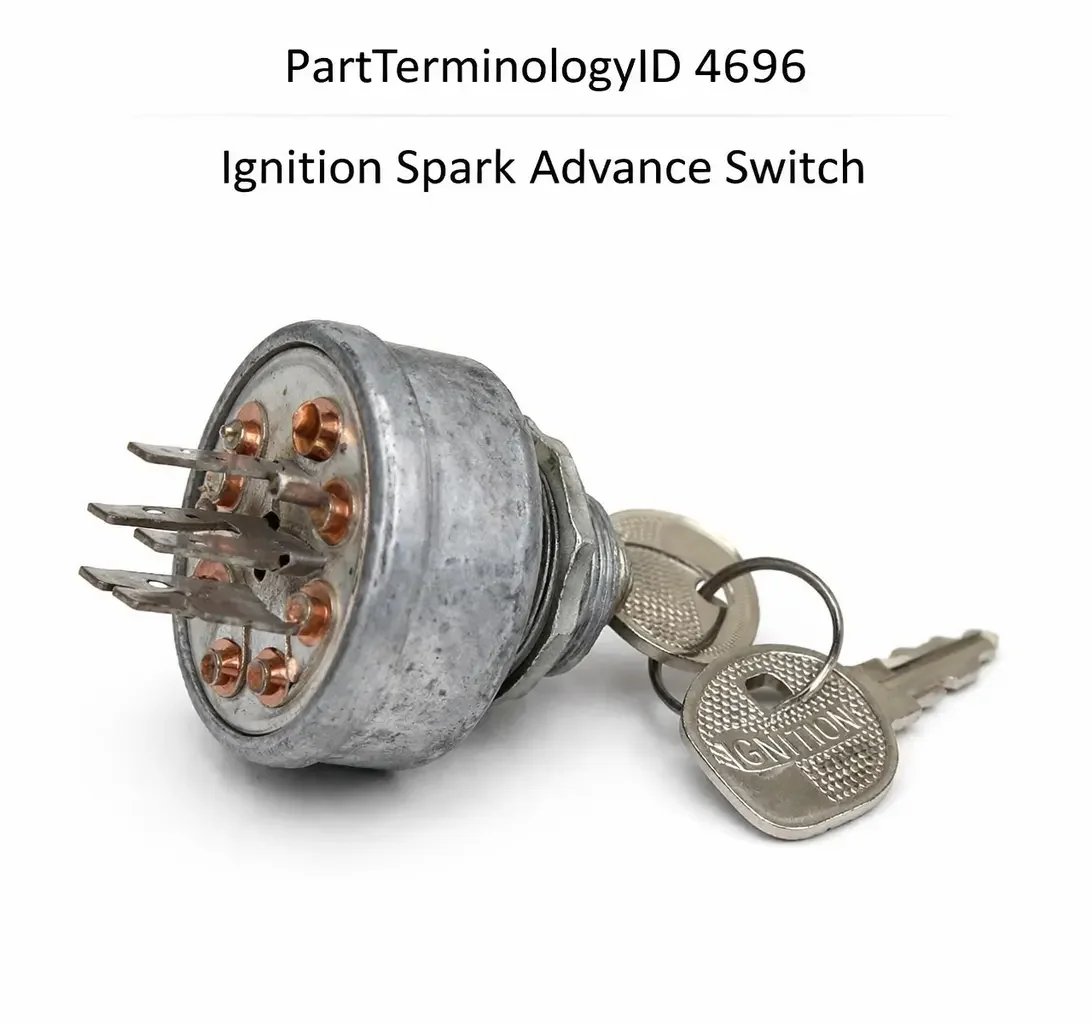
Ignition Spark Advance Switch (PartTerminologyID 4696): Vacuum Signal Routing, Temperature Threshold, and Distributor Advance Compatibility
Written by Arthur Simitian | PartsAdvisory
Introduction
The ignition spark advance switch is a thermostatic vacuum switching valve that controls whether ported vacuum or manifold vacuum is supplied to the distributor vacuum advance unit based on engine coolant temperature. Its function is to delay distributor vacuum advance during cold engine warm-up, preventing advanced timing at operating conditions where unburned hydrocarbons and emissions output would be elevated by early advance activation. Once coolant temperature exceeds the switch's calibrated threshold, the switch routes the full vacuum advance signal to the distributor, allowing normal timing advance for fuel economy and performance.
When it fails or is replaced with an incorrectly specified part, the result is either permanent vacuum advance regardless of coolant temperature, which increases hydrocarbon emissions during warm-up and can cause a failed emissions test, or permanently suppressed vacuum advance regardless of temperature, which reduces fuel economy and can cause elevated exhaust temperatures during extended highway driving.
What the Ignition Spark Advance Switch Does
The switch monitors engine coolant temperature through a sensing element in the coolant passage and controls the vacuum signal path to the distributor advance unit. Below the calibrated activation temperature, the switch blocks ported vacuum from reaching the distributor advance diaphragm, keeping ignition timing at the base setting. Above the activation temperature, the switch opens the vacuum path and the distributor advance unit advances timing in proportion to engine vacuum.
On some applications the switch performs the inverse function: it supplies manifold vacuum to the distributor below the threshold temperature to retard timing during cold warm-up, and switches to ported vacuum above the threshold to allow normal load-dependent advance. The direction of the switching function is determined by the emissions calibration strategy for the specific engine and model year and must match the original design exactly.
The switch is part of the vehicle's emissions control system. On vehicles subject to emissions testing, correct switch function is required to pass the test. A switch that supplies advance vacuum during cold warm-up when it should be blocking it will produce elevated hydrocarbon and carbon monoxide readings during the cold phase of an emissions test.
What Makes This Part Generate Returns
Temperature activation threshold is the primary return driver. The switch activates at a calibrated coolant temperature, typically between 55 and 85 degrees Celsius depending on the application and the emissions calibration for the engine and model year. A switch calibrated to activate at 55 degrees installed in an application requiring an 85-degree threshold will open the vacuum advance path during early warm-up when the emissions calibration requires it to remain closed, producing elevated cold-start emissions and a potential emissions test failure.
Vacuum port configuration is the second return driver. The switch is available in two-port and three-port designs. A two-port switch connects one vacuum source to one output, either blocking or passing the signal based on temperature. A three-port switch routes between two vacuum sources or two outputs depending on temperature. Installing a two-port switch in a three-port application leaves one vacuum port disconnected, producing a vacuum leak and incorrect advance behavior.
Switching direction is the third return driver. A switch that opens vacuum advance above the threshold and one that closes it above the threshold are opposite in function. Installing the wrong direction reverses the entire advance timing strategy relative to coolant temperature, producing advanced timing when retarded timing is required and vice versa.
Cataloging Attributes: What to Confirm Before Listing
Temperature activation threshold: State the opening or closing temperature in both Fahrenheit and Celsius. This is the most consequential attribute. Do not list only the part number without the threshold value.
Vacuum port configuration: State two-port or three-port explicitly. Do not assume port count is implied by the vehicle application.
Switching direction: State whether the switch opens the advance vacuum path above the threshold or closes it above the threshold. This attribute is frequently omitted and produces the least obvious symptom when wrong because the switch operates correctly within its calibration but in the wrong direction relative to the application's emissions strategy.
Thread specification: State the coolant passage thread diameter, pitch, and thread form. State whether the switch requires a sealing washer and whether one is included.
Vacuum port fitting size: State the vacuum hose fitting diameter in millimeters or inches for each port.
Common Cataloging Mistakes
The most common mistake is listing the switch without the temperature threshold. On platforms where the engine was offered in multiple emissions configurations with different advance strategies, each configuration requires a switch with a different threshold. A listing without the threshold value forces the buyer to identify the correct threshold from other sources, which is often not possible if the original switch has already been removed.
The second mistake is conflating the ignition spark advance switch with the ported vacuum switch (PartTerminologyID 4604) or the EGR vacuum control switch. These components perform similar vacuum switching functions but are calibrated for different temperature thresholds and control different downstream components. They are not interchangeable. A listing that cross-references these components as equivalent will route an incorrectly calibrated switch to the application.
Status in New Databases
PIES/PCdb: PartTerminologyID 4696, Ignition Spark Advance Switch
PIES 8.0 / PCdb 2.0: No change in PartTerminologyID or terminology label
Summary
PartTerminologyID 4696, Ignition Spark Advance Switch, is an emissions system vacuum control component whose return rate is driven by missing temperature threshold data, incorrect port count, and omitted switching direction. Every listing must state the activation temperature threshold, the port configuration, and the switching direction explicitly. Thread specification and vacuum port fitting size must also be stated to prevent installation failures. Do not list this component without the threshold value and do not conflate it with other vacuum switching components that perform similar but distinctly different functions in the emissions control system.