
Introduction
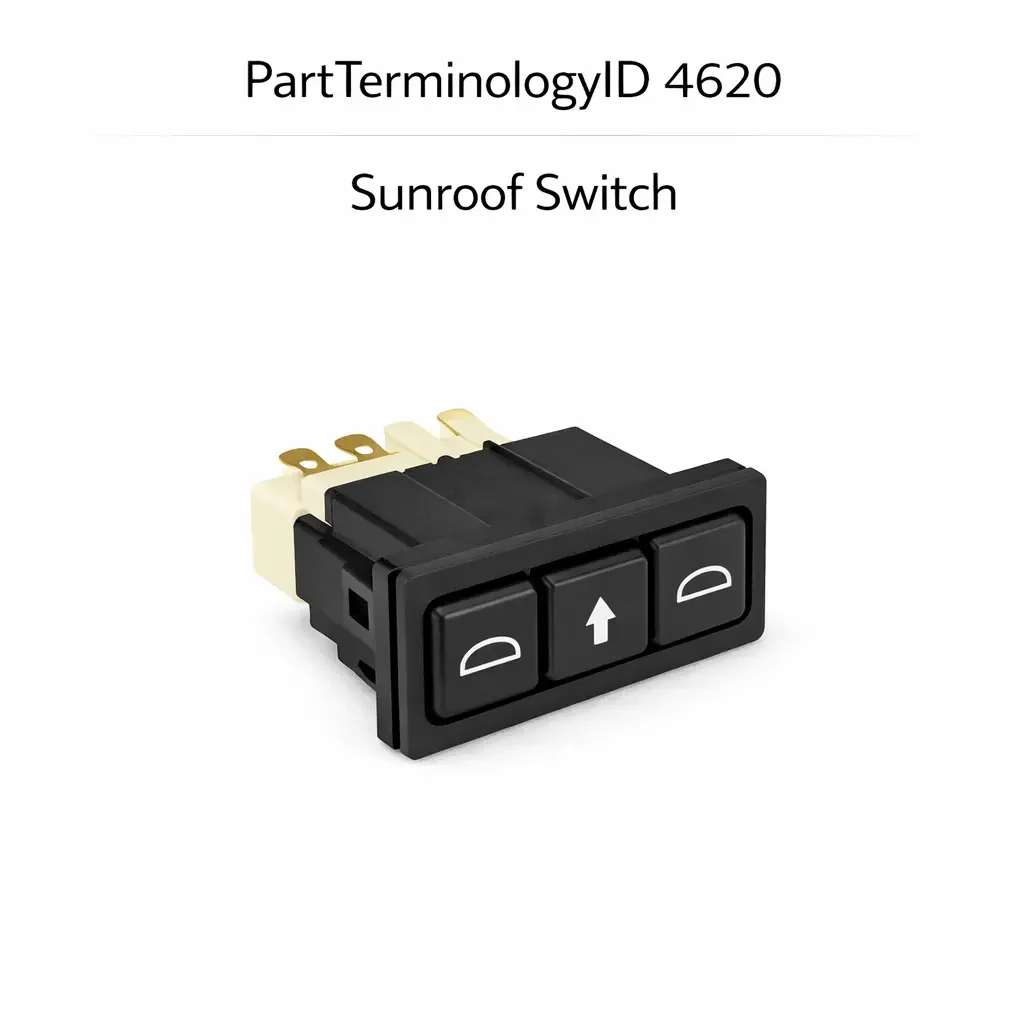
The sunroof switch is the driver's control interface for the power sunroof or moonroof system. Mounted in the headliner panel above the front seats or in the overhead console, it sends open, close, tilt, and in some cases slide and vent commands to the sunroof motor or sunroof control module. When it fails, the sunroof panel becomes either fixed in position or unresponsive to driver input, and on vehicles with an express open or express close feature, the automatic travel function may stop working while manual operation continues or ceases entirely.
The sunroof switch generates returns when it is selected without confirming the panel function count, the motor circuit architecture, and whether the vehicle's sunroof system uses a standalone motor or a dedicated sunroof control module. These three attributes determine compatibility more than vehicle year, make, and model alone, particularly on platforms where the sunroof system was revised across a production run or offered in multiple configurations within the same trim level.
What the Sunroof Switch Does
Open, Close, and Tilt Commands
The sunroof switch provides at minimum two commands: open and close. On tilt-capable sunroofs it adds a tilt command, typically produced by a dedicated button or by a second range of motion on the same rocker actuator. Each command produces a distinct electrical signal that the motor circuit or sunroof control module interprets as a direction command.
On basic systems the switch directly energizes the sunroof motor through a relay, applying voltage to the motor in the appropriate polarity for the commanded direction. On module-controlled systems the switch sends a low-current signal to the sunroof module, which then drives the motor through its own output circuit and manages express travel, anti-pinch reversal, and position tracking.
Express Open and Express Close
Many sunroof systems include an express function that drives the panel to the fully open or fully closed position with a single short press of the switch, without requiring the driver to hold the button. The express function is managed by the sunroof control module, which monitors motor current or a position sensor to determine when the panel has reached the endpoint. The switch triggers the express function through a specific input signal, typically a short press versus a long press on the same contact set.
A replacement switch that does not produce the correct signal format for the express input will disable the express function even if basic open and close commands work correctly. On systems where the express and manual commands share the same contact set and are distinguished only by press duration, the switch hardware is not the limiting factor. On systems where the express command uses a dedicated contact set, the replacement switch must include that contact set.
Anti-Pinch Input
On sunroof systems with anti-pinch protection, the sunroof module monitors motor current for an obstruction signature and reverses the panel if an obstruction is detected during closing. The switch is not directly involved in anti-pinch logic, but a switch that produces an incorrect or intermittent close signal can interfere with the module's ability to distinguish a normal close command from an obstruction event. A switch that produces a noisy or inconsistent signal during closing may cause the module to reverse the panel during normal operation as if an obstruction had been detected.
Design and Construction
Headliner-Mounted Rocker Switches
The most common sunroof switch design is a rocker or sliding actuator mounted flush in the headliner panel. The rocker pivots on a center axis and activates different contact sets depending on which end is pressed. A two-function rocker covers open and close. A three-function rocker or a rocker with an additional tilt button covers open, close, and tilt. The switch housing is designed to fit a specific headliner cutout and is retained by clips or a bezel retainer.
Overhead Console Integration
On vehicles with an overhead console containing map lights, garage door openers, and other controls, the sunroof switch is integrated into the console assembly. On some platforms the sunroof switch is a discrete replaceable module within the console. On others it is integrated into the console circuit board and the entire console must be replaced to service the switch. Confirm serviceability before ordering.
Illuminated Switches
Many sunroof switches include backlight illumination for visibility in low-light conditions. Illuminated switches have additional terminals for the lamp circuit. A non-illuminated replacement in an illuminated position will leave the switch dark and may generate a fault code on BCM-monitored lamp circuits.
Common Failure Modes
Contact Wear
The sunroof switch contacts wear with repeated use. Express open and express close commands are the most frequent single-press operations and their contact sets wear faster than tilt contacts on vehicles where tilt is used less often. Worn contacts produce a high-resistance connection that may cause the module to miss the command or misinterpret a long press as a short press, disabling the express function before the manual function fails.
Liquid Contamination
The overhead mounting position directly below the sunroof glass makes the switch vulnerable to water intrusion when the sunroof drain system is blocked or when the sunroof seal is degraded. Water that enters the headliner area can reach the switch connector and switch housing, depositing minerals on the contact surfaces and causing corrosion. A sunroof switch complaint that appears after a heavy rain or a car wash is often water intrusion related rather than mechanical wear.
Connector Corrosion
The headliner wiring connector for the sunroof switch is subject to moisture from the same water intrusion pathway. Corroded connector terminals produce intermittent switch signals that are difficult to reproduce consistently during diagnosis.
Symptoms of a Failing Sunroof Switch
Sunroof Does Not Respond to Any Input
A complete non-response to all switch inputs points to a power supply fault, a blown fuse, or a complete switch failure rather than a partial contact failure. Check the sunroof fuse before replacing the switch. If the fuse is intact and power and ground are confirmed at the switch connector, the switch has failed.
Express Function Does Not Work but Manual Operation Does
If the panel moves when the switch is held but does not travel to the endpoint on a short press, the express contact set or signal format is the fault. On module-controlled systems this may also indicate a module fault rather than a switch fault. Test the switch contact for the express input before condemning the module.
Sunroof Operates in One Direction Only
A single-direction fault, where the panel opens but does not close or closes but does not open, points to a specific contact set failure within the switch. Test the contact set for the non-functioning direction directly with a multimeter before replacing the switch.
Intermittent Operation
Intermittent response that correlates with temperature or recent rain points to contact contamination or connector corrosion rather than mechanical contact wear.
Cataloging Attributes: What to Confirm Before Listing
Panel function count: State the number of functions the switch controls: open and close only, open, close, and tilt, or open, close, tilt, and vent. A two-function switch installed in a three-function application leaves the tilt function without a control input. This is the most commonly omitted attribute in sunroof switch listings.
Motor circuit architecture: State whether the switch is for a direct motor control system or a sunroof control module signal input system. A direct motor control switch carries motor current through its contacts. A module input switch carries only signal current. These are not interchangeable and the circuit architecture must be stated.
Express function: State whether the switch supports express open and close and whether express is produced by the same contact set as manual or by a dedicated contact set. Buyers replacing a switch on an express-equipped vehicle need to confirm the replacement includes the express function.
Connector pin count and type: State the pin count. Sunroof switches range from 4-pin on basic two-function systems to 8-pin or more on fully featured systems with illumination and express contacts.
Illumination: State whether the switch includes backlight illumination.
Common Cataloging Mistakes
The most common mistake is listing sunroof switches without stating the panel function count. On platforms where both a basic open-close sunroof and a tilt-and-slide sunroof were offered as options, both configurations may share the same mounting location and connector but require different switches. A listing that does not state function count will generate returns from buyers with tilt-capable sunroofs who receive a two-function switch.
The second most common mistake is not distinguishing direct motor control switches from module input switches. These two types can be physically similar in appearance on some platforms but are electrically incompatible. A direct motor control switch installed on a module-controlled system will supply motor current directly to the module's signal input circuit, potentially damaging the module.
Diagnostic Process
Step One: Check the Fuse
The sunroof circuit fuse is the first thing to verify on a complete non-response complaint. A blown fuse disables all switch functions simultaneously and is a faster check than switch testing. If the fuse is blown, identify the cause before replacing it, as a fuse that blows again immediately indicates a short in the motor circuit or wiring rather than a switch fault.
Step Two: Confirm Power and Ground at the Switch
With the switch connector disconnected and the ignition on, measure voltage at the power supply terminal and continuity at the ground terminal. Absent power or ground at the connector points to a wiring fault or fuse issue upstream of the switch. Do not replace the switch until supply power and ground are confirmed.
Step Three: Test the Switch Contacts
With the switch removed and the connector disconnected, test each contact set with a multimeter in continuity mode. Actuate each switch position and confirm the expected contact pairs close. For express-function switches, test the dedicated express contact if present. Any contact set that fails to close during actuation confirms a switch fault for that function.
Step Four: Test the Motor Independently
If the switch tests correctly but the sunroof does not respond, test the motor by applying battery voltage directly to the motor terminals in both polarities. A motor that runs correctly when powered directly but not through the switch or module narrows the fault to the switch signal circuit or the module output. A motor that does not run when powered directly requires motor or mechanical drive system service.
Step Five: Scan for Module Faults
On module-controlled systems, connect a scan tool and check for DTCs in the sunroof module or BCM. Module codes referencing switch input circuits or motor output circuits direct the diagnosis to the specific fault area. Clear codes after repair and confirm they do not return through several full open and close cycles.
Frequently Asked Questions
My sunroof opens with express but will not close with express. Is the switch the cause?
A directional express fault, where one direction works but the other does not, can be caused by the switch contact for the non-functioning direction, the module's express logic for that direction, or the module's anti-pinch calibration triggering a reversal during the close cycle. Test the close contact set on the switch first. If it produces the correct signal, the fault is in the module's close express logic or anti-pinch calibration rather than the switch.
Can water damage cause the sunroof switch to fail permanently?
Yes. Water that reaches the switch contact surfaces deposits minerals that increase contact resistance. If the water intrusion event is severe or repeated, the contacts can corrode to the point where they no longer make electrical contact in one or more positions. The switch housing on most headliner-mounted sunroof switches is not designed to be waterproof, and a significant water intrusion event that reaches the switch typically requires switch replacement rather than cleaning. More importantly, the water intrusion pathway must be corrected before the new switch is installed, or the replacement will fail from the same cause.
Why does my sunroof reverse during closing even without an obstruction?
Unwanted reversal during closing without an obstruction present is almost always a module fault or a calibration issue rather than a switch fault. The anti-pinch system monitors motor current during closing and reverses the panel if current exceeds a threshold that indicates an obstruction. If the motor is worn and draws higher current than normal, or if the sunroof mechanism has increased friction from lack of lubrication, the current threshold may be exceeded during normal travel and the module will reverse the panel. Lubricating the sunroof track and resetting the module's learned endpoints through the initialization procedure is the correct approach before replacing any component.
Does the sunroof switch need initialization after replacement?
On direct motor control systems, no initialization is required. The switch connects directly to the motor and replacement is plug-and-play. On module-controlled systems the module may require an initialization procedure after any service that interrupts power to the system, including switch replacement. The initialization procedure, typically a specific sequence of switch presses with the ignition on, teaches the module the fully open and fully closed positions and calibrates the anti-pinch thresholds. Failure to initialize after replacement can result in the panel stopping short of the fully open or fully closed position or triggering false anti-pinch reversals. Confirm whether initialization is required for the specific application before completing the installation.
Status in New Databases
PIES/PCdb: PartTerminologyID 4620, Sunroof Switch
PIES 8.0 / PCdb 2.0: No change in PartTerminologyID or terminology label
Summary
The sunroof switch is a low-complexity component whose return rate is driven by two consistently omitted catalog attributes: panel function count and motor circuit architecture. Every listing for PartTerminologyID 4620 must state the number of functions the switch controls and whether it is designed for direct motor control or sunroof module signal input. Express function support and connector pin count are secondary attributes that must also be stated to prevent returns from buyers on express-equipped vehicles and to confirm connector compatibility before installation.