
Written by Arthur Simitian | PartsAdvisory
Introduction
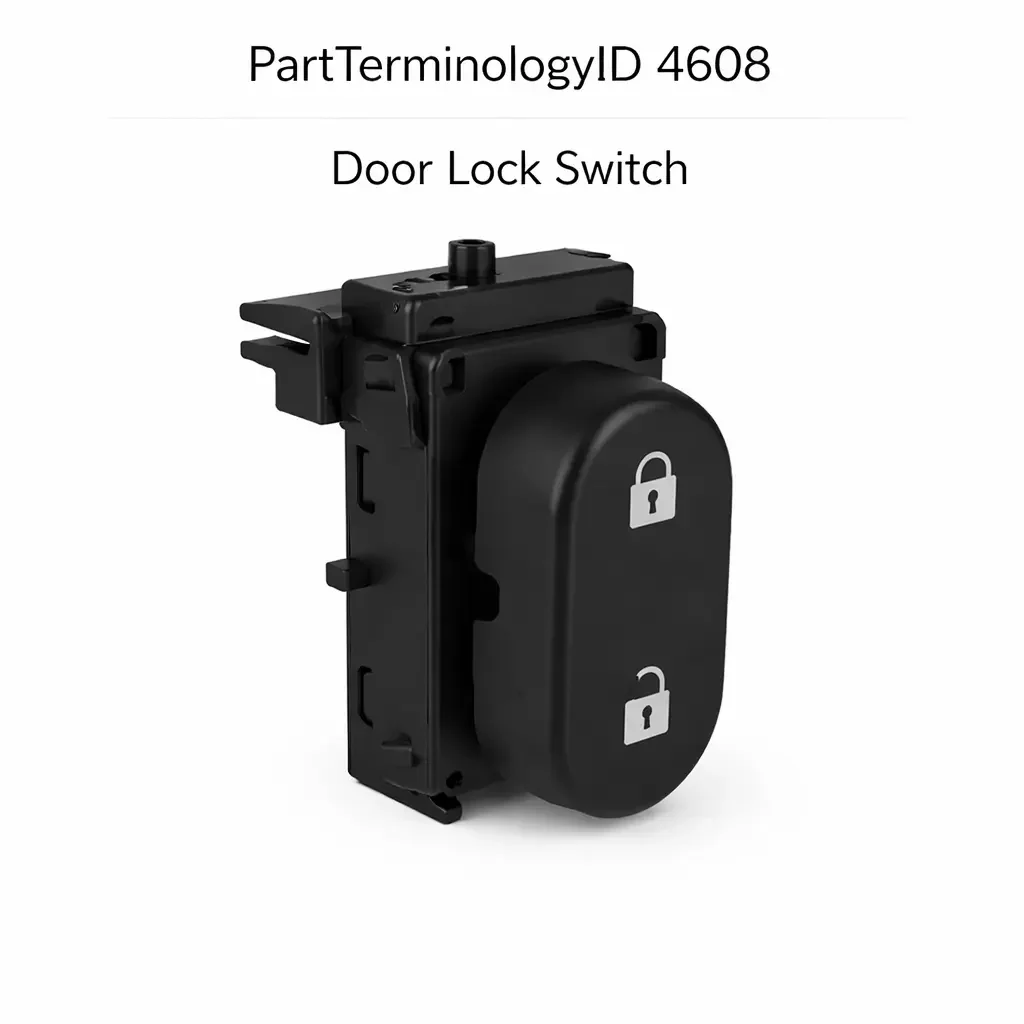
The door lock switch is the driver's primary interface with the vehicle's power door lock system. Mounted in the door panel armrest or center console, it is one of the most frequently used switches in the vehicle, activated multiple times on every trip. When it works correctly, it is invisible to the driver. When it fails, the inconvenience is immediate and the diagnostic path is less straightforward than it appears, because the door lock switch sits at the intersection of the mechanical lock actuator system, the body control module, and in modern vehicles, the passive entry and anti-theft systems.
Understanding PartTerminologyID 4608 fully requires understanding not just what the switch does at a basic level but how the circuit architecture differs across vehicle generations, how the BCM processes the switch input, and which specific attributes of the replacement switch must match the original to restore correct function. A door lock switch that looks identical to the original and physically fits the same mounting location can still fail to work if its internal circuit configuration does not match what the BCM expects.
The door lock switch is also one of the parts categories with the widest variation in internal design beneath a similar external appearance. Two rocker-style door lock switches from the same vehicle manufacturer, covering adjacent model years on the same platform, can have entirely different internal resistor values, different contact configurations, and different connector pinouts. This variation is what drives the return rate on this PartTerminologyID, and it is the reason that year, make, model, and door position alone are never sufficient catalog attributes for a door lock switch listing.
The shift toward BCM-controlled and multiplexed door lock systems has compounded this complexity. On vehicles from the early 1990s and before, a door lock switch was a simple two-direction momentary contact set. On a current luxury or near-luxury platform, the switch module is a microcontroller-based LIN bus node that must be recognized by the BCM before it will function. These two products share a PartTerminologyID and a part name but have almost nothing else in common, which makes the circuit architecture attribute not just important but foundational for every listing.
This guide covers the full picture: switch function, design variations, failure modes, diagnostic process, cataloging attributes that prevent returns, and the common mistakes that generate them.
What the Door Lock Switch Does
The door lock switch sends a command signal to the vehicle's door lock system when the driver or a passenger presses the lock or unlock button. On older vehicles with a simple relay-based power lock system, the switch directly controls the relay that energizes the door lock actuator motors. On modern vehicles with a body control module, the switch sends a signal to the BCM, which then commands the actuators.
Lock and Unlock Commands
The switch provides at minimum two distinct command states: lock and unlock. These are produced by two separate button positions or two separate rocker positions on a single rocker-style switch. Each command must produce a distinct, unambiguous electrical signal that the receiving circuit or BCM can differentiate reliably. A switch that produces the same signal for both commands, or produces an out-of-range signal for either, will cause incorrect or absent door lock response.
Driver Door Master Switch Functions
The switch assembly in the driver's door is typically a master switch that controls all doors simultaneously in addition to the driver's door individually. On vehicles where each door has individual lock and unlock control from the driver's position, the master switch assembly contains separate contact sets for each door zone. The number of contact sets, the number of terminals on the connector, and the internal wiring matrix of the master switch are all specific to the number of doors the vehicle has and the control architecture the BCM uses.
A master switch from a four-door application is not interchangeable with one from a two-door application even on the same vehicle platform, because the contact count and connector pinout differ.
Passenger Door Switches
Passenger door switches are simpler than the master switch. They typically control only the door in which they are installed and have a two-position rocker or button set with a smaller connector than the master. On some applications passenger switches are identical across all passenger doors. On others the rear door switch differs from the front passenger switch due to child lock integration or zone control differences.
Child Safety Lock Integration
Some door lock switch assemblies include a child lock indicator or a child lock disable function that prevents the rear door lock switches from operating when activated. This function is integrated into the switch assembly on some platforms and requires the replacement switch to include the correct contact set for the child lock circuit. A switch without the child lock contact installed in a position that requires it will leave the child lock indicator inoperative or generate a BCM fault.
Circuit Architecture Variations
The circuit architecture of the door lock switch is the single most consequential attribute for parts compatibility, and it is the attribute most commonly omitted from catalog listings.
Direct-Wired Relay Systems
On older vehicles, typically pre-2000 on most platforms, the door lock switch connects directly to the lock and unlock relays without an intermediate module. The switch supplies battery voltage or ground to the relay coil depending on the button pressed. The relay contacts then energize the actuator motors in the appropriate direction. In this architecture the switch carries relay coil current and must be rated for the coil current of the relay in the circuit.
Replacement switches for direct-wired relay systems must match the contact configuration exactly. A switch wired for a ground-switching circuit cannot replace one wired for a voltage-switching circuit without rewiring the connector, because the internal contact connections are reversed.
BCM-Controlled Systems
On modern vehicles the door lock switch sends a low-current signal to the BCM input circuit rather than directly switching relay coil current. The BCM processes the signal and commands the actuators through its own output drivers. In this architecture the switch carries only a small signal current, typically a few milliamperes, and the internal contact configuration is matched to the BCM's input circuit expectations.
Some BCM-controlled systems use a switched ground input: the switch connects the BCM input pin to ground when pressed, and the BCM detects the ground state as a command. Others use a switched voltage input: the switch connects the BCM input pin to a supply voltage when pressed. Still others use a resistor-coded input where different resistor values within the switch produce different voltage levels on a single input wire, allowing the BCM to distinguish lock from unlock and in some cases additional functions on a single wire pair.
Resistor-coded switches are the most common source of fitment failures in the modern aftermarket. The resistor values within the switch must exactly match the BCM's calibration. A switch with different resistor values will produce voltage levels the BCM either does not recognize or misidentifies as a different command.
Multiplexed and CAN Bus Systems
On the most modern vehicles, the door lock switch is part of a multiplexed switch module that communicates over the vehicle's LIN bus or CAN bus. The switch module contains its own microcontroller that monitors the switch state and transmits a digital message to the BCM when a button is pressed. In this architecture the replacement switch module must be compatible with the bus protocol and the message format the BCM expects. Generic switch assemblies that do not include the correct bus interface will not communicate with the BCM at all.
Design and Construction
Rocker Switch Design
The most common door lock switch design uses a rocker actuator that pivots on a central axis. Pressing one end of the rocker actuates the lock contact set and pressing the other end actuates the unlock contact set. The rocker returns to a center neutral position when released. Most rocker designs are momentary, meaning the contact set closes only while the button is held, though some designs latch in either position until the opposite end is pressed.
Button Array Design
Some vehicles use a button array rather than a single rocker, with separate lock and unlock buttons and in some cases additional buttons for window control, mirror adjustment, or other functions integrated into the same switch assembly. The door lock function is provided by a dedicated contact set within the array.
Illuminated Switches
Many door lock switches include indicator illumination, either a backlight for visibility in low-light conditions or a status indicator that reflects the current lock state. Illuminated switches have additional terminals for the lamp circuit. A non-illuminated replacement installed in a position requiring illumination will leave the switch dark and may generate a BCM fault if the BCM monitors the lamp circuit for continuity.
Switch Panel Integration
On vehicles where the door lock switch is part of an integrated door switch panel that also includes window switches, mirror controls, and seat adjustments, the door lock function cannot be serviced independently of the panel assembly on some applications. Confirm whether the door lock switch is available as a standalone component or only as part of the full panel assembly before ordering.
Common Failure Modes
Contact Wear
The door lock switch is used multiple times daily over the vehicle's lifetime. The internal contact surfaces wear with repeated actuation, developing increased resistance that produces weak or absent signals. On BCM-controlled systems a high-resistance contact produces a voltage level that falls outside the BCM's valid input range, causing the BCM to ignore the command. The failure is often intermittent in early stages, with the switch occasionally failing to produce a response before failing completely.
Contact Contamination
Spilled liquids are a frequent cause of door lock switch failure, particularly on the driver's door where drinks are common. Even a small amount of liquid entering the switch housing deposits sugar, salts, or other contaminants on the contact surfaces that increase resistance or cause contacts to stick. Cleaning is sometimes possible but the switch housing must be fully accessible for cleaning to be effective.
Connector Terminal Corrosion
The wiring connector on door lock switches, particularly on driver's door installations where the door is opened and closed frequently, is subject to flexing of the door harness and eventual wire fatigue or connector seal degradation. Corroded or loose connector terminals produce intermittent switch signals that are difficult to diagnose because the fault may not be present when the connector is manipulated during testing.
Broken Rocker or Button
Physical damage to the rocker actuator or individual buttons from heavy-handed operation or impact is a common cause of switch replacement. The mechanical actuator can crack or break, preventing it from depressing the contact plunger fully even when the contact surfaces are in good condition.
Illumination Failure
The lamp or LED element within an illuminated switch can fail independently of the switch contacts. This is a cosmetic failure that does not affect function but may prompt a switch replacement if the driver is unaware that the illumination and the switch function are separate elements. On BCM-monitored lamp circuits, a failed lamp may generate a fault code.
Symptoms of a Failing Door Lock Switch
All Doors Fail to Lock or Unlock from One Switch
If all doors fail to respond to commands from the driver's master switch but respond correctly to commands from individual door switches, the master switch is the most probable fault. Confirm by testing individual door switches first. If individual switches work correctly, the master switch circuit is at fault. Verify the connector and wiring before replacing the master switch.
One Door Fails to Respond
If one door fails to respond to any lock or unlock command, the fault is more likely in the actuator or wiring for that door than in the switch. The switch sends a command to the BCM for all doors simultaneously. If only one door fails to respond, the BCM is receiving the command but the actuator for that door is not responding.
Intermittent Response
Intermittent door lock response, where the locks operate correctly sometimes but not others, typically points to a contact or connector issue rather than a complete switch failure. Temperature-dependent intermittent faults, where the switch works when warm but fails when cold or vice versa, often indicate contact resistance issues that worsen at temperature extremes.
BCM Fault Codes for Door Lock Switch Input
On BCM-controlled systems, a fault in the door lock switch input circuit will generate a DTC referencing the door lock switch input. These codes typically distinguish between open circuit, short to ground, short to voltage, and signal out of range conditions, which helps direct the diagnosis to the specific fault type before any physical testing begins.
Diagnostic Process
Step One: Retrieve DTCs
Scan all modules for DTCs. BCM codes referencing door lock switch input circuits confirm the switch circuit as a suspect. Note which door zones are affected. On vehicles with multiple door switch inputs, a code that references a specific door zone input helps narrow the diagnosis to the switch for that zone rather than requiring testing of all switches simultaneously.
Step Two: Test at the Actuators
Before testing the switch, confirm the actuators are functional by commanding them through the scan tool if the BCM supports bidirectional control. If the actuators respond to scan tool commands but not to switch inputs, the fault is in the switch or its circuit. If the actuators do not respond to scan tool commands either, the fault is in the actuator circuit or the BCM output driver for that zone. This step prevents misdiagnosis of a switch fault when the actual problem is a failed actuator or BCM output.
Step Three: Inspect the Connector
Disconnect the switch connector and inspect all terminals. Look for green or white corrosion on terminal faces, bent or pushed-back pins, and evidence of moisture intrusion in the connector body. Test continuity from each terminal back to the BCM connector to confirm the wiring harness is intact. On driver's door applications, pay particular attention to the section of the harness that crosses the door hinge area, as this section flexes with every door opening and is prone to wire fatigue and insulation cracking on high-mileage vehicles. Repair any open or shorted circuits before replacing the switch.
Step Four: Test the Switch
With the connector disconnected, use a multimeter to test continuity between the relevant terminal pairs in the lock and unlock positions. For resistor-coded switches, measure resistance between the appropriate terminals in each position and compare to the specification from the service manual or the replacement part documentation. Any position that does not produce the expected value confirms a switch fault. For multiplexed switch modules, a multimeter test is not sufficient because the module must be powered and communicating on the bus to verify function. On these applications, substitution with a known-good switch is often the most practical diagnostic step.
Step Five: Verify BCM Input
On systems where the switch wiring tests correctly but the BCM still reports a fault, confirm the BCM input circuit is receiving the correct signal by measuring voltage at the BCM input pin while operating the switch. A correct signal at the BCM input that still produces a fault code indicates a BCM input circuit fault rather than a switch fault. Document this finding before recommending a BCM replacement, as BCM replacements typically require programming and are significantly more expensive than switch replacements.
Cataloging Attributes: What to Confirm Before Listing
These are the attributes most commonly missing or incorrect in catalog listings for PartTerminologyID 4608 and the ones most likely to cause a return.
Circuit architecture: State whether the switch is for a direct-wired relay system, a BCM signal input system, a resistor-coded single-wire system, or a multiplexed bus system. This is the most consequential attribute and the one most commonly absent from listings. A switch designed for a direct-wired relay system installed in a BCM signal input system will not function and may damage the BCM input circuit.
Resistor values for coded switches: For resistor-coded applications, state the resistance value for each button position. Two switches that appear identical and cover the same vehicle may have different resistor values if the BCM was revised across a production run. A listing that does not state the resistor values forces the buyer to measure the original switch before ordering, which is often not possible if the switch has already failed.
Number of buttons and functions: State the number of buttons and the functions each controls. A four-button switch assembly covering lock, unlock, window, and mirror is not interchangeable with a two-button assembly covering only lock and unlock, even if both physically fit the same mounting location.
Master versus passenger designation: State explicitly whether the switch is the driver's door master switch or a passenger door switch. These are not interchangeable. A passenger switch installed in the driver's master position will not provide all-door control.
Illumination: State whether the switch includes illumination and the lamp type if so. A non-illuminated switch installed in an illuminated position will generate a BCM lamp circuit fault on monitored systems.
Connector pin count and terminal type: State the pin count and connector body type. Door lock switches on the same vehicle platform may use different connectors for the master and passenger positions.
Common Cataloging Mistakes
The most common mistake is listing door lock switches by year, make, model, and door position without stating the circuit architecture. On platforms that were sold with both a basic relay-based lock system and a BCM-controlled system across trim levels or model years, a listing that does not distinguish between the two will generate returns from buyers on the non-default configuration. This mistake is most prevalent on domestic platforms from the mid-1990s through early 2000s where the transition from relay-based to BCM-controlled systems occurred mid-generation and both system types share the same vehicle application range.
The second most common mistake is listing a master switch assembly under a passenger door application or vice versa. The physical appearance of master and passenger switches can be similar on some platforms, and catalog entries based on physical appearance rather than circuit function will route the wrong part to a significant percentage of buyers. Master switch assemblies have more terminals and more internal contact sets than passenger switches. Installing a passenger switch in the master position will appear to work for the door in which it is installed but will not provide all-door control and will leave multiple BCM input circuits open.
The third mistake is omitting resistor values on coded switch applications and stating only the vehicle fitment. On platforms where the BCM was revised mid-production-run with a different resistor calibration, two switches that both correctly list the same vehicle will have different internal resistor values. Without the resistor values in the listing, the buyer cannot determine which one is correct for their specific production date vehicle. Production date breakpoints for resistor calibration changes should be included in the application note when this condition is known.
The fourth mistake is failing to distinguish between switch assemblies for vehicles with and without passive entry. On platforms where passive entry is an option rather than standard equipment, the door lock switch on a passive entry vehicle includes an additional input contact or a capacitive touch element for the exterior handle passive entry trigger. This contact or element is not present on the non-passive-entry switch. A non-passive-entry switch installed on a passive entry vehicle will disable the passive entry function even though power lock function works correctly, producing a complaint that can be difficult to trace back to the switch without knowing to look for the passive entry input contact.
The fifth mistake is treating all door positions as interchangeable on platforms where rear door switches differ from front passenger switches due to child lock integration. If the rear door switch includes a child lock indicator lamp circuit or an additional contact for the child lock status input, the front passenger switch cannot replace it without losing the child lock function. Application data must specify front passenger and rear passenger separately on these platforms rather than grouping all passenger doors under a single application entry.
Installation Overview
Door lock switch installation difficulty ranges from straightforward to moderately involved depending on whether the switch is a standalone rocker or part of an integrated door panel switch assembly.
Standalone Rocker or Button Switch
On vehicles where the door lock switch is a standalone unit mounted in the armrest or door panel, replacement typically involves prying the switch out of its mounting cutout with a trim tool, disconnecting the connector, and pressing the new switch into place. The connector is the primary concern on these applications. Inspect the connector terminals before plugging in the new switch, and apply a small amount of dielectric grease to the terminal faces to resist future moisture intrusion.
Integrated Door Switch Panel
On vehicles where the door lock switch is part of an integrated panel that also includes window switches, mirror controls, or other functions, the panel must be removed as a unit. This typically requires removing the door panel or at least releasing the armrest section. Most door panels are retained by a combination of plastic clips around the perimeter and one or two screws hidden under trim caps near the door handle and armrest. A dedicated trim panel removal tool prevents clip breakage.
With the panel loose, the switch assembly connector or connectors are accessible from behind. Disconnect all connectors before attempting to separate the switch panel from the door panel backing. On some platforms the individual switch modules within the panel are replaceable independently. On others the entire panel is a single assembly.
Post-Installation Verification
After installation, test all functions of the new switch before reassembling the door panel. Confirm lock and unlock commands operate all intended doors. On master switch assemblies, confirm each door zone responds to individual commands if the switch provides that capability. Confirm illumination if the switch includes it. On BCM-controlled systems, connect a scan tool and confirm no new DTCs are present before and after several lock and unlock cycles.
If the vehicle uses a resistor-coded switch and the new switch was selected based on resistor specification, measure the resistance across the appropriate terminals before installation to confirm the values match the specification. A five-minute check before installation prevents a full door panel removal if the wrong part was delivered.
Related Components and Systems
Door Lock Actuators
The door lock actuator is the electric motor or solenoid that physically moves the door lock mechanism. When a door lock switch command produces no response from a specific door, the actuator for that door is the most probable cause, not the switch. Actuator failures are more common than switch failures on high-mileage vehicles because the actuator contains moving mechanical parts subject to wear and the electric motor is subject to corrosion and winding failure.
Before replacing the door lock switch on a complaint where only one door fails to respond, test the actuator for that door directly by applying power and ground to its terminals. If the actuator does not move, replace the actuator. If it moves correctly when powered directly but does not respond to the switch, the fault is in the wiring between the BCM and the actuator or in the BCM output circuit for that door zone.
Body Control Module
The BCM is the central processor for the door lock system on modern vehicles. It receives switch inputs, applies the configured lock behavior (automatic locking, speed-dependent locking, unlock on ignition off, etc.), and commands the actuators. A BCM with a failed input channel or a failed output driver can produce symptoms that closely resemble a failed door lock switch or a failed actuator. Scan tool bidirectional control of the actuators is the most efficient way to isolate the fault to the switch, the BCM, or the actuator circuit.
Passive Entry System
On vehicles equipped with passive entry, the door lock switch interacts with the passive entry control module or the BCM passive entry logic. The switch may have an additional function that arms or disarms the passive entry system when the door handle is touched or when the lock button on the exterior door handle is pressed. A door lock switch replacement that does not include the passive entry input contact, if required, will leave the passive entry function inoperative even though basic power lock function works correctly.
Anti-Theft System
The Park position of the gear shift switch and the door lock switch state are both inputs to the anti-theft system on many vehicles. A door lock switch that produces an incorrect or absent lock confirmation signal may prevent the anti-theft system from arming correctly, which can result in the alarm activating unexpectedly or the system generating a fault code that appears unrelated to the door lock switch.
Frequently Asked Questions
Why do my door locks work from the key fob but not from the door switch?
This is a classic symptom of a failed door lock switch or its wiring rather than a BCM or actuator fault. The key fob communicates with the BCM through the RF receiver, bypassing the door lock switch circuit entirely. If the BCM receives the fob command and operates the actuators correctly, the BCM and actuators are functional. The fault is isolated to the switch or its wiring to the BCM input.
Can a failed door lock switch drain the battery?
In most cases no, because the switch only produces a momentary signal when pressed and does not draw current at rest. However, a switch with contacts stuck in the closed position on a direct-wired relay system will keep the relay coil energized continuously, which will draw enough current to discharge the battery over several hours. On BCM-controlled systems a stuck switch signal may keep the BCM in an active state that prevents it from entering sleep mode, producing a parasitic draw. If a parasitic draw complaint is accompanied by door lock anomalies, include the door lock switch circuit in the draw diagnosis.
My door locks work but make a grinding or clicking noise. Is the switch the cause?
No. The switch produces no mechanical noise. Grinding or clicking during door lock operation is caused by the actuator mechanism, a binding lock rod, or a worn door lock cylinder linkage. Replace or lubricate the actuator and linkage before concluding the door lock switch has any role in the noise.
Do I need to program a new door lock switch?
On most applications the door lock switch requires no programming. It is a passive input device that sends signals to the BCM, which contains the programmed behavior. The exception is multiplexed switch modules on some luxury and European platforms where the switch module communicates over LIN or CAN bus and may require initialization or configuration through the BCM programming interface. Confirm whether the specific application requires initialization before ordering to avoid a situation where a correctly specified switch cannot be activated without dealer-level programming access.
Why does only the rear passenger door fail to lock with the switch but lock correctly with the fob?
This is typically an actuator fault for that specific door rather than a switch fault, as noted above. However, on vehicles where the rear door has a child lock that is activated, the rear door lock actuator may be mechanically prevented from moving to the unlocked position by the switch command even though it moves correctly to the locked position. Check the child lock lever on the rear door edge before diagnosing an actuator or switch fault on a rear door that locks but will not unlock.
How long should a door lock switch last?
There is no defined replacement interval for door lock switches. On vehicles where the parking brake is used regularly and the door is operated normally, an OE switch can last the life of the vehicle. High-use scenarios, liquid contamination events, or physical damage are the most common causes of early replacement. The driver's door master switch is replaced more frequently than passenger switches due to higher use frequency. On vehicles used in commercial fleets or as ride-share vehicles, switch replacement at high mileage is not uncommon.
Status in New Databases
PIES/PCdb: PartTerminologyID 4608, Door Lock Switch
PIES 8.0 / PCdb 2.0: No change in PartTerminologyID or terminology label
Summary
The door lock switch is a high-use, frequently replaced component whose return rate is driven almost entirely by catalog attribute omissions rather than by part quality issues. The circuit architecture, resistor values for coded systems, master versus passenger designation, button count, and illumination status are the attributes that determine whether the replacement works correctly in the specific vehicle. A listing that states only year, make, model, and door position without these attributes will generate returns from every buyer whose vehicle has a non-default configuration.
The diagnostic process for a door lock switch complaint must follow a logical sequence: retrieve DTCs, confirm actuator function through the scan tool, inspect the wiring and connector, test the switch directly, and verify the BCM input signal before concluding the switch is the fault. Skipping steps in this sequence leads to unnecessary switch replacements when the actual fault is in the actuator, the wiring, or the BCM output circuit.
PartTerminologyID 4608, Door Lock Switch, covers a wide range of switch designs across vehicle generations and body configurations. Correct cataloging requires distinguishing between direct-wired relay systems and BCM signal input systems, stating resistor values where applicable, clearly designating master versus passenger applications, and noting passive entry compatibility where relevant. These distinctions are what separate a listing that drives confident purchases from one that drives returns.