
Written by Arthur Simitian | PartsAdvisory
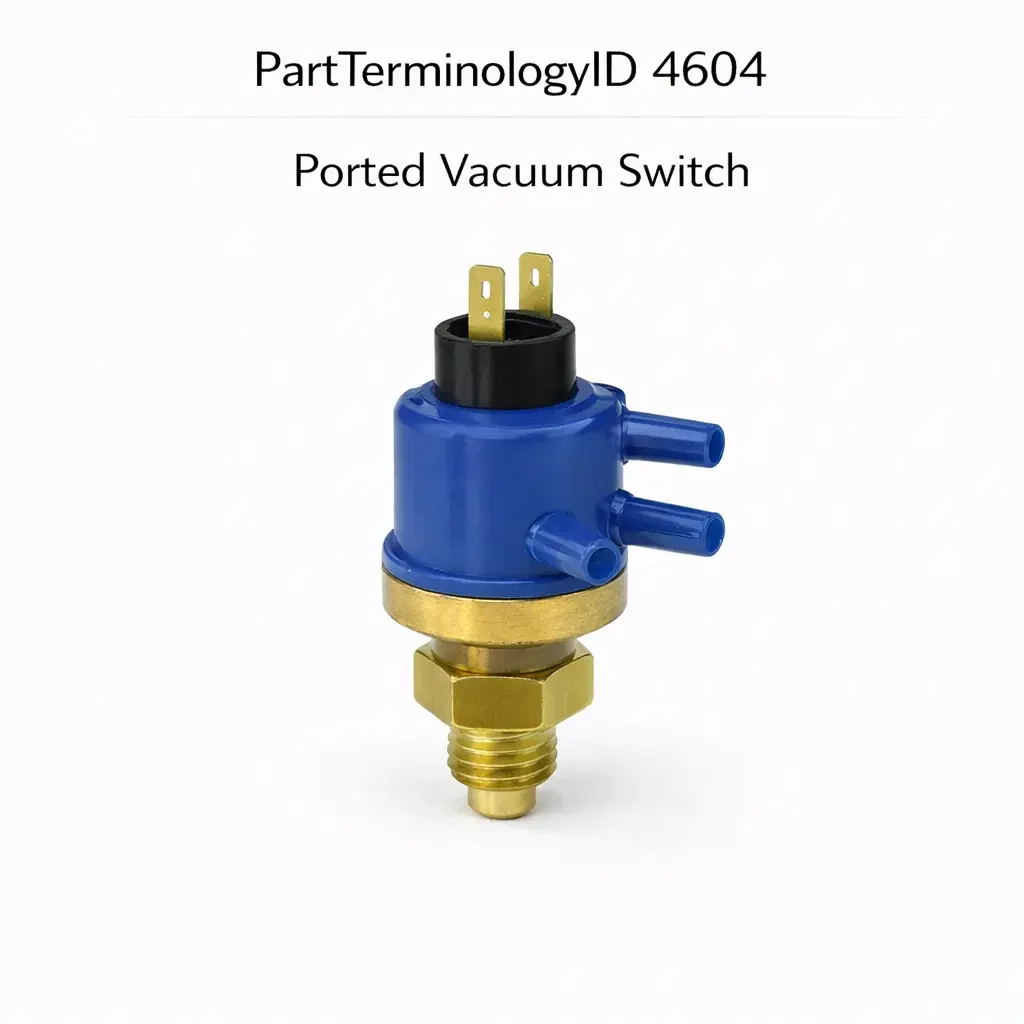
PartTerminologyID 4604, Ported Vacuum Switch, is a thermostatic vacuum control valve mounted in the engine coolant passage that opens or closes a vacuum signal port based on coolant temperature, routing ported vacuum from the carburetor or throttle body to a connected emissions or ignition component when coolant temperature crosses the switch's calibrated threshold. The switch does not carry electrical current. It controls vacuum flow mechanically through a temperature-sensitive bimetallic or wax-element actuator that opens the internal valve at the calibrated temperature and closes it below that threshold, or vice versa depending on the switch type.
The vacuum signal controlled by the switch is routed to components including the exhaust gas recirculation valve, the distributor vacuum advance unit, the thermostatic air cleaner actuator, and the evaporative emissions purge circuit depending on the application. Each of these components depends on receiving the vacuum signal at the correct coolant temperature to function within the parameters defined by the emissions calibration for that engine and model year.
What Makes This Part Generate Returns
Returns on PartTerminologyID 4604 come from three sources: the wrong temperature activation threshold for the application, the wrong number of vacuum ports, and the wrong vacuum flow direction (normally open versus normally closed).
Temperature threshold is the most common mismatch. Ported vacuum switches are calibrated to open or close at a specific coolant temperature, typically expressed in degrees Fahrenheit or Celsius on the part specification. A switch calibrated to open at 125 degrees Fahrenheit installed in an application requiring a 160-degree threshold will route vacuum to the EGR valve or distributor advance at a lower coolant temperature than the emissions calibration requires, causing EGR operation during cold warm-up, rough idle, and a failed emissions test. The temperature threshold must match the OE specification exactly and must be confirmed before ordering.
Port count is the second mismatch source. Ported vacuum switches are available in two-port and three-port configurations. A two-port switch connects one vacuum source to one output. A three-port switch connects one vacuum source to two outputs or switches between two vacuum sources to one output depending on the design. Installing a two-port switch in a three-port application leaves one vacuum line unconnected, causing a vacuum leak and incorrect operation of the component on the unconnected port.
Normally open versus normally closed is the third mismatch. A normally open switch passes vacuum below the activation temperature and blocks it above. A normally closed switch blocks vacuum below the activation temperature and passes it above. The correct type is determined by the function of the connected component and the emissions strategy for the specific engine. Installing the wrong type reverses the vacuum signal timing relative to coolant temperature and produces incorrect component behavior at every operating condition.
Cataloging Attributes: What to Confirm Before Listing
These are the attributes most commonly missing or incorrect in catalog listings for PartTerminologyID 4604 and the ones most likely to cause a return if omitted.
Temperature activation threshold: State the opening or closing temperature in both Fahrenheit and Celsius. Do not list only the part number without the threshold value. A buyer replacing a failed switch on a vehicle with no service history cannot verify the correct threshold from the failed part and depends entirely on the catalog data.
Number of vacuum ports: State two-port or three-port explicitly. Do not assume the port count is implied by the application. Multiple switch designs exist for the same vehicle application across model years and emission package variations.
Flow direction: State normally open or normally closed explicitly. This is the attribute most often omitted from aftermarket listings and the one that produces the least obvious symptom when wrong, because the switch functions mechanically and passes a basic inspection without revealing the directional error until the vehicle is tested on a dynamometer or emissions analyzer.
Thread specification: State the coolant passage thread diameter, pitch, and thread form. Ported vacuum switches use both metric and NPT threads depending on the engine family. A switch with the correct function but the wrong thread will either not seal in the coolant passage or will cross-thread and damage the passage on installation.
Vacuum port fitting size: State the vacuum port diameter in millimeters or inches. Vacuum hose sizes vary across applications and a fitting that does not match the hose inside diameter will either not accept the hose or produce a leak at the connection.
Common Cataloging Mistakes
The most common mistake is listing ported vacuum switches by year, make, model, and engine displacement alone without stating the temperature threshold or flow direction. Two switches that cover the same vehicle application but are calibrated for different emission packages or different model year emission revisions will have different thresholds and potentially different flow directions. A listing that does not distinguish between them will generate returns from buyers whose vehicle has the non-default emission package.
The second most common mistake is conflating the ported vacuum switch with the coolant temperature switch or the thermal vacuum valve. These are distinct components with different functions. The ported vacuum switch controls a vacuum signal based on temperature. The coolant temperature switch controls an electrical circuit based on temperature. The thermal vacuum valve may perform a similar vacuum control function but is typically a different physical design and is cataloged under a different PartTerminologyID. Listings that cross-reference these components as equivalent will produce returns.
Status in New Databases
PIES/PCdb: PartTerminologyID 4604, Ported Vacuum Switch
PIES 8.0 / PCdb 2.0: No change in PartTerminologyID or terminology label
Summary
PartTerminologyID 4604, Ported Vacuum Switch, is a low-cost component with a high return rate when cataloged without its three critical attributes: temperature activation threshold, port count, and flow direction. Every listing must state all three explicitly. A switch that is wrong on any one of these attributes will produce incorrect emissions system behavior, a failed emissions test, or a vacuum leak, and the buyer will return it. State the thread specification and vacuum port fitting size as secondary attributes to prevent installation failures. Do not conflate the ported vacuum switch with the coolant temperature switch or thermal vacuum valve.