
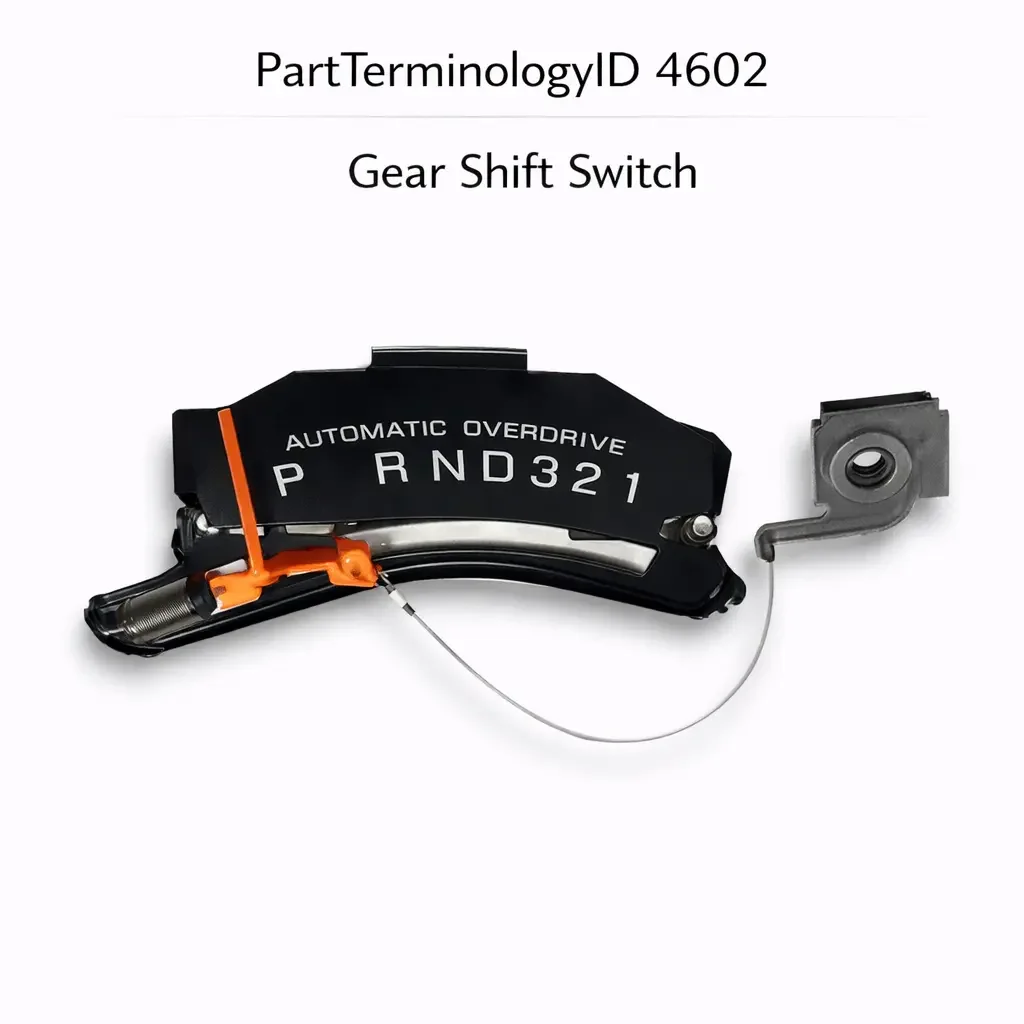
Written by Arthur Simitian | PartsAdvisory
Introduction
The gear shift switch is the electrical interface between the driver's gear selector input and the vehicle's transmission control and safety systems. Every time a driver moves the shift lever from Park to Drive, from Drive to Reverse, or through any position in the selector range, the gear shift switch translates that mechanical movement into an electrical signal that the transmission control module, the body control module, the powertrain control module, and the instrument cluster all depend on to function correctly.
When the gear shift switch works as designed, the vehicle starts only in Park or Neutral, the reverse lights illuminate when Reverse is selected, the speedometer and odometer receive the correct gear context, and the transmission control module applies the correct shift logic for the selected range. When the switch fails, any one of these systems can behave incorrectly, and the resulting symptoms range from a vehicle that will not start in any position to a transmission that shifts erratically or a backup light circuit that stays on regardless of gear selection.
Understanding the gear shift switch fully, what it does, how it is constructed, how it fails, and what attributes determine correct replacement fitment, is essential for anyone diagnosing a shifting or starting complaint or selecting a replacement part. This guide covers all of it.
What the Gear Shift Switch Does
The gear shift switch, also referred to in some catalogs and service manuals as the transmission range sensor, neutral safety switch, inhibitor switch, or park/neutral position switch depending on the application and the specific functions the switch performs, serves several distinct electrical functions simultaneously.
Starter Interlock Function
The most safety-critical function of the gear shift switch is the starter interlock. On all automatic transmission vehicles, the starter circuit is routed through the gear shift switch so that the starter motor can only be energized when the transmission is in Park or Neutral. This prevents the vehicle from lurching forward or backward under starter motor torque if the driver attempts to start the engine with a gear engaged.
The interlock is implemented either as a direct switched circuit between the ignition switch and the starter relay or as a signal to the body control module or powertrain control module, which then permits or denies the start request based on the switch input. On older vehicles the direct switched circuit is the norm. On modern vehicles with smart start systems, push-button start, or integrated BCM start control, the signal-to-module approach is more common.
Reverse Light Circuit
The gear shift switch controls the reverse light circuit on most automatic transmission applications. When the driver selects Reverse, a dedicated contact set within the switch closes the reverse light circuit, illuminating the white reverse lamps at the rear of the vehicle. This function is safety-related because reverse lights warn pedestrians and other drivers that the vehicle is moving or preparing to move rearward.
On some applications the reverse light circuit is handled by a separate dedicated reverse light switch rather than by the gear shift switch. In these cases the gear shift switch handles the remaining functions and the reverse light switch handles only the lamp circuit. Both components must be in good condition for the full system to function correctly.
Gear Position Signal to the Transmission Control Module
On electronically controlled automatic transmissions, the gear shift switch provides a multi-position signal that tells the transmission control module which range the driver has selected. The TCM uses this signal to apply the correct hydraulic circuit logic, permit or restrict specific gear ratios, and manage torque converter lockup and shift timing in a way that matches the driver's intent.
The signal format varies by application. Some systems use a simple resistor ladder inside the switch that produces a unique analog voltage for each selector position. Others use a pattern of switched ground or switched voltage signals across multiple signal wires, producing a binary code that the TCM decodes to identify the selected range. Still others use a digital output over the vehicle's CAN bus or LIN bus. The replacement switch must match the signal format of the original for the TCM to interpret the position correctly.
Park Position Signal for Anti-Theft and Accessory Control
Many vehicles use the Park position signal from the gear shift switch as an input to the anti-theft system, the automatic door lock system, or the accessory power control logic. A vehicle that loses the Park signal may not lock the doors automatically on shift into Park, may not enable certain accessory circuits that are Park-only, or may generate a stored fault code in the anti-theft or BCM that appears unrelated to the transmission at first glance.
Instrument Cluster Gear Position Display
On vehicles with a gear position indicator in the instrument cluster or a shift indicator display on the center console, the gear shift switch provides the signal that drives the display. A switch that produces an incorrect or intermittent position signal will cause the display to show the wrong gear, flash between positions, or go blank. Drivers sometimes notice the instrument cluster display anomaly before they notice any drivability issue, making it an early warning of switch degradation.
Design and Construction
Gear shift switches are built in several configurations depending on the transmission type, the selector mechanism, and the functions the switch is required to perform.
Column-Shift Switches
On vehicles with a column-mounted shift selector, the gear shift switch is typically mounted on the steering column near the base of the shift lever. A cam or actuator rod attached to the shift lever rotates or translates as the lever moves through its positions, actuating the switch contacts at each defined position. Column-shift switches are common on trucks, vans, and full-size sedans with traditional column shifters.
Floor Console Switches
On vehicles with a floor-mounted shift console, the switch is mounted at the base of the selector lever assembly inside the console. The switch body is typically oriented vertically or at an angle to align with the lever's range of motion. Access requires removal of the console trim in most applications.
Transmission-Mounted Switches
On many modern vehicles, particularly those with electronically controlled transmissions, the gear shift switch or transmission range sensor is mounted directly on the transmission case at the manual valve shaft. The switch body engages a detent plate or cam on the manual shaft and rotates with the shaft as the driver moves the selector lever. Because this location is on the transmission itself, the switch is exposed to transmission fluid heat, vibration, and in some configurations, transmission fluid contact. Transmission-mounted switches are more robustly constructed than interior-mounted units to withstand these conditions.
Internal Transmission Switches
Some automatic transmissions integrate the range sensor entirely within the transmission valve body or control module assembly. These are not serviceable as standalone components in the same way as externally mounted switches and require specific procedures defined in the transmission service documentation.
Contact Architecture
Inside the switch housing, the contact architecture varies by the number of functions the switch performs. A basic switch with only a starter interlock and reverse light function may have as few as three terminals. A full-range position switch providing individual signals for Park, Reverse, Neutral, Drive, and manual range positions may have eight or more terminals. The internal contact pattern, the number of positions, and the contact material all affect the switch's compatibility with a specific application.
Common Failure Modes
Contact Wear and Resistance Increase
The most common failure mode in any mechanical switch is degradation of the internal contact surfaces. In the gear shift switch, the contacts experience wear each time the selector is moved, and the contact surfaces develop oxidation, carbon deposits, and pitting over time. As contact resistance increases, signal voltages drop, the TCM receives out-of-range inputs, and fault codes are generated.
Corrosion on Transmission-Mounted Units
Transmission-mounted switches are particularly vulnerable to corrosion. Even though the switch housing is sealed, small amounts of moisture can enter through the wiring connector or through housing seal degradation over time. On vehicles operated in regions with road salt, the connector terminals corrode faster than the switch contacts, often making a wiring repair necessary alongside the switch replacement.
Physical Damage from Misadjustment
Many gear shift switches, particularly transmission-mounted units, require precise alignment between the switch body and the manual valve shaft detent positions. If the switch is even slightly out of alignment, the contact pattern does not correspond correctly to the actual gear positions. The vehicle may behave as if it is in the wrong gear, or the starter interlock may prevent starting in what the driver believes is Park when the switch is reading an adjacent position.
Misadjustment is common after transmission service or any repair that involves removing the shift linkage. It is not a switch failure in the internal sense but produces identical symptoms and must be addressed by realignment before or instead of switch replacement.
Wiring Connector Damage
The multi-pin connectors used on gear shift switches, particularly on transmission-mounted units where connector access is limited, are prone to terminal damage during removal and installation. Bent or pushed-back terminals produce intermittent connections that are difficult to diagnose because they may produce normal readings when the connector is manipulated during testing but fail again under road vibration.
Age-Related Housing Degradation
On older vehicles, the plastic switch housing can become brittle and crack under normal operating stress. A cracked housing on a transmission-mounted switch may allow transmission fluid to enter the switch body, contaminating the contacts. A cracked housing on an interior-mounted switch exposes the contacts to moisture and debris from the vehicle cabin.
Symptoms of a Failing Gear Shift Switch
Vehicle Will Not Start in Park or Neutral
This is the most disruptive symptom and the one most likely to leave a driver stranded. If the starter interlock contacts within the switch fail to close correctly in Park or Neutral, the starter circuit remains open and the engine will not crank. The driver may try multiple selector positions, sometimes finding that the engine will start in a position adjacent to Park (indicating misadjustment) or in no position at all (indicating contact failure).
Before replacing the switch, verify the shift linkage adjustment and confirm the selector is actually reaching the full Park detent. A stretched or misadjusted cable can prevent the selector from fully reaching Park even when the lever appears to be in the correct position.
Reverse Lights Do Not Work or Stay On Continuously
A reverse light circuit that does not activate in Reverse, or one that stays illuminated regardless of gear position, points to the reverse light contact set within the gear shift switch. This symptom is sometimes dismissed as a bulb issue, but if both reverse lights are affected simultaneously, the switch is the more probable cause.
A switch with contacts welded in the closed position will keep the reverse lights on in all gear positions. This is both a safety concern because it confuses drivers behind the vehicle and a legal concern in jurisdictions that treat continuously illuminated reverse lights as a lighting violation.
Erratic Transmission Shifting or Wrong Gear Displayed
If the gear position signal to the TCM becomes intermittent or produces incorrect codes, the transmission may shift at the wrong points, refuse to enter overdrive, or exhibit harsh shifts. The instrument cluster gear display may show the wrong position or flicker between positions. These symptoms can be mistaken for a transmission mechanical fault or a TCM fault, leading to expensive misdiagnosis.
A scan tool that can display TCM live data will typically show the gear position signal as reported by the switch. Comparing the displayed gear position to the actual selector position through the full range of motion is one of the most efficient diagnostic steps for a suspected gear shift switch fault.
Transmission Control Module Fault Codes
The TCM monitors the gear position signal for plausibility. If the signal falls outside the expected voltage range, shows an invalid combination of contact states, or changes too rapidly to correspond to a physical gear change, the TCM will log a DTC. Common code categories include transmission range sensor circuit faults, invalid range signal, and shift position sensor performance. These codes do not always point exclusively to the switch, as wiring faults can produce identical codes, but they direct the diagnosis to the switch circuit.
Diagnostic Process
Step One: Retrieve and Document All DTCs
Before any physical inspection, retrieve DTCs from the TCM, BCM, and PCM. Document all codes present. Transmission range sensor codes confirm the switch circuit as a suspect. Codes in other modules that reference gear position or Park status provide additional context.
Step Two: Observe Live TCM Data
With a scan tool capable of accessing TCM data, select the transmission range sensor input parameter and cycle the selector through all positions. The displayed position should match the actual selector position at every point. Any mismatch, gap, or position that fails to register confirms the switch is not producing the correct signal for that position.
Step Three: Inspect the Wiring and Connector
Disconnect the switch connector and inspect all terminals for corrosion, damage, or pushed-back pins. Measure resistance on each wire between the connector and the relevant module to identify any open circuits or shorts. Repair any wiring faults before replacing the switch.
Step Four: Test the Switch Directly
With the switch connector disconnected, use a multimeter to test continuity between the relevant terminal pairs in each selector position. Compare the results to the expected contact pattern from the vehicle service manual. Any position that does not produce the expected continuity pattern confirms a switch fault.
Step Five: Check Adjustment
On transmission-mounted switches with an adjustable mounting, verify alignment before condemning the switch. Many manufacturers provide an adjustment procedure that uses the Park position detent as a reference. Correct alignment and retest before ordering a replacement.
Replacement Considerations
Signal Format Compatibility
The single most important attribute when selecting a replacement gear shift switch is signal format compatibility with the TCM. A switch that produces a resistor-ladder analog voltage output is not interchangeable with one that produces a digital switched-ground pattern, even if both physically fit the same mounting location. Confirm the signal type from the service manual or by comparing part numbers before ordering.
Number of Positions
Confirm the number of selector positions the switch must cover. A switch designed for a four-position selector (P, R, N, D) is not the same as one for a six-position selector (P, R, N, D, 2, 1) even on the same transmission family if the overdrive or manual range positions require additional contact sets.
OE Versus Aftermarket
Gear shift switch signal calibration is tightly coupled to the TCM's input expectations. Original equipment switches are the safest choice for ensuring the signal output precisely matches the TCM's calibration. Quality aftermarket options from reputable suppliers that specify exact OE signal compatibility are acceptable alternatives. Generic or unbranded switches with no signal specification data should be avoided for this application.
Adjustment Requirement
Many transmission-mounted switches require adjustment after installation. Confirm whether the replacement requires adjustment and obtain the specific procedure before beginning the installation. Installing a correctly specified switch without correct alignment produces the same symptoms as installing the wrong switch.
Installation Overview
Installation procedures differ significantly between interior-mounted and transmission-mounted switches, and the correct approach for each type must be followed to avoid misalignment or connector damage.
Interior-Mounted Switches
For column-shift applications, access typically requires removing the steering column trim panels and, on some vehicles, the lower instrument panel cover. The shift lever must be placed in a specific position before the switch is disconnected, because the actuating cam or rod must be in a known reference position to correctly set the new switch. Refer to the service manual for the required selector position during removal and installation.
For floor console switches, the console trim surrounding the shift lever must be removed. On most applications this involves prying up the shift boot trim ring, removing retaining screws under the trim, and lifting the console section away. The switch is typically retained by two screws and has a multi-pin connector. Replacement is straightforward once the console is open, but adjustment must be verified after installation before the console is reassembled.
Transmission-Mounted Switches
Transmission-mounted switch replacement requires access to the side of the transmission, which on front-wheel-drive transaxle applications may require lifting the vehicle and working from underneath. On rear-wheel-drive applications the switch is often accessible from above on inline engines but may require working from below on some configurations.
Before removing the switch, place the selector in the Park position and note the relationship between the switch body and the reference mark on the transmission case or detent plate. Some switches have a dedicated alignment slot or hole that is used with a specific alignment pin or drill bit during installation.
After installing the new switch and before tightening the mounting fasteners, perform the adjustment procedure. The most common procedure involves rotating the switch body until the alignment slot aligns with the reference hole in the switch body at the Park position detent, then inserting the alignment pin to hold the position while the fasteners are torqued. Remove the alignment pin, reconnect the connector, and verify operation through all positions before final assembly.
Any time the shift linkage is disconnected during transmission-mounted switch replacement, confirm linkage adjustment after the switch is installed. Linkage adjustment and switch alignment are independent procedures, both of which must be correct for the switch to produce accurate position signals.
Post-Installation Verification
After any gear shift switch replacement, cycle the selector through all positions with a scan tool connected and confirm the TCM live data shows the correct gear position at each detent. Confirm the starter activates only in Park and Neutral. Confirm reverse lights illuminate only in Reverse. Clear any stored DTCs and road test the vehicle to confirm they do not return.
Related Components and Systems
Shift Linkage and Cable
The shift linkage or cable connects the selector lever to the manual valve shaft on the transmission. If the linkage is stretched, bent, or out of adjustment, the manual valve shaft will not reach the correct position at each detent, and the gear shift switch will produce incorrect signals even if the switch itself is in perfect condition. Always verify linkage adjustment as part of any gear shift switch diagnosis.
Transmission Control Module
The TCM is the module that processes the gear shift switch signal and applies the correct transmission behavior based on the selected range. A TCM with a faulty input circuit can produce symptoms identical to a failed switch, and replacing the switch will not resolve the problem. If the switch tests correctly and the wiring is sound but the TCM still reports a fault, the TCM input circuit should be tested before the TCM is replaced.
Neutral Safety Relay
On some older applications, a dedicated neutral safety relay is used in conjunction with the gear shift switch to control the starter circuit. The switch controls the relay coil, and the relay contacts carry the starter current. A failed relay will prevent starting even if the switch is functioning correctly. Testing the relay is a quick step that should be included in any no-start diagnosis on applications that use this design.
Reverse Light Relay
Similarly, some applications route the reverse light circuit through a relay rather than directly through the switch contacts. On these vehicles a failed reverse light relay will prevent the reverse lights from functioning even with a good switch signal. Confirm whether a relay is present in the reverse light circuit before condemning the switch based on reverse light symptoms alone.
Body Control Module
On modern vehicles where the BCM manages the starter interlock and processes the Park position signal for door lock and accessory control functions, a BCM fault can produce symptoms that overlap with a gear shift switch fault. If the switch and wiring both test correctly but BCM-related symptoms persist, the BCM input circuit and software calibration should be reviewed.
Frequently Asked Questions
Why does my car sometimes start in Drive but not in Park?
This is a classic symptom of a misadjusted gear shift switch rather than a failed one. If the switch alignment is off by a small amount, the Park position contact may not close fully at the Park detent, but an adjacent position may happen to close the contact due to the misalignment. Adjustment correction resolves this without requiring a new switch.
Can I bypass the gear shift switch to start my car in an emergency?
On older vehicles with a direct wired starter interlock, it is physically possible to jump the switch terminals to allow the starter to operate regardless of gear position, but doing so removes the safety interlock entirely. The vehicle can then be cranked with any gear engaged, which creates a serious risk of unexpected movement. This should only be done as a temporary measure by someone who is fully aware of the risks and is keeping the vehicle stationary and supervised. It is not a repair and must not be left in place.
Will a bad gear shift switch damage the transmission?
The switch itself does not cause mechanical damage to the transmission. However, if the TCM receives an incorrect gear position signal and applies incorrect shift logic as a result, the transmission may shift at inappropriate times or hold gears longer than intended, which can increase wear over time. More immediately, an incorrect signal can cause the transmission to operate in a limp-home mode that limits available gear ratios, which is disruptive but not directly damaging in the short term.
Is the gear shift switch the same as the neutral safety switch?
The terms are often used interchangeably in consumer language, but there is a technical distinction. The neutral safety switch refers specifically to the starter interlock function, which allows starting only in Park or Neutral. The gear shift switch, transmission range sensor, or inhibitor switch typically refers to the complete assembly that also includes the reverse light contact set and the multi-position gear signal contacts. On many vehicles a single assembly performs all of these functions and may be called by any of these names in different service publications.
How do I know if my transmission range sensor needs adjustment versus replacement?
If the symptoms appeared after transmission service, linkage work, or any repair that involved moving the selector mechanism, adjustment is the first thing to check. If the symptoms appeared gradually over time with no recent service, or if the switch has failed the direct multimeter continuity test, replacement is indicated. In practice, it is worth performing the adjustment procedure on a transmission-mounted switch even when replacing it, because the new switch must be aligned correctly to function.
Can a gear shift switch cause the check engine light to come on?
Yes. On vehicles where the PCM monitors the gear position signal as part of its fuel and ignition management logic, an out-of-range or implausible gear position signal can set a DTC that illuminates the check engine light. This is more common on vehicles where the PCM and TCM share a processor or where the PCM uses gear position data for torque management. The code stored will typically reference the transmission range sensor input circuit, directing the diagnosis to the switch or its wiring.
Status in New Databases
PIES/PCdb: PartTerminologyID 4602, Gear Shift Switch
PIES 8.0 / PCdb 2.0: No change in PartTerminologyID or terminology label
Summary
The gear shift switch is a multi-function electrical component that simultaneously controls the starter interlock, the reverse light circuit, the gear position signal to the transmission control module, and in many applications the instrument cluster gear display and ancillary BCM functions. Failure at any of the contact sets within the switch can produce symptoms that range from a no-start condition to erratic transmission behavior to a continuously illuminated reverse light.
Accurate diagnosis requires retrieving TCM fault codes, observing live gear position data with a scan tool, testing the switch contacts directly with a multimeter, and verifying correct adjustment before and after any replacement. Selecting the correct replacement requires confirming signal format, number of positions, and connector compatibility.
PartTerminologyID 4602, Gear Shift Switch, covers the full range of switch designs used across automatic transmission applications. Matching the replacement to the vehicle's specific TCM signal requirements and selector position count ensures the transmission control system receives the accurate, unambiguous input it needs to operate correctly.