
Overdrive Kickdown Switch (PartTerminologyID 4596): Throttle Position Activation Geometry, Contact Configuration, and Transmission Control Circuit Compatibility
Written by Arthur Simitian | PartsAdvisory
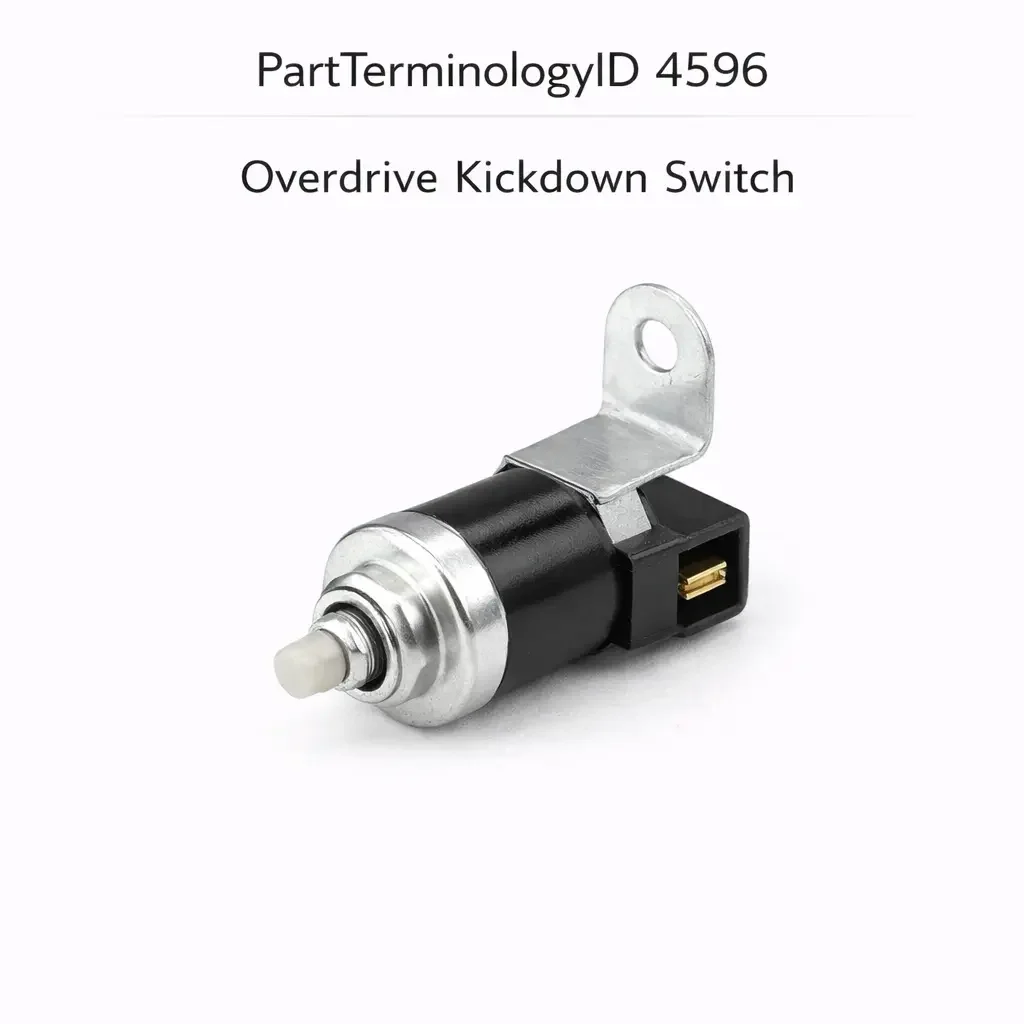
PartTerminologyID 4596, Overdrive Kickdown Switch, is the mechanically actuated switch mounted at the throttle body, carburetor throttle linkage, or accelerator pedal assembly that detects when the throttle reaches a defined high-throttle position and signals the automatic transmission's overdrive cancel circuit or kickdown solenoid to downshift from overdrive to a lower gear ratio in order to provide maximum acceleration power, operating by physically contacting the throttle linkage or pedal mechanism at the kickdown threshold position and closing or opening its electrical contact to command the transmission's kickdown hydraulic circuit, the overdrive cancel relay, or the transmission control module's kickdown input. That definition covers the overdrive kickdown detection and downshift command function correctly and leaves unresolved every question that determines whether the replacement switch's mechanical activation geometry matches the throttle linkage travel at the kickdown threshold position in the specific engine and throttle body combination, whether the switch is a normally open type that closes at kickdown throttle or a normally closed type depending on the transmission control circuit design, whether the switch connector matches the harness at the installation position, whether the switch plunger travel and actuation depth match the throttle linkage's contact point travel at the kickdown position, whether the switch is compatible with the transmission control module's kickdown input signal type on modern electronically controlled transmissions, and whether the switch includes a fixed kickdown geometry or an adjustable mounting that allows the activation position to be calibrated to the specific throttle travel range.
It does not specify the activation geometry, contact configuration, plunger travel, connector type, TCM signal compatibility, or adjustability. A listing under PartTerminologyID 4596 that states only year, make, and model without contact configuration and activation geometry cannot be evaluated by a technician replacing a failed overdrive kickdown switch on a vehicle where the original switch was a normally closed type that opened its contact at kickdown throttle position to cancel the overdrive hold and command a kickdown downshift through the overdrive cancel relay, and the replacement is a normally open type, which permanently maintains the overdrive cancel signal with the throttle below kickdown position and prevents overdrive engagement during all normal driving, reducing fuel economy significantly on every highway cruise segment.
For sellers, PartTerminologyID 4596 is closely related to PartTerminologyID 4444 (Full Throttle Cut-Off Switch) in mechanism and installation position, but differs in its transmission control function: where PartTerminologyID 4444 cuts off a secondary system at wide-open throttle, PartTerminologyID 4596 specifically activates a kickdown downshift command at a defined high-throttle position that may be below full throttle depending on the transmission's kickdown calibration. The kickdown threshold position is transmission-model-specific and may be set at 80 to 95 percent of full throttle travel depending on the transmission's shift scheduling and the vehicle's performance intent.
What the Overdrive Kickdown Switch Does
Kickdown Function and the Downshift Command Architecture
The overdrive kickdown switch provides the transmission with a signal that the driver is demanding maximum acceleration, commanding the transmission to downshift from overdrive to a lower gear ratio that provides higher torque multiplication for passing, merging, or hill climbing. Without the kickdown signal, the transmission must rely on vehicle speed and throttle position sensor data alone to determine when a kickdown downshift is appropriate, which on older transmissions without electronic speed sensing may produce a delayed or missed downshift response.
On hydraulically controlled transmissions, the kickdown switch directly activates a kickdown solenoid or hydraulic valve in the transmission valve body that shifts the hydraulic circuit pressure to force a downshift independent of the vehicle speed governor's normal upshift pressure. The switch contact closes at the kickdown throttle position and the solenoid valve opens a pressure passage that mechanically commands the downshift in the valve body. The switch carries the kickdown solenoid's operating current (typically 0.5 to 2.0 amperes) directly through its contacts.
On electronically controlled transmissions, the kickdown switch provides a discrete input signal to the transmission control module that tells the TCM the driver has requested maximum performance. The TCM evaluates this input alongside vehicle speed, current gear ratio, and turbine speed to execute the most appropriate downshift for the conditions. In this architecture, the switch carries only the milliamp-level TCM input signal rather than the solenoid current directly.
Normally Open versus Normally Closed Kickdown Circuit Logic
The contact configuration of the overdrive kickdown switch determines whether the transmission enters kickdown mode when the contact closes or when it opens, and this configuration is specific to each transmission's control circuit design.
A normally open switch that closes at kickdown throttle position provides a closed-contact kickdown signal only when the throttle is at or above the kickdown threshold. At all throttle positions below the threshold, the contact is open and the transmission operates in its normal automatic mode. This configuration is the most common for direct solenoid activation circuits where the solenoid coil is energized by the closed switch contact.
A normally closed switch that opens at kickdown throttle position maintains a closed contact at all throttle positions below the kickdown threshold, which keeps an overdrive cancel relay deenergized and allows overdrive to engage. When the throttle reaches the kickdown position and the switch opens its contact, the overdrive cancel relay is no longer held in its normal state and the relay's spring action commands the overdrive cancel. This configuration is used in circuits where the overdrive engagement is maintained through a normally closed contact in the enable circuit, and the kickdown switch opens this contact to cancel overdrive.
The consequence of installing the wrong configuration is the same as described across all contact-configuration-sensitive PartTerminologyIDs in this series: a normally open switch in a normally closed circuit permanently holds the overdrive cancel active, preventing overdrive engagement during all normal highway driving and producing the elevated RPM and reduced fuel economy that accompanies a locked-out overdrive gear.
Plunger Travel, Activation Depth, and Throttle Linkage Geometry
The kickdown switch is mechanically actuated by the throttle linkage, throttle cam, or accelerator pedal mechanism at the specific throttle position corresponding to the kickdown threshold. The switch plunger must be depressed to the activation depth precisely when the throttle reaches the kickdown position, not earlier and not later.
A plunger with too little travel will activate the kickdown before the throttle reaches the intended kickdown threshold, causing premature downshifts at moderate acceleration where the driver expects overdrive to remain engaged. A plunger with too much travel will not reach the activation depth at the kickdown throttle position, preventing the kickdown signal from activating at any throttle position and leaving the driver without a kickdown downshift during hard acceleration.
The adjustment provision on the mounting bracket allows the switch body to be repositioned relative to the throttle linkage contact point to calibrate the kickdown threshold to the designed throttle position. The adjustment range must be sufficient to accommodate manufacturing tolerances in the throttle linkage geometry and the switch body dimensions. A replacement switch without an adjustment provision requires the switch body's fixed mounting position to precisely match the original's throttle contact geometry, which may not be achievable across the full range of throttle linkage wear and manufacturing variation.
TCM Kickdown Input and the Modern Electronic Architecture
On modern electronically controlled transmissions where the TCM receives a dedicated kickdown input, the switch provides a switched ground or switched voltage signal to the TCM's kickdown pin. The TCM monitors this pin and executes a kickdown downshift command when the signal changes state. On some modern transmissions, the TCM receives kickdown information from the throttle position sensor rather than from a dedicated kickdown switch, making the standalone switch redundant. In these cases, the kickdown switch may still be present as a backup or confirmation input, or it may be absent entirely.
A standalone kickdown switch installed on a transmission whose TCM uses only the TPS for kickdown detection will provide a redundant input that the TCM may or may not recognize. If the TCM's software does not include a kickdown switch input in its control logic, the switch's output will have no effect on shift behavior. The listing must confirm whether the application requires a standalone kickdown switch or whether the TPS handles kickdown detection entirely.
Top Return Scenarios
Scenario 1: "Normally open switch in normally closed overdrive cancel circuit, overdrive permanently cancelled"
The replacement switch is normally open. The overdrive cancel circuit requires normally closed. With the switch below the kickdown threshold, the normally open contact is open. The overdrive cancel relay receives no holding current and its spring action maintains the overdrive cancel state permanently. The transmission cannot engage overdrive at any highway speed. The engine runs at approximately 500 to 800 RPM above normal highway cruise RPM due to the absent overdrive gear.
Prevention language: "Contact configuration: [normally open, closes at kickdown threshold / normally closed, opens at kickdown threshold]. Verify the contact configuration against the transmission's overdrive cancel circuit design. A normally open switch in a normally closed overdrive cancel circuit permanently prevents overdrive engagement, producing elevated highway RPM and significantly reduced fuel economy on every drive."
Scenario 2: "Plunger 3mm too long, kickdown activates at 70 percent throttle, premature downshifts during moderate acceleration"
The replacement switch plunger extends 3mm further than the original. At 70 percent throttle, the throttle linkage contact point depresses the replacement plunger to its activation depth. The original activated at 90 percent throttle. During normal moderate acceleration at 70 to 80 percent throttle, the transmission unexpectedly downshifts from overdrive to third gear, producing a surge of engine braking followed by acceleration that the driver experiences as an unwanted aggressive downshift at a normal throttle application.
Prevention language: "Plunger activation depth: [X] mm from unactuated position to contact change. Kickdown threshold throttle position: [X] percent of full throttle travel. Verify the plunger travel against the throttle linkage contact point geometry at the intended kickdown threshold position. A plunger that reaches its activation depth below the intended throttle threshold produces premature kickdown downshifts during moderate acceleration that the driver experiences as unexpected transmission behavior."
Scenario 3: "No adjustment provision, throttle linkage wear shifts contact point, kickdown never activates"
The replacement switch has a fixed mounting position with no adjustment range. After a cable stretch event, the throttle linkage contact point has moved 2mm away from the switch plunger tip. The switch never reaches its activation depth at any throttle position. The transmission never receives a kickdown signal and downshifts only when vehicle speed drops below the automatic downshift threshold, producing slow downshift response during passing maneuvers.
Prevention language: "Adjustment provision: [adjustable mounting bracket with [X] mm adjustment range / fixed position, no adjustment]. Verify whether the application requires an adjustable mounting to accommodate throttle linkage variation and wear. A fixed-position replacement that cannot be calibrated to the throttle contact point geometry will not activate the kickdown if the linkage position has shifted from wear or adjustment."
Scenario 4: "Relay coil-rated contacts in direct kickdown solenoid circuit, contacts arc under solenoid current"
The replacement switch contacts are rated for 0.3 amperes relay signal level. The application routes the kickdown solenoid's 1.5-ampere coil current directly through the switch contacts without an intermediate relay. Each kickdown event closes the contacts under 1.5 amperes and opens them when the throttle returns below the threshold. The arc at each make-and-break event erodes the contacts progressively. After approximately 400 kickdown events, the contacts produce intermittent solenoid activation.
Prevention language: "Contact current rating: [X] amperes. Circuit architecture: [TCM signal input, milliamp level / kickdown relay coil, [X] ampere / direct kickdown solenoid, [X] ampere]. Verify the contact current rating against the circuit current the switch carries. A relay-signal-rated switch in a direct solenoid circuit will arc at the contact gap on each kickdown event and accumulate progressive pitting."
Core Listing Attributes for PartTerminologyID 4596
PartTerminologyID: 4596
Component: Overdrive Kickdown Switch
Contact configuration: normally open or normally closed (mandatory, in title)
Kickdown threshold throttle position: percentage of full throttle travel or mm from throttle stop (mandatory)
Plunger activation depth in mm (mandatory)
Plunger total travel in mm (mandatory)
Contact current rating in amperes (mandatory)
Circuit architecture: direct solenoid, relay coil, or TCM signal input (mandatory)
Adjustment provision: adjustable with range in mm, or fixed position (mandatory)
Connector type and pin count (mandatory)
Mounting type: throttle body bracket, carburetor linkage, or pedal assembly (mandatory)
Year/make/model/engine/transmission model
Catalog Checklist for ACES/PIES Teams
PartTerminologyID = 4596
Require contact configuration in title (mandatory)
Require kickdown threshold position (mandatory)
Require plunger activation depth (mandatory)
Require contact current rating (mandatory)
Require circuit architecture: direct solenoid, relay coil, or TCM input (mandatory)
Require adjustment provision status (mandatory)
Prevent contact configuration omission: a normally open switch in a normally closed overdrive cancel circuit permanently prevents overdrive engagement; configuration is the primary attribute
Prevent plunger travel omission: a plunger 3mm longer than the original activates kickdown at moderate throttle, producing premature downshifts; plunger geometry must match the original
Prevent current rating omission: a relay-rated switch in a direct solenoid circuit arcs at each kickdown event; current rating must match the circuit architecture
Differentiate from Full Throttle Cut-Off Switch (PartTerminologyID 4444): the full throttle cut-off switch activates at 100 percent throttle travel; the overdrive kickdown switch activates at 80 to 95 percent depending on the transmission calibration; both are mechanically actuated at high throttle positions but for different transmission control purposes
Differentiate from Automatic Transmission Lock-Up Torque Converter Switch (PartTerminologyID 4548): the lock-up switch governs torque converter clutch engagement; the kickdown switch commands a gear ratio downshift; both affect transmission performance but through different control circuits
FAQ (Buyer Language)
How do I confirm the correct kickdown threshold position for my transmission?
The kickdown threshold is specified in the factory service manual for the specific transmission model. It is typically expressed as a throttle opening percentage or as a cable travel measurement from the closed throttle position. The original switch part number cross-reference is the most reliable confirmation for the specific engine and transmission combination.
My transmission does not downshift when I press the accelerator hard. Is the kickdown switch the cause?
A transmission that does not downshift under hard acceleration could be a failed kickdown switch (no activation signal reaching the transmission), a failed kickdown solenoid (switch activates but solenoid does not respond), or a hydraulic valve body issue. Confirm whether the kickdown switch is producing the correct output by testing the switch contact state with a multimeter at the throttle's kickdown position. If the contact changes state correctly at the kickdown position, the switch is functioning and the fault is downstream.
Can I adjust the kickdown switch position after installation?
Only if the replacement switch includes an adjustable mounting bracket. Place the throttle at the intended kickdown position, position the switch so the plunger is at its activation depth at that throttle position, and tighten the mounting hardware. If the switch is a fixed-position type, it must be dimensionally matched to the original to produce the correct kickdown threshold without adjustment.
Related PartTerminologyIDs
Full Throttle Cut-Off Switch (PartTerminologyID 4444): activates at 100 percent throttle travel to interrupt secondary systems; the overdrive kickdown switch activates at a calibrated sub-WOT position to command a transmission downshift; both are mechanically actuated throttle position switches at different threshold positions
Automatic Transmission Lock-Up Torque Converter Switch (PartTerminologyID 4548): governs torque converter clutch engagement rather than gear ratio downshift; both affect transmission performance but through different control circuits at different operating conditions
Status in New Databases
PIES/PCdb: PartTerminologyID 4596, Overdrive Kickdown Switch
PIES 8.0 / PCdb 2.0: No change in PartTerminologyID or terminology label
Final Take for PartTerminologyID 4596
Overdrive Kickdown Switch (PartTerminologyID 4596) is the transmission control PartTerminologyID where contact configuration is the attribute with the most immediately driveable and fuel-economy-visible consequence of mismatch, because a normally open switch in a normally closed overdrive cancel circuit locks out the overdrive gear during all highway driving and elevates highway cruise RPM until the error is identified. The plunger activation depth is the attribute with the most throttle-position-specific calibration consequence, because a plunger 3mm longer than the original produces premature kickdown downshifts at moderate throttle. State the contact configuration in the title. State the plunger activation depth. State the kickdown threshold throttle position. State the contact current rating. State the circuit architecture. For PartTerminologyID 4596, contact configuration, plunger activation depth, and circuit architecture are the three attributes that prevent the three most consequential return scenarios in the overdrive kickdown switch buyer population.