
Neutral Safety Switch (PartTerminologyID 4584): Selector Position Coverage, Backup Lamp Circuit Integration, and Transmission Control Compatibility
Written by Arthur Simitian | PartsAdvisory
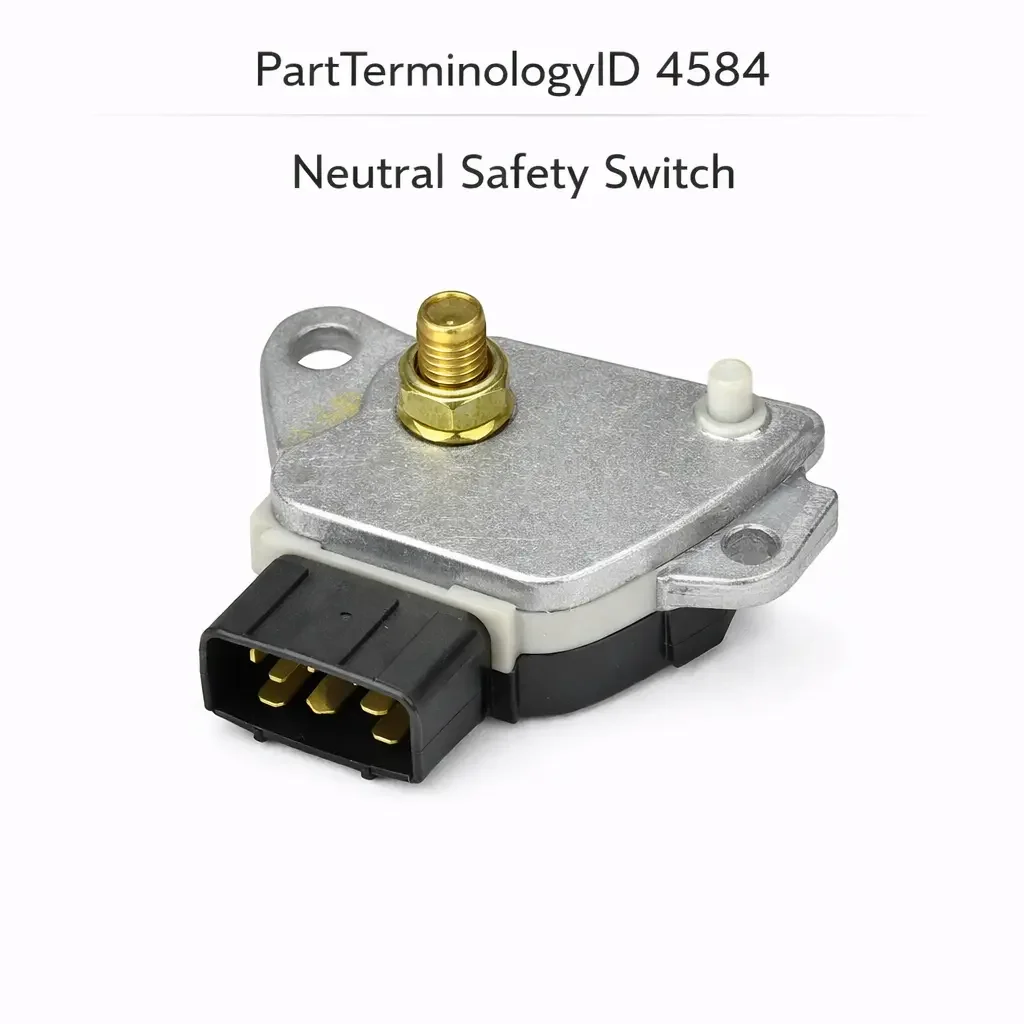
PartTerminologyID 4584, Neutral Safety Switch, is the position-sensing switch mounted on the automatic transmission selector linkage, the transmission case at the manual valve shaft, or the transmission control module's gear position sensor port that prevents the starter motor from engaging when the transmission selector is in any drive range position and permits starter engagement only when the selector is in park or neutral, simultaneously controlling the backup lamp circuit by completing the lamp circuit only when the reverse selector position is detected, and in modern electronically managed transmissions providing a continuous gear position signal to the transmission control module, the engine control module, and in some applications the instrument cluster for gear position display. That definition covers the starter lockout, backup lamp, and gear position signal functions correctly and leaves unresolved every question that determines whether the replacement switch's position coverage matches the full selector position sequence of the specific transmission, whether the switch is a simple two-circuit type covering only the starter enable and reverse lamp functions or a multi-circuit type also providing individual gear position signals to the TCM and ECM, whether the switch connector pin count and terminal assignment match the harness at the transmission case or selector linkage mounting position, whether the switch is externally adjustable after installation to align the switch's internal detent positions with the transmission selector's mechanical positions, whether the switch body thread or mounting flange specification matches the transmission case port where it installs, whether the switch is compatible with the TCM's input signal type on vehicles where the TCM uses the switch's position data for shift scheduling, torque management, and diagnostic monitoring, whether the switch's backup lamp circuit contact rating covers the backup lamp circuit's current draw, and whether the replacement requires initialization or calibration after installation on vehicles where the TCM or BCM must learn the new switch's position reference before the gear position display and shift control operate correctly.
It does not specify the position coverage, circuit count, connector pin count, external adjustability, thread specification, TCM signal compatibility, backup lamp current rating, or initialization requirement. A listing under PartTerminologyID 4584 that states only year, make, and model without position coverage and connector pin count cannot be evaluated by a technician replacing a failed neutral safety switch on a vehicle where the original switch was a nine-pin multi-circuit type providing individual position signals for park, reverse, neutral, drive, third, second, and first to the TCM in addition to the starter enable and backup lamp circuit contacts, and the replacement is a three-pin type covering only starter enable, backup lamp, and ground, leaving the TCM without individual gear position inputs for all drive range positions and producing a TCM that cannot schedule shifts correctly, cannot manage torque reduction during shifts, and stores fault codes for all missing gear position inputs simultaneously.
For sellers, PartTerminologyID 4584 is the transmission system PartTerminologyID with the broadest range of circuit complexity within the same part category, because the neutral safety switch on a pre-OBD carbureted vehicle with a three-speed transmission may be a simple two-circuit switch covering starter enable and backup lamps, while the neutral safety switch on a modern eight-speed electronically controlled transmission may be a multi-circuit position sensor providing ten or more individual signals to the TCM, ECM, and instrument cluster simultaneously. Both components are correctly cataloged under PartTerminologyID 4584 despite requiring entirely different replacement specifications. A listing that does not identify where on this complexity spectrum the specific application falls cannot be evaluated and cannot prevent a mismatched replacement.
What the Neutral Safety Switch Does
Starter Lockout Function and the Park and Neutral Enable Logic
The starter lockout function prevents the starter motor from engaging when the transmission selector is in any forward or reverse drive range, reducing the risk of accidental vehicle movement from an unintended start. The neutral safety switch provides this function by completing the starter circuit (or the starter relay coil circuit) only when the selector is confirmed in park or neutral. In all other selector positions, the switch presents an open circuit to the starter enable path and the starter cannot engage regardless of ignition switch position.
The starter enable logic in the neutral safety switch operates through one of two circuit designs. In the direct switch-to-starter architecture used on older applications, the switch contacts are wired in series with the ignition switch's start position output and the starter solenoid engagement circuit. When the switch is in the closed state (park or neutral confirmed), the full starter engagement current or the solenoid control current passes through the switch contacts to the starter. In the relay-mediated architecture used on most modern applications, the switch provides a switched ground or switched voltage signal to the starter relay coil, and the relay carries the full starter solenoid current independently of the switch.
A replacement switch that does not provide the closed contact state at park and neutral, or that does not provide the open contact state in all drive range positions, defeats the starter lockout function and exposes the vehicle to unintended starting in drive range. A switch with misaligned position detents (not properly adjusted to the transmission selector's mechanical positions) may provide the park enable contact correctly but fail to provide the neutral enable contact at the neutral position, preventing starting in neutral and requiring the driver to use park for every start.
Backup Lamp Circuit Function and the Contact Current Requirement
The backup lamp circuit in the neutral safety switch provides the electrical path that activates the vehicle's reverse lamps when the selector is in the reverse position. The switch's reverse position contact closes when the selector reaches the reverse detent, completing the circuit from the backup lamp fuse supply through the switch contact to the backup lamp bulbs or LED assemblies.
The contact current rating for the backup lamp circuit must cover the total current draw of all backup lamps simultaneously. A vehicle with four incandescent backup lamps (two standard tail position and two auxiliary rear-mounted) draws approximately 8 amperes from the backup lamp circuit. A vehicle with LED backup lamps draws significantly less, typically 0.5 to 2.0 amperes total. The backup lamp contact in the replacement switch must be rated for the maximum simultaneous lamp load at the specific installation.
An undersized backup lamp contact will arc at the reverse position on each drive range change and produce progressive pitting that increases contact resistance. The backup lamps will dim progressively as the contact resistance increases and eventually fail to illuminate when the contact resistance becomes too high to sustain the lamp circuit current.
Multi-Circuit Gear Position Signal Architecture and the TCM Input Coverage
The most significant source of neutral safety switch replacement mismatch in modern electronically controlled transmissions is the multi-circuit gear position signal function that advanced switches provide to the TCM, ECM, and instrument cluster. On four-speed and older transmissions with simple electronic controls, the TCM may require only the park, neutral, and reverse signals from the neutral safety switch, using internal transmission speed and ratio sensing for the remaining gear identification. On five-speed and newer transmissions with full adaptive electronic control, the TCM typically requires individual position signals for every selector position to manage shift scheduling, adaptive pressure control, and torque reduction coordination.
The individual gear position signals from the switch allow the TCM to know the exact selector position before the transmission has completed a ratio change, enabling the TCM to pre-configure hydraulic circuits for the incoming gear before the actual ratio change begins. This pre-configuration reduces shift response time and minimizes driveline shock during gear changes. A replacement switch that provides only park, neutral, and reverse signals forces the TCM to infer the drive range position from turbine speed and output speed ratio data after the gear change has already occurred, producing slower shift response and reduced shift quality that the driver perceives as a degraded transmission feel compared to the original.
On vehicles with a driver-selectable gear display in the instrument cluster (showing P, R, N, D, 3, 2, 1 or similar), the cluster receives the gear position signals from the neutral safety switch or from the TCM via the vehicle network. A replacement switch missing individual gear position signals produces a cluster display that is permanently stuck at a single indicator position or alternates incorrectly between positions as the selector is moved.
Transmission Range Sensor versus Traditional Neutral Safety Switch
The traditional neutral safety switch uses mechanical contact points within the switch body that physically open and close in response to the switch cam's rotation with the transmission manual valve shaft. Each contact position corresponds to a specific transmission range position, and the contact state at each position is determined by the physical geometry of the switch cam and the contact arm's position relative to the cam profile.
The transmission range sensor (TRS), which serves the same functional role as the neutral safety switch on modern transmissions, uses a Hall effect sensor or a resistance-encoded position sensor rather than mechanical contacts to determine the manual valve shaft's angular position. The TRS produces an analog voltage output or a series of discrete resistance values corresponding to each range position, and the TCM reads this output to determine the selected range. The TRS has no mechanical contact wear concerns but requires the TCM to have a calibration map for the specific sensor's output values at each range position.
A mechanical contact switch installed in a TRS application will not produce the correct analog signal type for the TCM's input circuit, and the TCM will either store a fault code for an invalid sensor signal or default to a limp-home mode that disables full electronic transmission management. A TRS installed in a mechanical contact switch application provides the wrong signal type for the starter circuit and backup lamp circuit, which expect discrete contact closures rather than analog voltage levels.
The switch type (mechanical contact or transmission range sensor) must be the first confirmed attribute for every modern neutral safety switch listing.
External Adjustability and the Selector Alignment Requirement
Most neutral safety switches include an adjustment provision that allows the technician to align the switch's internal detent positions with the transmission selector's mechanical positions after installation. The adjustment procedure typically involves placing the selector in the neutral position, loosening the switch mounting screws, rotating the switch body to the position where the neutral contact is confirmed closed, and retightening the screws with the switch in this aligned position. The ability to perform this adjustment is essential because small manufacturing tolerances in the transmission selector linkage and the switch cam geometry mean that a switch installed at a fixed position without adjustment will have its internal detents misaligned from the selector positions by varying amounts depending on the specific vehicle's tolerance stack.
A replacement switch without external adjustability requires the technician to rely entirely on the positional accuracy of the switch mounting hardware and the transmission selector linkage alignment. On applications where the linkage has worn or stretched and the neutral position is slightly offset from its original location, a non-adjustable replacement switch will have the neutral enable contact misaligned from the actual neutral selector position, producing a no-start from the neutral position that requires the driver to rock the selector between neutral and park to find the contact engagement point.
The adjustment range and adjustment procedure must be stated in the listing and the technician must perform the adjustment before the installation is considered complete. A listing that does not mention the adjustment requirement leaves the technician unaware that a post-installation alignment step is needed, and the vehicle may be returned as a no-start complaint when the actual cause is an unperformed adjustment.
Push-Button and Electronic Selector Integration
On vehicles with push-button or electronic transmission selectors that have no mechanical linkage to the transmission manual valve shaft, the traditional mechanical neutral safety switch is replaced by an electronic gear selector module that communicates the driver's range selection to the TCM through the vehicle network. The TCM then actuates the transmission's electro-hydraulic manual valve through internal solenoids based on the selector module's command.
In this architecture, there is no neutral safety switch in the traditional sense. The starter lockout function is managed by the BCM or the body electronics based on the TCM's reported gear state transmitted on the CAN bus, and the backup lamp activation is similarly managed by the BCM based on network messages. A buyer looking for a neutral safety switch for a push-button selector vehicle is either servicing the electronic selector module (a different PartTerminologyID) or the vehicle does not use a traditional neutral safety switch at the transmission.
Listings for vehicles with push-button or electronic selectors must explicitly state that the traditional mechanical neutral safety switch is not present on the application and direct the buyer to the appropriate selector module or BCM component.
Why This Part Generates Returns
Buyers return neutral safety switches because the replacement is a three-pin type covering starter enable, backup lamp, and ground while the original was a nine-pin type providing individual gear position signals to the TCM for all forward drive ranges, leaving the TCM without shift scheduling inputs and generating fault codes for every missing position signal; the replacement is a mechanical contact switch and the application uses a transmission range sensor that the TCM expects to produce an analog voltage output rather than discrete contact closures, placing the transmission in limp-home mode immediately after installation; the backup lamp contact rating is 5 amperes and the vehicle has four incandescent backup lamps drawing 8.5 amperes, producing progressive contact pitting that dims the backup lamps to half-brightness within 6 months; the switch is installed without performing the external alignment adjustment and the neutral starter enable contact is misaligned by one position, preventing starting from the neutral position and requiring park for every start; the connector is a seven-pin type and the harness at the transmission case uses a nine-pin connector covering the instrument cluster gear display signal and the TCM reverse position input that the seven-pin replacement omits; the switch requires TCM initialization after installation on a vehicle with adaptive shift control and the listing does not disclose this, leaving the transmission shift quality degraded and the TCM storing adaptation data from the old switch's position offsets; the thread specification is M20 x 1.5 and the transmission case port uses M22 x 1.5, preventing full thread engagement and allowing transmission fluid to weep at the partial engagement zone; and the replacement does not include the park position signal to the BCM that enables keyless entry to lock the doors when park is selected, leaving the auto-lock on park feature permanently disabled.
Top Return Scenarios
Scenario 1: "Three-pin replacement in nine-pin TCM application, shift scheduling inputs absent, multiple fault codes"
The buyer replaces the neutral safety switch on a modern six-speed automatic. The listing covers the vehicle without specifying circuit count. The delivered three-pin switch provides starter enable and backup lamp circuits. After installation, the transmission shifts correctly between park, reverse, and neutral based on the mechanical positions, but the TCM stores fault codes for absent individual drive range position inputs. Shift quality degrades as the TCM loses its position pre-configuration capability and the instrument cluster gear display is blank.
Prevention language: "Circuit count: [X] circuits covering [park enable, reverse lamp, neutral enable, drive, third, second, first, and TCM/ECM individual position signals as applicable]. Connector pin count: [X] pins. Verify the circuit count against the original switch. A three-circuit replacement in a nine-circuit application removes all individual drive range position signals to the TCM, degrading shift quality and generating fault codes for all missing inputs simultaneously."
Scenario 2: "Mechanical contact switch in TRS application, TCM enters limp-home mode"
The buyer installs the replacement mechanical contact switch in a vehicle where the TCM expects an analog voltage output from a transmission range sensor. The TCM receives a series of 0-volt and 12-volt contact closures rather than the calibrated voltage levels it expects for each range position. The TCM stores an invalid sensor input fault and enters limp-home mode, limiting the transmission to a single forward gear and preventing shifts above approximately 3,000 RPM.
Prevention language: "Switch type: [mechanical contact, provides discrete circuit closures / transmission range sensor, provides analog voltage output calibrated for TCM input]. This switch is the [type]. Verify the switch type against the TCM's input specification. A mechanical contact switch in a TRS application produces an invalid signal type for the TCM, which stores a fault and enters limp-home mode."
Scenario 3: "Backup lamp contact rated 5 amperes, four incandescent lamps draw 8.5 amperes, lamps dim progressively"
The buyer installs the replacement switch. The backup lamps activate correctly at installation. Over the following 6 months, the backup lamps gradually dim to approximately 60 percent of their original brightness. The backup lamp contact has been operating at 170 percent of its current rating, producing progressive contact surface oxidation from elevated contact temperature. The increased contact resistance reduces the effective voltage at the lamps.
Prevention language: "Backup lamp contact current rating: [X] amperes. Verify the total backup lamp circuit current against the contact rating. Sum the current draw of all backup lamps including auxiliary and trailer-connected backup lamps if the trailer connector is wired to the vehicle's backup lamp circuit. An undersized contact rating produces progressive contact resistance increase and lamp brightness reduction."
Scenario 4: "Adjustment not performed, neutral enable contact misaligned, vehicle will not start from neutral"
The buyer installs the replacement switch without performing the external alignment adjustment. The switch is mounted at its default position, which places the neutral enable contact approximately half a detent position away from the actual neutral selector position. The vehicle starts normally from park but will not start from neutral regardless of how carefully the selector is positioned at the neutral indicator. The driver returns to the service department with a no-start from neutral complaint.
Prevention language: "External adjustment: [required, align switch to neutral position before tightening mounting hardware / not required, self-aligning design]. After installation, position the selector in neutral, confirm the neutral enable contact is closed with a continuity tester, then tighten the mounting hardware with the switch held in the aligned position. An unperformed alignment produces selector position offset that varies by application from one that prevents neutral starting to one that prevents park starting."
Scenario 5: "Thread mismatch at transmission case port, fluid weep at partial engagement"
The replacement switch thread is M20 x 1.5. The transmission case port is M22 x 1.5. The M20 thread engages 2 to 3 turns before binding against the larger thread of the port. Transmission fluid weeps at the partial thread engagement zone after the first heat cycle. The fluid loss is initially slow enough that the owner does not notice until the transmission fluid level warning activates.
Prevention language: "Thread specification: [diameter x pitch, metric or NPT]. Verify the thread specification against the transmission case port using a thread gauge before installation. A metric M20 switch in an M22 port will engage partially before binding. Transmission fluid will leak from the partial engagement zone under operating pressure and temperature cycling."
Scenario 6: "TCM initialization required, shift quality degraded, old adaptation data mismatches new switch position offsets"
The buyer installs the replacement switch. The transmission operates correctly initially. After 1 week of daily driving, the shift quality is noticeably rougher than before the replacement, particularly on 2-3 and 3-4 upshifts. The TCM's adaptive shift data was calibrated to the original switch's position offsets and is applying incorrect pressure and timing corrections to the replacement switch's position signals. The listing does not disclose that TCM adaptation reset is required after installation.
Prevention language: "TCM initialization after installation: [not required / required, TCM adaptation reset with [scan tool type]. After replacing the switch, the TCM's accumulated adaptive shift data must be reset so the module can relearn the new switch's position calibration. Operating the transmission without resetting adaptation will apply incorrect pressure and timing corrections derived from the previous switch's offsets, degrading shift quality."
Scenario 7: "Park signal absent, BCM auto-lock on park permanently disabled"
The buyer replaces the neutral safety switch on a vehicle with an automatic door lock-on-park feature managed by the BCM. The replacement switch includes park enable for the starter circuit but does not include the separate park position signal to the BCM that the auto-lock feature requires. The BCM no longer receives the park confirmation signal and the auto-lock on park function is permanently disabled. The doors do not lock automatically when the selector is placed in park.
Prevention language: "Park position signal to BCM: [included at pin [X] / not included]. Verify whether the original switch includes a dedicated park signal to the BCM for auto-lock or other BCM-managed functions. A replacement without this pin permanently disables BCM functions that depend on receiving a park confirmation signal directly from the neutral safety switch rather than from the TCM via the vehicle network."
Scenario 8: "Seven-pin replacement in nine-pin harness, instrument cluster gear display and TCM reverse input unconnected"
The buyer installs the replacement seven-pin switch in a nine-pin harness. The starter lockout and backup lamp functions operate correctly. The instrument cluster gear display is blank in all positions. The TCM stores a fault for a missing reverse position input from the switch's dedicated TCM reverse signal pin, which differs from the backup lamp reverse contact and is absent in the seven-pin replacement. The cluster and TCM reverse signal functions are permanently unconnected.
Prevention language: "Connector pin count: [X] pins with separate TCM reverse signal and cluster gear display output where applicable. Verify pin count and function mapping against the original harness connector. The backup lamp reverse contact and the TCM's dedicated reverse signal input are separate circuits in some applications and must both be present in the replacement. A replacement missing the TCM reverse signal pin generates a TCM fault and prevents accurate reverse engagement detection by the electronic control system."
Core Listing Attributes for PartTerminologyID 4584
PartTerminologyID: 4584
Component: Neutral Safety Switch
Switch type: mechanical contact or transmission range sensor (mandatory, in title)
Circuit count with all covered positions listed (mandatory, in title)
Starter enable position coverage: park only, or park and neutral (mandatory)
Backup lamp contact current rating in amperes (mandatory)
TCM individual gear position signal coverage: list all positions provided (mandatory for multi-circuit types)
Connector pin count with function mapping for all pins (mandatory)
External adjustability: required with procedure note, or self-aligning (mandatory)
Thread specification: diameter, pitch, and thread form for case-mounted types (mandatory)
Sealing method: O-ring, crush washer, or NPT thread sealant (mandatory)
TCM initialization requirement: not required or tool and procedure required (mandatory)
Park signal to BCM: included or not included (mandatory where applicable)
Transmission model compatibility (mandatory)
Year/make/model/engine/transmission model/transmission generation
Note for production date range where switch type changed from mechanical contact to TRS
Note for applications where TCM initialization is required after replacement
Note for vehicles with auto-lock on park requiring dedicated BCM park signal pin
Note for push-button selector vehicles where traditional neutral safety switch is absent
Catalog Checklist for ACES/PIES Teams
PartTerminologyID = 4584
Require switch type in title: mechanical contact or transmission range sensor (mandatory)
Require circuit count with all covered positions in title or description (mandatory)
Require connector pin count with function mapping (mandatory)
Require backup lamp contact current rating (mandatory)
Require external adjustment requirement disclosure (mandatory)
Require thread specification for case-mounted types (mandatory)
Require TCM initialization disclosure (mandatory)
Require park signal to BCM status for applicable vehicles (mandatory)
Prevent circuit count omission: a three-circuit replacement in a nine-circuit application removes all individual TCM drive range inputs; circuit count is the primary specification differentiator in this PartTerminologyID and must be stated alongside the switch type
Prevent switch type omission: a mechanical contact switch in a TRS application places the transmission in limp-home mode immediately; switch type must be in the title as the first confirmed attribute
Prevent backup lamp current rating omission: an undersized backup lamp contact dims the lamps progressively over months before complete failure; contact rating must be confirmed against the total lamp load
Prevent adjustment disclosure omission: an unperformed alignment produces selector position offset that prevents starting from a valid selector position; adjustment requirement must be stated and the procedure referenced
Prevent TCM initialization omission: a replacement installed without adaptation reset produces degraded shift quality from mismatched adaptation data; initialization requirement must be disclosed for all adaptive transmission applications
Prevent thread specification omission: a thread mismatch at the transmission case port produces a fluid leak; thread specification must be confirmed with a thread gauge before installation
Prevent BCM park signal omission: a replacement missing the BCM park signal pin permanently disables auto-lock on park and other BCM park-dependent functions; pin presence must be confirmed
Differentiate from Transmission Control Module (if cataloged): the TCM manages transmission gear selection and shift control; the neutral safety switch is the position input device the TCM uses; a TCM that enters limp-home mode after switch replacement confirms a switch type mismatch (mechanical contact where TRS is required) rather than a TCM failure
Differentiate from Backup Light Switch (if cataloged as standalone): some applications use a separate dedicated backup light switch independent of the neutral safety switch; confirm whether the reverse lamp circuit is integrated into the neutral safety switch or uses a separate component before ordering either
Differentiate from Park Neutral Position Switch (if cataloged separately): some catalog databases list the transmission range sensor type under a separate PartTerminologyID; where both exist in the same catalog, mechanical contact switches catalog under 4584 and TRS types may catalog under the alternate PartTerminologyID; confirm the applicable PartTerminologyID before listing
FAQ (Buyer Language)
How do I know whether my vehicle uses a mechanical contact neutral safety switch or a transmission range sensor?
Count the pins on the switch connector. A three-pin or four-pin connector strongly suggests a simple mechanical contact switch covering starter enable, backup lamp, and ground. A six-pin or higher connector suggests either a multi-circuit mechanical contact switch providing individual gear position signals or a transmission range sensor. Confirm by measuring the switch output with a multimeter at each selector position: discrete 0-volt and 12-volt readings at each position confirm a mechanical contact type; a continuously variable voltage reading that changes proportionally through the selector travel confirms an analog TRS type.
My vehicle will not start from neutral after replacing the neutral safety switch. What should I check?
A vehicle that starts from park but not from neutral after switch replacement almost always indicates an unperformed external alignment adjustment. With the selector in neutral, use a continuity tester at the starter enable circuit pins of the switch connector. If continuity is absent in neutral, the switch is not aligned correctly to the transmission selector's neutral position. Loosen the switch mounting hardware slightly, rotate the switch until continuity is present at the neutral position, and retighten the mounting hardware while holding the switch in this aligned position.
Why does my transmission shift differently after replacing the neutral safety switch?
Degraded shift quality after neutral safety switch replacement typically indicates either a TCM adaptation reset was not performed (the TCM is applying shift correction data learned from the old switch's position offsets to the new switch's different output values) or the replacement switch has fewer gear position output signals than the original (the TCM is operating without individual drive range position inputs and inferring gear position from turbine speed ratios). Use a scan tool to check for active fault codes and to reset the TCM's adaptive shift data. If fault codes indicate missing gear position inputs, the replacement switch circuit count does not match the original.
Do I need a scan tool to replace the neutral safety switch?
On older applications with simple mechanical contact switches covering only starter enable and backup lamp circuits, no scan tool is required. The replacement procedure is limited to mechanical installation and external alignment. On modern applications with adaptive electronic transmission control, a scan tool is typically required to reset the TCM's accumulated shift adaptation data after any neutral safety switch replacement, because the TCM's adaptation tables are calibrated to the specific position offsets of the original switch. Confirm the TCM initialization requirement from the factory service manual before starting the installation.
Can I use the neutral safety switch from the manual transmission version of my vehicle?
No. Manual transmission vehicles do not use a neutral safety switch in the same sense as automatic transmission vehicles. The manual transmission clutch safety switch (which prevents starting unless the clutch pedal is depressed) is a different component with a different PartTerminologyID, different circuit architecture, and no gear position signal function. The neutral safety switch for an automatic transmission cannot substitute for a clutch safety switch, and vice versa.
Related PartTerminologyIDs
Transmission Control Module (if cataloged): the module that receives gear position inputs from the neutral safety switch and manages shift control; a TCM that enters limp-home mode immediately after neutral safety switch replacement confirms a switch type mismatch rather than a TCM failure; verify the switch type against the TCM's input specification before replacing the TCM
Backup Light Switch (if cataloged as standalone): the dedicated reverse lamp switch on applications where the backup lamp circuit is not integrated into the neutral safety switch; confirm whether the backup lamp circuit runs through the neutral safety switch or through a separate switch before ordering either component
Clutch Safety Switch (if cataloged): the clutch pedal-actuated start enable switch on manual transmission vehicles; functionally analogous to the neutral safety switch in providing a start enable circuit, but at the clutch pedal position rather than the transmission selector; not interchangeable with the neutral safety switch
Starter Relay (if cataloged): the relay whose coil the neutral safety switch typically controls on modern applications; a starter that does not engage despite the neutral safety switch providing a correct enable signal in park and neutral confirms a failed starter relay rather than a switch fault; test the relay independently before replacing the switch on a no-crank complaint
Status in New Databases
PIES/PCdb: PartTerminologyID 4584, Neutral Safety Switch
PIES 8.0 / PCdb 2.0: No change in PartTerminologyID or terminology label
Final Take for PartTerminologyID 4584
Neutral Safety Switch (PartTerminologyID 4584) is the transmission position control PartTerminologyID with the widest range of circuit complexity within a single PartTerminologyID, spanning from a two-circuit starter enable and backup lamp switch on simple transmissions to a ten-circuit position sensor providing individual signals to the TCM, ECM, BCM, and instrument cluster on modern electronically controlled transmissions. The switch type (mechanical contact versus transmission range sensor) is the attribute with the most immediate and severe mismatch consequence because a type mismatch places the transmission in limp-home mode on the first drive. The circuit count is the attribute with the most silent and progressive mismatch consequence because a replacement with fewer circuits than the original degrades shift quality without generating an immediately obvious fault, leading the owner to attribute transmission feel changes to an unrelated cause before the missing TCM inputs are identified.
State the switch type in the title. State the circuit count with all covered positions. State the connector pin count with function mapping. State the backup lamp contact current rating. State the external adjustment requirement. State the TCM initialization requirement. State the thread specification. State the park signal to BCM status. For PartTerminologyID 4584, switch type, circuit count, and TCM initialization requirement are the three attributes that prevent the three most consequential and most frequently overlooked return scenarios in the neutral safety switch buyer population.