
Written by Arthur Simitian | PartsAdvisory
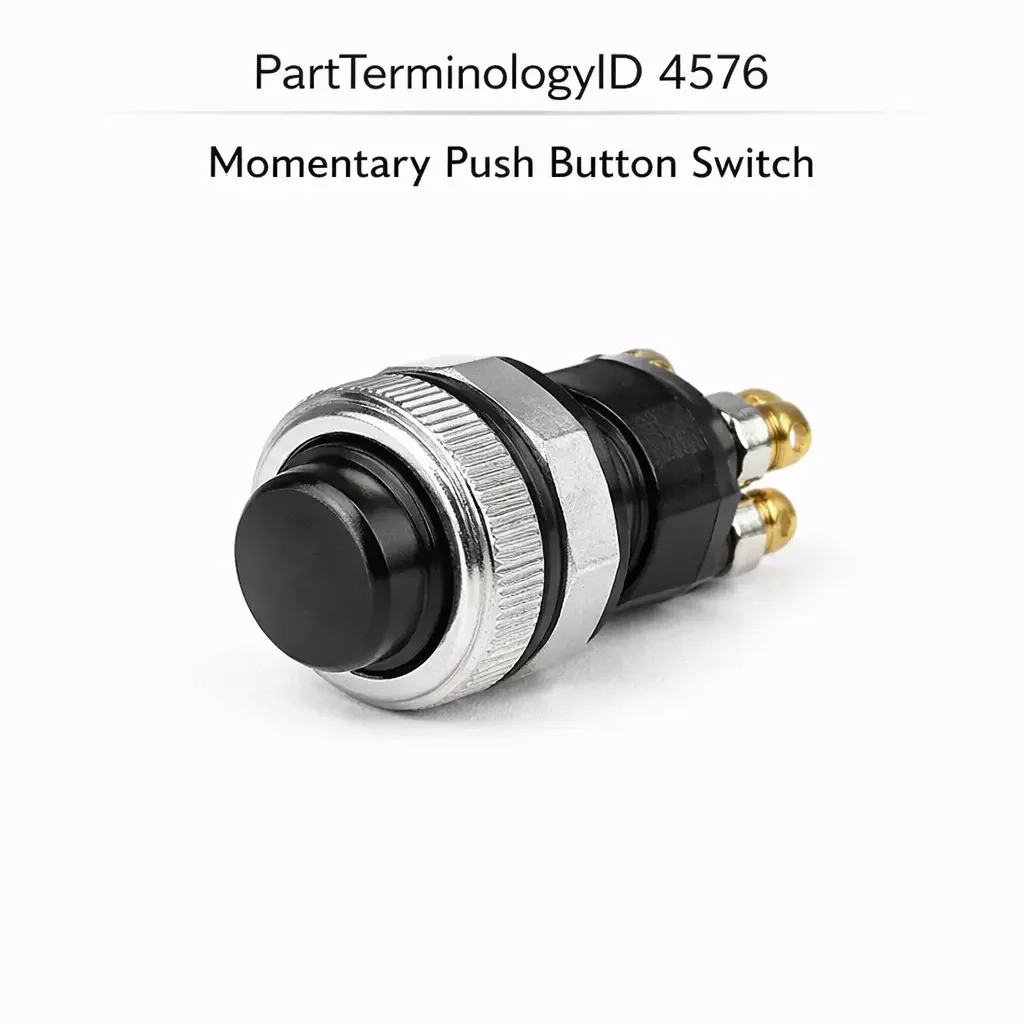
PartTerminologyID 4576, Momentary Push Button Switch, is the spring-return switch that completes or interrupts an electrical circuit only while the button is actively depressed and returns to its normal contact state when released, used in automotive applications including horn activation circuits, starter engagement override circuits, engine start buttons on racing and performance vehicles, momentary lighting activation for map lights and cargo lights, shift interlock override buttons, fuel pump prime buttons, and any application where a brief discrete pulse rather than a sustained contact closure is the required input to the controlled circuit. That definition covers the momentary actuation and spring-return function correctly and leaves unresolved every question that determines whether the replacement switch is a normally open type that closes on depression or a normally closed type that opens on depression, whether the switch's actuation force matches the driver's or technician's tactile expectation for the specific application, whether the switch body diameter and thread or snap-in mounting specification match the panel or bracket at the installation position, whether the contact current rating covers the circuit the switch controls directly, whether the switch includes an integrated indicator lamp that illuminates when the circuit is active or when power is present at the switch supply terminal, whether the switch is rated for the environmental conditions at the installation position including moisture ingress on exterior-mounted horn or auxiliary lighting applications, and whether the switch includes momentary-on or momentary-off function in the context of the circuit it controls.
It does not specify the contact configuration, actuation force, body diameter, mounting thread or clip type, contact current rating, indicator lamp configuration, environmental rating, or momentary function direction. A listing under PartTerminologyID 4576 that states only panel diameter and current rating without contact configuration cannot be evaluated by a technician replacing a failed momentary push button in a horn circuit on a race car where the original switch was a normally open type that completed the horn relay coil circuit on depression, and the replacement is a normally closed type, which permanently completes the horn circuit with the button released and produces continuous horn activation that cannot be stopped without disconnecting the horn fuse.
For sellers, PartTerminologyID 4576 covers the broadest general-purpose switch type in the catalog, because a momentary push button switch is used across more circuit types and application positions than any other single switch PartTerminologyID in the body electrical category. The contact configuration, actuation force, and panel mounting specification are the three attributes that must be confirmed before body diameter and current rating, because a normally closed switch in a normally open circuit produces exactly opposite behavior from the intended function, and an actuation force 3x the original produces a button that resists easy operation and causes driver fatigue in applications requiring frequent activation.
What the Momentary Push Button Switch Does
Normally Open versus Normally Closed Function Direction
The momentary push button switch's contact configuration is the attribute that most directly determines whether the switch produces the intended circuit behavior. A normally open switch has open contacts at rest and closes the circuit when the button is depressed. Releasing the button returns the contacts to the open state and the circuit is interrupted. This configuration is used in circuits that should be active only during the button press: horn activation, starter engagement, momentary lighting, and engine start.
A normally closed switch has closed contacts at rest and opens the circuit when the button is depressed. Releasing the button returns the contacts to the closed state and the circuit is restored. This configuration is used in circuits that should be interrupted during the button press: kill switch override circuits where pressing the button temporarily interrupts a safety lockout, bump-to-idle circuits on diesel injection systems, and in some alarm bypass applications where momentarily opening the circuit resets a timing circuit.
A normally open switch installed in a normally closed circuit position keeps the controlled circuit permanently open at rest, which in a normally closed safety interlock produces the appearance of a permanent fault or fault code. A normally closed switch installed in a normally open circuit position keeps the controlled circuit permanently active, which in a horn circuit produces continuous horn activation and in a starter circuit produces continuous starter engagement.
Actuation Force and the Application Tactile Requirement
The actuation force is the force in grams or Newtons required to depress the button to the point of contact change. Actuation force specifications for automotive momentary push buttons range from approximately 100 grams (light touch, appropriate for frequently used driver-accessible switches) to 1,500 grams or higher (firm push, appropriate for safety-critical override switches where accidental activation is a concern).
The actuation force must match the application's tactile requirement. A horn button on a steering wheel requires a light actuation force (300 to 500 grams) for comfortable high-frequency use during normal driving. A fuel pump prime button in a service panel position can use a heavier actuation force (800 to 1,200 grams) because it is used infrequently and the higher force prevents accidental activation. A starter button on a racing application requires a moderate actuation force (500 to 800 grams) that is positive enough to prevent accidental engagement from steering wheel vibration but light enough for rapid reliable use at the start line.
A replacement with an actuation force 2 to 3 times the original requires noticeably more effort to activate and causes driver fatigue in applications requiring frequent use. A replacement with an actuation force half the original produces an unexpectedly light touch that results in accidental activations during normal handling.
Panel Mounting Specification and Body Geometry
The momentary push button switch mounts in a panel, bracket, or console through one of three retention methods: threaded body with a jam nut (the most common for standalone switch positions), snap-in body with flexible retention clips (used in OEM instrument panel and console positions), or bracket-mount body with external fasteners (used in custom fabrication applications).
For threaded body switches, the thread specification (body diameter, thread pitch, and thread form) determines which panel holes the switch fits. Common thread specifications include 16mm x 0.75, 19mm x 0.75, 22mm x 0.75, and 30mm x 1.0 for round panel-mount switches, and 1/2-28 UNF or 5/8-32 UNF for domestic aftermarket switches. The panel cutout must match the switch body's unthreaded shoulder diameter, and the jam nut must engage the thread behind the panel to secure the switch.
The switch body length behind the panel must accommodate the panel thickness plus the jam nut engagement length. A switch body that is too short for the panel thickness will not extend enough thread behind the panel for the jam nut to engage. A switch body that is too long will position the button face too far from the panel surface, producing a recessed button that is difficult to reach and visually inconsistent with the surrounding panel.
Contact Current Rating and the Relay versus Direct Load Architecture
The momentary push button in an automotive circuit controls either a relay coil (carrying 0.1 to 0.5 amperes) or a direct load (carrying the full circuit current). Horn circuits on most vehicles route the horn current through a relay, so the horn button carries only the relay coil current and requires only a modest contact current rating. Racing starter buttons that carry the full starter solenoid engagement current may need to carry 15 to 30 amperes through the button contacts.
A relay coil-rated push button (typically 3 to 5 amperes) installed directly in a high-current starter solenoid circuit will produce an arc at the contact gap on each button press and release, causing progressive contact pitting that produces intermittent starter engagement within a few hundred activation events. Confirming the circuit architecture (relay coil or direct load) before ordering is essential for any high-current application.
Environmental Rating and the Exterior Application Requirement
Momentary push buttons used in exterior or underhood positions require an environmental rating that prevents moisture ingress and corrosion of the contact assembly. IP ratings (Ingress Protection) for automotive exterior switches typically start at IP54 (dust-protected and splash-resistant) for underhood and door-pillar positions and extend to IP67 or IP68 (fully dust-tight and submersion-resistant) for bumper-mounted auxiliary lighting switches or off-road vehicle applications where the switch may be exposed to pressure washing or stream crossing.
A switch without an IP rating installed in an exterior position will allow moisture into the contact assembly during the first rain or car wash event, producing contact corrosion that increases contact resistance and eventually produces an open circuit intermittency. The environmental rating must be confirmed for any switch installed outside the passenger compartment or in a position exposed to water spray, humidity, or contamination.
Top Return Scenarios
Scenario 1: "Normally closed switch in normally open horn circuit, horn activates continuously"
The buyer replaces the horn button in a racing steering wheel. The replacement is a normally closed type. With the button released, the normally closed contact permanently completes the horn relay coil circuit. The horn activates immediately when the ignition is switched on and cannot be deactivated without pressing the button (which opens the contact briefly) or removing the horn fuse. The normally open button press to stop behavior is the opposite of the intended momentary press to activate behavior.
Prevention language: "Contact configuration: [normally open, circuit closes on button depression / normally closed, circuit opens on button depression]. Verify the contact configuration against the circuit design. A normally closed switch in a normally open horn circuit permanently activates the horn with the button released. A normally open switch in a normally closed kill circuit permanently interrupts the safety circuit with the button released."
Scenario 2: "Actuation force 3x original, driver fatigue on frequently used switch"
The replacement horn button requires 1,400 grams of actuation force. The original required 450 grams. During a 2-hour endurance race, the driver uses the horn button approximately 80 times for passing signals. The substantially higher actuation force causes noticeable thumb fatigue by the race's midpoint and the driver reduces horn use to avoid discomfort, missing several passing signals on the final lap.
Prevention language: "Actuation force: [X] grams / [X] Newtons. Verify the actuation force against the original switch and the application's frequency of use. A replacement with 2 to 3 times the original actuation force causes driver fatigue in applications requiring frequent activation. High-frequency-use applications require light actuation force (300 to 500 grams). Safety-critical infrequent-use switches may appropriately use heavier actuation force to prevent accidental activation."
Scenario 3: "Relay coil-rated contacts in direct starter solenoid circuit, contact arc pitting within 200 activations"
The replacement push button is rated for 3 amperes. The racing start circuit routes the starter solenoid engagement current of 20 amperes directly through the button contacts. Each start event closes the contacts under 20 amperes and opens them when the button is released. The arc at each make-and-break event pits the contact surface progressively. After approximately 200 start events the contacts produce intermittent engagement requiring multiple button presses to start the engine.
Prevention language: "Contact current rating: [X] amperes. Circuit architecture: [relay coil control, [X] ampere coil current / direct load, [X] ampere maximum]. Verify the contact rating against the actual circuit current. A relay coil-rated button in a direct starter solenoid circuit will produce arc pitting at each activation and release, accumulating contact damage that produces intermittent function within a fraction of the expected service life."
Scenario 4: "No IP rating, exterior mounted, contact corrosion after first rain event"
The replacement push button has no environmental rating. It is installed on the exterior A-pillar of an off-road vehicle for auxiliary lighting activation. After the first off-road use in light rain, water enters the unprotected contact assembly. Within two weeks, the contact surfaces show green copper oxide corrosion deposits. The button produces intermittent contact and eventually fails open, requiring the driver to use the secondary lighting switch inside the cabin.
Prevention language: "Environmental rating: [IP54 splash-resistant / IP67 immersion-resistant / no rating, interior use only]. Exterior and underhood switch positions require a minimum IP54 rating to resist moisture ingress from rain and car washing. Off-road applications with stream crossing or pressure washing exposure require IP67 or IP68. A switch without an IP rating will allow moisture into the contact assembly during the first outdoor exposure."
Core Listing Attributes for PartTerminologyID 4576
PartTerminologyID: 4576
Component: Momentary Push Button Switch
Contact configuration: normally open or normally closed (mandatory, in title)
Contact current rating in amperes (mandatory)
Actuation force in grams or Newtons (mandatory)
Body diameter at panel cutout in mm (mandatory)
Thread specification: diameter and pitch for threaded body types (mandatory)
Mounting retention type: threaded with jam nut, snap-in clip, or bracket mount (mandatory)
Switch body length behind panel face in mm (mandatory)
Environmental rating: IP rating or indoor-only designation (mandatory)
Indicator lamp: included with type and supply voltage, or not included (mandatory)
Terminal type: screw, solder, quick-connect blade, or threaded stud (mandatory)
Year/make/model or application type for OEM replacement applications
Catalog Checklist for ACES/PIES Teams
PartTerminologyID = 4576
Require contact configuration in title: normally open or normally closed (mandatory)
Require contact current rating (mandatory)
Require actuation force (mandatory)
Require body diameter at panel cutout (mandatory)
Require thread specification for threaded body types (mandatory)
Require environmental rating (mandatory)
Require indicator lamp status (mandatory)
Prevent contact configuration omission: a normally closed switch in a normally open circuit activates the controlled load permanently with the button released; configuration is the first confirmed attribute for every momentary push button listing without exception
Prevent actuation force omission: a replacement 3x the original actuation force causes driver fatigue in high-frequency-use applications; force must be stated and matched to the application's frequency and user requirements
Prevent current rating omission: a relay coil-rated switch in a direct load circuit produces arc pitting that accumulates rapidly; contact current rating must be confirmed against the circuit architecture
Prevent environmental rating omission: a switch without an IP rating fails from moisture corrosion in the first exterior exposure; environmental rating must be stated for all non-interior applications
Differentiate from Latching Push Button Switch (if cataloged): the latching push button maintains its changed contact state after release (one press activates, second press deactivates); the momentary push button returns to its normal state immediately on release; confirm the required actuation behavior before ordering
Differentiate from Horn Switch (if cataloged as standalone): the horn switch is a specific application of the normally open momentary push button in the steering wheel or horn pad position; where a dedicated horn switch PartTerminologyID exists in the catalog, it covers the specific horn application with the appropriate steering wheel mounting interface; PartTerminologyID 4576 covers all other momentary push button applications
FAQ (Buyer Language)
How do I confirm whether my circuit needs a normally open or normally closed switch?
With the original switch removed and the circuit de-energized, use a multimeter in continuity mode across the switch terminals. Continuity with the button released and no continuity with the button pressed confirms a normally closed type. No continuity with the button released and continuity with the button pressed confirms a normally open type.
What is the difference between a momentary and a latching push button?
A momentary push button returns to its original contact state immediately when released, providing a circuit pulse only during the press duration. A latching push button maintains its changed state after release until pressed a second time. The horn and starter applications require momentary action. Interior light activation in some overhead console designs and mode selection buttons on climate control panels use latching action. Confirm the required action before ordering.
My new push button fits the panel cutout but the jam nut does not engage behind the panel. What is wrong?
The switch body length behind the panel face is shorter than the panel thickness. The unthreaded shoulder of the switch body contacts the back of the panel before the threaded section extends far enough behind the panel for the jam nut to engage. Either the panel is too thick for the replacement switch body length or the switch is a shallow-panel variant. Confirm the panel thickness and the switch body's available thread length behind the panel before ordering.
Related PartTerminologyIDs
Latching Push Button Switch (if cataloged): performs the same panel mounting function as the momentary push button but maintains its changed contact state after release; confirm the required actuation behavior before selecting between the two types
Horn Switch (if cataloged as standalone): the steering wheel-mounted horn activation switch; uses normally open momentary action in the horn relay coil circuit; where a dedicated horn switch PartTerminologyID exists, it covers the steering wheel interface and airbag clock spring compatibility that PartTerminologyID 4576 does not address
Status in New Databases
PIES/PCdb: PartTerminologyID 4576, Momentary Push Button Switch
PIES 8.0 / PCdb 2.0: No change in PartTerminologyID or terminology label
Final Take for PartTerminologyID 4576
Momentary Push Button Switch (PartTerminologyID 4576) is the general-purpose switching PartTerminologyID where the contact configuration is the attribute with the most immediately obvious and most alarming failure consequence, because a normally closed switch in a normally open horn circuit activates the horn immediately and continuously on ignition-on, which is impossible to ignore and produces an urgent return demand. The actuation force is the attribute with the most ergonomic consequence in high-frequency-use applications, and the environmental rating is the attribute with the longest-duration silent failure consequence because moisture corrosion of an unrated exterior switch accumulates over weeks before producing intermittent function.
State the contact configuration in the title. State the actuation force. State the contact current rating. State the body diameter and thread specification. State the environmental rating. State the indicator lamp status. For PartTerminologyID 4576, contact configuration, contact current rating, and environmental rating are the three attributes that prevent the three most consequential return scenarios in the momentary push button switch buyer population.