
Written by Arthur Simitian | PartsAdvisory
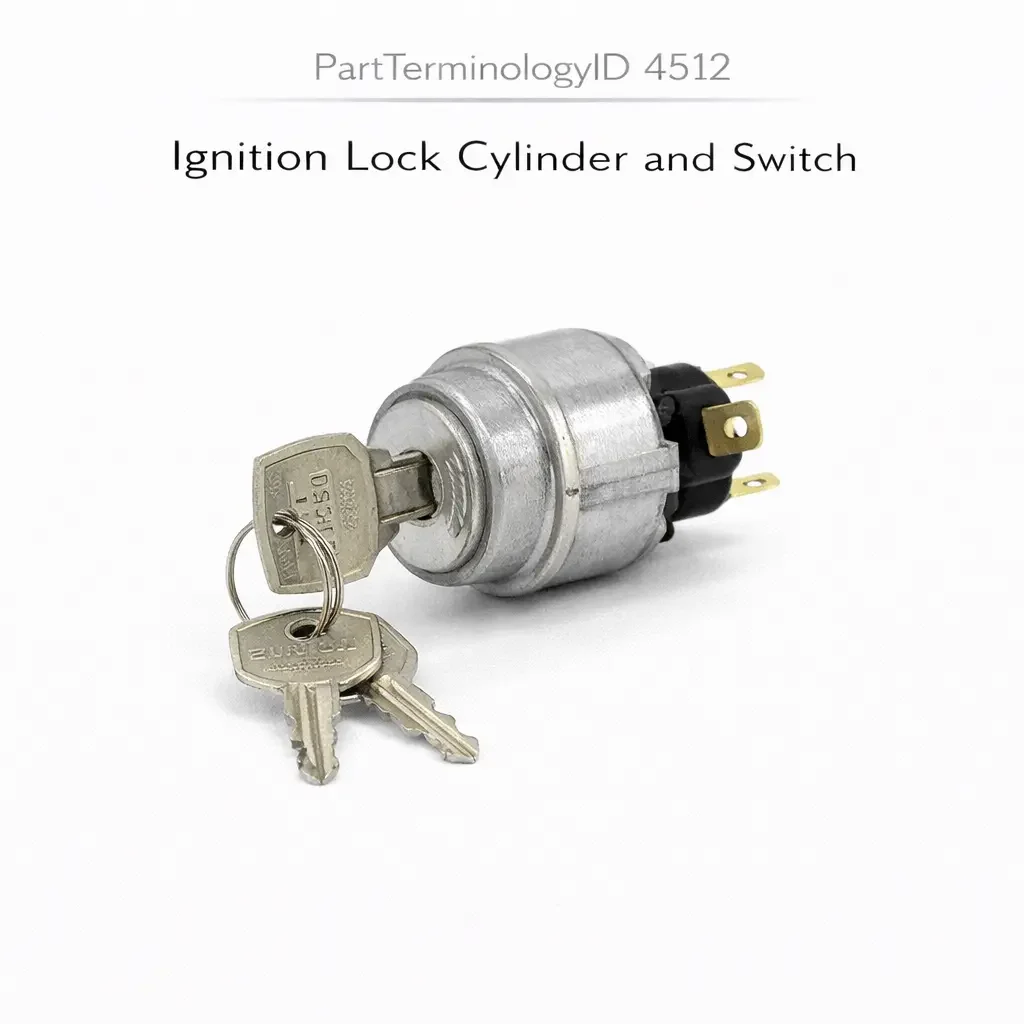
PartTerminologyID 4512, Ignition Lock Cylinder and Switch, is the combined assembly consisting of the mechanical lock cylinder that accepts the ignition key and the electrical switch module that carries the ignition circuit contacts, supplied and installed together as a single integrated or co-dependent replacement unit on applications where the lock cylinder and switch module are not separately serviceable at the repair level, where both components share a housing that must be replaced as a unit, or where the application's anti-theft architecture requires the lock cylinder and switch to be replaced together to restore full anti-theft function, and encompassing all key compatibility, immobilizer integration, transponder programming, electrical circuit coverage, and steering column interface requirements that govern whether the replacement restores complete ignition system function without additional service steps or component sourcing. That definition covers the combined assembly replacement function correctly and leaves unresolved every question that determines whether the replacement assembly's lock cylinder is keyed-to-code matching the vehicle's existing key or requires re-keying, whether the assembly includes the transponder or immobilizer components necessary for a transponder-equipped vehicle to start without additional programming, whether the electrical switch module covers all ignition circuit positions including retained accessory power and any additional positions specific to the vehicle's electrical architecture, whether the assembly's steering column interface geometry matches the specific column type and column housing at the installation position, whether the assembly is compatible with the PASSKEY, PASSLOCK, or coded key immobilizer system present on the vehicle, whether the replacement includes the anti-theft steering column lock pin assembly that engages the steering shaft when the key is removed, whether the assembly requires dealer programming or VIN-specific initialization after installation, and whether the assembly is compatible with push-button start systems that use an electronic lock cylinder without a traditional rotating key mechanism.
It does not specify the key compatibility, transponder integration, switch circuit coverage, column interface geometry, anti-theft lock pin assembly, dealer programming requirement, or push-button start compatibility. A listing under PartTerminologyID 4512 that states only year, make, and model without key configuration and transponder specification cannot be evaluated by a technician replacing a combined lock cylinder and switch assembly on a vehicle with a PASSLOCK II system where the lock cylinder's resistor sensor value determines the PASSLOCK module's authorization signal, and the replacement assembly uses a different resistor sensor value than the original, causing the PASSLOCK module to detect an unauthorized key insertion event and disable fuel injection for a 10-minute lockout period after every start attempt, leaving the vehicle effectively undriveable without an additional PASSLOCK module reprogramming service.
For sellers, PartTerminologyID 4512 is the most complex ignition system PartTerminologyID in the catalog because it combines the key compatibility requirements of the lock cylinder, the anti-theft integration requirements of the immobilizer architecture, the electrical circuit requirements of the switch module, and the mechanical interface requirements of the steering column into a single replacement unit where all four attribute sets must simultaneously match the vehicle's original configuration. A mismatch in any one of the four attribute sets produces an ignition system that either will not start the vehicle, starts the vehicle but with reduced anti-theft protection, starts the vehicle but with missing electrical circuit positions, or does not fit the steering column housing. All four failure modes are preventable with explicit attribute listing and none produces an installation error that is immediately visible before the first start attempt.
What the Ignition Lock Cylinder and Switch Assembly Does
Integrated Assembly Architecture and the Separation of Services
The ignition lock cylinder and switch are combined under PartTerminologyID 4512 for two distinct reasons depending on the application. The first reason is physical inseparability: on some column designs, the lock cylinder and switch module share a housing, a connecting mechanism, or a mounting architecture that makes them non-serviceable independently at the shop level. Replacing one requires removing and replacing the complete assembly. The second reason is anti-theft interdependency: on applications where the lock cylinder's unique characteristics (resistor pellet, transponder, or coded tumblers) are read by the switch assembly's electronic components or by an integrated circuit in the combined housing, the anti-theft authentication occurs within the assembly and cannot be performed with a mismatched pairing of a replacement lock cylinder and an original switch.
The distinction between PartTerminologyID 4508 (Ignition Switch Kit) and PartTerminologyID 4512 (Ignition Lock Cylinder and Switch) is that PartTerminologyID 4508 covers service kits where the components are packaged together but may be separately installable, while PartTerminologyID 4512 covers assemblies that are functionally or physically integrated and must be replaced as a complete unit. In practice, many catalog databases use both PartTerminologyIDs for the same physical part depending on how the application is described, and the attributes required for both PartTerminologyIDs are substantially the same. The key compatibility and anti-theft attributes are the primary specifications in both cases.
Key Compatibility Architecture: Traditional Tumblers, Transponders, and Coded Keys
The ignition lock cylinder in the combined assembly accepts the vehicle's key through a keyway profile that matches the key blank's cross-sectional geometry, and authenticates the key through one or more of three mechanisms depending on the vehicle's security generation.
The traditional tumbler mechanism uses wafer or disc tumblers whose positions are set by the key's cut pattern (the depths and spacing of the notches cut along the key blade). When the correct key is inserted, all tumblers align at the shear line and the cylinder rotates freely. An incorrect key misaligns one or more tumblers and blocks rotation. A replacement assembly using this mechanism must match the vehicle's key cut code (the specific sequence of tumbler positions) or must be supplied uncut for a locksmith to cut to the existing code.
The transponder mechanism adds an electronic authentication layer where a radio frequency transponder chip embedded in the key head communicates with an antenna coil surrounding the lock cylinder barrel. When the correct key is inserted, the transponder chip transmits its unique code to the antenna coil, which relays the code to the immobilizer module for validation. If the code matches the module's stored authorization list, the module enables fuel injection and allows the engine to start. If the code does not match or is absent, the module prevents starting. A replacement assembly for a transponder-equipped vehicle must include the antenna coil integrated into or supplied with the assembly, and any new keys included in the assembly must have their transponder chips programmed to the vehicle's immobilizer module before the vehicle will start.
The coded key mechanism used on some European and Asian applications embeds a unique key profile that interacts with an electronic encoder in the lock cylinder to produce a digital authorization code transmitted to the vehicle's immobilizer controller. This mechanism combines the mechanical tumbler authentication with an electronic coding layer that is cylinder-specific rather than key-blank-specific, meaning the coding is in the cylinder rather than in the key and the cylinder must be initialized to the vehicle's immobilizer system rather than the key being programmed to the vehicle.
PASSKEY, PASSLOCK, and VATS System Compatibility
General Motors used three successive immobilizer architectures across different model years that each require specific compatibility in the replacement lock cylinder and switch assembly.
The Vehicle Anti-Theft System (VATS) used from the mid-1980s through the mid-1990s embeds a resistor pellet in the key blade whose resistance value is read by contacts in the lock cylinder. The contacts measure the resistance when the key is inserted and transmit the value to the VATS control module. If the resistance matches the module's calibration, the module enables starter engagement and fuel injection. If the resistance is incorrect or absent (as with a non-VATS key), the module prevents starting for a timed lockout period. The replacement assembly for a VATS vehicle must include contacts in the lock cylinder compatible with the specific resistance pellet value programmed into the VATS module. VATS resistor pellets are available in 15 resistance values and the correct value must be identified from the existing key before a replacement assembly is ordered.
The PASSKEY II system used from the early to mid-1990s operates similarly to VATS but with a different circuit architecture and resistance reading mechanism. PASSKEY II also uses a resistance pellet in the key but the circuit interface in the lock cylinder differs from VATS. A VATS replacement assembly cannot substitute for a PASSKEY II application and vice versa.
The PASSLOCK system used from the mid-1990s through the early 2000s eliminated the resistor pellet from the key and moved the authentication to the lock cylinder itself. The PASSLOCK lock cylinder contains a Hall effect sensor or a resistance element that produces a specific electrical signal when the correct mechanical key is inserted and the cylinder begins to rotate. The signal value is specific to the replacement lock cylinder and must either match the PASSLOCK module's stored value (if the module is not being replaced) or require the PASSLOCK module to be reprogrammed to the new cylinder's signal value after installation. PASSLOCK relearn procedures are available through the factory service manual and can be performed without a scan tool in most cases, but require a specific key cycle sequence that may take up to 30 minutes to complete on the first start attempt.
Electronic Ignition Lock Cylinder for Push-Button Start Systems
Vehicles with keyless push-button start systems use an electronic ignition lock cylinder or a slot-type smart key reader rather than a rotating mechanical lock cylinder. The driver inserts or places the smart key in the designated location, the smart key reader verifies the key's transponder communication, and the driver presses a start button to initiate the ignition sequence. In this architecture, the traditional rotating lock cylinder is absent and the ignition switch module is activated electronically rather than mechanically.
A replacement ignition lock cylinder and switch assembly for a push-button start vehicle is not a traditional rotating lock cylinder and switch. It is an electronic smart key reader assembly or a smart key slot assembly, and the replacement must match the specific smart key frequency and protocol used by the vehicle's body control module. A generic or incorrect smart key reader assembly will not recognize the vehicle's existing smart key and the vehicle will not start regardless of how many times the start button is pressed.
Push-button start applications under PartTerminologyID 4512 require explicit disclosure that the assembly is a smart key reader type rather than a traditional rotating cylinder type, and must state the smart key communication protocol compatibility.
Electrical Switch Circuit Coverage and Position Configuration
The electrical switch module in the combined assembly provides the ignition circuit contact positions that govern which vehicle systems are powered at each key position. The standard positions are identical to those described in PartTerminologyID 4508 (off, accessory, run, start), and all of the position coverage requirements described in that PartTerminologyID apply equally to PartTerminologyID 4512.
On modern vehicles with retained accessory power (RAP) systems, the switch module must provide the RAP circuit output that keeps the radio, power windows, moonroof, and other accessories powered for a defined period after the key is returned to the off position. The RAP function is implemented through a dedicated circuit position or through a timing circuit that monitors the switch position transitions. A replacement assembly without the RAP function cuts off accessory power immediately when the key is returned to off, which the owner interprets as a defect in the replacement.
The connector pin count and terminal assignment for the switch module must match the vehicle harness connector at the steering column position. Different trim levels and equipment packages may use different connector pin counts even within the same model year if the equipment level differences produce different active circuits at the ignition switch position. A replacement with fewer pins than the harness connector leaves the circuits corresponding to the absent pins permanently unconnected or in an uncontrolled state.
Steering Column Interface and the Lock Pin Mechanism
The ignition lock cylinder and switch assembly interfaces with the steering column through a mounting bracket, retaining ring, or housing that must match the column's physical geometry. The steering column type (tilt, non-tilt, telescoping), the column diameter at the ignition assembly mounting position, and the lock pin mechanism that engages the steering shaft when the key is removed all determine whether the replacement assembly fits and functions correctly in the column.
The anti-theft steering column lock pin is a spring-loaded or cam-driven pin in the lock cylinder housing that engages a groove or notch in the steering shaft when the key is fully removed, physically locking the steering column and preventing the vehicle from being steered without a key. The lock pin mechanism is one of the oldest and most basic anti-theft features on passenger vehicles, and its function depends on the dimensional match between the lock pin's extended length, the steering shaft's groove depth, and the angular alignment of the pin with the shaft groove at the off key position.
A replacement assembly with a lock pin that does not fully engage the steering shaft groove will allow the steering column to be rotated even without a key, eliminating the steering lock anti-theft function. A lock pin that is too long may contact the steering shaft groove before the key reaches the full off position, preventing the key from being fully removed or creating resistance at the off position that the owner notices immediately.
Theft Attempt Recovery and the Complete Assembly Replacement Requirement
Drill-and-hotwire recovery and the combined assembly necessity
The most common scenario requiring a complete ignition lock cylinder and switch assembly replacement under PartTerminologyID 4512 rather than a component-level repair under PartTerminologyID 4508 or a standalone part is vehicle recovery after a theft attempt. A theft attempt using drill-and-pry methods typically damages both the lock cylinder (destroying the tumbler mechanism) and the switch module (damaging the contacts or housing from the force applied to the drill point or pry bar). The damage to both components simultaneously makes a standalone lock cylinder or switch module replacement insufficient, and the complete assembly is the appropriate repair.
Theft recovery replacement under PartTerminologyID 4512 requires particular attention to the key compatibility attribute because the original keys are typically with the vehicle owner rather than the thief, and the replacement assembly must either accept the existing keys (keyed-to-code) or include a complete re-keying of the door, trunk, and glove box locks to match the new ignition key (which adds significant service cost beyond the assembly itself). The listing must make this consequence explicit for theft recovery buyers.
Anti-theft steering column lock damage and the housing replacement requirement
A severe theft attempt using channel-lock pliers or a steering wheel breaker bar to force the locked steering column can damage the column housing around the lock pin engagement zone in addition to destroying the ignition assembly. In this case, the replacement ignition lock cylinder and switch assembly must be accompanied by a replacement steering column housing section to restore the lock pin's engagement geometry. A listing for a theft recovery application should note whether the assembly requires a compatible column housing and whether the housing is included in the assembly or must be ordered separately.
Why This Part Generates Returns
Buyers return combined ignition lock cylinder and switch assemblies because the replacement uses a generic change key and the buyer expected keyed-to-code matching the existing door locks, requiring either carrying two keys or a locksmith re-keying service; the PASSLOCK resistor sensor value in the replacement cylinder differs from the PASSLOCK module's calibration and the vehicle enters a 10-minute lockout after every start attempt until the PASSLOCK module is relearned; the transponder programming requirement is not disclosed and the vehicle does not start after installation on a transponder-equipped vehicle; the assembly is specified for a non-tilt column and the vehicle has a tilt column where the housing mounting geometry differs; the anti-theft steering lock pin in the replacement is 1mm shorter than the original and does not fully engage the steering shaft groove, allowing the steering column to be rotated without a key; the RAP circuit position is absent in the replacement and the radio, power windows, and moonroof cut off immediately at key removal; the connector pin count is sixteen and the vehicle harness has twenty pins on the equipment level that includes the heated steering wheel and wheel-mounted audio controls, leaving four circuits unconnected; the assembly requires dealer VIN programming after installation and the listing describes it as a direct plug-and-play replacement, leaving the vehicle unable to start after installation; the smart key reader assembly is specified for the standard keyless entry protocol and the vehicle uses a high-security protocol that requires a specifically coded reader; and the assembly is installed on a VATS vehicle with resistor pellet value 11 (470 ohms) but the replacement assembly's contacts are calibrated for value 9 (330 ohms), preventing VATS authentication on every start attempt.
Top Return Scenarios
Scenario 1: "Generic change key, buyer expected keyed-to-code, two-key consequence"
The buyer orders the combined assembly for a failed lock cylinder with intact switch module. The listing covers the vehicle without specifying key configuration. The delivered assembly includes a generic change key different from the existing door, trunk, and glove box keys. The buyer must either carry two keys for the life of the vehicle or pay a locksmith to re-key the replacement cylinder to the existing code and re-cut a matching key.
Prevention language: "Key configuration: [keyed-to-code, cylinder matches existing vehicle key from VIN code / generic change key, different from existing door and trunk keys]. A keyed-to-code assembly requires no locksmith service and allows the existing keys to operate all locks. A generic change key assembly requires carrying a separate ignition key or paying a locksmith to re-key the replacement cylinder and all other lock cylinders to a single matching key."
Scenario 2: "PASSLOCK resistor sensor mismatch, 10-minute fuel disable lockout after every start"
The buyer installs the replacement assembly on a GM PASSLOCK-equipped vehicle. The PASSLOCK relearn procedure is not performed after installation. The replacement cylinder's resistor sensor produces a different output value than the PASSLOCK module is calibrated for. Every start attempt results in a 10-minute fuel disable lockout where the engine cranks but does not start.
Prevention language: "PASSLOCK compatibility: [PASSLOCK module relearn required after installation / PASSLOCK signal value [X] ohms, matches vehicles with PASSLOCK module calibrated for this value]. After installation, the PASSLOCK relearn procedure must be completed using the key cycle sequence described in the factory service manual. Without the relearn, the PASSLOCK module will detect a mismatch and impose a timed fuel disable after every start attempt."
Scenario 3: "Transponder programming not disclosed, vehicle does not start, dealer programming required"
The buyer installs the combined assembly on a transponder-equipped vehicle. The engine cranks but does not start. The immobilizer module does not recognize the new key's transponder chip. The listing described the assembly as a direct replacement. The buyer cannot start the vehicle and must have it towed to a dealer for transponder programming.
Prevention language: "Transponder programming: [not required, direct replacement / required after installation, new key must be programmed to vehicle immobilizer module using [dealer scan tool / compatible aftermarket programmer]. The vehicle will not start after installation until the new key's transponder chip is programmed to the immobilizer module. Arrange programming access before installation."
Scenario 4: "Tilt column assembly on non-tilt column vehicle, housing mounting geometry mismatch, key cannot rotate to start"
The buyer installs the assembly on a non-tilt column vehicle. The tilt column assembly's housing is 8mm longer at the mounting boss than the non-tilt column housing. The switch module sits 8mm further from the steering shaft actuating mechanism than the original, preventing the mechanical connection between the lock cylinder rotation and the switch module actuation. The key rotates to accessory and run positions but cannot reach the start position against the misaligned mechanism.
Prevention language: "Steering column type: [tilt / non-tilt / telescoping]. This assembly is specified for [column type]. Tilt and non-tilt column assemblies use different housing lengths and mounting geometries. A tilt column assembly in a non-tilt column prevents full key rotation to the start position from actuating mechanism misalignment."
Scenario 5: "Anti-theft steering lock pin 1mm short, steering column rotatable without key, anti-theft compromised"
The buyer installs the replacement assembly. All electrical ignition functions operate correctly. Two weeks later, during a police theft report investigation, it is discovered that the vehicle's steering column can be rotated without a key because the lock pin does not fully engage the steering shaft groove. The replacement assembly's lock pin extends 8mm when the key is in the off position. The original pin extended 9mm. The 1mm shortfall prevents the pin from reaching the bottom of the groove.
Prevention language: "Anti-theft steering lock pin extension: [X] mm at key-off position. Verify the lock pin extension against the steering shaft groove depth. A lock pin 1mm shorter than the original will not fully engage the groove, allowing the steering column to be rotated without a key and eliminating the mechanical anti-theft steering lock function."
Scenario 6: "VATS resistor pellet value mismatch, starter lockout on every start attempt"
The buyer installs the replacement assembly on a GM VATS-equipped vehicle. The replacement assembly's contacts are calibrated for VATS pellet value 9 (330 ohms). The vehicle's VATS module is calibrated for value 11 (470 ohms) based on the key cut at the factory. Every start attempt activates the VATS lockout because the 330-ohm contact reading does not match the 470-ohm calibrated value, preventing starter engagement for the lockout duration.
Prevention language: "VATS resistor pellet compatibility: [value [X], [X] ohms]. Confirm the VATS pellet value from the existing key before ordering. VATS keys contain one of 15 specific resistance values and the replacement assembly's contacts must match the vehicle's calibrated value. An incorrect value prevents starter engagement on every start attempt."
Scenario 7: "Dealer VIN programming required, listed as plug-and-play, vehicle does not start after installation"
The buyer installs the replacement assembly on a modern vehicle with a coded key immobilizer system. No start occurs after installation. The assembly requires VIN-specific initialization where the dealer programs the assembly's internal immobilizer controller to recognize the vehicle's existing key transponder codes. The listing described the assembly as direct plug-and-play. The buyer cannot start the vehicle and must have it towed for dealer programming.
Prevention language: "Dealer initialization required: [yes, VIN-specific programming required at dealer or authorized programming center / no, self-initializing or no programming required]. This assembly requires VIN-specific programming before the vehicle will start. The programming initializes the assembly's immobilizer controller to the vehicle's existing key transponder codes. Arrange dealer programming before installation."
Scenario 8: "RAP circuit position absent, radio and power windows cut off at key removal"
The buyer installs the replacement assembly. All ignition circuit positions function correctly. The radio and power windows cut off immediately when the key is returned to the off position, where the original assembly kept them powered for 10 minutes to allow driver egress. The replacement module does not include the retained accessory power circuit position.
Prevention language: "Retained accessory power (RAP) circuit: [included, accessories powered for [X] minutes after key-off / not included, accessories cut off immediately at key-off]. Verify RAP inclusion against the original assembly. On vehicles with factory RAP function, a replacement without this circuit cuts off radio, power windows, and moonroof immediately at key removal, which is immediately noticed by the driver as a defect."
Core Listing Attributes for PartTerminologyID 4512
PartTerminologyID: 4512
Component: Ignition Lock Cylinder and Switch
Key compatibility: keyed-to-code, unkeyed, or generic change key with new key included or excluded (mandatory, in title)
Immobilizer system compatibility: none, transponder with programming requirement and method, PASSLOCK with relearn procedure, VATS with pellet value, PASSKEY with resistance value, or coded key (mandatory, in title)
Anti-theft steering column lock: included with lock pin extension specification, or not included (mandatory)
Electrical switch position coverage: off, accessory, run, start, RAP, and any additional positions (mandatory)
Start position contact current rating in amperes (mandatory)
Connector pin count with function mapping for all active circuit pins (mandatory)
Steering column type: tilt, non-tilt, or telescoping (mandatory)
Assembly type: traditional rotating cylinder, electronic smart key reader, or slot-type smart key (mandatory)
Dealer programming requirement: none, self-relearn procedure, or dealer VIN programming (mandatory)
VATS pellet value range or specific value (mandatory for VATS applications)
PASSLOCK relearn procedure disclosure (mandatory for PASSLOCK applications)
Year/make/model/submodel/trim/engine/column type/immobilizer system
Note for production date range where immobilizer system changed
Note for trim levels where connector pin count differs due to equipment level differences
Note for theft recovery applications where column housing replacement may also be required
Note for smart key protocol variants where reader must match specific frequency
Catalog Checklist for ACES/PIES Teams
PartTerminologyID = 4512
Require key configuration in title: keyed-to-code, unkeyed, or generic change key (mandatory)
Require immobilizer compatibility in title: transponder, PASSLOCK, VATS, PASSKEY, coded key, or none (mandatory)
Require steering column type (mandatory)
Require electrical switch position coverage with all positions listed (mandatory)
Require start contact current rating (mandatory)
Require connector pin count with function mapping (mandatory)
Require dealer programming disclosure with method specified (mandatory)
Require anti-theft steering lock pin extension specification (mandatory)
Require RAP circuit status: included or not included (mandatory)
Prevent key configuration omission: a generic change key in a keyed-to-code expectation forces a two-key situation or locksmith service; key configuration must be the primary consumer-facing attribute in every listing
Prevent transponder programming omission: a transponder-equipped vehicle that receives an undisclosed programming requirement produces a no-start condition after installation; programming requirement and specific method must be disclosed in every transponder application listing
Prevent PASSLOCK relearn omission: a PASSLOCK vehicle requires a relearn procedure after every lock cylinder or combined assembly replacement; the procedure must be disclosed even when it is a self-relearn rather than a dealer service
Prevent VATS value omission: an incorrect VATS pellet value produces a starter lockout on every start attempt; the specific pellet value or value range must be stated for every VATS application listing
Prevent column type omission: a tilt assembly in a non-tilt column prevents full key rotation to start; column type must be in the title or first line of description
Prevent RAP circuit omission: a replacement without RAP cuts off radio and power windows at key removal; RAP inclusion must be stated
Prevent anti-theft lock pin omission: a lock pin 1mm shorter than the original eliminates the mechanical steering lock anti-theft function; lock pin extension must be stated and verified
Relationship to PartTerminologyID 4508 (Ignition Switch Kit): both cover combined ignition lock cylinder and switch replacement; PartTerminologyID 4508 typically covers service kit configurations where components may be separately installable; PartTerminologyID 4512 covers integrated or physically inseparable assemblies; the attributes required for both are substantially identical and cross-referencing between the two PartTerminologyIDs is recommended
Differentiate from Ignition Switch (standalone electrical module if cataloged): the standalone ignition switch covers only the electrical switch module; PartTerminologyID 4512 covers the combined lock cylinder and switch assembly; confirm whether the specific failure mode and column architecture allow standalone component replacement before directing the buyer to a combined assembly
FAQ (Buyer Language)
Does the replacement assembly include a key that will work in my door locks?
Only if the listing specifies a keyed-to-code assembly. A keyed-to-code assembly is pre-cut to match your vehicle's existing key code (derived from the VIN) and the included key will work in all locks that use the same key code. A generic change key assembly includes a key that is different from your existing keys and will not work in your door or trunk locks. Always confirm the key configuration before ordering to avoid carrying two keys or paying for locksmith re-keying service.
My vehicle has the flashing security light on the dashboard. Does this affect the replacement?
A flashing security light indicates the immobilizer system is active and relevant to the replacement. Identify the specific immobilizer system (VATS, PASSLOCK, PASSKEY, or transponder) from the vehicle service manual and confirm the replacement assembly's compatibility with that specific system. Replacing the assembly without completing the required initialization or relearn procedure will maintain or worsen the security light condition and may prevent the vehicle from starting.
How long does the PASSLOCK relearn procedure take?
The PASSLOCK relearn procedure requires a specific key cycle sequence that varies by application but typically involves turning the ignition to the on position (not start), waiting for the security light to extinguish (3 to 10 minutes), then cycling the ignition off for a defined interval and repeating the sequence twice more. The complete procedure takes 15 to 30 minutes the first time and must be performed without interruption. The factory service manual for the specific year, make, and model provides the exact procedure. The relearn must be completed the first time the vehicle is started after installation.
Can I install this assembly myself or do I need a dealer?
The mechanical installation is within the scope of a competent home mechanic with the appropriate steering column tools (lock plate compressor, steering wheel puller). However, if the application requires transponder programming, VIN-specific immobilizer initialization, or PASSKEY module replacement, dealer tool access is required for those specific steps. The PASSLOCK relearn can be performed without dealer tools on most applications. Confirm the programming requirements before beginning installation to determine whether dealer involvement will be needed after the mechanical installation is complete.
What happens if I install the wrong VATS resistor value?
The VATS module compares the measured key pellet resistance to its calibrated value at every start attempt. If the values do not match, the module prevents starter engagement and fuel injection for the VATS lockout period (typically 3 to 5 minutes). After the lockout expires, the ignition can be cycled again and the VATS module will attempt authentication again with the same result. The lockout repeats on every start attempt until the correct pellet value is installed. The correct VATS pellet value can be read from the existing key with an ohmmeter: measure across the two terminals of the resistor pellet in the key blade and record the resistance.
Related PartTerminologyIDs
Ignition Switch Kit (PartTerminologyID 4508): covers combined component kits where the lock cylinder and switch may be separately installable; many applications are cataloged under both PartTerminologyIDs; attributes required for both are substantially identical and listings under both should be cross-referenced for consistency
Ignition Switch (standalone if cataloged): covers the electrical switch module only for applications where the lock cylinder and switch are separately serviceable and only the switch has failed; confirm the failure mode and column architecture before directing a buyer to a combined assembly when a standalone switch may be the appropriate repair
Lock Cylinder (standalone if cataloged): covers the mechanical lock cylinder only for applications where only the cylinder has failed and the switch module is functional; confirm the failure mode before ordering a combined assembly when a standalone cylinder may avoid the unnecessary key compatibility consequences of a new combined assembly
Transponder Key (if cataloged): the key with the transponder chip that must be programmed to the immobilizer module after combined assembly replacement; on applications where the combined assembly does not include a key, the transponder key must be sourced and programmed separately before the vehicle will start
Status in New Databases
PIES/PCdb: PartTerminologyID 4512, Ignition Lock Cylinder and Switch
PIES 8.0 / PCdb 2.0: No change in PartTerminologyID or terminology label
Final Take for PartTerminologyID 4512
Ignition Lock Cylinder and Switch (PartTerminologyID 4512) is the ignition system PartTerminologyID with the highest combined consequence of attribute mismatch across four independent specification categories simultaneously: key compatibility determines whether the buyer carries one key or two, anti-theft immobilizer compatibility determines whether the vehicle starts or sits in a 10-minute lockout on every attempt, electrical switch position coverage determines whether accessory functions are available after key removal, and steering column interface geometry determines whether the key reaches the start position. None of these mismatches is visible at installation, and all four manifest on or after the first start attempt.
State the key configuration in the title. State the immobilizer system compatibility in the title. State the dealer programming requirement and method. State the anti-theft steering lock pin extension. State the RAP circuit inclusion. State the electrical switch position coverage with all positions. State the start contact current rating. State the connector pin count with function mapping. State the steering column type. For PartTerminologyID 4512, key configuration, immobilizer system compatibility with programming disclosure, and anti-theft steering lock pin extension are the three attributes that prevent the three most consequential and most frequently overlooked return scenarios in the ignition lock cylinder and switch buyer population.