
Written by Arthur Simitian | PartsAdvisory
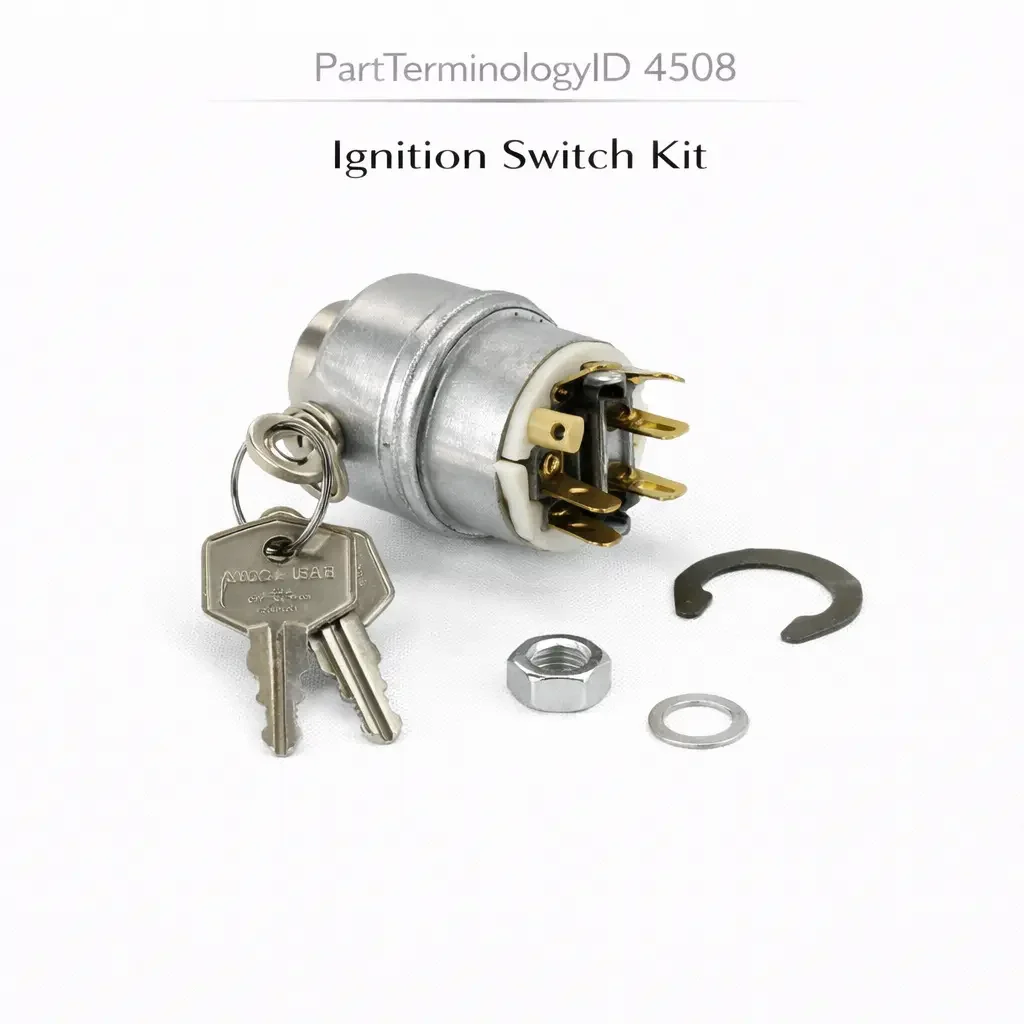
PartTerminologyID 4508, Ignition Switch Kit, is the packaged assembly containing the components required to restore complete ignition switch function, typically including the electrical ignition switch module that carries the ignition circuit contacts, the mechanical lock cylinder that accepts the vehicle key and translates key rotation into mechanical switch actuation, the retaining hardware, and in some kit configurations the steering column housing components or trim panels necessary to complete the installation, and distinguishing itself from standalone ignition switch replacements (where only the electrical switch module or only the lock cylinder is replaced) by providing the complete assembly needed when either or both components have failed simultaneously or when the kit is being installed as part of a security upgrade or anti-theft service. That definition covers the kit assembly and multi-component service function correctly and leaves unresolved every question that determines whether the kit covers the specific combination of components required for the vehicle's failure mode (electrical switch only, lock cylinder only, or both), whether the electrical switch module's contact configuration and circuit coverage match the original ignition circuit's position outputs (off, accessory, run, and start positions plus any additional positions such as bulb check or retained accessory power), whether the lock cylinder's key cut specification matches the vehicle's key blank or whether the cylinder is a coded type requiring dealer programming or a passkey transponder configuration, whether the steering column housing trim components in the kit match the specific column type (tilt or non-tilt, standard or telescoping), whether the kit includes or excludes a new key and whether the new key must be cut to the vehicle's existing key code, and whether the electrical switch module is compatible with the specific ignition circuit voltage and current load including the starter solenoid circuit, the ignition primary circuit, the accessory circuit, and the retained accessory power circuit.
It does not specify the kit component content, electrical switch circuit coverage, lock cylinder key specification, passkey or transponder compatibility, column type compatibility, or key inclusion. A listing under PartTerminologyID 4508 that states only year, make, and model without kit content and circuit coverage cannot be evaluated by a technician replacing a failed ignition switch on a vehicle where the electrical switch module has failed but the lock cylinder is intact, and the replacement kit includes a new lock cylinder that requires a different key cut than the vehicle's existing keys, requiring the owner to have all new keys cut and the existing door and trunk locks re-keyed or to carry two different keys for the ignition and body locks, neither of which was the intended outcome of an ignition switch replacement.
For sellers, PartTerminologyID 4508 is the ignition system PartTerminologyID with the most critical key compatibility consequence of any kit-format product in the electrical catalog, because a kit that includes a new lock cylinder with an incompatible or non-matching key specification either forces the owner to carry a second key for the ignition or requires a locksmith service to re-cut the replacement cylinder to the vehicle's existing key code. Both outcomes are avoidable with explicit kit content disclosure in the listing and a clear note on whether the replacement cylinder is keyed-to-code (matching the vehicle's existing key from the VIN key code) or uncut (requiring professional cutting after installation).
What the Ignition Switch Kit Does
Electrical Switch Module and the Ignition Circuit Contact Coverage
The electrical ignition switch module is the contact assembly inside the steering column that carries the ignition circuit current through its multiple position contacts. In most applications, the switch module operates independently of the lock cylinder: the lock cylinder's mechanical rotation actuates the switch module through a connecting link or cam, but the two components can typically be separated and replaced independently.
The ignition switch module provides contacts for four standard ignition positions: off (all circuits open), accessory (accessory circuit active, ignition and starter inactive), run (ignition circuit active, starter inactive), and start (ignition and starter circuits simultaneously active, some accessories deactivated). On modern vehicles, additional positions may be present: a retained accessory power position (between run and off) where certain accessories remain powered briefly after the key is returned to off, a bulb check position (briefly activating warning lamps at key insertion before the accessory position) on some older domestic applications, and in some cases a park interlock position that is mechanically linked to the automatic transmission selector.
The replacement electrical switch module must cover all active positions in the original circuit with the same contact current rating for each position. The start position contact carries the starter solenoid control circuit current (typically 5 to 15 amperes on the solenoid engagement circuit). The run position carries the ignition primary, fuel pump relay, and ECU supply circuits. The accessory position carries the radio, power window, and heated seat circuits. Each position has a different aggregate current load, and the switch module contacts must be rated for the maximum expected current at each position.
A replacement module with fewer positions than the original leaves the circuits corresponding to the absent positions permanently in one state (open or connected to an adjacent position's circuit). On a vehicle with a retained accessory power position, a module without this position will either cut accessory power immediately on key removal (if the retained position was between run and off) or maintain accessory power continuously (if the module's off position was mapped to the original's retained position).
Lock Cylinder Key Specification and the Rekeying Consequence
The lock cylinder is the mechanical component that accepts the ignition key and translates the key's rotation into switch module actuation through the steering column's lock mechanism. The lock cylinder contains the tumbler wafer stack that aligns when the correct key is inserted, allowing the cylinder to rotate, and misaligns when an incorrect key is inserted, blocking rotation.
The key specification for the replacement lock cylinder is the most critically consumer-visible attribute in this kit category because it determines whether the owner can use existing keys or must obtain new ones. Lock cylinder replacements are available in three key configurations. The keyed-to-code configuration provides a cylinder pre-cut to match the vehicle's existing key code, which is derived from the VIN key code on record with the vehicle manufacturer or the dealer. With a keyed-to-code cylinder, the original keys work in the replacement cylinder and no locksmith service is required.
The unkeyed or uncut configuration provides a cylinder with uncut tumblers that must be cut to match the vehicle's key code by a locksmith or dealer before installation. If the cylinder is installed without cutting, it will accept any key that fits the cylinder's keyway profile, which is a security vulnerability and is not an acceptable installation outcome.
The generic or change key configuration provides a cylinder with a new key blank that is different from the vehicle's existing key. The owner receives a new key for the ignition but must carry a separate key for the door and trunk locks. This configuration is commonly used in emergency replacement situations where the vehicle's key code is unknown, but produces the two-key consequence described above.
The listing must state the key configuration (keyed-to-code, unkeyed, or generic change key) as a primary attribute and must note whether the kit includes a new key or requires the original key to be transferred or a new key to be cut separately.
Passkey and Transponder Compatibility
Many vehicles from the mid-1990s onward use a transponder-based immobilizer system where the ignition key contains a radio frequency transponder chip that must be recognized by the vehicle's immobilizer control module before the ECU will enable fuel injection and ignition. Vehicles with transponder-based immobilizers include the lock cylinder as part of the anti-theft architecture because an unauthorized key without the correct transponder chip cannot start the engine even if the lock cylinder tumblers are manipulated.
A replacement lock cylinder for a transponder-equipped vehicle must be compatible with the specific transponder protocol used by the vehicle's immobilizer module. If the replacement cylinder includes a new key blank, the new key's transponder chip must be programmed to the vehicle's immobilizer module before the engine will start. This programming step requires a dealer-level scan tool or a compatible aftermarket programming device and may require programming of multiple keys to satisfy the immobilizer system's minimum key count requirement.
A kit listing that does not disclose the transponder programming requirement leaves the buyer expecting a straightforward mechanical replacement but receiving a component that requires an additional programming service before the vehicle will start. The programming requirement must be disclosed in the listing with the specific programming method (dealer only, aftermarket scan tool with VIN-specific access, or self-programming procedure using existing programmed keys).
Some GM vehicles from the 1990s and early 2000s used the PASSKEY or PASSLOCK system where a resistor pellet in the key or a lock cylinder resistance sensor communicates with the body control module during the ignition cycle. The resistance value in the replacement key or the resistance sensor in the replacement lock cylinder must match the original system's calibration. An incorrect resistance value produces a fuel disable condition where the ECM prevents fuel injection for a timed lockout period (typically 3 to 10 minutes) after the incorrect resistance is detected.
Steering Column Type and Housing Compatibility
The ignition switch kit's mounting components (housing, trim bezel, lock plate, and retaining ring) must match the specific steering column type. Tilt column and non-tilt column configurations use different housing geometries, different lock plate assemblies, and different tilt mechanism components. A kit specified for a non-tilt column will not include the tilt mechanism components required for a tilt column installation and may not fit the tilt column housing's mounting boss dimensions.
Telescoping columns used on some commercial vehicles and luxury domestic applications add an additional dimension of compatibility: the ignition switch and lock cylinder must accommodate the column's telescoping travel without binding the switch mechanism at any column extension length. A switch module specified for a non-telescoping column may have a shorter connecting link that does not maintain proper actuation geometry at the telescoping column's extended position.
The column type (tilt, non-tilt, or telescoping) must be stated as a mandatory attribute for every ignition switch kit listing that includes housing or column components.
Kit Content Configurations and the Buyer's Failure Mode Diagnosis
Electrical switch only, lock cylinder only, or complete kit
The most common failure modes in the ignition switch system are sufficiently distinct to allow the technician to identify which component requires replacement before ordering the kit. An electrical switch failure produces ignition circuit symptoms: the engine cranks but does not start (run position contacts failed), the starter engages but the engine immediately cuts out when the key is released to run (run position contacts failed but start contacts are intact), or the accessory circuit is active at all positions including off (contacts fused or shorted). All of these symptoms are present regardless of whether the key operates the lock cylinder correctly.
A lock cylinder failure produces mechanical symptoms: the key does not turn (tumbler wear, foreign object, or cylinder damage), the key turns but the cylinder does not return to the off position (cylinder detent spring failure), or the key can be removed from any position (cylinder detent failure allowing key removal while the switch is in the run position). None of these symptoms involves the electrical switch module's contact function.
A kit that includes both the electrical switch module and the lock cylinder is appropriate when both components require replacement simultaneously (such as after a theft attempt where the lock cylinder was drilled and the switch module was damaged by attempted hotwiring), or when the kit represents a factory service package where both components are supplied together as a service convenience.
A listing under PartTerminologyID 4508 must clearly state which components are included in the kit and must guide the buyer toward ordering the appropriate kit configuration for the identified failure mode. A buyer who orders a complete kit including a new lock cylinder when only the electrical switch has failed will receive an unwanted new lock cylinder requiring either installation with key incompatibility or a locksmith service to match the original key code.
Why This Part Generates Returns
Buyers return ignition switch kits because the kit includes a new lock cylinder with a generic change key and the buyer expected a keyed-to-code cylinder matching their existing keys, requiring a locksmith visit or a second set of keys; the kit is specified for the non-tilt column and the vehicle has a tilt column where the housing mounting boss dimensions differ, preventing the kit components from fitting the column; the transponder programming requirement is not disclosed and the vehicle does not start after installation because the new key's transponder chip has not been programmed to the immobilizer module; the PASSLOCK resistor value in the replacement key differs from the original and the vehicle enters a 10-minute fuel disable lockout on every start attempt; the electrical switch module does not include a retained accessory power position and the radio cuts off immediately when the key is returned to off rather than remaining active for the driver's egress period; the kit includes only the electrical switch module and the buyer's failure mode is a lock cylinder that will not turn, requiring the separate lock cylinder that was not included; the start position contact rating in the replacement module is lower than the starter solenoid engagement current on a diesel engine with a high-torque starter, producing arc erosion at the start contact within 50 start events; and the kit is specified for a steering column without a security column lock and the vehicle has a locking column where the lock pin engages the steering shaft, requiring a different lock cylinder body geometry that the non-locking replacement does not provide.
Top Return Scenarios
Scenario 1: "Generic change key in keyed-to-code application, owner must carry two keys or pay locksmith"
The buyer orders the ignition switch kit to replace a failed electrical switch module. The kit includes a new lock cylinder with a generic change key. The buyer expected a keyed-to-code cylinder matching the existing door and trunk keys. After installation, the ignition requires the new key while all other locks require the original key. The buyer must either carry two keys or pay a locksmith to re-cut the replacement cylinder to the original key code.
Prevention language: "Lock cylinder key configuration: [keyed-to-code, matches existing vehicle key from VIN key code / unkeyed, requires professional cutting before installation / generic change key included, different from existing vehicle keys]. If the kit includes a new lock cylinder and matching the existing key set is required, verify the key configuration before ordering. A generic change key cylinder requires locksmith service or will result in carrying two keys."
Scenario 2: "Transponder programming requirement not disclosed, vehicle does not start after installation"
The buyer installs the complete kit on a transponder-equipped vehicle. The engine cranks normally but does not start. The immobilizer module does not recognize the new key's transponder chip, which has not been programmed. The listing described the kit as a direct replacement with no additional steps required.
Prevention language: "Transponder programming requirement: [none, direct mechanical replacement / required, new key transponder must be programmed to vehicle immobilizer module using [dealer scan tool / aftermarket programmer]. Programming must be completed before the engine will start. Failure to program the new key transponder produces a no-start condition from immobilizer fuel disable."
Scenario 3: "Non-tilt column kit on tilt column vehicle, housing does not fit mounting boss"
The buyer installs the kit on a tilt column vehicle. The replacement housing's mounting boss is 3mm narrower than the tilt column's housing receiver. The housing cannot be seated fully, leaving the lock cylinder and switch module misaligned with the column actuating mechanism and preventing the key from turning to the start position.
Prevention language: "Steering column type: [tilt / non-tilt / telescoping]. This kit is specified for [column type]. Tilt and non-tilt column kits are not interchangeable. Verify the steering column type before ordering. A non-tilt kit installed on a tilt column will not align with the column's actuating mechanism, preventing key rotation to the start position."
Scenario 4: "PASSLOCK resistor value mismatch, 10-minute fuel disable lockout on every start attempt"
The buyer installs the kit on a GM vehicle with PASSLOCK. The replacement key's resistor pellet value is 720 ohms. The vehicle's PASSLOCK module is calibrated for a 450-ohm resistor. On every start attempt, the PASSLOCK module detects the incorrect resistance and enters a 10-minute fuel disable lockout. The engine cranks but does not start for 10 minutes after every key cycle.
Prevention language: "PASSLOCK compatibility: [resistor value [X] ohms, compatible with vehicles calibrated for [X]-ohm PASSLOCK key / PASSKEY resistor pellet included, verify resistance value against vehicle specification]. PASSLOCK vehicles require the replacement key's resistor pellet value to match the immobilizer module's calibration. An incorrect resistor value produces a timed fuel disable lockout after every start attempt."
Scenario 5: "Retained accessory power position absent, radio cuts off immediately at key removal"
The buyer installs the replacement electrical switch module. The ignition circuit positions (off, accessory, run, and start) all function correctly. After a drive, the radio immediately cuts off when the key is returned to the off position. The original module had a retained accessory power position between run and off that kept the radio and power windows active for 10 minutes after key removal. The replacement module does not include this position.
Prevention language: "Circuit position coverage: [off, accessory, run, start / off, accessory, run, start, retained accessory power]. Verify the position coverage against the original switch module. A module without the retained accessory power position cuts off accessory circuits immediately at key removal. On vehicles where retained accessory power governs the radio, power windows, and moonroof, this function loss is immediately noticed."
Scenario 6: "Start contact rating below diesel starter solenoid current, arc erosion within 50 start events"
The buyer installs the kit on a diesel vehicle with a high-torque starter drawing 12 amperes through the start solenoid engagement circuit. The replacement switch module's start position contact is rated for 7.5 amperes. At each start event, the start contact closes under 12 amperes and opens when the key is released to run, producing an arc at each make-and-break event that erodes the contact surface. After approximately 50 start events, the start contact produces intermittent engagement failure requiring multiple key turns to start the engine.
Prevention language: "Start position contact current rating: [X] amperes. Verify the start contact rating against the starter solenoid engagement circuit current draw. Diesel engines with high-torque starters draw higher solenoid engagement current than equivalent gasoline engines. An undersized start contact rating produces arc erosion and intermittent start failures within a fraction of the expected service life."
Core Listing Attributes for PartTerminologyID 4508
PartTerminologyID: 4508
Component: Ignition Switch Kit
Kit content: electrical switch module only, lock cylinder only, or electrical switch module and lock cylinder combined (mandatory, in title)
Lock cylinder key configuration: keyed-to-code, unkeyed, or generic change key with new key included or excluded (mandatory)
Transponder or immobilizer compatibility: none required, transponder programming required with method specified, or PASSLOCK with resistor value (mandatory)
Electrical switch position coverage: list all positions (off, accessory, run, start, retained accessory, bulb check) (mandatory)
Start position contact current rating in amperes (mandatory)
Run position contact current rating in amperes (mandatory)
Steering column type: tilt, non-tilt, or telescoping (mandatory)
Security column lock: locking column or non-locking column (mandatory)
Connector pin count and terminal assignment for electrical switch module (mandatory)
Housing and trim components included or excluded (mandatory)
PASSKEY or PASSLOCK resistor value where applicable (mandatory)
Year/make/model/submodel/trim/engine/column type
Note for production date range where column type changed
Note for vehicles with transponder immobilizer requiring additional programming
Note for fleet or commercial applications with high starter current draw requiring higher-rated start contacts
Catalog Checklist for ACES/PIES Teams
PartTerminologyID = 4508
Require kit content specification in title: switch only, cylinder only, or combined (mandatory)
Require lock cylinder key configuration: keyed-to-code, unkeyed, or generic change key (mandatory)
Require transponder programming disclosure for immobilizer-equipped applications (mandatory)
Require electrical switch position coverage with all positions listed (mandatory)
Require start and run position contact current ratings (mandatory)
Require steering column type: tilt, non-tilt, or telescoping (mandatory)
Require security column lock type: locking or non-locking (mandatory)
Prevent key configuration omission: a generic change key cylinder in a keyed-to-code expectation requires locksmith service; key configuration is the primary consumer-visible attribute and must be stated in the listing
Prevent transponder omission: a transponder-equipped vehicle that receives a kit without programming disclosure produces a no-start condition; programming requirement and method must be stated for all post-1994 applications with transponder immobilizers
Prevent position coverage omission: a module without retained accessory power cuts off accessory circuits immediately at key removal; all position coverage must be listed and verified against the original
Prevent start contact rating omission: an undersized start contact on a diesel or high-current starter produces arc erosion within dozens of start events; start contact rating must be confirmed against the starter solenoid circuit current
Prevent column type omission: a non-tilt kit on a tilt column will not align with the column actuating mechanism; column type must be in every listing
Prevent PASSLOCK resistor omission: an incorrect PASSLOCK resistor value produces a timed fuel disable lockout after every start; resistor value must be stated for all PASSLOCK-equipped GM applications
Differentiate from Ignition Switch (if cataloged as standalone): the standalone ignition switch covers only the electrical switch module; the ignition switch kit covers the complete assembly including the lock cylinder and housing components; confirm which components require replacement before selecting between the standalone and kit formats
Differentiate from Lock Cylinder (if cataloged as standalone): the standalone lock cylinder covers only the mechanical key cylinder; the ignition switch kit includes the electrical switch module in addition; confirm the failure mode before ordering to avoid receiving unwanted components
FAQ (Buyer Language)
How do I know whether to order the kit with a lock cylinder or just the electrical switch module?
If your key turns in the ignition but the vehicle has electrical symptoms (no crank, engine cuts out at run, or circuits active when they should not be), the electrical switch module is the failed component and you may not need a new lock cylinder. If your key does not turn or is difficult to operate, the lock cylinder requires replacement. If both symptoms are present, or if the vehicle was subject to a theft attempt, a complete kit covering both components is the appropriate choice.
Will the replacement lock cylinder in the kit work with my existing house key-sized ignition key?
Only if the kit specifies a keyed-to-code lock cylinder matching your VIN key code. A generic change key cylinder will include a different key that will not match your existing keys. Contact the supplier before ordering to confirm whether a keyed-to-code option is available for your vehicle or whether the unkeyed cylinder option allows professional cutting to your existing code.
My vehicle has a transponder chip in the key. Will the kit work without any programming?
No. If your vehicle uses a transponder immobilizer system, any new key included with the kit must be programmed to the vehicle's immobilizer module before the engine will start. The kit may include the transponder chip in the new key blank, but the programming step connects the chip's unique identifier to your vehicle's immobilizer memory. Confirm the programming method required and have the programming tool or dealer service access arranged before the kit arrives.
My GM vehicle enters a long wait period after I try to start it with the new key. What is happening?
A timed wait period (typically 3 to 10 minutes) where the engine will not start after a key cycle is the PASSLOCK or PASSKEY fuel disable lockout. The replacement key's resistor pellet or the replacement lock cylinder's resistance sensor is not matching the value the PASSLOCK module is calibrated for. The module detects a theft attempt and locks out fuel injection for the timed period. Confirm the resistor value in the replacement key matches the vehicle's PASSLOCK calibration before installing.
Can I install the ignition switch kit on my tilt column without special tools?
The lock plate removal on a tilt column requires a lock plate compressor tool to depress the lock plate spring and remove the retaining ring. Without this tool, the lock plate cannot be safely removed and the steering column will be damaged if force is applied. Confirm the tool requirements from the factory service manual before beginning the installation.
Related PartTerminologyIDs
Ignition Switch (if cataloged as standalone): the electrical switch module only; when only the electrical switch module requires replacement and the lock cylinder is intact, the standalone ignition switch covers the repair without an unwanted lock cylinder; confirm the failure mode before choosing between the standalone and kit format
Lock Cylinder (if cataloged as standalone): the mechanical key cylinder only; when only the lock cylinder requires replacement and the electrical switch is functional, the standalone lock cylinder covers the repair; the standalone cylinder is also the appropriate choice when the kit's lock cylinder key configuration does not match the needed key specification
Starter Solenoid (PartTerminologyID 4191 or similar): the solenoid the start position contact energizes; if the engine does not crank after ignition switch kit installation and the start contact tests functional, confirm the starter solenoid's primary circuit continuity before attributing a no-crank complaint to the replacement kit
Status in New Databases
PIES/PCdb: PartTerminologyID 4508, Ignition Switch Kit
PIES 8.0 / PCdb 2.0: No change in PartTerminologyID or terminology label
Final Take for PartTerminologyID 4508
Ignition Switch Kit (PartTerminologyID 4508) is the ignition system PartTerminologyID where the lock cylinder key configuration is the consumer-facing attribute with the most immediate and visible consequence of mismatch, because a generic change key cylinder forces the owner to carry two keys or pay for locksmith service on an otherwise straightforward component replacement. The transponder programming requirement is the attribute with the most installation-failure consequence because an undisclosed programming step produces a no-start condition after what appears to be a complete installation. The start position contact current rating is the attribute with the most progressive wear consequence on high-current starter applications.
State the kit content in the title. State the lock cylinder key configuration explicitly. State the transponder programming requirement and method. State all switch position coverage. State the start contact current rating. State the column type. State the PASSLOCK resistor value where applicable. For PartTerminologyID 4508, lock cylinder key configuration, transponder programming disclosure, and start position contact current rating are the three attributes that prevent the three most consequential and most frequently overlooked return scenarios in the ignition switch kit buyer population.