
Written by Arthur Simitian | PartsAdvisory
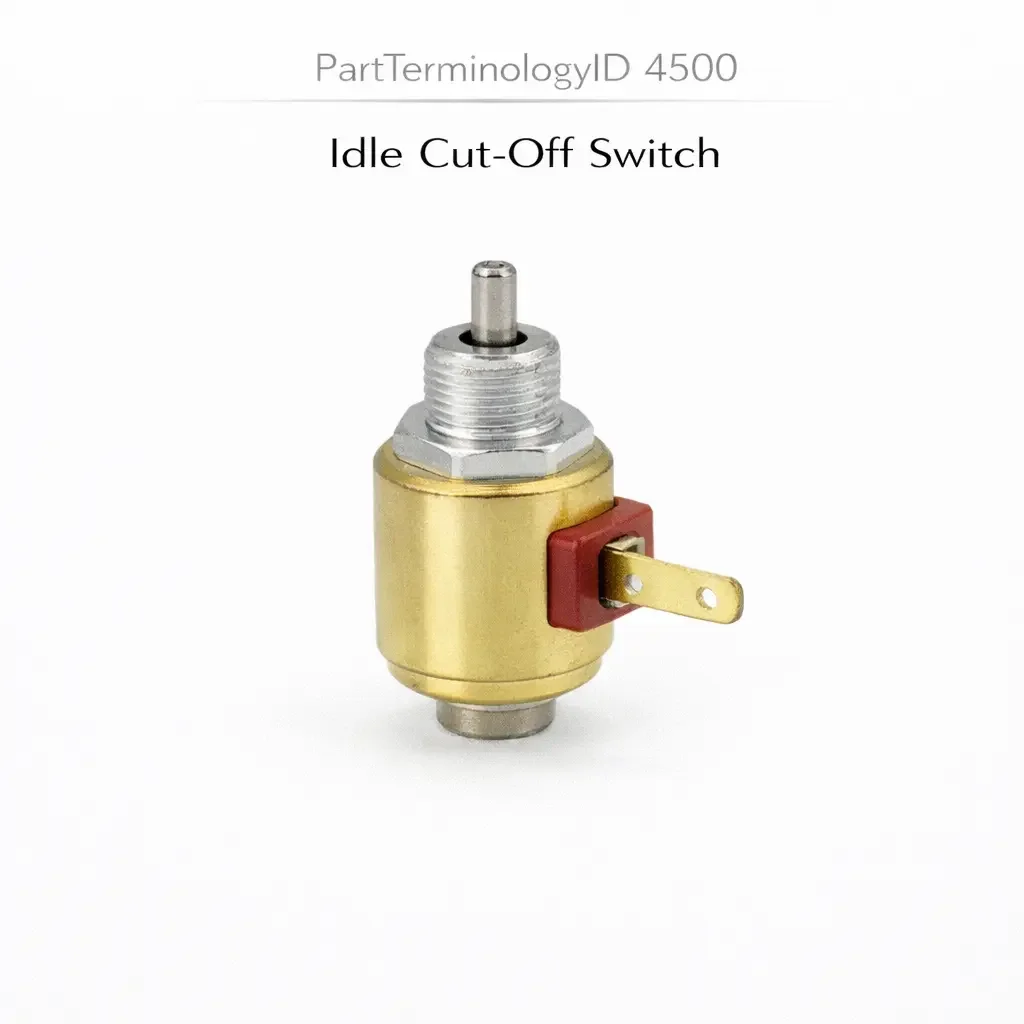
PartTerminologyID 4500, Idle Cut-Off Switch, is the electrically operated solenoid valve or plunger-actuated switch integrated into the carburetor or mounted at the carburetor's idle fuel circuit port that controls the flow of fuel through the idle metering circuit by opening the idle jet passage when the ignition is on and closing it when the ignition is switched off, preventing the engine from continuing to fire on residual fuel in the idle circuit after the ignition key is returned to the off position, a condition known as dieseling or run-on that occurs on high-compression engines or engines with hot combustion chambers when residual fuel in the idle passage ignites from combustion chamber heat without an ignition spark. That definition covers the anti-dieseling and idle fuel cutoff function correctly and leaves unresolved every question that determines whether the replacement switch is rated for the carburetor's system voltage, whether the plunger travel and tip geometry match the idle jet passage at the specific carburetor body installation position, whether the switch is a normally closed type that opens the idle circuit when energized or a normally open type depending on the carburetor's idle solenoid circuit design, whether the thread specification matches the carburetor body's idle solenoid port, and whether the plunger tip material is compatible with the fuel type including ethanol-blended fuels.
It does not specify the system voltage, plunger travel, tip geometry, contact configuration, thread specification, or fuel compatibility. A listing under PartTerminologyID 4500 that states only carburetor model or vehicle application without voltage specification and thread specification cannot be evaluated by a technician replacing a failed idle cut-off switch on a carbureted application where the original switch was a 12-volt normally closed solenoid with a 5/16-24 UNF thread and the replacement is a 6-volt normally closed solenoid with the same thread specification, drawing twice its rated current from a 12-volt ignition supply and overheating the coil winding within the first few ignition cycles before the coil insulation fails and the solenoid loses its ability to retract the plunger, leaving the idle circuit permanently blocked and the engine unable to idle regardless of ignition state.
For sellers, PartTerminologyID 4500 covers carbureted engines from the 1960s through the early 1990s where idle cut-off solenoids were standard equipment on emissions-controlled applications, high-performance carburetor applications where dieseling was a documented problem, and some commercial engine applications where controlled fuel shutoff at key-off is required for safety reasons. The buyer population is narrow and technically specific, typically sourcing a replacement for a known failed solenoid on a classic or vintage vehicle, a collector's engine, or a commercial engine and requiring accurate voltage and thread specification to avoid the coil burnout scenario above.
What the Idle Cut-Off Switch Does
Anti-Dieseling Function and the Idle Fuel Circuit Control
Dieseling occurs when a hot-running high-compression engine continues to fire after the ignition is switched off because residual fuel in the idle metering circuit continues to flow into the intake manifold and the hot combustion chamber surfaces, pre-ignition phenomenon, or residual heat ignites this fuel without a spark. The idle cut-off switch prevents dieseling by physically blocking the idle fuel jet passage the moment the ignition circuit is de-energized.
When the ignition is on, the solenoid coil is energized and the plunger retracts, opening the idle jet passage and allowing fuel to flow through the idle circuit for normal idle operation. When the ignition is switched off, the coil is de-energized and a return spring pushes the plunger forward, sealing the idle jet passage and cutting off fuel flow through the idle circuit. Without fuel available to the idle circuit, the combustion chamber cannot sustain ignition events after the ignition is off and the engine stops cleanly on the first compression stroke.
The idle cut-off solenoid also serves a secondary function on some applications: on vehicles with an electrically controlled idle speed circuit, the solenoid's plunger extends slightly further than the closed position during deceleration fuel cutoff, completely sealing the idle passage to prevent fuel delivery during engine braking events where fuel is not needed and would only increase hydrocarbon emissions.
System Voltage and the Coil Current Requirement
The solenoid coil is wound to develop the required magnetic force for plunger retraction at a specific supply voltage. A 12-volt coil draws approximately 0.5 to 1.5 amperes at 12 volts, producing the designed magnetic force to overcome the return spring and open the idle jet passage. A 6-volt coil draws approximately 0.5 to 1.5 amperes at 6 volts but receives 12 volts from a modern vehicle's ignition circuit, drawing double the rated current and dissipating four times the rated power in the coil winding. The excess heat destroys the coil insulation within minutes to hours of continuous energization, producing an open circuit in the coil that leaves the solenoid permanently de-energized and the idle circuit permanently blocked.
The voltage specification must be the first confirmed attribute for every idle cut-off switch listing. A 6-volt switch on a 12-volt system is the most common and most immediately destructive mismatch in this PartTerminologyID. The error is not immediately apparent because the solenoid opens the idle circuit correctly initially (drawing double current but functioning mechanically) before the coil overheats and fails over subsequent ignition cycles.
Thread Specification, Plunger Travel, and Idle Jet Passage Compatibility
The idle cut-off switch threads into a port in the carburetor body at the idle jet passage location. The thread specification is carburetor-model-specific and varies between domestic and imported carburetor designs. Common specifications include 5/16-24 UNF, 3/8-24 UNF, 1/4-28 UNF, and metric equivalents on imported carburetors.
The plunger travel (the distance the plunger extends when de-energized) must match the depth of the idle jet passage so the plunger tip seals completely against the jet seat when the solenoid is de-energized. A plunger with insufficient travel does not reach the jet seat and the idle circuit is never fully blocked, allowing the engine to diesel on key-off. A plunger with excessive travel bottoms against the carburetor body before the thread is fully engaged, preventing complete thread engagement and potentially cracking the carburetor body under installation torque.
Top Return Scenarios
Scenario 1: "6-volt solenoid on 12-volt ignition circuit, coil overheats and fails within first drive cycle"
The replacement is a 6-volt solenoid. The ignition circuit supplies 12 volts. The coil draws double its rated current continuously while the ignition is on. The coil insulation softens and fails after approximately 20 to 40 minutes of continuous energization during a drive cycle. The coil develops an open circuit. The solenoid cannot retract its plunger. The idle circuit is permanently blocked and the engine will not idle after the coil fails.
Prevention language: "System voltage: [6 volt / 12 volt]. This solenoid is rated for [voltage] operation. A 6-volt solenoid on a 12-volt ignition circuit draws double its rated current, overheating the coil winding and producing coil failure within the first drive cycle. Verify the system voltage before ordering."
Scenario 2: "Plunger travel insufficient, idle circuit never fully blocked, engine diesels on key-off"
The replacement solenoid plunger extends 8mm when de-energized. The idle jet passage requires 10mm of plunger extension to reach the jet seat. The idle circuit is never fully blocked when the solenoid is de-energized. The engine diesels for 2 to 3 seconds after every key-off event.
Prevention language: "Plunger travel when de-energized: [X] mm. Verify the plunger travel against the idle jet passage depth in the carburetor body. Insufficient plunger travel prevents complete sealing of the idle circuit, allowing the engine to diesel on key-off."
Scenario 3: "Thread mismatch, solenoid cannot be fully seated, partial thread engagement leaks fuel"
The replacement uses a 3/8-24 UNF thread. The carburetor port uses a 5/16-24 UNF thread. The larger thread engages partially before binding. Fuel weeps past the partial thread engagement zone under carburetor bowl pressure.
Prevention language: "Thread specification: [diameter x pitch, thread form]. Verify the thread specification against the carburetor body's idle solenoid port. A thread mismatch prevents full seating and produces a fuel weep at the port under fuel system pressure."
Core Listing Attributes for PartTerminologyID 4500
PartTerminologyID: 4500
Component: Idle Cut-Off Switch
System voltage: 6 volt or 12 volt (mandatory, in title)
Contact configuration: normally closed (energized to open) or normally open (mandatory)
Plunger travel when de-energized in mm (mandatory)
Thread specification: diameter, pitch, and thread form (mandatory)
Plunger tip material and fuel compatibility including ethanol blend rating (mandatory)
Coil resistance in ohms (mandatory)
Carburetor model and application compatibility (mandatory)
FAQ (Buyer Language)
How do I confirm the correct voltage for my idle cut-off solenoid?
Measure the voltage at the solenoid connector with the ignition on and the engine off. A reading of approximately 12 to 14 volts confirms a 12-volt application. A reading of approximately 6 to 7 volts confirms a 6-volt application. Do not assume the voltage from the vehicle's general electrical system specification, as some older vehicles used a resistor wire to supply a reduced voltage to certain ignition components while maintaining full battery voltage at the main positive terminal.
My engine diesels for a few seconds after key-off even with the original solenoid. What should I check?
Confirm the solenoid is receiving voltage when the ignition is on and losing voltage immediately when the ignition is switched off. If the solenoid receives voltage correctly, confirm the plunger extends fully when de-energized by pressing the plunger tip gently: it should be spring-loaded outward. If the plunger retracts with light finger pressure when de-energized, the solenoid coil has partially failed and is producing insufficient force to hold the plunger open but insufficient de-energization to fully extend the plunger. A weak coil requires replacement.
Related PartTerminologyIDs
Carburetor Temperature Switch (PartTerminologyID 4272): controls EGR and vacuum advance circuits during warm-up; both are carburetor-area electrical components but serve different circuits; confirm which circuit the replacement governs before ordering either component
Full Throttle Cut-Off Switch (PartTerminologyID 4444): interrupts a circuit at wide-open throttle rather than at idle; both are carburetor-associated switches but for different circuit positions and different control purposes
Status in New Databases
PIES/PCdb: PartTerminologyID 4500, Idle Cut-Off Switch
PIES 8.0 / PCdb 2.0: No change in PartTerminologyID or terminology label
Final Take for PartTerminologyID 4500
Idle Cut-Off Switch (PartTerminologyID 4500) is the carburetor PartTerminologyID where system voltage is the attribute with the most immediate and severe consequence of mismatch, because a 6-volt solenoid on a 12-volt circuit fails within the first drive cycle from coil overheating, converting a simple solenoid replacement into a second replacement visit. State the system voltage in the title. State the thread specification. State the plunger travel. State the coil resistance. For PartTerminologyID 4500, system voltage, plunger travel, and thread specification are the three attributes that prevent the three most common return scenarios in the idle cut-off switch buyer population.