
Written by Arthur Simitian | PartsAdvisory
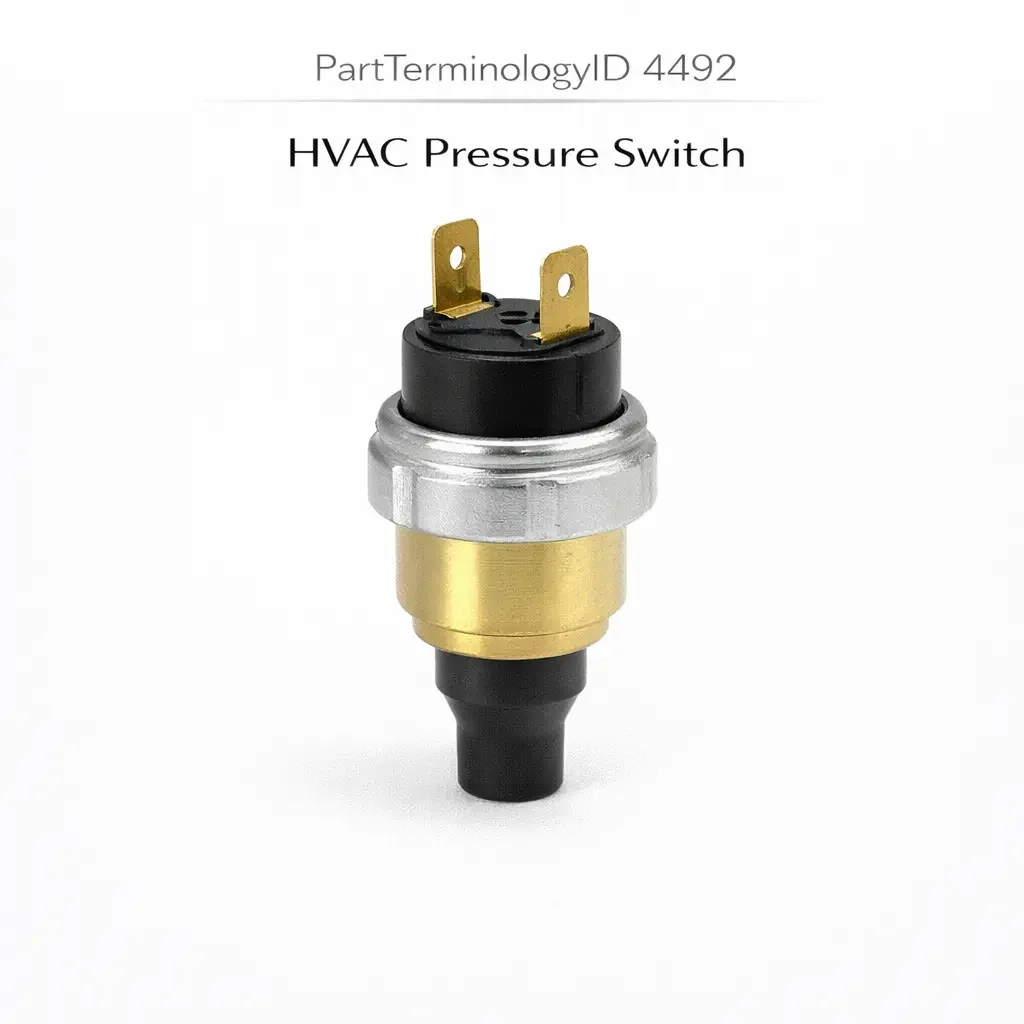
PartTerminologyID 4492, HVAC Pressure Switch, is the pressure-sensing switch installed in the refrigerant circuit of the vehicle's air conditioning system that monitors refrigerant pressure at one or more points in the high-side or low-side circuit and opens or closes an electrical contact at calibrated pressure thresholds to protect the compressor from operating under unsafe pressure conditions, to prevent compressor operation when the refrigerant charge is insufficient for adequate lubrication, to activate auxiliary cooling components at intermediate pressure levels, or to signal the ECU or climate control module with circuit pressure status for system diagnostics and control strategy decisions, and is distinguished from PartTerminologyID 4284 (A/C Clutch Switch) by its broader application across all pressure-sensing switch types in the HVAC refrigerant circuit including high-pressure cutout, low-pressure cutout, dual-function, and trinary configurations when those switches are cataloged as part of the HVAC system rather than as standalone A/C clutch control components. That definition covers the HVAC refrigerant pressure sensing and switching function correctly and leaves unresolved every question that determines whether the replacement switch's pressure activation thresholds match the original calibration for the specific refrigerant type and compressor model in the system, whether the switch function type (high-pressure cutout, low-pressure cutout, dual-function, or trinary) matches the original circuit position and the number of active pressure monitoring functions required at that position, whether the switch connector pin count and terminal assignment match the harness at the refrigerant circuit mounting position, whether the switch thread specification and sealing method match the service port or dedicated switch port where the switch installs, whether the switch is calibrated for R-134a operating pressures or R-1234yf operating pressures or legacy R-12 pressures on a retrofitted system, whether the switch body sealing element (O-ring, flare, or Schrader depressor) matches the fitting at the installation point, whether the switch is compatible with a fixed-displacement compressor that relies on a cycling function for evaporator temperature regulation or a variable-displacement compressor that does not require cycling switch operation, and whether the replacement requires a specific refrigerant system pressure range that the vehicle's current charge level must meet before the switch will produce its correct output signal.
It does not specify the pressure activation thresholds, switch function type, connector pin count, thread specification, refrigerant type calibration, sealing method, compressor displacement compatibility, or required system pressure at installation. A listing under PartTerminologyID 4492 that states only year, make, and model without switch function type and refrigerant type cannot be evaluated by a technician replacing a failed HVAC pressure switch on a vehicle originally charged with R-12 that has been retrofitted to R-134a without replacement of the pressure switches, where the original R-12 high-pressure cutout threshold of 380 psi corresponds to a significantly different refrigerant circuit condition than the same 380 psi threshold on an R-134a system whose normal high-side operating range already approaches this value during hot ambient conditions, causing the high-pressure cutout to activate during normal hot-weather A/C operation on the retrofitted system rather than providing compressor protection only during genuine overpressure events.
For sellers, PartTerminologyID 4492 is distinct from PartTerminologyID 4284 (A/C Clutch Switch) primarily in catalog organization rather than physical component differentiation, because many of the same pressure switches are cataloged under both PartTerminologyIDs depending on whether the application description emphasizes the switch's role in the compressor clutch engagement circuit or its role in the broader HVAC refrigerant circuit management system. Where PartTerminologyID 4284 focuses specifically on the compressor clutch activation and protection function, PartTerminologyID 4492 encompasses the complete pressure management role of the switch in the HVAC system including condenser fan activation, ECU pressure data input, and system diagnostics in addition to compressor clutch protection. A listing under PartTerminologyID 4492 must address all active functions the switch performs in the circuit, not merely the compressor clutch protection function.
What the HVAC Pressure Switch Does
Refrigerant Circuit Pressure Management and the Multi-Function Switch Role
The HVAC pressure switch in a modern vehicle climate system performs one or more of the following functions simultaneously from a single switch body: compressor clutch disengagement on high-pressure overload, compressor clutch disengagement on low-pressure or low-charge condition, condenser cooling fan activation at an intermediate pressure threshold to prevent high-side pressure from reaching the cutout level, and in some applications an analog or digital pressure data output to the climate control module for closed-loop pressure management and diagnostic monitoring.
The specific combination of these functions present in any single switch body is what differentiates the switch function types from each other. A high-pressure cutout switch monitors only the high side and produces a single binary output at one threshold. A low-pressure cutout switch monitors only the low side and produces a single binary output at a different threshold. A dual-function switch monitors both high and low pressure with two independent thresholds and two independent output contacts in a single body with a higher pin count connector. A trinary switch adds a third threshold for condenser fan activation at an intermediate high-side pressure, producing three independent outputs with a three or four-pin connector. Each function type is appropriate only for the specific circuit position it was designed for, and installing a function type with fewer monitoring functions than the original removes protection capabilities that the vehicle manufacturer designed into the system.
High-Pressure Cutout Threshold and the Compressor Overpressure Protection Function
The high-pressure cutout threshold is the refrigerant high-side pressure at which the switch opens its contact and disengages the compressor clutch to prevent mechanical damage to the compressor, condenser, and high-side refrigerant lines from sustained overpressure operation. High-side pressure rises above the design operating range when condenser airflow is restricted (failed condenser fan, debris-clogged condenser face, or extended idling on a hot day), when the system is overcharged with refrigerant, or when non-condensable gases are present in the circuit.
For R-134a systems, the normal high-side operating pressure range is approximately 150 to 280 psi at moderate ambient temperatures, rising to 300 to 380 psi on hot days with the A/C at maximum demand. The high-pressure cutout threshold is typically set between 400 and 500 psi, above the normal maximum operating pressure but below the burst pressure of the system components. A replacement switch with a threshold of 300 psi will activate the cutout during normal hot-weather operation when the high-side pressure is within the expected range, producing an intermittent A/C complaint on the hottest days that worsens as ambient temperature rises.
For R-1234yf systems, the operating pressure profile differs from R-134a and the cutout threshold must be calibrated for R-1234yf's pressure-temperature relationship. A switch calibrated for R-134a cutout thresholds installed in an R-1234yf system may activate the cutout at pressures that are normal and expected for R-1234yf operation, because R-1234yf's saturation curve produces different pressures at the same temperatures compared to R-134a.
Low-Pressure Cutout Threshold and the Compressor Lubrication Protection Function
The low-pressure cutout threshold is the refrigerant low-side pressure at which the switch opens its contact and disengages the compressor clutch to prevent compressor damage from operating without adequate refrigerant oil circulation. Refrigerant and compressor oil circulate together through the A/C circuit, and a low refrigerant charge means inadequate oil delivery to the compressor's internal bearing surfaces. Sustained compressor operation with insufficient oil delivery produces rapid bearing wear, reed valve damage, and eventual mechanical failure.
For R-134a systems, the low-pressure cutout threshold is typically set at 20 to 30 psi on the low side, corresponding to a refrigerant charge level below which the oil circulation is compromised. A replacement switch with a threshold of 10 psi allows the compressor to operate in a low-charge condition that the original 25 psi switch was designed to prevent, allowing compressor damage to begin accumulating without the protection the owner believes is present.
The low-pressure cutout switch also prevents compressor operation when the A/C is activated at ambient temperatures below approximately 35 to 40 degrees Fahrenheit, where the refrigerant charge pressure drops below the cutout threshold even on a fully charged system due to the reduced vapor pressure at low temperatures. This low-temperature lockout is an intentional design feature that protects the compressor from the damage caused by attempting to circulate refrigerant in liquid or near-liquid state, and a replacement switch with a lower threshold than the original may allow compressor engagement at ambient temperatures where the original switch correctly prevented operation.
Dual-Function Switch Architecture and the Combined High and Low Monitoring
The dual-function HVAC pressure switch combines the high-pressure cutout and low-pressure cutout functions in a single switch body with two independent pressure-sensing diaphragms, two independent contact mechanisms, and a multi-pin connector that carries separate signal outputs for each function. The high-side sensing element and its contact share one set of connector pins, and the low-side sensing element and its contact share a separate set of pins. Both sensing elements are in the same switch body and share a common ground return.
A replacement single-function switch installed in a dual-function position covers only one of the two monitoring functions. If the replacement covers the high-pressure cutout only, the low-pressure protection is absent and the compressor can operate on a depleted refrigerant charge without triggering a cutout. If the replacement covers the low-pressure cutout only, the high-pressure protection is absent and the compressor can operate into an overpressure condition without protection. Both protection gaps are invisible to the driver and to a basic A/C operation test because the A/C appears to function normally until the specific abnormal condition occurs that the absent protection was designed to detect.
Trinary Switch Architecture and the Condenser Fan Activation Function
The trinary switch adds a third pressure threshold to the dual-function switch architecture: an intermediate high-side pressure at which the switch activates the condenser cooling fan before the high-pressure cutout threshold is reached. The condenser fan activation at the intermediate threshold (typically 240 to 280 psi for R-134a systems) provides preventive cooling that reduces the high-side pressure before it reaches the 400 to 500 psi cutout threshold, maintaining system efficiency and preventing the intermittent cutout events that would otherwise occur during sustained high-demand A/C operation on hot days.
The trinary switch uses a three or four-pin connector to carry the three independent output signals: high-pressure cutout, low-pressure cutout, and condenser fan activation. A dual-function replacement in a trinary switch position leaves the condenser fan activation circuit unconnected, removing the preventive pressure reduction function and allowing the high-side pressure to climb toward the cutout threshold without fan intervention. The vehicle's climate performance on hot days will degrade, with more frequent high-pressure cutout activations and longer recovery periods before the A/C resumes after each cutout.
Refrigerant Type Calibration and the Pressure-Temperature Relationship
The HVAC pressure switch's activation thresholds are calibrated to the operating pressure range of the specific refrigerant type. R-134a, R-1234yf, and R-12 have different pressure-temperature saturation curves, meaning the same refrigerant circuit condition (the same evaporator temperature, the same condenser loading) produces different pressures in each refrigerant. A switch calibrated for one refrigerant type will produce incorrect circuit behavior when installed in a system charged with a different refrigerant.
The most common refrigerant type mismatch in the HVAC pressure switch category is the R-12 to R-134a retrofit scenario, where older vehicles have had their original R-12 refrigerant replaced with R-134a during a retrofit service but some or all of the original R-12-calibrated pressure switches were not replaced at the same time. The R-12 high-pressure cutout threshold typically set at 375 to 400 psi may be within or near the normal operating range for an R-134a system on a hot day, causing nuisance cutout activations. The R-12 low-pressure cutout threshold set for R-12's vapor pressure characteristics may produce different behavior with R-134a's different vapor pressure profile.
For vehicles originally designed for R-1234yf (standard on new vehicles from approximately 2017 in the United States and 2013 in the European Union), the pressure switches are calibrated specifically for R-1234yf's operating pressures. Installing an R-134a calibrated switch in an R-1234yf system will produce systematic pressure monitoring errors because the two refrigerants have different saturation curves.
Thread Specification, Sealing Method, and the Refrigerant Leak Risk
The HVAC pressure switch installs in a threaded port in the refrigerant circuit at a dedicated switch port on the high-side or low-side line, at a Schrader valve service port, or at a port on the accumulator or receiver-drier. The thread specification (diameter, pitch, and thread form) and sealing method (O-ring face seal, flare, or Schrader depressor with core) must match the port exactly.
A thread mismatch in the refrigerant circuit is a refrigerant release risk, because the refrigerant system operates at pressures that will force refrigerant through any imperfect thread engagement. Even a partial thread engagement that appears secure at installation may develop a leak path under the thermal cycling of normal A/C operation as the thread engagement loosens from the differential thermal expansion of the switch body and the circuit fitting. Refrigerant released in a shop environment is subject to EPA Section 608 reporting requirements, and a refrigerant release from a thread mismatch adds refrigerant recovery and recharge costs to the switch replacement labor.
Variable-Displacement Compressor Compatibility and the Cycling Function Exclusion
Why variable-displacement compressors do not require a cycling switch
Variable-displacement compressors modulate their own pumping output in response to demand signals from the climate control module, maintaining a stable low-side pressure without requiring the compressor clutch to cycle on and off. The cycling function described in PartTerminologyID 4288 (A/C Clutch Cycle Switch) is incompatible with variable-displacement compressor systems because the cycling switch's activation and deactivation thresholds bracket the steady-state low-side pressure the variable-displacement compressor maintains, producing unnecessary clutch cycling.
On variable-displacement compressor systems, the HVAC pressure switch provides only high-pressure cutout and low-pressure protection functions (and condenser fan activation in trinary configurations), without a cycling function. A replacement switch that includes a cycling function (engaging and disengaging the clutch to regulate evaporator temperature) installed on a variable-displacement compressor system will cause the clutch to cycle at the compressor's steady-state operating pressure, accumulating clutch engagement wear that shortens the clutch service life.
The compressor type (fixed-displacement or variable-displacement) is a mandatory attribute for any HVAC pressure switch listing on platforms where both compressor types were used, and the listing must explicitly exclude cycling switch types from variable-displacement applications.
Why This Part Generates Returns
Buyers return HVAC pressure switches because the replacement is a single high-pressure cutout type and the application requires a dual-function type covering both high and low pressure, leaving the compressor without low-pressure lubrication protection and allowing the compressor to operate on a depleted charge; the pressure threshold is calibrated for R-134a and the system is an R-12 retrofit where the high-side pressure approaches the R-134a-calibrated cutout during normal hot-weather operation, activating the cutout during normal A/C use on every summer afternoon; the replacement is a dual-function type and the application requires a trinary type, leaving the condenser fan activation output unconnected and producing more frequent high-pressure cutout activations as the high-side pressure climbs unchecked on hot days; the thread is 3/8-24 UNF and the service port is M10 x 1.0 metric, producing a partial thread engagement that leaks refrigerant at the service port before the mismatch is identified; the switch body uses an O-ring face seal and the installation port is a Schrader valve fitting without a depressor, leaving the Schrader valve core closed and the switch isolated from refrigerant circuit pressure; the switch is a cycling type with engagement and disengagement thresholds and the vehicle has a variable-displacement compressor where the steady-state low-side pressure falls between the cycling thresholds, causing the clutch to cycle every few seconds and accumulating clutch wear at a rate that destroys the friction disc within one season; and the connector is a two-pin type and the harness at the high-side service port uses a three-pin connector because the original switch included a separate ground return and a condenser fan activation output in addition to the compressor cutout signal.
Top Return Scenarios
Scenario 1: "Single high-pressure cutout in dual-function application, low-pressure lubrication protection absent"
The buyer replaces the dual-function pressure switch at the accumulator with a single high-pressure cutout switch. The listing covers the vehicle by year and model without specifying function type. The two-pin replacement mates with the outer two positions of the original four-pin connector. After installation, the high-pressure cutout functions correctly. The low-pressure protection circuit is unconnected. The compressor engages during a low-charge condition and operates without adequate refrigerant oil circulation, producing bearing wear within the first extended A/C use period.
Prevention language: "Switch function type: [high-pressure cutout only / low-pressure cutout only / dual-function high and low pressure cutout / trinary: high-pressure cutout, low-pressure cutout, and condenser fan activation]. Connector pin count: [X] pins. A single-function switch in a dual-function application leaves one protection circuit permanently unconnected. The compressor can operate in the unprotected pressure condition without triggering a cutout."
Scenario 2: "R-134a calibrated switch in R-12 retrofitted system, cutout activates during normal hot-weather operation"
The buyer replaces the pressure switch on a vehicle retrofitted from R-12 to R-134a. The original R-12 pressure switches were never replaced during the retrofit. The listing offers an R-134a calibrated replacement. The R-134a high-pressure cutout threshold of 450 psi is appropriate for an R-134a system but the R-12 system on this vehicle produces high-side pressures that approach 430 to 460 psi during normal hot-weather operation because the R-12 to R-134a retrofit has not been fully optimized and some R-12 system sizing remains in the circuit. The A/C cuts out on every afternoon above 95 degrees Fahrenheit.
Prevention language: "Refrigerant type calibration: [R-134a / R-1234yf / R-12]. Verify the refrigerant type currently in the system. On vehicles retrofitted from R-12 to R-134a, confirm whether all pressure switches have been updated to R-134a calibration during the retrofit. An R-134a calibrated switch in a system with R-12-era component sizing may produce cutout activations at pressures within the system's normal operating range."
Scenario 3: "Dual-function switch in trinary application, condenser fan unactivated, high-pressure cutout frequency increases on hot days"
The buyer installs the replacement dual-function switch at the high-side port. The high-pressure cutout and low-pressure cutout functions both operate correctly during testing. On the first hot day above 100 degrees Fahrenheit, the A/C cuts out every 15 to 20 minutes. The condenser fan activation circuit, which was previously preventing the high-side pressure from reaching the cutout threshold by activating the fan at 260 psi, is now unconnected. The high-side pressure climbs from 260 psi to the 450 psi cutout level without fan intervention on each cycle.
Prevention language: "Switch function type: [trinary: high-pressure cutout at [X] psi, low-pressure cutout at [X] psi, condenser fan activation at [X] psi]. Connector pin count: [3 or 4 pins]. A dual-function switch in a trinary application leaves the condenser fan activation output unconnected. Without preventive fan activation at the intermediate pressure threshold, the high-side pressure reaches the cutout level on every hot-day operation cycle, producing frequent A/C interruptions."
Scenario 4: "O-ring face seal switch at Schrader valve port, valve core remains closed, switch reads atmospheric pressure"
The buyer installs the replacement low-pressure cutout switch at the low-side Schrader service port. The replacement uses an O-ring face seal and does not include a Schrader depressor pin. After threading in the switch, the Schrader valve core remains closed. The switch sensing element is isolated from the refrigerant circuit and reads the atmospheric pressure trapped between the switch face and the closed Schrader core. The low-pressure cutout activates immediately on every compressor engagement attempt because the switch reads near-zero gauge pressure.
Prevention language: "Sealing method: [O-ring face seal / Schrader with depressor pin]. Installation port type: [O-ring face seal port / Schrader valve service port]. A switch without a Schrader depressor pin at a Schrader service port leaves the valve core closed and isolates the switch from refrigerant circuit pressure. The switch reads near-atmospheric pressure and activates the low-pressure cutout on every compressor engagement attempt."
Scenario 5: "Cycling switch in variable-displacement compressor application, clutch cycles every few seconds"
The buyer replaces the low-side pressure switch with a cycling type on a vehicle with a variable-displacement compressor. The variable-displacement compressor modulates its output to hold a steady 30 psi low-side pressure. The cycling switch has an engagement threshold of 45 psi and a disengagement threshold of 22 psi. The steady-state 30 psi falls between these thresholds, causing the clutch to cycle as the variable-displacement compressor's output variation produces small pressure oscillations that cross the switch thresholds. The clutch cycles every 4 to 6 seconds during A/C operation.
Prevention language: "Compressor type compatibility: [fixed-displacement compressor only / variable-displacement compressor, no cycling function]. A cycling switch on a variable-displacement compressor system causes the clutch to cycle at the compressor's steady-state operating pressure. The clutch friction disc accumulates wear at many times the normal rate, shortening clutch service life from years to weeks or months."
Scenario 6: "Thread mismatch, refrigerant released before mismatch identified, EPA Section 608 implications"
The buyer installs the replacement switch at the high-side service port. The replacement thread is 3/8-24 UNF. The service port is M10 x 1.0 metric. The UNF thread engages two turns before binding. The technician applies installation torque attempting to seat the O-ring against the port face. The partial thread engagement creates a refrigerant leak path. High-side refrigerant escapes at 300 psi from the partial engagement zone before the mismatch is identified. The refrigerant release in the shop requires documentation under EPA Section 608, and the system must be evacuated and recharged after the correct switch is installed.
Prevention language: "Thread specification: [diameter x pitch, thread form: UNF / metric]. Verify thread specification before installation using a thread gauge on the service port. A UNF switch will engage partially in a metric port before binding. Applying torque to a mismatched partial engagement creates a refrigerant release path. High-side refrigerant released at system operating pressure is subject to EPA Section 608 reporting requirements."
Scenario 7: "Low-pressure threshold 10 psi below original, compressor operates in low-charge condition before cutout activates"
The replacement low-pressure cutout switch activates at 15 psi. The original activated at 25 psi. A refrigerant leak gradually reduces the charge over several weeks. When the low-side pressure drops to 18 psi, the compressor should cut out (the original switch threshold) but the replacement switch allows continued operation down to 15 psi. The compressor operates for several additional hours in the 15 to 25 psi range before the replacement switch finally cuts out, with inadequate oil circulation during this period accelerating bearing wear.
Prevention language: "Low-pressure cutout threshold: [X] psi. Verify the threshold against the original switch specification. A threshold set below the original allows the compressor to operate in a low-charge condition that the original switch was calibrated to prevent. The additional operating time below the original threshold produces progressive compressor bearing wear that is not immediately detectable."
Scenario 8: "R-1234yf system, R-134a calibrated switch installed, low-pressure cutout activates during normal cold-start A/C operation"
The buyer replaces the pressure switch on a 2019 model year vehicle with a factory R-1234yf charge. The listing covers the vehicle by year without specifying refrigerant type. The delivered switch is calibrated for R-134a. R-1234yf has a slightly lower vapor pressure than R-134a at the same temperature, and the normal R-1234yf low-side pressure during initial A/C operation on a cool morning (ambient 60 degrees Fahrenheit) is approximately 22 to 26 psi. The R-134a calibrated low-pressure cutout threshold of 25 psi overlaps with this normal operating range, causing the low-pressure cutout to activate during normal cool-morning A/C start-up.
Prevention language: "Refrigerant type calibration: [R-1234yf]. This switch is calibrated for R-1234yf operating pressures. Verify the refrigerant type before ordering. On vehicles from model year 2017 onward in the US market, R-1234yf is the standard factory refrigerant. Installing an R-134a calibrated switch in an R-1234yf system will produce low-pressure cutout activations during normal cool-ambient A/C operation where R-1234yf low-side pressures fall within the R-134a calibrated cutout range."
Core Listing Attributes for PartTerminologyID 4492
PartTerminologyID: 4492
Component: HVAC Pressure Switch
Switch function type: high-pressure cutout, low-pressure cutout, dual-function, or trinary (mandatory, in title)
High-pressure cutout threshold in psi and bar (mandatory for types including high-pressure function)
Low-pressure cutout threshold in psi and bar (mandatory for types including low-pressure function)
Condenser fan activation threshold in psi and bar for trinary types (mandatory)
Refrigerant type calibration: R-134a, R-1234yf, or R-12 (mandatory, in title)
Compressor type compatibility: fixed-displacement, variable-displacement, or both (mandatory)
Connector pin count and terminal assignment with function mapping (mandatory)
Thread specification: diameter, pitch, and thread form (mandatory)
Sealing method: O-ring face seal, flare, or Schrader with depressor pin (mandatory)
Circuit installation position: high-side port or low-side port (mandatory)
Switch body hex size in mm (mandatory)
Year/make/model/engine/A/C system configuration
Note for vehicles retrofitted from R-12 to R-134a requiring R-134a calibrated thresholds
Note for variable-displacement compressor applications excluding cycling switch function
Note for trinary switch applications requiring three or four-pin connector
Note for production date range where refrigerant type changed from R-134a to R-1234yf
Catalog Checklist for ACES/PIES Teams
PartTerminologyID = 4492
Require switch function type in title: high-pressure cutout, low-pressure cutout, dual-function, or trinary (mandatory)
Require refrigerant type calibration in title (mandatory)
Require pressure thresholds in psi and bar for all active monitoring functions (mandatory)
Require compressor type compatibility statement (mandatory)
Require connector pin count with function mapping (mandatory)
Require thread specification: diameter, pitch, thread form (mandatory)
Require sealing method with Schrader depressor note where applicable (mandatory)
Require circuit installation position: high-side or low-side (mandatory)
Prevent function type omission: a single-function switch in a dual-function application leaves one protection circuit unconnected; function type and pin count must both be confirmed before ordering
Prevent refrigerant type omission: an R-134a calibrated switch in an R-1234yf system produces systematic pressure monitoring errors; refrigerant type calibration must be in the title for every listing
Prevent trinary and dual-function conflation: a dual-function switch in a trinary application leaves the condenser fan activation output unconnected; function type and pin count must both be confirmed on all trinary applications
Prevent Schrader port and O-ring face seal conflation: a switch without a Schrader depressor in a Schrader port reads near-atmospheric pressure and activates the cutout on every compressor engagement attempt; sealing method must be confirmed against the port type
Prevent cycling switch installation on variable-displacement compressor: the cycling function causes continuous clutch cycling at the compressor's steady-state operating pressure; compressor type must be confirmed and variable-displacement applications must be excluded from cycling switch listings
Prevent threshold tolerance conflicts: a low-pressure threshold below the original allows compressor operation in a low-charge condition that produces bearing wear; both high and low thresholds must be stated and verified against the original specification
Differentiate from A/C Clutch Switch (PartTerminologyID 4284): PartTerminologyID 4284 covers all A/C clutch switch types with emphasis on the compressor clutch engagement and protection function; PartTerminologyID 4492 covers the broader HVAC pressure management role including condenser fan activation and ECU pressure monitoring; both may cover the same physical switch depending on catalog organization
Differentiate from A/C Clutch Cycle Switch (PartTerminologyID 4288): the cycle switch performs evaporator temperature regulation through continuous clutch cycling on fixed-displacement systems; the HVAC pressure switch performs compressor protection and system management functions; both monitor refrigerant pressure but for different circuit functions with different threshold calibrations
FAQ (Buyer Language)
How do I know which type of HVAC pressure switch my vehicle needs: high-pressure cutout, low-pressure cutout, dual-function, or trinary?
Count the pins on the harness connector at the pressure switch mounting position. A two-pin connector typically indicates a single-function switch (high or low pressure cutout only). A three or four-pin connector indicates a dual-function or trinary switch. Confirm the circuit position (high-side or low-side installation) to identify whether the single-function type is a high-pressure or low-pressure cutout. Cross-reference the original switch part number to confirm the function type from the manufacturer's specification.
My A/C cuts out frequently on hot days after I replaced the pressure switch. What should I check?
Frequent A/C cutout on hot days after pressure switch replacement is the characteristic symptom of either a high-pressure cutout threshold set below the system's normal maximum operating pressure for hot ambient conditions, or a missing condenser fan activation output (if a dual-function switch was installed in a trinary switch position). First, confirm the high-side pressure at the moment of cutout using a manifold gauge set. If the pressure at cutout is within the expected range for the ambient temperature, the replacement threshold is too low. If the pressure is at or above the expected range but the condenser fan was not running when it should have been, the trinary fan activation function is absent.
Does my vehicle use R-134a or R-1234yf refrigerant?
Vehicles sold in the United States from model year 2017 onward typically use R-1234yf as the factory refrigerant. Vehicles from model year 2016 and earlier typically use R-134a, unless the A/C system has been retrofitted. Check the underhood A/C service label, which identifies the refrigerant type and the system charge weight. The service port fittings also differ between R-134a and R-1234yf: R-1234yf uses a different service fitting size to prevent accidental cross-charging with R-134a.
Can I use a dual-function switch to replace a trinary switch if the connector fits?
The connector physical compatibility is necessary but not sufficient. A dual-function switch covers the high-pressure cutout and low-pressure cutout functions but does not include the condenser fan activation output. Installing a dual-function switch in a trinary application leaves the condenser fan activation circuit unconnected. On hot days, the high-side pressure will climb to the cutout threshold before the fan activates, producing more frequent A/C interruptions compared to the original trinary switch. Confirm the function type match, not just the connector fit, before installing.
My A/C worked after I installed the new pressure switch but the compressor will not engage when I turn the A/C on from a cold soak. What happened?
A compressor that does not engage from a cold soak after pressure switch replacement is the characteristic symptom of a low-pressure cutout threshold that is above the system's low-side pressure at ambient temperature. At cold ambient conditions, the refrigerant charge pressure (both high and low side) is lower than at warm ambient, and if the replacement low-pressure cutout threshold is higher than the system's low-side pressure at cold ambient, the compressor will be prevented from engaging even on a fully charged system. This is most common when an R-134a calibrated switch is installed in an R-1234yf system, where R-1234yf's lower vapor pressure at cold temperatures produces lower low-side pressure than an R-134a system at the same ambient.
Related PartTerminologyIDs
A/C Clutch Switch (PartTerminologyID 4284): covers all A/C clutch switch types with primary emphasis on the compressor clutch engagement and protection function; many pressure switches are cataloged under both PartTerminologyID 4284 and 4492 depending on catalog organization; the attributes required for both PartTerminologyIDs are identical and listings under both should be cross-referenced for consistency
A/C Clutch Cycle Switch (PartTerminologyID 4288): the cycling switch for evaporator temperature regulation on fixed-displacement compressor systems; distinct from the HVAC pressure switch in that the cycling function performs a normal regulation role rather than a protective cutout function; both monitor low-side pressure but for different circuit functions with different threshold calibrations
A/C Compressor Clutch (PartTerminologyID 4279 or similar): the electromagnetic clutch that the pressure switch engages and disengages; a clutch that fails to engage despite a functioning pressure switch output signal indicates a failed clutch coil, relay, or control module rather than a switch fault
A/C Condenser Fan Motor (if cataloged): the fan whose activation is controlled by the trinary switch's intermediate threshold; if the condenser fan does not activate on a trinary switch application despite correct high-pressure cutout and low-pressure protection function, confirm the trinary fan activation output is present and connected
Status in New Databases
PIES/PCdb: PartTerminologyID 4492, HVAC Pressure Switch
PIES 8.0 / PCdb 2.0: No change in PartTerminologyID or terminology label
Final Take for PartTerminologyID 4492
HVAC Pressure Switch (PartTerminologyID 4492) is the refrigerant circuit PartTerminologyID where the switch function type determines the number of simultaneous protection functions present in the circuit, and a function type mismatch silently removes one or more protection capabilities from the A/C system that appear fully operational on a basic function test but fail under the specific abnormal conditions those protections were designed to detect. A single-function switch in a dual-function position removes either high-pressure or low-pressure protection. A dual-function switch in a trinary position removes preventive condenser fan activation. A cycling switch in a variable-displacement compressor application destroys the clutch. None of these produces an obvious installation error, and all four manifest as recurring failures or progressive damage that the buyer attributes to other causes until the switch type mismatch is identified.
State the switch function type in the title. State the refrigerant type calibration in the title. State all active pressure thresholds in psi and bar. State the compressor type compatibility. State the connector pin count with function mapping. State the thread specification with thread form. State the sealing method with the Schrader depressor note. For PartTerminologyID 4492, switch function type, refrigerant type calibration, and compressor type compatibility are the three attributes that prevent the three most consequential and least immediately visible return scenarios in the HVAC pressure switch buyer population.