
Ignition Hall Effect Switch (PartTerminologyID 4464): Signal Output Type, Air Gap Specification, and Distributor or Trigger Wheel Compatibility
Written by Arthur Simitian | PartsAdvisory
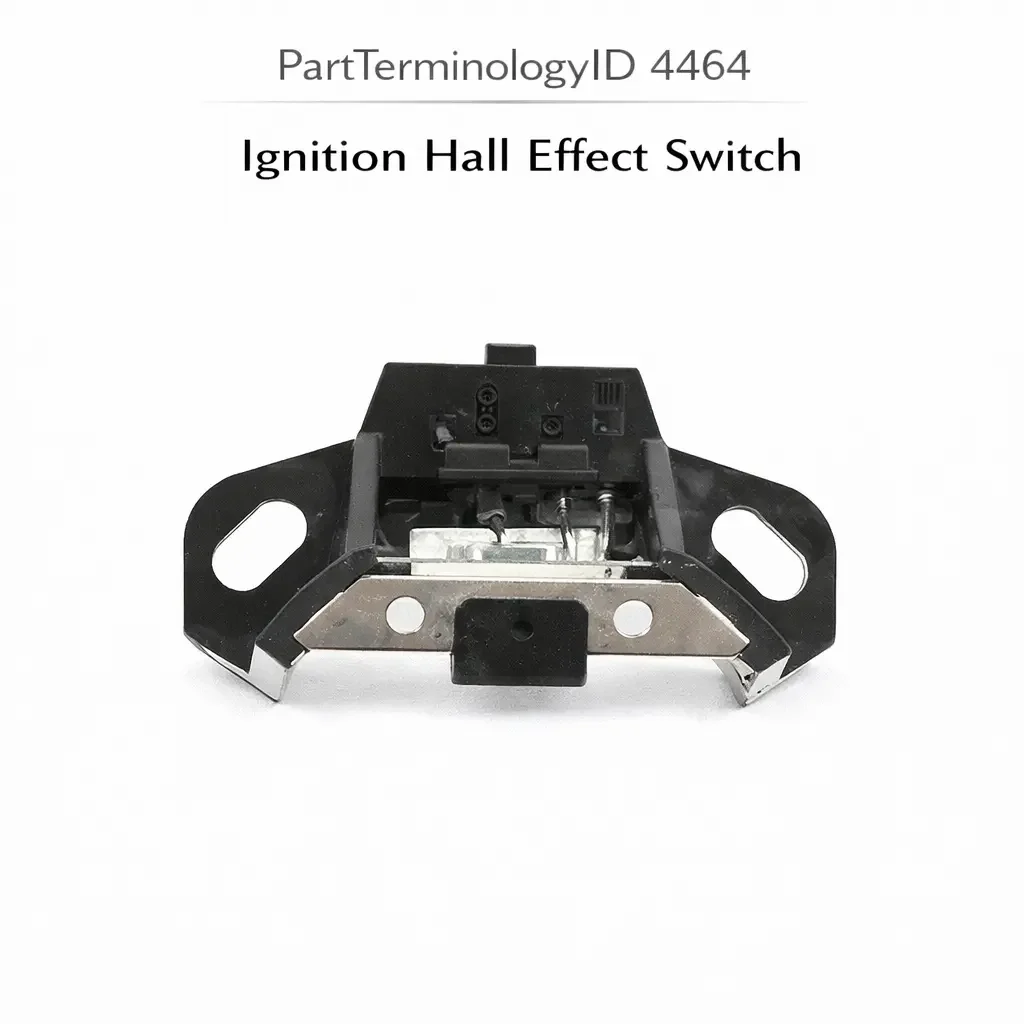
PartTerminologyID 4464, Ignition Hall Effect Switch, is the semiconductor-based position sensor mounted in the distributor housing or in proximity to a ferromagnetic trigger wheel that detects the passage of a shutter blade, reluctor tooth, or magnetic vane through a calibrated air gap and produces a digital square-wave output signal that the ignition control module, ECU, or ignition amplifier uses to determine crankshaft position, trigger primary ignition coil collapse, and in some applications determine cylinder identification for sequential fuel injection timing. That definition covers the Hall effect switching and ignition trigger function correctly and leaves unresolved every question that determines whether the replacement switch's supply voltage and signal output voltage match the ignition control module's input specification, whether the switch is a two-wire or three-wire type depending on whether the module provides a separate power supply and ground in addition to the signal line or combines power and signal on fewer wires, whether the switch air gap specification matches the installed trigger wheel or shutter blade geometry at the installation position, whether the switch is a single-channel type producing one trigger pulse per distributor revolution or a multi-channel type producing separate signals for each cylinder's TDC position used for cylinder identification, whether the switch body dimensions and mounting flange geometry match the distributor housing or sensor bracket at the installation position, and whether the replacement is compatible with the ignition control module's signal polarity (active high output when shutter blocks the Hall element, or active low output when shutter is clear of the Hall element).
It does not specify the supply voltage, signal output voltage, wire count, air gap specification, channel count, mounting geometry, or signal polarity. A listing under PartTerminologyID 4464 that states only year, make, and model without signal output voltage and air gap specification cannot be evaluated by a technician replacing a failed Hall effect switch in a distributor on a vehicle where the original switch produced a 0 to 5 volt digital output referenced to a 5-volt module supply, and the replacement produces a 0 to 12 volt output referenced to battery voltage, which will present 12 volts to the ignition control module's 5-volt logic input on every trigger pulse and damage the module's input stage within the first drive cycle.
For sellers, PartTerminologyID 4464 is the ignition sensing PartTerminologyID where signal voltage compatibility is the most immediately consequential attribute, because a replacement that presents a higher voltage than the module's input rating damages the module on the first ignition cycle. The air gap specification is the second most consequential attribute because an air gap outside the specified range produces a signal with incorrect duty cycle or amplitude that the module may not recognize as a valid trigger, causing misfire or no-start conditions that are attributed to the ignition module or the ignition coil rather than the sensor.
What the Ignition Hall Effect Switch Does
Hall Effect Sensing Principle and the Digital Trigger Signal
A Hall effect switch produces a digital output signal by detecting the presence or absence of a magnetic field at its sensing face. In the distributor application, a permanent magnet is fixed to one side of the sensing gap and the Hall IC is on the other side. A ferromagnetic shutter or reluctor blade passes through the gap as the distributor shaft rotates, periodically blocking and restoring the magnetic flux path through the Hall element. When the shutter blocks the flux, the Hall IC's output changes state. When the shutter clears the gap, the output returns to its normal state. This on-off switching produces a square-wave digital signal whose frequency corresponds to the distributor's rotational speed and whose pulse width corresponds to the shutter blade's arc width.
The ignition control module or ECU receives this square-wave signal and uses the falling or rising edge of each pulse to trigger the primary coil collapse that generates the high-voltage spark. The precise timing of the spark relative to the trigger pulse edge is calibrated into the module and varies with engine speed and load through the module's advance strategy. The Hall effect switch does not determine ignition timing directly; it provides the position reference from which the module calculates and implements the timed spark.
Supply Voltage, Signal Output Voltage, and Module Input Compatibility
Hall effect switches are manufactured for two common supply voltage ranges. The 5-volt supply type is powered from the ignition control module's internal 5-volt reference output and produces a 0 to 5 volt digital signal (0 volts when the shutter blocks, 5 volts when the shutter is clear, or the inverse depending on polarity). The 12-volt supply type is powered directly from the battery-referenced switched ignition supply and produces a 0 to 12 volt digital signal. The module's input stage is designed for one specific supply and signal voltage; applying a 12-volt signal to a 5-volt module input stage will forward-bias the input protection diode and potentially destroy the input transistor on the first high-state transition.
The three-wire connection is the standard for Hall effect switches: wire one carries the supply voltage from the module or ignition circuit, wire two is the signal output returning the square-wave trigger to the module, and wire three is the ground return. Some two-wire designs combine the supply and signal on a single wire with a current-sink output where the switch draws current from the signal line when activated, but this design is uncommon in automotive ignition applications.
The supply voltage and the signal output voltage range must both be stated and confirmed against the module's input specification. These two values are not always identical: some designs use a 12-volt supply but produce a 5-volt logic-level output through an internal voltage regulator, providing a logic-compatible signal to a 5-volt module input while drawing power from the 12-volt ignition circuit. The listing must state both the supply voltage and the signal output voltage as separate attributes.
Air Gap Specification and the Trigger Wheel Geometry Dependency
The air gap between the Hall element's sensing face and the trigger wheel or shutter blade must fall within the switch's specified range for correct signal generation. If the air gap is too large, the shutter blade's passage through the gap produces insufficient change in flux density at the Hall element to trigger a reliable output transition. The output signal will have rounded transition edges rather than sharp square-wave edges, and the module may misread the pulse timing or miss pulses entirely at high engine speeds where the transition time is critical.
If the air gap is too small, the shutter blade may contact the switch body during rotation if the distributor shaft has any axial or radial play, damaging the switch body and producing an intermittent no-spark condition. The air gap specification must be set within the switch manufacturer's acceptable range during installation, using a feeler gauge to confirm the gap between the switch face and the trigger blade at the closest approach point.
The air gap specification is determined by the switch design and by the trigger wheel or shutter blade geometry at the installation position. Different distributor designs use different shutter blade heights and tip clearances, and the switch's air gap specification must be compatible with the available clearance in the specific distributor housing. A switch specified for a 0.5mm minimum air gap installed in a distributor providing only 0.3mm clearance will contact the shutter during rotation.
Multi-Channel Switches and Cylinder Identification
Some distributor-mounted Hall effect switches include two or more sensing channels at different angular positions around the distributor shaft, producing separate trigger signals for each cylinder's TDC position. These multi-channel switches allow the ECU to identify which specific cylinder is approaching TDC and sequence the fuel injectors individually rather than batch-firing them. Sequential fuel injection requires cylinder identification that a single-channel switch cannot provide.
A single-channel replacement installed in a multi-channel application will not provide cylinder identification signals, preventing the ECU from operating in sequential injection mode. The ECU will typically fall back to a batch injection mode (firing all injectors simultaneously or in pairs), which is functional but does not provide the fuel efficiency and emission control benefits of sequential injection. On some ECUs, the absence of the cylinder identification signal generates a fault code and triggers a check engine warning.
The channel count must be confirmed for every Hall effect switch listing on applications where sequential fuel injection or cylinder identification is used.
Top Return Scenarios
Scenario 1: "12-volt output switch in 5-volt module input, module input stage damaged on first ignition cycle"
The buyer replaces the Hall effect switch in the distributor. The engine starts and runs normally for the first five minutes. The ignition control module's input stage receives 12 volts on each signal pulse high transition, which is above the 5-volt maximum for the module's CMOS input. After approximately 200 ignition events, the input protection diode fails from repeated transient overvoltage. The module stores no fault code and produces no spark. The buyer replaces the module before identifying the signal voltage mismatch as the cause of the module failure.
Prevention language: "Signal output voltage: [0 to 5 volt logic level / 0 to 12 volt battery-referenced]. Module input voltage rating: [5 volt logic input / 12 volt input]. Verify the signal output voltage against the ignition control module's input rating. A 12-volt output switch in a 5-volt module input damages the input stage on the first high-state transition. Confirm both supply voltage and signal output voltage as separate specifications."
Scenario 2: "Air gap too large for shutter blade height, rounded signal transitions, misfire at high RPM"
The buyer installs the replacement switch. At idle the engine runs normally. Above 4,000 RPM, a misfire develops that worsens with increasing speed. The air gap between the replacement switch face and the shutter blade is 1.2mm. The switch's maximum specified air gap is 0.8mm. At high RPM, the reduced time for each shutter transition causes the rounded output transitions from the excessive air gap to fall below the module's input threshold voltage midway through the transition, producing an ambiguous trigger signal that the module interprets as a false trigger or misses entirely.
Prevention language: "Air gap specification: [minimum X mm, maximum X mm] between switch sensing face and trigger blade at closest approach. Verify the available clearance in the distributor before ordering. An air gap exceeding the switch's maximum specification produces rounded signal transitions that cause the ignition module to misread or miss trigger pulses at high engine speeds."
Scenario 3: "Single-channel switch in multi-channel application, ECU falls back to batch injection, fault code stored"
The buyer replaces the two-channel Hall effect switch with a single-channel type. The engine starts and runs but the check engine lamp illuminates. A scan tool reveals a cylinder identification signal fault. The ECU has switched from sequential injection mode to batch injection mode due to the absent cylinder identification channel. Fuel economy decreases noticeably and idle quality deteriorates slightly compared to the original sequential injection operation.
Prevention language: "Channel count: [single channel, crankshaft position reference only / multi-channel, includes cylinder identification output]. Verify the channel count against the original switch. A single-channel replacement in a multi-channel application removes cylinder identification capability, preventing sequential fuel injection and generating a fault code for the absent cylinder identification signal."
Scenario 4: "Active-high polarity switch in active-low module input, module receives inverted signal, no spark"
The original switch produces a low output when the shutter blocks the Hall element (active-low: 0 volts with shutter present) and a high output when the shutter is clear (5 volts with shutter absent). The module triggers coil collapse on the falling edge (high-to-low transition). The replacement switch has active-high polarity: high output with shutter present, low output with shutter absent. The trigger pulse edges are inverted. The module now triggers on the opposite edge of each pulse, advancing or retarding ignition timing by the angular width of the shutter blade rather than triggering at the designed leading edge of the blade's passage.
Prevention language: "Signal polarity: [active-high, output high when shutter blocks Hall element / active-low, output low when shutter blocks Hall element]. Verify signal polarity against the original switch specification. An inverted polarity switches the trigger edge from the designed leading edge to the trailing edge of each shutter passage, shifting all ignition timing by the shutter blade's arc width."
Core Listing Attributes for PartTerminologyID 4464
PartTerminologyID: 4464
Component: Ignition Hall Effect Switch
Supply voltage: 5 volt module supply or 12 volt ignition circuit (mandatory, in title)
Signal output voltage range: 0 to 5 volt logic level or 0 to 12 volt (mandatory)
Signal polarity: active-high or active-low (mandatory)
Wire count: two-wire or three-wire (mandatory)
Air gap specification: minimum and maximum in mm (mandatory)
Channel count: single channel or multi-channel with cylinder identification (mandatory)
Mounting geometry: distributor housing type with body dimensions, or external bracket mount with sensor body dimensions (mandatory)
Year/make/model/engine/distributor or trigger wheel application
Catalog Checklist for ACES/PIES Teams
PartTerminologyID = 4464
Require supply voltage and signal output voltage as separate attributes (mandatory)
Require signal polarity: active-high or active-low (mandatory)
Require wire count (mandatory)
Require air gap specification with minimum and maximum values (mandatory)
Require channel count: single or multi-channel (mandatory)
Require mounting geometry (mandatory)
Prevent signal voltage omission: a 12-volt output switch in a 5-volt module input damages the module input stage on the first high-state transition; signal output voltage must be confirmed against the module's input rating as the first compatibility check
Prevent air gap omission: an air gap exceeding the switch's maximum causes rounded transitions and high-RPM misfire; minimum and maximum air gap must be stated for every listing
Prevent polarity omission: an inverted polarity shifts all ignition timing by the shutter blade arc width; polarity must be confirmed against the original switch
Prevent channel count omission: a single-channel switch in a multi-channel application removes sequential injection capability; channel count must be confirmed for all applications using sequential fuel injection
Differentiate from Variable Reluctance (VR) Sensor (if cataloged): the VR sensor produces an analog sine-wave output whose amplitude varies with rotational speed; the Hall effect switch produces a constant-amplitude digital square-wave output regardless of speed; both provide crankshaft position data but through fundamentally different signal types requiring different module input circuits
Differentiate from Crankshaft Position Sensor (PartTerminologyID 4468 or similar): the crankshaft position sensor is mounted externally at the engine block reading a crank trigger wheel; the ignition Hall effect switch is mounted inside the distributor or at a distributor-equivalent trigger position; both provide position data for ignition timing but at different positions in the engine
FAQ (Buyer Language)
How do I identify whether my ignition Hall effect switch uses a 5-volt or 12-volt supply?
Measure the voltage at the switch supply wire with the ignition on and engine not running. A 5-volt reading confirms a 5-volt module supply type. A 12-volt reading confirms a battery-referenced supply type. Do not assume the supply voltage from the number of wires alone, as both 5-volt and 12-volt types commonly use three-wire connections.
My engine starts but misfires above 4,000 RPM after replacing the Hall effect switch. What should I check first?
High-RPM misfire after Hall effect switch replacement is the characteristic symptom of an air gap too large for the switch's specification. Measure the air gap between the switch sensing face and the shutter blade or reluctor tooth at the closest approach point using a feeler gauge. Compare to the switch's specified maximum air gap. If the measured gap exceeds the specification, reposition the switch closer to the trigger blade within the distributor housing's adjustment range.
Can I use a Hall effect switch from a different engine family if the connector matches?
Only if the signal output voltage, supply voltage, signal polarity, air gap specification, and channel count all match the requirements of both the original module and the specific trigger wheel geometry. A matching connector does not confirm electrical or geometric compatibility. Confirm all specifications independently before substituting a switch from a different engine family.
Related PartTerminologyIDs
Ignition Control Module (if cataloged): the module that receives the Hall effect switch trigger signal and commands coil collapse; a module with a damaged input stage from a signal voltage mismatch will not respond to a correctly installed replacement switch; confirm module input function with a known-good switch signal before concluding the module has also failed
Crankshaft Position Sensor (PartTerminologyID 4468 or similar): the external engine-block-mounted position sensor for engines without a distributor; both provide ignition timing reference but at different positions in the engine's position sensing architecture
Status in New Databases
PIES/PCdb: PartTerminologyID 4464, Ignition Hall Effect Switch
PIES 8.0 / PCdb 2.0: No change in PartTerminologyID or terminology label
Final Take for PartTerminologyID 4464
Ignition Hall Effect Switch (PartTerminologyID 4464) is the ignition sensing PartTerminologyID where signal output voltage is the attribute with the most immediate hardware damage consequence, because a 12-volt output switch connected to a 5-volt module input damages the module's input stage on the first ignition cycle and converts a sensor replacement into a module replacement. The air gap specification is the attribute with the most installation-specific consequence because an excessive air gap produces rounded signal transitions that cause high-RPM misfire without any obvious installation error. Signal polarity is the attribute with the most timing consequence because an inverted polarity shifts all ignition timing by the shutter blade arc width on every ignition event.
State the supply voltage and signal output voltage as separate attributes. State the signal polarity. State the air gap specification with minimum and maximum values. State the channel count. State the mounting geometry. For PartTerminologyID 4464, signal output voltage, air gap specification, and signal polarity are the three attributes that prevent the three most consequential return scenarios in the ignition Hall effect switch buyer population.