
Written by Arthur Simitian | PartsAdvisory
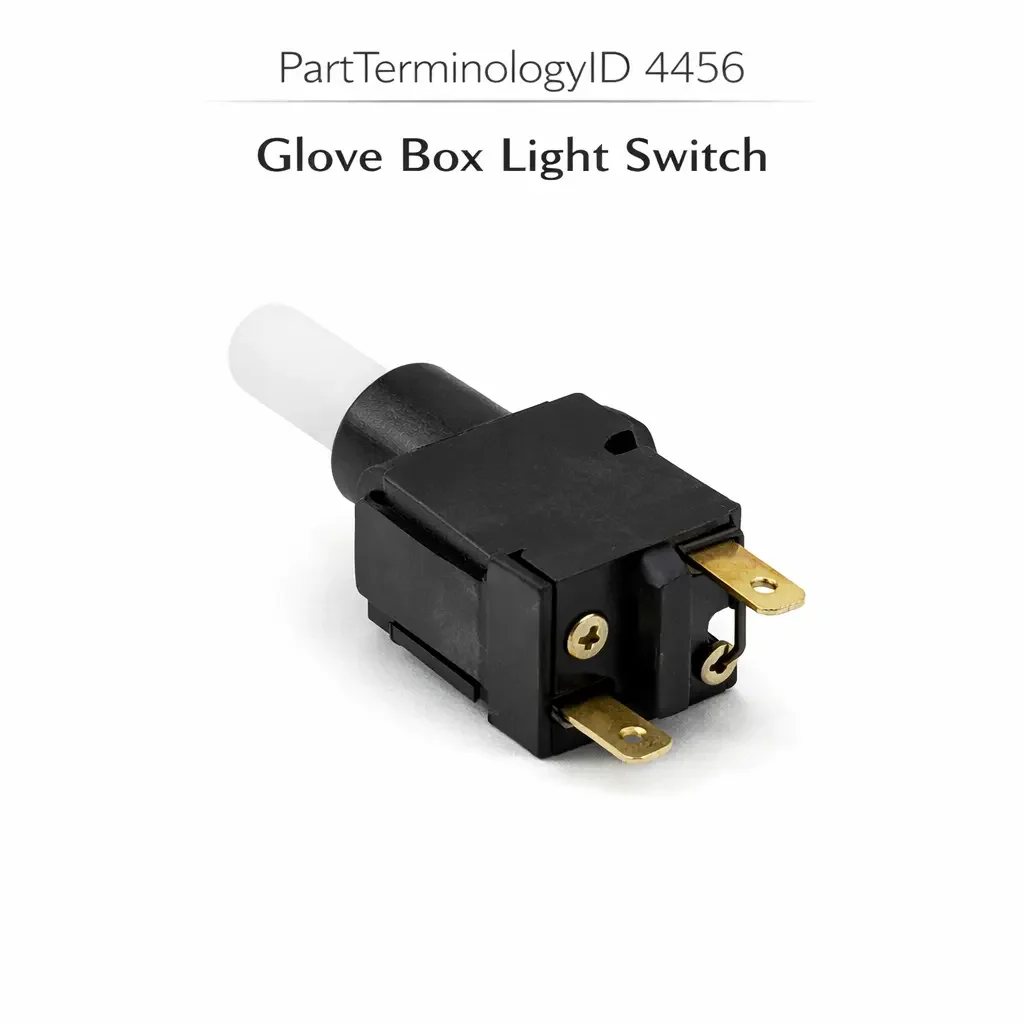
PartTerminologyID 4456, Glove Box Light Switch, is the switch mounted in the glove box opening, glove box door hinge area, or glove box lid frame that detects the open and closed state of the glove box door and activates the glove box interior light when the door is opened and deactivates it when the door is closed, operating through the same contact-closure and plunger-depression mechanism as the door jamb switch (PartTerminologyID 4360) but calibrated for the shorter plunger travel and lighter actuation force typical of glove box door installations where the door's closing force is lower than a full vehicle door's and the switch body dimensions are correspondingly smaller. That definition covers the glove box light activation function correctly and leaves unresolved every question that determines whether the replacement switch's plunger travel matches the glove box door's engagement depth at the installation position, whether the switch contact configuration matches the lighting circuit design, whether the switch mounting thread or push-in clip geometry matches the glove box frame hole, whether the switch body dimensions fit the available space within the glove box lid or frame at the mounting point, whether the switch is a standalone glove box light switch or a combined glove box and glovebox ajar type that sends a secondary signal to the BCM for door status monitoring, and whether the replacement switch is rated for the glove box light circuit's current draw or only a low-current BCM signal depending on the circuit architecture.
It does not specify the plunger travel, contact configuration, mounting specification, body dimensions, secondary BCM output, or current rating. A listing under PartTerminologyID 4456 that states only year, make, and model without plunger travel and contact configuration cannot be evaluated by a technician replacing a failed glove box light switch on a vehicle where the glove box door's closing face is 4mm from the switch plunger tip at the fully closed and latched position, and the replacement switch's plunger travel is only 3mm, leaving the switch plunger 1mm short of full depression at door close and keeping the glove box light illuminated continuously while driving with the door closed, draining the battery on overnight parking events and reducing the glove box bulb's service life.
For sellers, PartTerminologyID 4456 occupies a lower-urgency position in the body electrical catalog than the door jamb switch (PartTerminologyID 4360) or the courtesy light switch (PartTerminologyID 4316) because a failed glove box light switch rarely produces a safety consequence or a driveability complaint. The consequence is limited to a glove box that does not illuminate on opening (failed open contact) or a glove box light that runs continuously with the door closed (failed plunger travel match or failed closed contact), the second of which carries a genuine battery drain risk on vehicles parked for extended periods. The buyer arriving at this PartTerminologyID has typically noticed a dead battery traced to a continuously illuminated glove box light, or a glove box that remains dark after bulb replacement confirms the bulb is functional.
What the Glove Box Light Switch Does
Plunger Travel and the Glove Box Door Engagement Geometry
The glove box light switch plunger is depressed by the glove box door or lid when the door closes, pushing the plunger to its fully depressed position and opening (for normally closed types) or keeping open (for normally open types) the lighting circuit contact. When the door opens, the plunger extends to its full length and the contact changes state, completing the circuit to the glove box light.
The plunger travel required for full depression depends on the specific glove box installation: the distance between the switch mounting face and the glove box door's inner closing surface at the installation position when the door is fully latched. This distance is typically 3 to 8mm on glove box applications, which is shorter than the 8 to 14mm typical of full vehicle door jamb switch applications. A switch with a plunger travel shorter than the engagement depth will not reach full depression at door close. A switch with a plunger travel longer than the engagement depth will be fully depressed before the door reaches the fully latched position, which is acceptable as long as the switch achieves full contact change before the latch engages.
The most consequential plunger mismatch is the short-travel scenario: a plunger that cannot fully depress at door close leaves the circuit in the door-open state, illuminating the glove box light continuously. On vehicles where the glove box light is powered from an ignition-off circuit (as most glove box lights are, to provide illumination when the ignition is off during access), a continuously illuminated light draws current from the battery at all times. A typical glove box incandescent bulb draws 5 watts. Left illuminated for 12 hours on a 60 amp-hour battery, a single 5-watt glove box light consumes approximately one amp-hour, which alone is not sufficient to fully discharge a healthy battery but combined with other standby loads and a marginal battery can produce a no-start condition after extended parking.
Contact Configuration and the Lighting Circuit Logic
The glove box light switch is almost universally a normally closed type on direct lamp circuit applications: the switch contacts are closed when the plunger is extended (door open, light on) and open when the plunger is depressed (door closed, light off). This is the same logic as the normally closed door jamb switch description: the lighting circuit is completed through the switch when the plunger is free to extend.
On BCM-managed vehicles where the glove box light is activated by the BCM's output rather than by a direct lamp circuit, the switch is a switched ground type that pulls the BCM's glove box input pin to ground when the door is opened. The BCM detects the ground and activates the glove box light output through its own transistor or relay output. In this architecture, the switch contact is normally open at door close (BCM input pin floating at pull-up voltage) and closed at door open (BCM input pulled to ground).
The two contact conventions are opposite between direct lamp and BCM input architectures, and a switch designed for one architecture installed in the other will produce the reversed behavior described across multiple PartTerminologyIDs in this catalog: light on with door closed, light off with door open.
Mounting Specification and Body Dimension Constraints
The glove box light switch is installed in one of three configurations. The first is a threaded body switch that screws into a threaded hole in the glove box frame or lid, using the same thread forms described across other panel-mount switches in this series (3/8-24 UNF or M10 x 1.0 being common). The second is a push-in clip type that snaps into a cutout in the glove box frame. The third is a surface-mount type that attaches to the glove box door hinge pin or a bracket in the hinge area, actuated by the door's rotation rather than a plunger contact.
The body dimension constraint is more restrictive for glove box switches than for door jamb switches because the glove box frame and lid are typically thinner-walled plastic components with limited mounting boss depth. A switch body that is too long will protrude into the glove box interior, where it may interfere with items stored in the glove box or be contacted by the door's inner surface rather than its intended contact point. A switch body that is too wide will not fit in the mounting boss without splitting the plastic.
Top Return Scenarios
Scenario 1: "Plunger 1mm short, light illuminated continuously, battery drain on overnight parking"
The replacement switch has a 3mm plunger travel. The glove box door engagement depth at the installation position is 4mm. With the door fully latched, the switch plunger is 1mm short of full depression. The circuit contact does not reach its door-closed state. The glove box light remains illuminated continuously. After two nights of parking, the owner returns to a battery that will not start the engine.
Prevention language: "Plunger travel: [X] mm from unactuated to full depression. Verify the engagement depth at the glove box door installation position before ordering. A plunger shorter than the door engagement depth leaves the lighting circuit in the door-open state when the door is latched, illuminating the glove box light continuously and creating a battery drain risk on extended parking."
Scenario 2: "Normally open switch in normally closed direct lamp circuit, light never illuminates on door open"
The replacement switch is normally open. The direct lamp circuit requires normally closed. With the door open and the plunger extended, the normally open contact is open. The lighting circuit is interrupted and the glove box light does not illuminate. The switch changes state when the door closes, closing the contact and illuminating the light while the door is closed and dark while it is open.
Prevention language: "Contact configuration: [normally closed, light activates on door open (plunger extended) / normally open, light activates on door close (plunger depressed)]. Verify the configuration against the glove box lighting circuit design. A normally open switch in a normally closed direct lamp circuit illuminates the glove box only when the door is closed."
Scenario 3: "Switch body too long, protrudes into glove box interior, door inner surface contacts switch body rather than plunger tip"
The replacement switch body is 18mm in length from the mounting face to the plunger tip. The original body was 12mm. With the replacement installed, the switch body protrudes 6mm into the glove box compartment beyond the original. The glove box door's inner surface contacts the switch body shoulder rather than the plunger tip as the door closes. The plunger is never actuated and the switch remains in the door-open state with the door closed, illuminating the light continuously.
Prevention language: "Switch body length from mounting face to plunger tip: [X] mm. Verify the switch body length against the available mounting boss depth in the glove box frame. A switch body longer than the original protrudes into the glove box interior and may contact the door surface at the body shoulder rather than the plunger tip, preventing plunger actuation."
Scenario 4: "BCM input switch installed in direct lamp circuit, switch carries no lamp current, light does not illuminate"
The buyer installs a BCM input type switch (switched ground, normally open) in a vehicle with a direct lamp circuit that requires a normally closed type carrying the lamp current. The BCM input switch's contacts carry only milliamp-level signal current. With the door open, the normally open contact closes (correct for BCM input architecture) but the lamp circuit is not completed because the switch is not wired in the lamp circuit supply path. The BCM is not present in this circuit to activate a lamp output in response to the switch's ground signal.
Prevention language: "Circuit architecture: [direct lamp circuit, switch carries [X] ampere lamp current / BCM input circuit, switch carries milliamp signal current only]. Verify the circuit architecture before ordering. A BCM input switch installed in a direct lamp circuit will not illuminate the glove box light because the switch is not rated for or wired in the lamp current path."
Core Listing Attributes for PartTerminologyID 4456
PartTerminologyID: 4456
Component: Glove Box Light Switch
Contact configuration: normally open or normally closed (mandatory, in title)
Circuit architecture: direct lamp circuit or BCM input circuit (mandatory)
Plunger travel in mm from unactuated to full depression (mandatory)
Switch body length from mounting face to plunger tip in mm (mandatory)
Mounting type: threaded body with thread specification, push-in clip with body diameter, or hinge-area bracket mount (mandatory)
Contact current rating in amperes for direct lamp circuit types (mandatory)
BCM signal type for BCM input types: switched ground or switched voltage (mandatory)
Secondary BCM ajar output: included or absent (mandatory where applicable)
Year/make/model/submodel
Catalog Checklist for ACES/PIES Teams
PartTerminologyID = 4456
Require contact configuration in title: normally open or normally closed (mandatory)
Require circuit architecture: direct lamp or BCM input (mandatory)
Require plunger travel in mm (mandatory)
Require switch body length from mounting face to plunger tip (mandatory)
Require mounting type with thread or clip specification (mandatory)
Require contact current rating for direct lamp circuit types (mandatory)
Prevent plunger travel omission: a plunger 1mm shorter than the engagement depth illuminates the glove box light continuously and produces a battery drain on extended parking; plunger travel must be stated and verified against the door engagement depth
Prevent contact configuration omission: a normally open switch in a normally closed direct lamp circuit illuminates the glove box only when the door is closed; configuration must be stated for every listing
Prevent body length omission: a switch body longer than the mounting boss depth protrudes into the glove box interior and may prevent plunger actuation; body length must be confirmed against the available mounting depth
Prevent circuit architecture omission: a BCM input switch in a direct lamp circuit does not carry lamp current and will not illuminate the glove box light; architecture must be confirmed for all post-1995 applications with BCM body electronics
Relationship to PartTerminologyID 4360 (Door Jamb Switch): the glove box light switch and the door jamb switch are the same functional type in different installation scales; where both PartTerminologyIDs appear in the same catalog, the plunger travel and body dimension specifications are the primary differentiators between the two
Differentiate from Glove Box Light (if cataloged): the glove box light is the lamp assembly the switch activates; a glove box that remains dark after switch replacement confirms the lamp or the lamp circuit rather than the switch as the remaining fault
FAQ (Buyer Language)
How do I measure the engagement depth at my glove box switch position?
With the glove box door open, position a small ruler or digital caliper from the switch mounting face to the door inner surface at the contact point with the door fully closed. This measurement is the engagement depth the switch plunger must equal or exceed. For threaded switches, account for the thread engagement depth that sets the switch face position relative to the glove box frame surface.
My glove box light stays on with the door closed. Is the switch the cause?
A glove box light that remains on with the door closed indicates either that the plunger is not being fully depressed at door close (plunger travel too short for the engagement depth), that the switch contact has failed in the closed position, or that the switch contact configuration is incorrect for the circuit. Confirm by pressing the switch plunger manually with the door open: if pressing the plunger extinguishes the light, the switch is functional and the plunger is not reaching full depression at door close, confirming a plunger travel mismatch.
Does the glove box light switch need to be the same brand as the original?
No, as long as the plunger travel, contact configuration, mounting specification, and circuit architecture all match the original. The glove box light switch is one of the more interchangeable switch types in the body electrical category because it performs a simple single-circuit function with no BCM integration complexity on most applications.
Related PartTerminologyIDs
Door Jamb Switch (PartTerminologyID 4360): the door position switch at the vehicle door opening; same functional mechanism as the glove box light switch but with longer plunger travel and higher contact current rating for the door circuit; where a vehicle uses the same physical switch body for both the door jamb and the glove box, confirm the plunger travel specification for the specific application position before assuming interchangeability
Courtesy Light Switch (PartTerminologyID 4316): the door-activated courtesy lighting switch; same contact mechanism and circuit architecture types as the glove box light switch; shares catalog structure and attribute requirements
Status in New Databases
PIES/PCdb: PartTerminologyID 4456, Glove Box Light Switch
PIES 8.0 / PCdb 2.0: No change in PartTerminologyID or terminology label
Final Take for PartTerminologyID 4456
Glove Box Light Switch (PartTerminologyID 4456) is the interior lighting PartTerminologyID where plunger travel shortfall carries a genuine battery drain consequence on vehicles with ignition-off glove box lighting circuits and extended parking intervals, and body length excess prevents plunger actuation by allowing the door surface to contact the switch body rather than the plunger tip. Both failures produce the same symptom (light on with door closed) through different mechanisms that require different remedies. State the contact configuration in the title. State the plunger travel in mm. State the switch body length from mounting face to plunger tip. State the mounting type and specification. State the circuit architecture. For PartTerminologyID 4456, plunger travel, switch body length, and contact configuration are the three attributes that prevent the three most common return scenarios in the glove box light switch buyer population.