
Written by Arthur Simitian | PartsAdvisory
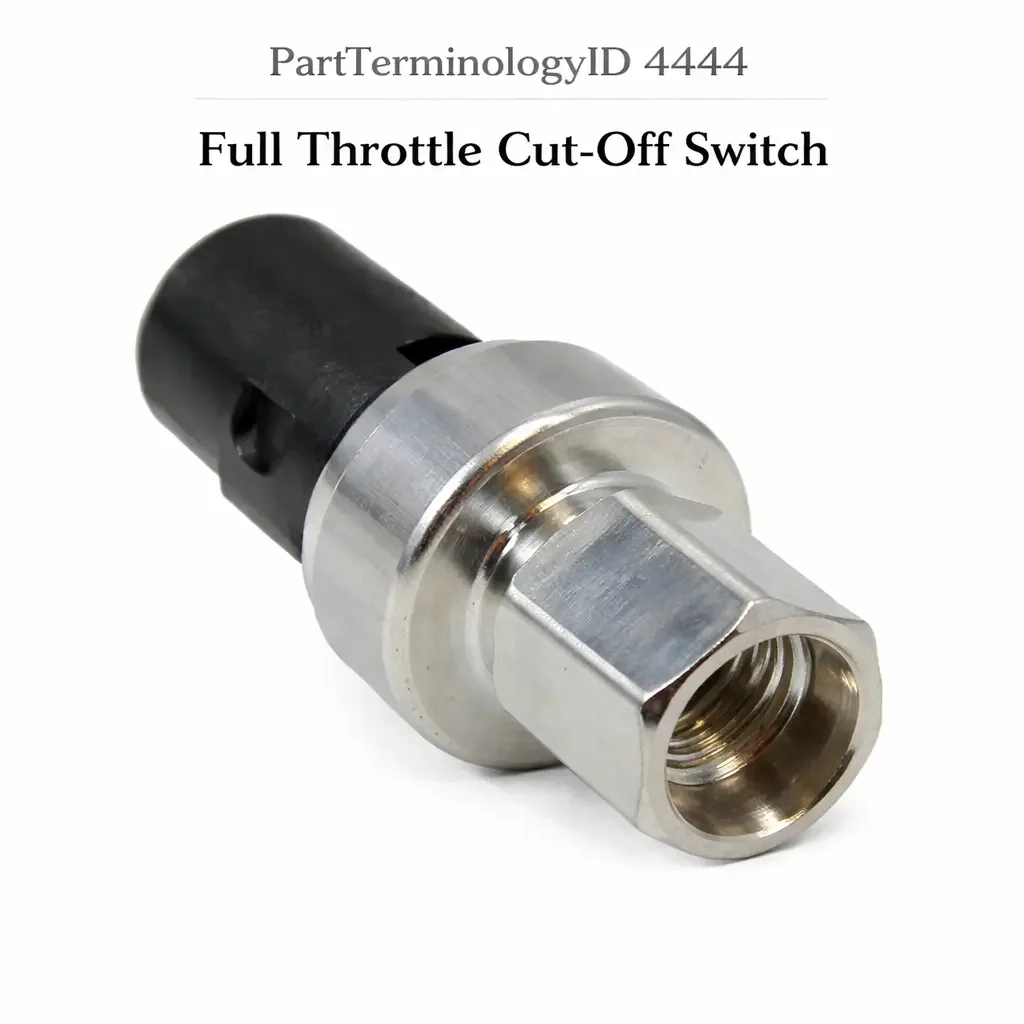
PartTerminologyID 4444, Full Throttle Cut-Off Switch, is the mechanically activated switch mounted at the throttle body, carburetor throttle linkage, or accelerator pedal assembly that detects when the throttle plate or accelerator input reaches the full-travel position and opens or closes an electrical contact to interrupt or activate a secondary system in response to maximum throttle demand, most commonly used to disengage the A/C compressor clutch at wide-open throttle to recover the compressor's parasitic load for maximum acceleration, to disable overdrive transmission engagement during full-throttle acceleration, to activate a fuel enrichment circuit on carbureted performance engines, or to signal the ECU that a wide-open-throttle condition exists on vehicles where a discrete mechanical switch supplements or replaces the throttle position sensor's WOT detection function. That definition covers the full-throttle detection and circuit control function correctly and leaves unresolved every question that determines whether the replacement switch's mechanical activation geometry matches the throttle linkage or pedal travel at the specific installation position, whether the switch is a normally open type that closes at full throttle or a normally closed type that opens at full throttle depending on the controlled circuit's design, whether the switch contact current rating covers the circuit it controls, whether the switch connector matches the harness at the installation position, and whether the switch includes an adjustable activation point that allows fine-tuning the throttle travel percentage at which the switch changes state.
It does not specify the activation geometry, contact configuration, contact current rating, connector type, or adjustability. A listing under PartTerminologyID 4444 that states only year, make, and model without contact configuration and activation geometry cannot be evaluated by a technician replacing a failed WOT cut-off switch on a vehicle where the original switch was a normally closed type that kept the overdrive circuit enabled during partial throttle and opened at full throttle to disable overdrive, and the replacement is normally open, which keeps overdrive disabled at all throttle positions below full throttle and enables it only at full throttle, producing the exact opposite transmission behavior from the original on every drive cycle.
For sellers, PartTerminologyID 4444 is closely related to PartTerminologyID 4304 (AC Compressor Cut-Off Switch) in the WOT application. Where PartTerminologyID 4304 covers the complete A/C compressor cut-off switch including all activation trigger types, PartTerminologyID 4444 is specific to the mechanically actuated full-throttle detection switch, typically located at the throttle linkage rather than in the refrigerant or coolant circuit. The mechanical activation geometry of the throttle linkage contact is the distinguishing specification in this PartTerminologyID and must be confirmed against the specific throttle body or carburetor installation before ordering.
What the Full Throttle Cut-Off Switch Does
Mechanical Activation Geometry and the Throttle Travel Calibration
The full throttle cut-off switch is actuated by direct mechanical contact with the throttle linkage, throttle cam, or accelerator pedal assembly at the point of maximum travel. The switch body mounts at a fixed position relative to the throttle mechanism, and the throttle's moving parts contact and depress the switch plunger when the throttle reaches the full-open position. The switch plunger travel required for contact change must match the distance between the switch body mounting position and the throttle linkage contact point at full throttle.
A switch with a shorter plunger travel than the original activates before the throttle reaches true full-open position, triggering the cut-off at a partial throttle position and disabling the A/C or overdrive during aggressive but not maximum throttle applications. A switch with a longer plunger travel than the original requires more throttle travel to actuate and may not activate at all if the throttle cam's full-travel contact point does not reach the switch plunger's activation depth.
On applications with an adjustable switch mounting bracket, the throttle travel percentage at which the switch activates can be fine-tuned by moving the switch body closer to or further from the throttle contact point. A replacement switch for an adjustable bracket application must fit within the bracket's adjustment range to allow correct calibration. A switch body that is too wide or too long for the bracket prevents adjustment to the correct activation point.
Contact Configuration and the Controlled Circuit Logic
The contact configuration determines how the controlled circuit responds to full-throttle detection. A normally closed switch that opens at full throttle is used in circuits that must be active during normal operation and interrupted at full throttle: overdrive disable circuits, A/C clutch circuits powered through the switch, and transmission line pressure circuits that hold at base pressure during full-throttle acceleration. A normally open switch that closes at full throttle is used in circuits that must be activated only at full throttle: fuel enrichment circuits that activate a secondary injector or an enrichment solenoid at WOT, and ECU WOT signal inputs that require a positive signal to enable the ECU's WOT fuel and spark strategy.
Installing a normally open switch in a normally closed circuit position will leave the controlled circuit permanently interrupted at all throttle positions below full throttle, which is typically more disruptive than the reverse: A/C disabled during all partial throttle operation, overdrive disabled at all times except full throttle, or fuel enrichment permanently inactive except at WOT.
Contact Current Rating and Circuit Load
The contact current rating of the full throttle cut-off switch must cover the current drawn by the circuit it controls. A switch carrying the A/C compressor clutch coil current directly must be rated for the clutch coil's operating current, typically 3 to 5 amperes. A switch signaling a relay coil or an ECU input carries only the low-current signal, typically 0.1 to 0.5 amperes. A switch in the overdrive enable circuit carries the overdrive solenoid current, typically 0.5 to 1.5 amperes.
An undersized contact rating produces arc erosion at the switch contact with each full-throttle activation and deactivation event, shortening the switch contact life and eventually producing intermittent contact failure that manifests as the controlled circuit behaving erratically during hard acceleration events.
Top Return Scenarios
Scenario 1: "Normally open switch in normally closed overdrive circuit, overdrive disabled at all partial throttle positions"
The replacement switch is normally open. The overdrive enable circuit requires normally closed. Below full throttle, the normally open contact is open, interrupting the overdrive enable circuit permanently at all partial throttle positions. Overdrive cannot engage during normal highway cruising, producing elevated RPM and increased fuel consumption on every drive until the throttle is briefly floored to close the switch and allow an overdrive engagement attempt.
Prevention language: "Contact configuration: [normally open, closes at full throttle / normally closed, opens at full throttle]. Verify the configuration against the controlled circuit's design. A normally open switch in a normally closed circuit interrupts the controlled circuit at all throttle positions below full throttle, disabling the controlled function during normal operation."
Scenario 2: "Plunger travel too long, switch does not activate at full throttle travel, A/C never disengages at WOT"
The replacement switch requires 14mm of plunger depression to change state. The throttle cam's contact point at full travel moves the switch plunger only 11mm. The switch never reaches its activation depth at any throttle position. The A/C compressor remains engaged continuously at full throttle, reducing available power during maximum acceleration events.
Prevention language: "Plunger activation depth: [X] mm from unactuated position to contact change. Verify the plunger activation depth against the throttle cam's travel at the switch mounting position. A switch requiring more plunger depression than the throttle cam provides will never activate, leaving the controlled circuit in its normal state regardless of throttle position."
Scenario 3: "Contact rated for signal current in direct clutch coil circuit, arc erosion within 500 activation events"
The replacement switch contacts are rated for 0.3 amperes signal current. The application connects the A/C compressor clutch coil circuit directly through the switch, drawing 4 amperes. At each full-throttle activation and deactivation, the switch opens and closes under 4 amperes. The arc at the contact gap at each make-and-break event erodes the contact surface progressively. After approximately 500 WOT acceleration events, the contacts produce intermittent A/C engagement at full throttle before failing to open reliably.
Prevention language: "Contact current rating: [X] amperes. Verify the current rating against the circuit load the switch carries directly. A signal-rated switch in a direct clutch coil or solenoid circuit will experience arc erosion proportional to the current excess, producing intermittent contact failure within a fraction of the expected service life."
Core Listing Attributes for PartTerminologyID 4444
PartTerminologyID: 4444
Component: Full Throttle Cut-Off Switch
Contact configuration: normally open or normally closed (mandatory, in title)
Controlled circuit: A/C clutch, overdrive disable, fuel enrichment, or ECU WOT input (mandatory)
Plunger activation depth in mm (mandatory)
Plunger travel total in mm (mandatory)
Contact current rating in amperes (mandatory)
Mounting type: fixed position or adjustable bracket (mandatory)
Connector pin count and terminal type (mandatory)
Year/make/model/engine/throttle body or carburetor application
FAQ (Buyer Language)
How do I confirm the correct plunger activation depth for my throttle linkage?
With the throttle held at wide-open position, measure the distance between the switch mounting surface and the throttle cam or linkage contact point at full travel. This is the maximum plunger depression the switch will receive. The switch's activation depth must be less than or equal to this distance. If the activation depth exceeds the available travel, the switch will not activate at full throttle.
Can I adjust the activation point to trigger the cut-off slightly before full throttle?
On applications with an adjustable mounting bracket, moving the switch body closer to the throttle contact point allows the switch to activate at a slightly earlier throttle position. This is common on A/C cut-off applications where activating the cut-off at 90 to 95 percent throttle rather than 100 percent provides the power recovery benefit slightly earlier in the throttle sweep. Confirm that the adjusted position does not cause switch activation during normal aggressive but sub-WOT throttle applications where A/C or overdrive operation is still desired.
Related PartTerminologyIDs
AC Compressor Cut-Off Switch (PartTerminologyID 4304): covers all A/C compressor cut-off switch types including mechanically actuated WOT types, coolant temperature types, and pressure types; PartTerminologyID 4444 is specific to the mechanical full-throttle detection switch; on some catalog structures both PartTerminologyIDs cover the same physical switch depending on whether the application description emphasizes the A/C cut-off function or the full-throttle detection function
Throttle Position Sensor (if cataloged): the electronic sensor that provides continuous throttle position data to the ECU; on modern vehicles the TPS WOT signal typically replaces the discrete full throttle cut-off switch; a WOT cut-off function complaint on a modern vehicle should be diagnosed through the TPS signal before assuming a discrete switch is present
Status in New Databases
PIES/PCdb: PartTerminologyID 4444, Full Throttle Cut-Off Switch
PIES 8.0 / PCdb 2.0: No change in PartTerminologyID or terminology label
Final Take for PartTerminologyID 4444
Full Throttle Cut-Off Switch (PartTerminologyID 4444) is the mechanical throttle detection PartTerminologyID where contact configuration is the most consequential attribute because a normally open switch in a normally closed circuit disables the controlled function during all normal driving and enables it only at full throttle, which is the exact opposite of the intended behavior. Plunger activation depth is the attribute with the most installation-specific consequence because a switch that never reaches its activation depth at the throttle's full travel provides no cut-off function regardless of all other correct specifications. State the contact configuration in the title. State the plunger activation depth. State the contact current rating. State the mounting type. For PartTerminologyID 4444, contact configuration, plunger activation depth, and contact current rating are the three attributes that prevent the three most common return scenarios in the full throttle cut-off switch buyer population.