
Fuel Tank Selector Switch (PartTerminologyID 4440): Valve Control Architecture, Gauge Circuit Switching, and Dual-Tank Fuel Delivery Compatibility
Written by Arthur Simitian | PartsAdvisory
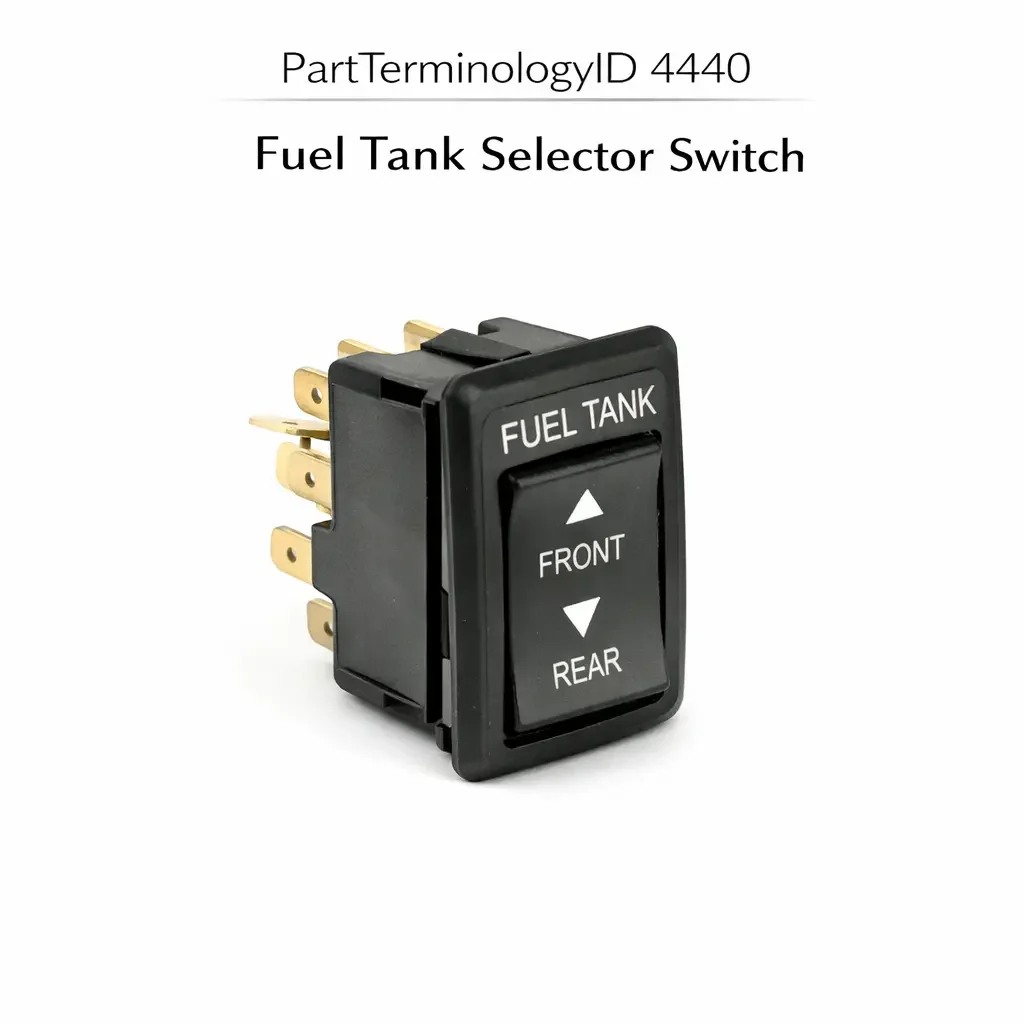
PartTerminologyID 4440, Fuel Tank Selector Switch, is the driver-operated switch that controls the selection of the active fuel tank on vehicles equipped with dual fuel tanks, commanding the fuel supply selector valve to direct fuel flow from either the front or rear tank to the fuel pump and engine, simultaneously switching the fuel gauge circuit to display the fuel level of the selected tank so the driver can monitor the level of the tank currently supplying fuel. That definition covers the tank selection and gauge switching function correctly and leaves unresolved every question that determines whether the replacement switch matches the original's valve control output type (direct solenoid activation, relay coil signal, or electronic module command), whether the switch covers the correct number of tank positions, whether the switch includes an integrated gauge circuit switching output that routes the appropriate sending unit signal to the fuel gauge, whether the connector pin count and terminal assignment match the harness at the instrument panel or center console position, whether the switch includes indicator lamps or indicator lamp outputs for the selected tank position, and whether the switch is compatible with the tank selector valve's operating voltage and current draw.
It does not specify the valve control output type, position count, gauge switching output, connector pin count, indicator lamp configuration, or valve current compatibility. A listing under PartTerminologyID 4440 that states only year, make, and model without output type and gauge switching output cannot be evaluated by a technician replacing a failed tank selector switch on a vehicle where the original switch simultaneously commanded the selector valve solenoid and routed the front or rear tank sending unit signal to the fuel gauge through an integrated switching circuit in the switch body, and the replacement covers only the valve solenoid command without the gauge switching circuit, causing the gauge to remain permanently connected to one tank's sending unit regardless of which tank is selected, and displaying the wrong tank's fuel level whenever the alternate tank is in use.
For sellers, PartTerminologyID 4440 is the dual-tank fuel system PartTerminologyID where the gauge switching output is the most frequently omitted attribute in catalog listings, because sellers focus on the valve activation function and treat the gauge circuit switching as a secondary feature when it is in fact an equal and independent function that the switch must perform simultaneously with the valve command. A switch that correctly transfers fuel supply between tanks but leaves the gauge permanently reading one tank's level gives the driver an inaccurate indication of available fuel whenever the non-gauge-connected tank is in use, which is a systematic accuracy failure with the same consequence as a failed sending unit: a driver running out of fuel based on a gauge that does not reflect the active tank's actual level.
What the Fuel Tank Selector Switch Does
Dual-Tank Fuel System Architecture and the Selector Valve Function
Dual-tank fuel systems on pickup trucks, vans, and commercial vehicles use a selector valve in the fuel supply line that can direct fuel flow from either tank to the fuel pump and engine on the driver's command. On most applications, only one tank supplies fuel at a time: the selector valve routes fuel from the selected tank to the pump and the return line from the fuel pressure regulator back to the selected tank. The unselected tank is isolated from the fuel supply circuit and its level is maintained unchanged until the driver switches to that tank.
The selector valve is typically a solenoid-operated valve with two inlet ports (one from each tank) and one outlet port to the fuel pump. When the solenoid is de-energized, the valve allows flow from the default tank (typically the main or rear tank). When the solenoid is energized, the valve shifts to allow flow from the alternate tank (typically the auxiliary or front tank). Some applications use a three-position valve with separate solenoids for each tank position and a neutral state where neither tank is selected.
The selector switch activates the solenoid at the commanded tank selection and simultaneously routes the corresponding sending unit signal to the fuel gauge. The solenoid activation and the gauge signal routing are independent functions performed by separate electrical circuits within the switch body, and both must function correctly for the dual-tank system to operate as intended.
Gauge Circuit Switching and the Sending Unit Signal Routing Function
The gauge circuit switching function in the fuel tank selector switch routes the fuel level signal from the selected tank's sending unit to the fuel gauge, ensuring the gauge displays the level of the tank currently supplying fuel. On a vehicle with separate front and rear tank sending units producing different resistance values (because the tanks have different capacities or because the sending unit arms have different geometries), the gauge must receive the signal from the correct sending unit to display an accurate reading.
The gauge circuit switching is implemented inside the switch body through a set of contacts that connect either the front or the rear sending unit output wire to the fuel gauge input wire, depending on the switch position. When the driver selects the front tank, the switch simultaneously energizes the front tank selector valve solenoid and connects the front sending unit signal to the fuel gauge. When the driver selects the rear tank, the switch de-energizes the front solenoid (or energizes the rear solenoid) and connects the rear sending unit signal to the gauge.
A replacement switch that does not include the gauge circuit switching contacts will leave the gauge permanently connected to whichever sending unit was previously wired at the gauge input. The gauge will read the level of that sending unit's tank regardless of which tank the selector valve is directing fuel from. If the permanently connected tank is the one the driver has depleted, the gauge will read empty even when the selected tank is full, and vice versa.
Valve Control Output Type and the Solenoid Current Requirement
The selector valve solenoid draws a specific operating current when energized, typically 0.5 to 2.0 amperes depending on the solenoid design. The switch must be rated for the solenoid's operating current plus any inrush current at energization. A switch carrying the solenoid current directly must have contacts rated for the solenoid's current draw. On some applications, the switch does not carry the solenoid current directly but instead signals a relay that carries the solenoid current, in which case the switch contacts carry only the relay coil current (typically 0.1 to 0.3 amperes).
A switch rated for relay coil current installed in a circuit that routes the full solenoid current through the switch contacts will arc at the contacts during solenoid activation, producing contact erosion and eventual contact failure. A switch rated for direct solenoid operation installed in a relay-switched circuit will function correctly but will carry excess current capacity that is not harmful, though the switch contacts will be oversized for the relay coil load.
The valve control output type (direct solenoid or relay-triggered solenoid) must be confirmed from the vehicle's circuit diagram before ordering and must be stated in the listing.
Indicator Lamp Integration and the Selected Tank Status Display
Many fuel tank selector switches include indicator lamps (incandescent or LED) that illuminate to show which tank is currently selected. The indicator for the active tank illuminates when the switch is in that tank's position and extinguishes when the switch moves to the other position. Some switches use a shared indicator that changes color between positions (green for one tank, amber for the other), while others use separate indicator positions for each tank.
The indicator lamp circuit is powered from either the switch's own position contact (illuminating directly from the switch position) or from the selector valve solenoid's confirmation signal (illuminating only when the valve has confirmed its shift position). A replacement switch without indicator lamps in an application that includes them removes the driver's visual confirmation of which tank is active, which is a minor functional loss compared to the gauge switching omission but a usability issue that contributes to driver uncertainty about available fuel.
Top Return Scenarios
Scenario 1: "Gauge switching circuit absent in replacement, gauge reads wrong tank permanently"
The buyer replaces the tank selector switch. The valve shifts correctly between tanks when the switch is operated. The fuel gauge continues to read the same tank's level regardless of which tank is selected. The replacement switch covers only the valve solenoid activation and does not include the gauge circuit switching contacts present in the original. After selecting the alternate tank, the gauge reads the previously selected tank's level, which continues to decline as fuel is consumed from the now-selected alternate tank.
Prevention language: "Gauge circuit switching: [included, switch routes sending unit signal from selected tank to fuel gauge simultaneously with valve activation / not included, gauge remains connected to one sending unit regardless of switch position]. Verify whether the original switch includes integrated gauge circuit switching contacts. A replacement without gauge switching leaves the gauge reading a fixed tank regardless of which tank supplies fuel."
Scenario 2: "Direct solenoid-rated switch contacts in relay-triggered circuit, switch oversized but functional; reverse scenario welds contacts"
The buyer installs a replacement rated for direct solenoid activation in a relay-triggered circuit. The switch functions correctly because the relay coil current is below the switch's rated capacity. However, in the reverse scenario where a relay coil-rated switch is installed in a direct solenoid circuit, the 1.5-ampere solenoid current exceeds the 0.3-ampere contact rating, producing arc erosion and eventual contact failure within several hundred tank switching events.
Prevention language: "Valve control output type: [direct solenoid activation, [X] ampere contact rating / relay coil signal, [X] ampere contact rating]. Verify the circuit type before ordering. A relay coil-rated switch in a direct solenoid circuit will experience accelerated contact erosion and failure from the solenoid's full operating current passing through undersized contacts."
Scenario 3: "Two-position switch in three-position application, neutral position unavailable, valve stuck in last commanded position on switch failure"
The buyer's vehicle uses a three-position selector: front tank, rear tank, and a neutral position where neither tank is selected, used during maintenance to allow the fuel system to be depressurized without leaving either tank in the supply circuit. The replacement is a two-position switch covering front and rear only. The neutral position cannot be commanded from the switch. During a fuel filter replacement requiring system depressurization, the technician cannot isolate both tanks from the supply circuit.
Prevention language: "Switch position count: [two positions: front tank and rear tank / three positions: front tank, neutral, and rear tank]. Verify the position count against the original switch. A two-position replacement in a three-position application removes the neutral position needed for fuel system isolation during maintenance."
Scenario 4: "Indicator lamps absent, driver loses active tank visual confirmation, wrong tank depleted without awareness"
The buyer installs the replacement switch. Tank switching and gauge display both function correctly. The switch face has no indicator lamps. The driver operates the vehicle for several days before noticing that there is no visual confirmation of which tank is active. On a long highway trip, the driver inadvertently selects the nearly empty tank by bumping the switch and does not notice the gauge dropping because the indicator change that would normally alert the driver is absent.
Prevention language: "Indicator lamps: [included for each tank position / not included]. Verify whether the original switch includes indicator lamps for active tank status. A replacement without indicators removes the visual confirmation of which tank is currently supplying fuel. On long trips where the driver may not monitor the gauge continuously, the absence of indicators increases the risk of an unnoticed tank selection change."
Core Listing Attributes for PartTerminologyID 4440
PartTerminologyID: 4440
Component: Fuel Tank Selector Switch
Position count: two positions or three positions including neutral (mandatory, in title)
Gauge circuit switching output: included or not included (mandatory, in title)
Valve control output type: direct solenoid activation or relay coil signal (mandatory)
Solenoid or relay coil current rating in amperes (mandatory)
Connector pin count with function mapping for each pin (mandatory)
Indicator lamp type: incandescent, LED, or none (mandatory)
Indicator circuit source: switch position contact or solenoid confirmation signal (mandatory where indicators present)
Switch body mounting type: instrument panel cutout, console mount, or bracket mount (mandatory)
Year/make/model/engine/tank configuration
Catalog Checklist for ACES/PIES Teams
PartTerminologyID = 4440
Require position count in title: two or three positions (mandatory)
Require gauge circuit switching output in title: included or not included (mandatory)
Require valve control output type: direct solenoid or relay coil (mandatory)
Require current rating for the valve or relay coil circuit (mandatory)
Require connector pin count with function mapping (mandatory)
Require indicator lamp configuration (mandatory)
Prevent gauge switching omission: a switch without gauge circuit switching leaves the gauge permanently reading a fixed tank regardless of selection; gauge switching is a co-equal function with valve activation and must be stated in the title
Prevent current rating omission: a relay coil-rated switch in a direct solenoid circuit welds contacts from solenoid inrush current; current rating must be confirmed against the valve's operating current
Prevent position count omission: a two-position switch in a three-position application removes the neutral position used for fuel system isolation during maintenance; position count must be confirmed
Prevent indicator lamp omission: a switch without indicator lamps in an application requiring them removes the driver's visual confirmation of active tank selection; indicator configuration must be stated
Differentiate from Fuel Tank Sending Unit (PartTerminologyID 4436): the sending unit monitors fuel level in each tank; the selector switch routes the appropriate sending unit signal to the gauge and routes fuel flow from the selected tank; both are in the dual-tank fuel system but at different positions with different failure consequences
Differentiate from Tank Selector Valve (if cataloged): the selector valve is the solenoid-operated flow control device the switch commands; a switch that activates correctly but the valve does not shift indicates a failed valve or a faulty solenoid rather than a failed switch; confirm valve solenoid function before replacing the switch on a no-tank-switch complaint
FAQ (Buyer Language)
How do I know if my tank selector switch includes gauge circuit switching?
Count the pins on the switch connector. A switch performing only the valve solenoid activation function uses fewer pins (typically three to four: valve solenoid signal, common ground, and power supply). A switch performing both valve activation and gauge circuit switching uses additional pins for the sending unit input from each tank and the output to the fuel gauge. A six-pin or higher connector on the tank selector switch is a strong indicator of integrated gauge switching. Confirm by tracing the wires from the switch connector: one or two wires should connect to the fuel gauge circuit and one or two to the tank sending units.
My gauge always reads the same tank regardless of which tank I select. Is the switch or the gauge the problem?
If the valve shifts correctly between tanks (confirmed by engine behavior or by checking fuel consumption from each tank) but the gauge always reads the same tank, the gauge circuit switching in the selector switch has failed. With the correct replacement switch installed, the gauge should shift to read the newly selected tank immediately when the switch is moved. If the gauge still reads the same tank after switch replacement, trace the gauge input wire to confirm it is connected to the switch's gauge output pin and not wired directly to one tank's sending unit.
Can I use a single-tank sending unit with a dual-tank selector switch?
No. A dual-tank selector switch requires a separate sending unit signal from each tank to switch between for the gauge display function. If only one sending unit is connected to the switch, the switch can display only that tank's level when it is selected and will send no signal or a wrong signal to the gauge when the other tank is selected. Each tank in a dual-tank system must have its own sending unit connected to the selector switch's corresponding sending unit input pin.
Related PartTerminologyIDs
Fuel Tank Sending Unit (PartTerminologyID 4436): the level sensing assembly in each tank; the selector switch routes the active tank's sending unit signal to the gauge; a gauge that reads incorrectly after correct selector switch installation confirms a sending unit fault in one or both tanks
Tank Selector Valve (if cataloged): the solenoid-operated valve that the switch commands; a switch that activates its output correctly but the engine continues running from the same tank indicates a stuck or failed selector valve rather than a failed switch; test the valve solenoid independently before replacing the switch on a no-tank-switch complaint
Status in New Databases
PIES/PCdb: PartTerminologyID 4440, Fuel Tank Selector Switch
PIES 8.0 / PCdb 2.0: No change in PartTerminologyID or terminology label
Final Take for PartTerminologyID 4440
Fuel Tank Selector Switch (PartTerminologyID 4440) is the dual-tank fuel system PartTerminologyID where the gauge circuit switching output is the co-equal function that must be stated in the title alongside the valve activation function, because a switch that transfers fuel supply correctly but leaves the gauge permanently reading a fixed tank gives the driver a systematically inaccurate fuel level indication whenever the alternate tank is in use. State the position count in the title. State the gauge circuit switching output in the title. State the valve control output type and current rating. State the connector pin count with function mapping. State the indicator lamp configuration. For PartTerminologyID 4440, gauge circuit switching output, valve control current rating, and position count are the three attributes that prevent the three most consequential return scenarios in the fuel tank selector switch buyer population.