
Written by Arthur Simitian | PartsAdvisory
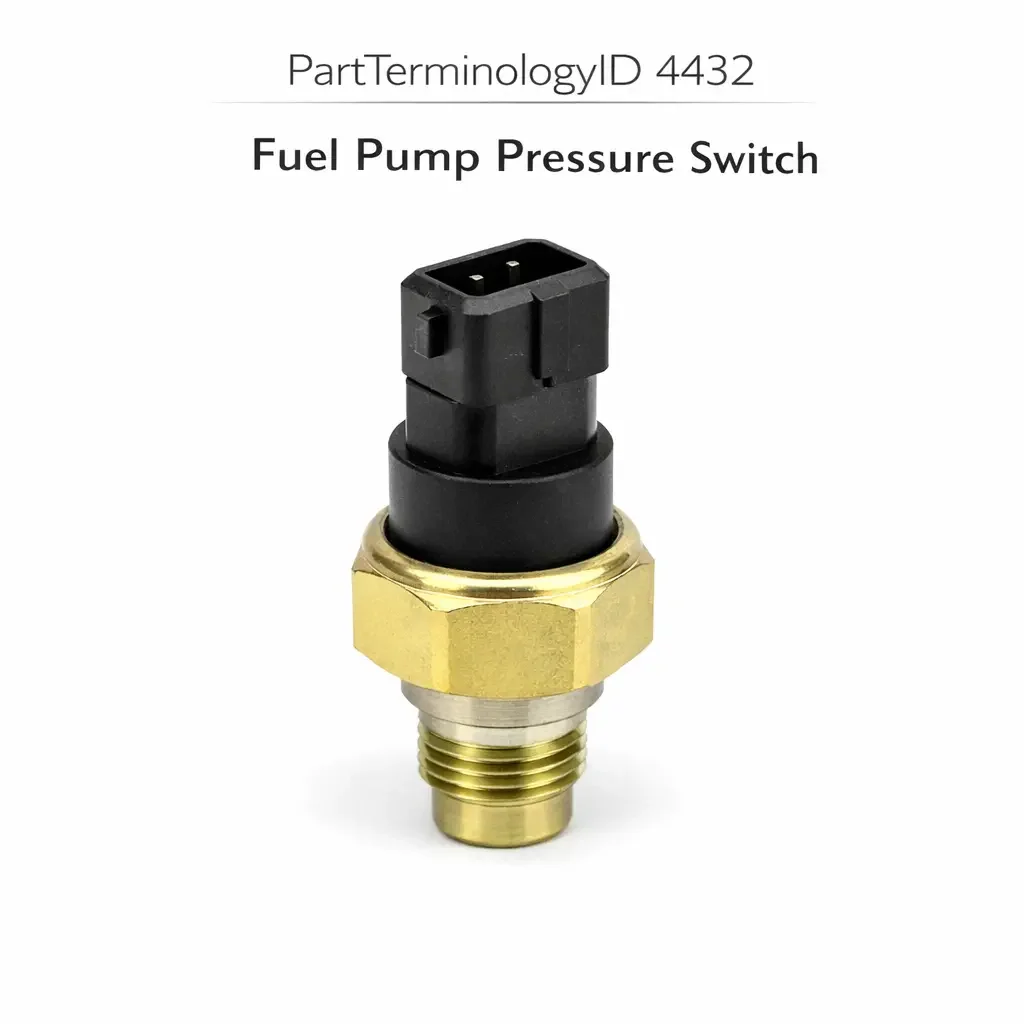
PartTerminologyID 4432, Fuel Pump Pressure Switch, is the pressure-sensing switch installed in the fuel supply circuit between the fuel pump output and the fuel rail that monitors the pressure developed by the fuel pump and activates or deactivates an electrical circuit at a calibrated threshold, used in applications including fuel pump prime confirmation circuits that verify the pump has built sufficient pressure before the ECU permits cranking, fuel pump protection circuits that disable the pump when pressure exceeds the maximum safe operating limit due to a blocked fuel filter or a stuck-closed pressure regulator, fuel pump fault warning circuits that alert the driver or the ECU when pump pressure is below the minimum required for adequate fuel delivery at cranking or at idle, and fuel pump priming relay circuits on diesel injection systems where the lift pump must confirm adequate transfer pressure before the high-pressure injection pump is engaged. That definition covers the pump pressure monitoring and circuit control function correctly and leaves unresolved every question that determines whether the replacement switch's activation threshold matches the original calibration for the specific fuel pump's rated output pressure and the injection system's minimum operating pressure, whether the switch is a normally open type that closes on pressure rise or a normally closed type that opens on pressure rise, whether the switch thread specification matches the fuel line fitting or the fuel pump body port where it installs, whether the switch seal material is compatible with the fuel type in the system, whether the switch pressure rating covers the maximum transient pressure the pump can produce during a blocked-filter event, whether the switch connector pin count and terminal type match the harness at the installation position, and whether the switch is rated for the fuel pump relay coil current or the full fuel pump motor current depending on whether the switch is in the relay control circuit or in the pump power circuit directly.
It does not specify the activation threshold, contact configuration, thread specification, seal material, maximum pressure rating, connector pin count, or circuit current position. A listing under PartTerminologyID 4432 that states only year, make, and model without threshold and circuit current position cannot be evaluated by a technician replacing a failed fuel pump pressure switch on a diesel lift pump application where the original switch was rated for the relay coil current of 0.3 amperes in a relay control circuit and the replacement is rated for the same 0.3 amperes but the buyer's application wires the pump pressure switch directly in the lift pump motor supply circuit drawing 6 amperes, causing the switch contacts to arc and weld on the first pump activation event under the full motor current.
For sellers, PartTerminologyID 4432 sits in direct adjacency to PartTerminologyID 4420 (Fuel Injection Pressure Switch) and the two PartTerminologyIDs share the most consequential safety attributes: seal material compatibility with the fuel type and maximum pressure rating including transient peaks. Both attributes are fire prevention specifications in a pressurized fuel system, not performance preference attributes, and both must be present in every listing without exception.
What the Fuel Pump Pressure Switch Does
Fuel Pump Prime Confirmation and the Pre-Crank Pressure Verification Function
The fuel pump prime confirmation circuit is the most common application of PartTerminologyID 4432 on port fuel injected and direct injected engines. When the ignition is switched to the on position, the ECU activates the fuel pump relay for a pre-crank priming interval (typically 2 to 3 seconds) to build fuel rail pressure before the starter engages. The fuel pump pressure switch monitors whether the pump has built adequate pressure during this priming interval. If the switch does not confirm adequate pressure within the priming time, the ECU inhibits the starter, stores a fuel system fault code, and illuminates the check engine or fuel system warning lamp.
The threshold for a prime confirmation switch is the minimum pressure that confirms the pump is functional and the fuel system is primed for cranking. For port injection systems operating at 35 to 65 psi, the prime confirmation threshold is typically 25 to 30 psi: sufficient to confirm pump function and basic rail pressure without requiring the pump to reach full operating pressure in the short priming interval. For diesel lift pump applications, the prime confirmation threshold is the minimum transfer pressure needed to supply the high-pressure injection pump, typically 8 to 15 psi depending on the specific high-pressure pump's minimum inlet pressure requirement.
A replacement switch with a threshold 10 psi above the original prime confirmation level will inhibit cranking when the pump is functional but has not yet reached the higher threshold during the priming interval, producing a no-start condition with a fuel pressure fault code that the technician may misattribute to a failed fuel pump rather than a switch threshold mismatch. A replacement with a threshold 10 psi below the original will permit cranking when the pump is developing less than adequate pressure for reliable injection, potentially allowing start attempts on a failing pump that would have been caught and diagnosed by the correctly calibrated switch.
Fuel Pump Protection and the Maximum Pressure Safety Function
On systems where a blocked fuel filter or a stuck-closed pressure regulator can cause the fuel pump to build pressure well above the design maximum, a high-threshold pressure switch monitors for overpressure events and disables the pump before the fuel line, fuel rail, or injector bodies are stressed beyond their pressure rating. The high-threshold protection switch in this application is typically a normally closed switch that remains closed during normal operating pressure and opens when pressure exceeds the safety threshold, interrupting the pump relay coil circuit or the pump motor supply and stopping the pump before damage occurs.
The protection threshold must be set above the pump's maximum normal operating pressure but below the burst pressure of the fuel system components. For a port injection system with a normal operating pressure of 55 psi and fuel line burst ratings of 150 psi or above, a protection switch threshold of 80 to 100 psi provides adequate margin above normal operating pressure while staying comfortably below the fuel line burst pressure. A replacement switch with a threshold equal to the normal operating pressure (55 psi) would deactivate the pump during normal operation. A replacement with a threshold at the fuel line burst pressure (150 psi) would provide no protection during a partially blocked filter event where pressure rises to 100 psi before the filter fully blocks.
The maximum pressure rating of the switch body itself must exceed the protection threshold. A switch rated for 100 psi maximum installed in a system where a fully blocked filter can drive pump pressure to 130 psi will rupture the switch diaphragm before the protection threshold is reached, releasing pressurized fuel at the switch body position on the fuel supply line.
Circuit Current Position and the Relay Control versus Direct Motor Circuit Distinction
The fuel pump pressure switch is placed in the fuel pump circuit at one of two positions. In the first position, the switch is in the fuel pump relay coil control circuit, carrying only the relay coil current (typically 0.2 to 0.5 amperes). The switch's contact opens or closes to energize or de-energize the relay coil, which in turn opens or closes the relay's power contacts that carry the full fuel pump motor current. In this position, the switch contact current rating needs only to cover the relay coil current, not the motor current.
In the second position, the switch is directly in the fuel pump motor supply circuit, carrying the full motor operating current (typically 4 to 10 amperes for a port injection fuel pump and up to 15 to 20 amperes for a high-flow performance pump). The switch contact current rating must cover the full motor current at this position, and the contacts must be rated for the inrush current at pump startup, which can briefly reach two to three times the steady-state operating current.
A switch with contacts rated for relay coil current installed in a direct motor circuit position will arc and weld its contacts on the first pump startup under full motor current inrush. Once the contacts weld, the switch is permanently closed and cannot deactivate the pump on a pressure overage event, eliminating the protection function the switch was designed to provide. The circuit current position must be confirmed before ordering and must be stated as a mandatory attribute in every listing.
Diesel Lift Pump Applications and the Transfer Pressure Confirmation Function
On diesel injection systems using a two-pump architecture (a low-pressure lift pump transferring fuel from the tank to the high-pressure injection pump), the fuel pump pressure switch in the lift pump circuit confirms that adequate transfer pressure is being developed before the high-pressure injection pump is engaged. If the lift pump pressure switch does not confirm minimum transfer pressure, the high-pressure injection pump does not receive fuel at its rated inlet pressure and will cavitate, producing accelerated wear at the high-pressure pump's internal valves and plungers.
The transfer pressure confirmation switch threshold on a diesel lift pump application is lower than the threshold on a gasoline port injection application because the lift pump is designed only to transfer fuel at moderate pressure, not to develop the injection rail pressure directly. A typical diesel lift pump confirmation threshold is 8 to 12 psi. A replacement switch calibrated for a gasoline port injection application (threshold of 25 to 30 psi) installed on a diesel lift pump circuit will never confirm adequate pressure because the lift pump's rated output is below the gasoline system's confirmation threshold, inhibiting the high-pressure injection pump engagement and preventing the diesel engine from starting.
The fuel system type (gasoline port injection, diesel lift pump, or GDI high-pressure) must be stated alongside the threshold in every listing to prevent cross-application of pressure switch thresholds between systems with different pressure ranges.
Seal Material Compatibility in Fuel Pump Pressure Switch Applications
The seal material requirements for PartTerminologyID 4432 are identical to those described in PartTerminologyID 4420 (Fuel Injection Pressure Switch): nitrile rubber (NBR) seals for gasoline and low-ethanol blends, fluoroelastomer (FKM) seals for E85 and high-ethanol content fuels, and application-specific materials for diesel and CNG. The fuel pump pressure switch in a flex-fuel application must use fluoroelastomer seals because the switch contacts pressurized fuel directly and a swelled nitrile seal will produce a fuel weep at the switch body under operating pressure.
The installation position of the fuel pump pressure switch on the fuel supply line between the tank and the rail exposes the switch to fuel that may be pressurized for extended periods even when the engine is not running (the fuel rail holds pressure for several hours to a day after shutdown on many injection systems). A seal that weeps intermittently under operating pressure may not be noticed immediately, allowing fuel to accumulate in the engine bay between drive events. The seal material and fuel type compatibility specification is a fire prevention requirement, not a performance attribute.
Why This Part Generates Returns
Buyers return fuel pump pressure switches because the threshold is 10 psi above the original prime confirmation level and the ECU inhibits cranking when the pump is functional but has not yet reached the higher threshold during the priming interval; the replacement is rated for relay coil current and the application places the switch directly in the fuel pump motor supply circuit, welding the contacts on the first pump startup and permanently disabling the protection function; the seal material is nitrile and the application is an E85 flex-fuel system where the ethanol content swells the seals, producing a fuel weep at the switch body that accumulates in the engine bay between drive events; the thread is M10 x 1.0 metric and the fuel supply line fitting is 1/8-27 NPT, producing a partial thread engagement that leaks fuel at operating pressure; the switch pressure rating is at the nominal operating pressure of 65 psi and the system produces a transient spike to 90 psi during a partially blocked filter event, rupturing the switch diaphragm and releasing pressurized fuel at the supply line; the replacement is calibrated for a gasoline port injection prime confirmation threshold of 28 psi and installs on a diesel lift pump application where the rated transfer pressure is 12 psi, preventing confirmation of adequate lift pump pressure and inhibiting high-pressure injection pump engagement; and the connector is a single-blade terminal and the harness at the fuel pump circuit position uses a two-blade weatherproof connector, leaving the switch signal circuit open and preventing any pressure confirmation or protection signal from reaching the ECU.
Top Return Scenarios
Scenario 1: "Threshold 10 psi too high for prime confirmation, ECU inhibits cranking on functional pump"
The replacement switch confirms prime at 38 psi. The original confirmed at 28 psi. During the 2.5-second priming interval, the fuel pump builds 32 psi before the ECU checks the confirmation switch. The ECU receives an unconfirmed signal at 38 psi threshold and inhibits cranking, storing a fuel pressure fault. The pump is functional and building 32 psi but cannot satisfy the replacement switch's higher threshold within the priming interval.
Prevention language: "Prime confirmation threshold: [X] psi. Verify the threshold against the original switch specification and the ECU's priming interval. A threshold above the pressure the pump builds during the priming interval will inhibit cranking even when the pump is functional. Confirm the pump's rated output pressure during the priming interval before selecting a replacement threshold."
Scenario 2: "Relay coil-rated switch in direct motor circuit, contacts weld on first startup, protection function lost"
The buyer installs the replacement switch directly in the fuel pump motor supply circuit. The switch contacts are rated for 0.5 amperes relay coil current. The pump motor draws 8 amperes steady-state and 20 amperes inrush at startup. On the first startup event, the switch contacts arc under the 20-ampere inrush and weld in the closed position. The fuel pump cannot be disabled by pressure overage, eliminating the protection function the switch was installed to provide.
Prevention language: "Circuit current position: [relay coil control circuit, [X] ampere maximum / direct motor supply circuit, [X] ampere maximum including inrush]. Verify the circuit current position in the fuel pump control circuit before ordering. A switch rated for relay coil current installed directly in the motor supply circuit will weld its contacts under motor inrush current, permanently disabling the protection function."
Scenario 3: "Nitrile seals in E85 flex-fuel application, fuel weep accumulates in engine bay between drive events"
The buyer installs the replacement switch on a flex-fuel vehicle. The nitrile seals absorb ethanol from the E85 fuel and swell within three weeks, producing a slow fuel weep at the switch body thread shoulder. The leak is not immediately visible during a hot engine inspection but accumulates in the lower engine bay between drive events. The fuel puddle is discovered during a cold-weather inspection when the evaporation rate is lower.
Prevention language: "Seal material: [nitrile NBR, compatible with gasoline to E10 / fluoroelastomer FKM, required for E85 and high-ethanol blends]. E85 applications require fluoroelastomer seals. Nitrile seals absorb ethanol and swell under E85 exposure, producing a fuel weep at the switch body that accumulates in the engine bay between drive events. Fuel accumulation in the engine bay is a fire risk."
Scenario 4: "Gasoline prime confirmation threshold in diesel lift pump application, high-pressure pump engagement inhibited"
The buyer replaces the lift pump pressure switch on a diesel application. The replacement is specified as a universal fuel pump pressure switch with a 28 psi prime confirmation threshold. The diesel lift pump's rated transfer pressure is 12 psi. The ECU's lift pump confirmation circuit requires the switch to close at 12 psi to permit high-pressure injection pump engagement. The 28 psi threshold switch never closes during normal lift pump operation because the lift pump never develops 28 psi. The ECU inhibits injection pump engagement and the engine does not start.
Prevention language: "Fuel system type: [gasoline port injection, prime confirmation at [X] psi / diesel lift pump transfer confirmation at [X] psi / GDI high-pressure circuit]. Verify the fuel system type and the rated pump output pressure before ordering. A gasoline system prime confirmation threshold is not appropriate for a diesel lift pump application where the rated transfer pressure is below the gasoline system's confirmation level."
Scenario 5: "Switch rated at nominal operating pressure, transient spike to 90 psi ruptures diaphragm, fuel release"
The buyer installs the replacement protection switch rated for 65 psi maximum. During a drive with a partially blocked fuel filter, the pump builds 72 psi before the filter fully blocks flow and the pump output reaches 90 psi. The switch diaphragm ruptures at 90 psi, well above its 65 psi rating. Pressurized gasoline is released at the supply line switch position in the engine bay.
Prevention language: "Switch maximum pressure rating: [X] psi. Verify the maximum pressure rating against both the normal operating pressure and the potential transient maximum in a blocked-filter event. A protection switch must be rated for the highest pressure the pump can develop under any failure condition, not merely the normal operating pressure."
Scenario 6: "Thread mismatch at fuel supply line fitting, fuel leak on first prime cycle"
The replacement switch uses M12 x 1.5 metric straight thread. The fuel supply line fitting uses 1/8-27 NPT tapered thread. The metric thread engages partially in the NPT port before binding. Fuel leaks from the partial engagement zone on the first prime cycle when pump pressure builds.
Prevention language: "Thread specification: [diameter x pitch, thread form: NPT tapered / metric straight with copper crush washer]. Verify thread form against the fuel supply line fitting or fuel pump body port. An NPT tapered switch will not seal in a metric straight port and vice versa. Fuel leaking from an unseated supply line fitting is a fire risk."
Core Listing Attributes for PartTerminologyID 4432
PartTerminologyID: 4432
Component: Fuel Pump Pressure Switch
Circuit function: prime confirmation, overpressure protection, or fault warning (mandatory, in title)
Fuel system type: gasoline port injection, diesel lift pump, or GDI high-pressure (mandatory)
Activation threshold in psi and bar (mandatory)
Maximum rated pressure including transient in psi and bar (mandatory)
Contact configuration: normally open or normally closed (mandatory)
Circuit current position: relay coil control circuit or direct motor supply circuit (mandatory)
Contact current rating in amperes including inrush for direct motor circuit types (mandatory)
Seal material: specify nitrile, fluoroelastomer, or application-specific (mandatory)
Fuel type compatibility: gasoline, diesel, E85, or combination (mandatory)
Thread specification: diameter, pitch, and thread form (mandatory)
Sealing method: crush washer, NPT thread sealant, or O-ring (mandatory)
Connector pin count and terminal type (mandatory)
Year/make/model/engine/fuel system type
Catalog Checklist for ACES/PIES Teams
PartTerminologyID = 4432
Require circuit function in title: prime confirmation, overpressure protection, or fault warning (mandatory)
Require fuel system type: gasoline, diesel lift pump, or GDI (mandatory)
Require activation threshold in psi and bar (mandatory)
Require maximum rated pressure including transient (mandatory)
Require contact configuration (mandatory)
Require circuit current position: relay coil or direct motor (mandatory)
Require contact current rating including inrush for direct motor circuit types (mandatory)
Require seal material with specific material designation (mandatory)
Require fuel type compatibility (mandatory)
Require thread specification with thread form (mandatory)
Prevent threshold omission: a prime confirmation threshold above the pump's rated priming interval output inhibits cranking on a functional pump; threshold must be verified against the pump's pressure development rate during the ECU's priming interval
Prevent circuit current position omission: a relay coil-rated switch in a direct motor circuit welds contacts on inrush, permanently disabling the protection function; circuit position must be confirmed before any other electrical specification
Prevent seal material omission: nitrile seals in an E85 application produce a fuel weep at the switch body that accumulates as a fire risk; seal material is mandatory for every listing without exception
Prevent maximum transient pressure omission: a switch rated only for nominal pressure ruptures during a blocked-filter transient; both nominal and transient maximum must be stated
Prevent fuel system type conflation: a gasoline prime confirmation threshold prevents diesel lift pump confirmation; fuel system type and threshold must both be confirmed for diesel applications
Differentiate from Fuel Injection Pressure Switch (PartTerminologyID 4420): the injection pressure switch monitors the fuel rail pressure at the injector supply point; the pump pressure switch monitors pump output pressure at the pump body or supply line; both are in the fuel pressure circuit but at different positions and with different threshold calibrations
Differentiate from Fuel Pump Relay (if cataloged): the relay is the power switching component for the fuel pump motor; the pump pressure switch confirms whether the relay has successfully resulted in adequate pump output; both are in the fuel pump circuit but at different positions with different failure consequences
FAQ (Buyer Language)
How do I tell the difference between a fuel pump pressure switch and a fuel injection pressure switch?
The fuel pump pressure switch monitors the pump's output pressure at the pump body or early in the supply line to confirm the pump is functioning and developing adequate pressure. The fuel injection pressure switch monitors the fuel rail pressure at the injection point to confirm the system is maintaining operating pressure for injection. Both are in the fuel pressure circuit but the pump pressure switch is closer to the pump and uses a lower threshold calibrated to the pump's output, while the injection pressure switch uses a threshold calibrated to the rail's operating pressure requirement.
My engine cranks but does not start after I replaced the fuel pump pressure switch. What should I check?
A no-start after fuel pump pressure switch replacement is most commonly caused by a prime confirmation threshold mismatch where the replacement threshold is above the pressure the pump develops during the priming interval, causing the ECU to inhibit cranking permission. Connect a scan tool and check for active fuel pressure fault codes. Then connect a fuel pressure gauge to the fuel rail to measure the actual pressure being developed during the priming cycle. If the pump is building less pressure than the replacement switch's confirmation threshold, the switch threshold is the cause.
Why does my fuel pump run continuously after replacing the pressure switch?
A fuel pump that cannot be deactivated by an overpressure protection switch indicates that the switch contacts have welded in the closed position, most commonly from a circuit current mismatch where the switch was installed directly in the motor supply circuit but was rated only for relay coil current. Confirm the circuit position and the switch's contact current rating against the motor's operating and inrush current before ordering a replacement.
Do I need fluoroelastomer seals even if I am currently using regular gasoline?
If the vehicle is certified as a flex-fuel vehicle and is capable of using E85, the fuel pump pressure switch should have fluoroelastomer seals regardless of the fuel currently in the tank. The seals must be compatible with any fuel the vehicle is designed to use because the fuel type may change at the next fill. On non-flex-fuel gasoline vehicles without any ethanol blend above E10 in the fuel supply, nitrile seals are appropriate.
Related PartTerminologyIDs
Fuel Injection Pressure Switch (PartTerminologyID 4420): monitors the fuel rail pressure at the injection point; the pump pressure switch and the injection pressure switch are both in the fuel pressure circuit but at different positions monitoring different pressure levels with different threshold calibrations
Fuel Pump Relay (if cataloged): the relay the pump pressure switch controls in relay-circuit applications; a relay that does not energize despite the pressure switch being in the closed position indicates a relay fault rather than a switch fault; confirm relay coil circuit continuity before replacing the switch on a no-prime complaint
Fuel Pressure Regulator (if cataloged): the regulator maintaining rail pressure; a pump pressure switch that confirms adequate pump output but the injection pressure switch shows low rail pressure indicates a failed regulator allowing rail pressure to bleed down rather than a failed pump; test the regulator independently before replacing the pump pressure switch on a low rail pressure complaint
Status in New Databases
PIES/PCdb: PartTerminologyID 4432, Fuel Pump Pressure Switch
PIES 8.0 / PCdb 2.0: No change in PartTerminologyID or terminology label
Final Take for PartTerminologyID 4432
Fuel Pump Pressure Switch (PartTerminologyID 4432) is the fuel system PartTerminologyID where circuit current position and seal material are the two safety-critical specifications that must be confirmed before the threshold and thread specification, because a relay coil-rated switch installed in a direct motor circuit welds its contacts on first startup and eliminates the protection function permanently, and nitrile seals in an E85 application produce a fuel weep that accumulates as a fire hazard between drive events. The prime confirmation threshold is the specification with the most diagnostic consequence, because a threshold above the pump's priming interval output produces a no-start that the technician will misattribute to a failed pump rather than a switch mismatch until the threshold is confirmed.
State the circuit function in the title. State the fuel system type. State the activation threshold. State the maximum rated pressure including transient. State the contact configuration. State the circuit current position. State the contact current rating including inrush. State the seal material. State the thread specification with thread form. For PartTerminologyID 4432, circuit current position, seal material, and prime confirmation threshold are the three attributes that prevent the three most consequential return scenarios in the fuel pump pressure switch buyer population.