
Written by Arthur Simitian | PartsAdvisory
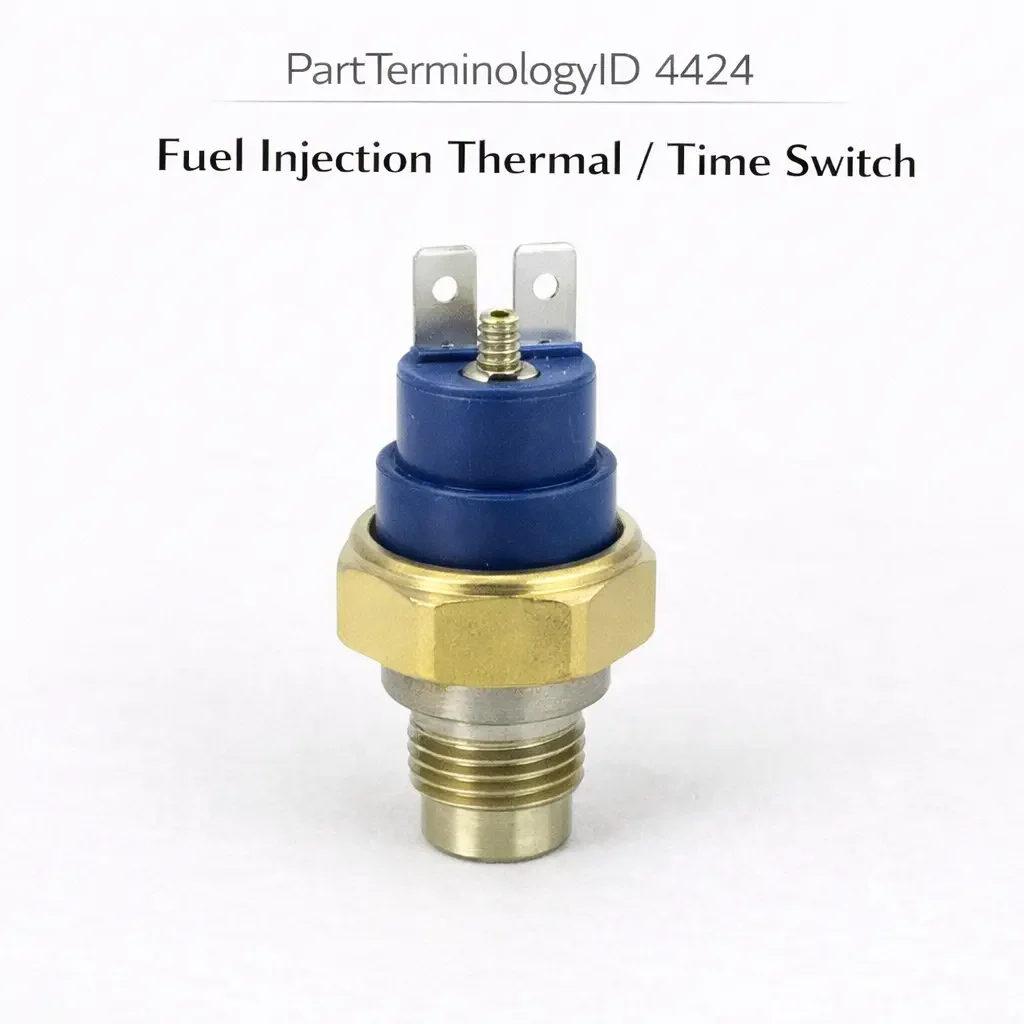
PartTerminologyID 4424, Fuel Injection Thermal / Time Switch, is the thermostatic switch with an integrated timer circuit that controls the cold start injector circuit on port fuel injected engines by monitoring coolant temperature to determine whether supplemental cold start enrichment is needed, and then limiting the duration of cold start injector operation to a fixed interval to prevent flooding when multiple extended cranking events occur on a very cold engine, combining the temperature gating function of PartTerminologyID 4292 (Cold Start Valve Temperature Switch) with an integrated bimetallic or electronic timer that limits the maximum cold start injector on-time per cranking event. That definition covers the combined temperature and time gating function correctly and leaves unresolved every question that determines whether the replacement switch's temperature activation threshold matches the original calibration, whether the integrated timer interval matches the original for the specific engine's cold start fuel requirement, whether the switch is a normally open type that closes below the temperature threshold to enable the cold start injector or a normally closed type depending on the circuit design, whether the thread specification matches the coolant passage port, whether the contact current rating covers the cold start injector's coil current, and whether the switch is compatible with a circuit that uses an external timer module to limit injector duration rather than the switch's own integrated timer.
It does not specify the temperature threshold, timer interval, contact configuration, thread specification, contact current rating, or timer architecture. A listing under PartTerminologyID 4424 that states only year, make, and model without temperature threshold and timer interval cannot be evaluated by a technician replacing a failed thermal time switch on a vehicle where the original switch activated the cold start injector below 35 degrees Celsius for a maximum of 8 seconds per cranking event, and the replacement is calibrated to activate below 20 degrees Celsius with a 12-second timer, causing the cold start injector to remain inactive during cool-weather starts between 20 and 35 degrees Celsius and to inject for 4 additional seconds when it does activate, over-enriching the mixture on very cold mornings and requiring extra throttle to clear the flooded condition before the engine will idle smoothly.
For sellers, PartTerminologyID 4424 occupies a specific position between PartTerminologyID 4292 (Cold Start Valve Temperature Switch) and PartTerminologyID 4376 (EGR Time Delay Switch) in the pre-OBD emissions control architecture: where 4292 provides temperature gating only and 4376 provides time delay only, 4424 provides both functions in a single switch body. The buyer must confirm both the temperature threshold and the timer interval as independent specifications, because a correct threshold with an incorrect timer interval produces a cold start that enriches for the wrong duration, and a correct timer with an incorrect threshold produces a cold start that enriches at the wrong ambient temperature range.
What the Fuel Injection Thermal / Time Switch Does
Combined Temperature and Timer Function in the Cold Start Circuit
The cold start injector on a port fuel injected engine injects a continuous fuel stream into the intake manifold during the starter motor cranking event to provide supplemental enrichment beyond what the main injectors deliver during cold cranking. Without the cold start injector, a cold-soaked engine at low ambient temperature may require several cranking cycles before the mixture ignites reliably. With the cold start injector, the enriched mixture typically ignites on the first or second crank revolution at temperatures as low as minus 20 degrees Celsius on properly calibrated systems.
The thermal time switch combines the temperature gate and the timer into a single device. Below the temperature threshold, the switch is in its active state and allows the cold start injector circuit to be completed when the ignition is in the start position. Simultaneously, the integrated timer begins counting from the moment the circuit is completed. When the timer expires, the switch opens the cold start injector circuit regardless of whether the engine has started, preventing continuous injection during an extended cranking event that would flood the intake manifold with excess fuel.
On a very cold engine requiring multiple cranking attempts, the timer resets between cranking events when the ignition returns to the run position, allowing a fresh injection cycle on each subsequent crank attempt. If the timer did not reset between attempts, the available injection duration would be consumed by the first cranking event and subsequent attempts would receive no cold start enrichment. The timer reset behavior must match the original switch's design because some applications use a timer that does not reset between rapid sequential cranking events to prevent cumulative flooding on repeated failed starts.
Temperature Threshold, Timer Interval, and the Calibration Interaction
The temperature threshold determines which ambient temperature conditions activate the cold start enrichment. A threshold of 35 degrees Celsius activates the cold start circuit whenever the coolant temperature is below 35 degrees at start, covering all cold starts from the mildest cool weather through the coldest conditions. A threshold of 20 degrees Celsius activates the circuit only in moderate-to-cold conditions, leaving cool-weather starts between 20 and 35 degrees without cold start enrichment.
The timer interval determines the maximum fuel delivery duration per cranking event. A short interval (4 to 6 seconds) provides minimal supplemental enrichment appropriate for a well-calibrated engine with adequate main injector cold start delivery. A long interval (10 to 15 seconds) provides substantial enrichment appropriate for an engine whose main injectors alone cannot achieve reliable cold ignition at the lowest ambient temperatures the system is designed to cover.
The two specifications interact: a high threshold combined with a long timer enriches the mixture aggressively across a wide ambient temperature range, which is appropriate for cold climate calibrations. A low threshold combined with a short timer provides minimal enrichment only in the coldest conditions, appropriate for mild climate or warm market calibrations. Replacing one specification while matching the other does not restore the original cold start strategy.
Top Return Scenarios
Scenario 1: "Threshold 15 degrees below original, cold start circuit inactive in cool-weather window, hard start on cool mornings"
The replacement switch activates below 20 degrees Celsius. The original activated below 35 degrees. In the 20 to 35 degree Celsius window, the cold start circuit is inactive. The engine requires multiple cranking attempts on cool autumn mornings that the original switch covered with supplemental enrichment.
Prevention language: "Temperature activation threshold: [X] degrees Celsius. The cold start injector circuit activates only when coolant temperature is below this threshold. A threshold lower than the original leaves the circuit inactive during cool-weather starts that the original switch was calibrated to cover."
Scenario 2: "Timer interval 4 seconds longer than original, intake manifold flooded on very cold start with multiple crank attempts"
The replacement timer runs for 12 seconds versus the original 8 seconds. On a very cold start requiring three cranking attempts, each attempt delivers 12 seconds of cold start injection rather than 8 seconds. The intake manifold accumulates 12 seconds of excess fuel per attempt over the 8-second baseline. After three attempts the intake manifold is flooded and the engine requires throttle-open cranking to clear the excess fuel before idle can be established.
Prevention language: "Timer interval: [X] seconds maximum cold start injector on-time per cranking event. A timer interval longer than the original delivers excess fuel during extended cranking events, particularly on very cold starts requiring multiple cranking attempts. Verify the timer interval against the original switch specification."
Scenario 3: "No integrated timer, cold start injector runs continuously during extended cranking, flooding on first very cold start"
The replacement switch has the correct temperature threshold but no integrated timer circuit. The application requires a timed switch to prevent continuous injection on extended cranking. On the first very cold start, the cold start injector runs continuously for the entire 15-second cranking event. The intake manifold floods immediately and the engine does not start until the excess fuel is purged.
Prevention language: "Timer function: [integrated bimetallic timer, [X] second maximum / no integrated timer, application requires timed switch]. Verify whether the application requires an integrated timer before ordering. A switch without a timer in an application requiring one allows continuous cold start injection during extended cranking, flooding the intake manifold on very cold starts."
Core Listing Attributes for PartTerminologyID 4424
PartTerminologyID: 4424
Component: Fuel Injection Thermal / Time Switch
Temperature activation threshold in degrees Celsius (mandatory, in title)
Timer interval in seconds per cranking event (mandatory, in title)
Timer reset behavior: resets between cranking events or cumulative across rapid sequential events (mandatory)
Contact configuration: normally open or normally closed (mandatory)
Contact current rating in amperes (mandatory)
Thread specification: diameter, pitch, and thread form (mandatory)
Sealing method: crush washer, O-ring, or NPT thread sealant (mandatory)
Year/make/model/engine
FAQ (Buyer Language)
How do I confirm both the threshold and the timer interval for my application?
Both specifications are listed in the factory service manual under the cold start system specifications for the specific engine and fuel injection system. The original switch part number cross-reference is the most reliable combined source. The threshold and timer interval must be confirmed independently because different cold-climate market variants of the same engine may use different thresholds while sharing the same timer interval, and vice versa.
My engine floods on very cold mornings after replacing the switch. Is the timer too long or the threshold too high?
Flooding after replacement on very cold mornings indicates either a timer interval longer than the original (delivering excess fuel per cranking attempt) or a threshold higher than the original (activating the cold start circuit at warmer temperatures than the original, enriching the mixture in conditions where enrichment is not needed). Test the switch by placing the sensing tip in heated water at increments from 15 degrees to 40 degrees Celsius and confirming the switch changes state at the rated threshold. Then time the circuit closure duration from circuit make to circuit break to confirm the timer interval matches the specification.
Related PartTerminologyIDs
Cold Start Valve Temperature Switch (PartTerminologyID 4292): provides temperature gating only without an integrated timer; used on applications where the injection duration is limited by a separate external timer circuit rather than the switch itself; confirm whether the application requires an integrated timer switch or a standalone temperature switch before ordering either component
Cold Start Valve (if cataloged): the injector the switch controls; a functioning switch that signals the circuit correctly with no cold start enrichment effect indicates a failed cold start injector rather than a switch fault; test the injector by grounding its circuit directly during cranking and listening for the injector click before replacing the switch
Status in New Databases
PIES/PCdb: PartTerminologyID 4424, Fuel Injection Thermal / Time Switch
PIES 8.0 / PCdb 2.0: No change in PartTerminologyID or terminology label
Final Take for PartTerminologyID 4424
Fuel Injection Thermal / Time Switch (PartTerminologyID 4424) is the cold start enrichment PartTerminologyID where both the temperature threshold and the timer interval are independent mandatory specifications, because a mismatch in either one produces a cold start strategy that either under-enriches the mixture across part of the target ambient temperature range or over-enriches it during extended cranking. State the temperature threshold in the title. State the timer interval in the title. State the timer reset behavior. State the contact configuration and current rating. State the thread specification with thread form. For PartTerminologyID 4424, temperature threshold, timer interval, and timer reset behavior are the three attributes that prevent the three most common return scenarios in the fuel injection thermal time switch buyer population.