
Written by Arthur Simitian | PartsAdvisory
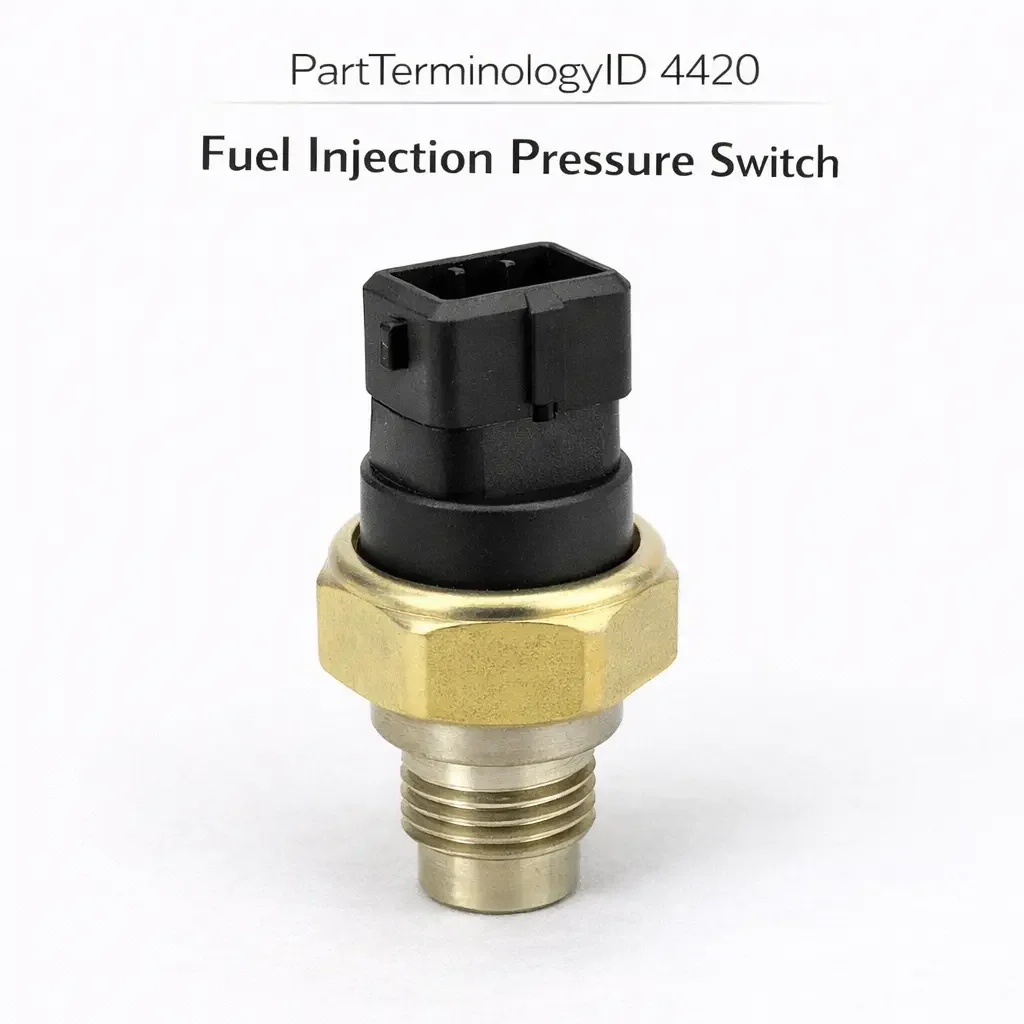
PartTerminologyID 4420, Fuel Injection Pressure Switch, is the pressure-sensing switch installed in the fuel injection system's high-pressure or low-pressure fuel circuit that monitors fuel rail pressure, fuel line pressure, or fuel return line pressure and activates or deactivates an electrical circuit when the pressure rises above or falls below a calibrated threshold, used in applications including fuel pump priming confirmation circuits that verify adequate fuel pressure has been established before cranking is permitted, fuel pressure warning circuits that alert the driver when injection rail pressure drops below the minimum required for complete fuel atomization and combustion, fuel pressure safety cutoffs that disable the fuel pump when pressure in the rail exceeds the system's safe operating maximum, and high-pressure direct injection circuit monitors that signal the ECU when common rail pressure is outside the commanded range. That definition covers the pressure monitoring and circuit switching function correctly and leaves unresolved every question that determines whether the replacement switch's pressure activation threshold matches the original calibration for the specific fuel injection system's operating pressure range, whether the switch is a normally open type that closes on pressure rise or a normally closed type that opens on pressure rise, whether the switch thread specification matches the fuel rail port or the fuel line fitting where the switch installs, whether the switch seal material is compatible with the fuel type in the system (gasoline, diesel, E85, or CNG), whether the switch connector pin count and terminal type match the harness at the fuel rail or fuel line mounting position, whether the switch is rated for the fuel rail's maximum operating pressure and not merely the nominal operating pressure, and whether the switch is compatible with the ECU's fuel pressure input signal type on vehicles where the switch sends a signal to the ECU rather than directly activating a warning lamp or fuel pump relay.
It does not specify the pressure activation threshold, contact configuration, thread specification, seal material, connector pin count, maximum pressure rating, or ECU signal compatibility. A listing under PartTerminologyID 4420 that states only year, make, and model without pressure threshold and seal material cannot be evaluated by a technician replacing a failed fuel pressure switch on a flex-fuel vehicle where the system operates on E85 ethanol blend and the replacement switch uses nitrile rubber seals designed for gasoline, which will swell in contact with the high ethanol content of E85 and either lock the switch diaphragm in a fixed position producing a continuous false signal, or crack and allow fuel to weep past the switch body seal into the engine bay within the first few weeks of operation.
For sellers, PartTerminologyID 4420 covers a pressure sensing component that sits in direct contact with pressurized fuel, which places it in a category where seal material compatibility and maximum pressure rating are not merely performance attributes but safety attributes. A switch whose seals are incompatible with the fuel type will leak fuel into the engine bay under operating pressure. A switch whose pressure rating is below the fuel rail's maximum transient pressure will rupture the switch diaphragm during a pressure spike, releasing fuel under pressure at the switch body. Both outcomes are fire risks that the listing must prevent through explicit material and pressure rating specifications.
What the Fuel Injection Pressure Switch Does
Low-Pressure Port Fuel Injection Circuit Monitoring
On port fuel injection systems, the fuel injection pressure switch monitors the low-pressure fuel circuit between the fuel pump and the fuel rail, typically at a nominal operating pressure of 35 to 65 psi depending on the specific system's regulator calibration. The switch is used in two common circuit roles. The first is the fuel pump priming confirmation circuit: before the ECU allows the starter to crank, it monitors the fuel pressure switch to confirm that the fuel pump has built adequate rail pressure during the pre-crank priming cycle. If the switch does not confirm adequate pressure within the priming interval, the ECU inhibits cranking and stores a fuel pressure fault.
The second role is the fuel pressure warning circuit: a normally closed switch that opens when fuel pressure drops below the minimum operating threshold illuminates a fuel pressure warning lamp or activates a limp-home mode in the ECU that reduces injector pulse width to prevent overfueling on a lean mixture that has already been reduced by low fuel pressure. The switch threshold in the warning circuit is calibrated to the minimum pressure at which the injectors can produce acceptable atomization, typically 28 to 35 psi for most port injection systems. A replacement switch with a threshold 10 psi above the original activates the warning during normal pressure fluctuations that are acceptable for the specific system, producing a nuisance warning that the driver learns to ignore before a genuine low-pressure event occurs that requires attention.
High-Pressure Common Rail Diesel Injection Monitoring
On high-pressure common rail diesel injection systems, the fuel injection pressure switch monitors the common rail at operating pressures of 1,500 to 2,500 bar (21,750 to 36,250 psi) depending on the specific injection system and load condition. The switch in this application is a pressure safety switch that signals the ECU when rail pressure exceeds the maximum safe operating pressure for the injectors and high-pressure fuel lines, triggering a pressure relief or a fuel delivery reduction to prevent structural failure of the rail or injector bodies under extreme overpressure.
The switch for a high-pressure common rail diesel application must be rated for the system's maximum transient pressure, not merely the nominal operating pressure. Transient pressure spikes during rapid load changes can reach 20 to 30 percent above the nominal maximum. A switch rated for the nominal maximum but not the transient peak will rupture during a pressure spike, releasing high-pressure diesel fuel at the switch body. A ruptured common rail pressure switch on a diesel engine is a diesel fuel fire risk because the injection rail is in close proximity to the hot exhaust system.
The thread specification on a common rail pressure switch is typically a fine metric thread (M12 x 1.5 or M14 x 1.5 in most common rail applications) with a copper sealing washer. The switch body's pressure rating must be verified against the specific injection system's maximum rated pressure, which is found in the injection system manufacturer's technical data rather than the vehicle manufacturer's service manual.
Gasoline Direct Injection High-Pressure Circuit Monitoring
Gasoline direct injection (GDI) systems operate at high-pressure on the injection side (150 to 350 bar depending on the specific GDI system) and at low pressure on the fuel pump feed side (typically 3 to 7 bar). A pressure switch in the GDI system may monitor either the low-pressure feed circuit or the high-pressure injection circuit. The two positions require switches with entirely different pressure ratings, thread specifications, and seal materials.
A low-pressure feed circuit switch for a GDI application uses the same specification range as a port fuel injection system switch. A high-pressure injection circuit switch for a GDI application requires the same specification rigor as a common rail diesel pressure switch: a maximum pressure rating well above the nominal operating pressure, a fine thread specification appropriate for the high-pressure port, and seal materials rated for both high pressure and the elevated temperature of the high-pressure fuel circuit.
Installing a low-pressure feed circuit switch in a high-pressure injection circuit position will rupture the switch diaphragm on the first start after installation when the high-pressure pump builds injection pressure. The listing must specify whether the switch is for the low-pressure feed circuit or the high-pressure injection circuit, and must state the pressure rating for both the nominal operating pressure and the maximum transient pressure for every GDI and common rail application.
Seal Material Compatibility and Fuel Type Specification
The switch's internal seals (the diaphragm that contacts the fuel and the body seal at the thread shoulder) must be compatible with the specific fuel type in the system. Gasoline-compatible seals (nitrile rubber, NBR) are the standard for conventional gasoline port injection and GDI systems but are not compatible with high ethanol content fuels. E85 flex-fuel applications require fluoroelastomer (FKM or Viton) seals that resist ethanol permeation and swelling. Diesel fuel is generally compatible with nitrile seals but some ultra-low-sulfur diesel blends used in modern systems perform better with EPDM or fluorosilicone seals.
CNG (compressed natural gas) fuel injection systems require seals compatible with the specific chemical properties of natural gas and the extremely high storage pressures of CNG tanks (up to 3,600 psi). A switch designed for gasoline port injection pressures installed in a CNG injection circuit has a pressure rating far below the CNG system's operating pressure and will fail immediately on installation.
The seal material must be stated explicitly in every fuel injection pressure switch listing. Stating only the fuel type compatibility (suitable for gasoline, suitable for E85) without stating the specific seal material (nitrile, fluoroelastomer, EPDM) leaves the buyer unable to verify compatibility with mixed or blended fuels or with fuels not explicitly listed but using similar chemical properties.
Thread Specification and Fuel System Port Sealing
The fuel injection pressure switch installs in a threaded port on the fuel rail, fuel supply line fitting, or fuel return line fitting. The thread specification must match the port in diameter, pitch, and thread form. Common thread specifications in this PartTerminologyID range from 1/8-27 NPT on domestic port injection fuel rail ports, through 10mm x 1.0 metric on many import port injection applications, to M12 x 1.5 and M14 x 1.5 on common rail diesel and GDI high-pressure applications.
The sealing method for fuel system pressure switches requires particular attention to fuel-tight sealing under both static pressure and thermal cycling. NPT tapered thread ports rely on thread interference and thread sealant (PTFE tape or anaerobic thread sealant) for fuel-tight sealing. Metric straight thread ports use a copper or aluminum crush washer at the thread shoulder. A tapered thread switch in a straight thread port will not develop a fuel-tight seal at any torque. A straight thread switch in a tapered thread port will not seal through thread interference and requires a sealing washer that must be specified and supplied with the switch.
Fuel leaking from a pressure switch installation is a fire risk that the thread specification and sealing method attributes exist specifically to prevent. These attributes are not optional catalog enhancement items; they are fire prevention specifications that must be present in every listing.
Why This Part Generates Returns
Buyers return fuel injection pressure switches because the seal material is nitrile and the vehicle is a flex-fuel E85 application where the ethanol content swells the seals, produces a fuel weep at the switch body, and locks the diaphragm in a fixed position generating a continuous false pressure signal; the pressure threshold is 10 psi above the original and the warning lamp activates during normal pressure fluctuations that the original switch tolerated, training the driver to ignore the warning before a genuine pressure fault occurs; the switch is rated for the nominal operating pressure and not the transient maximum, and the diaphragm ruptures during the first high-load acceleration event when rail pressure spikes above the nominal maximum; the thread is M12 x 1.5 and the fuel rail port is 1/8-27 NPT, producing a partial thread engagement that leaks fuel at operating pressure on the first start; the replacement is specified for a low-pressure port injection application and is installed in a GDI high-pressure injection port, rupturing the diaphragm immediately on system pressurization; the connector is a two-blade Metri-Pack and the fuel rail harness uses a three-pin weatherproof connector, preventing full mating and leaving the switch signal circuit open; and the switch is a normally open type and the circuit requires normally closed, preventing the ECU's fuel pressure confirmation circuit from receiving the closed-contact signal needed to permit cranking after the pre-crank priming cycle.
Top Return Scenarios
Scenario 1: "Nitrile seals in E85 flex-fuel application, diaphragm swells, continuous false pressure signal and fuel weep"
The buyer installs the replacement switch on a flex-fuel vehicle operating on E85. Within two weeks, the fuel pressure warning activates continuously regardless of actual rail pressure. Inspection reveals fuel seeping past the switch body seal. The nitrile diaphragm and body seal have swelled from ethanol permeation, locking the diaphragm in the closed position and allowing fuel to weep past the swelled body seal.
Prevention language: "Seal material: [nitrile NBR, compatible with gasoline and up to E10 ethanol blends / fluoroelastomer FKM, compatible with E85 and high-ethanol blends]. Verify seal material against the fuel type in the system. Nitrile seals are not compatible with E85 or high-ethanol content fuels. Swelled seals produce continuous false pressure signals and fuel weeping at the switch body."
Scenario 2: "Threshold 10 psi too high, warning activates during normal fluctuations, genuine fault later ignored"
The replacement switch activates the low-fuel-pressure warning at 38 psi. The original was calibrated to 28 psi. Normal fuel pressure fluctuations during cold start and idle on this application produce brief drops to 30 to 33 psi that are within the system's acceptable operating range but above the original 28 psi threshold. The warning activates on every cold start and the driver learns to ignore it. Three months later, a failing fuel pump reduces pressure to 22 psi and the warning that should alert the driver to a genuine fault has been dismissed as a nuisance.
Prevention language: "Pressure activation threshold: [X] psi. Verify the threshold against the original switch specification and the fuel injection system's minimum operating pressure. A threshold set above the system's normal minimum operating pressure activates the warning during acceptable pressure fluctuations, conditioning the driver to ignore the warning before a genuine pressure fault occurs."
Scenario 3: "Pressure rating at nominal operating pressure only, diaphragm ruptures on first high-load pressure spike"
The buyer installs the replacement switch on a common rail diesel application. The switch is rated for 2,000 bar nominal operating pressure. During the first full-load acceleration event, the common rail pressure spikes to 2,350 bar as the injector demand exceeds the regulator's response rate momentarily. The switch diaphragm, rated for 2,000 bar but exposed to 2,350 bar, ruptures. High-pressure diesel fuel releases at the switch body position on the fuel rail, which is adjacent to the exhaust manifold.
Prevention language: "Pressure rating: nominal [X] bar, maximum transient [X] bar. Verify the switch's maximum transient pressure rating against the injection system's peak transient pressure specification. Common rail diesel and GDI systems produce transient pressure spikes 20 to 30 percent above the nominal maximum. A switch rated only for nominal pressure will rupture during a transient spike, releasing pressurized fuel at the switch body."
Scenario 4: "NPT thread switch in metric straight thread fuel rail port, fuel leak at partial thread engagement"
The buyer installs the replacement switch at the fuel rail port. The replacement thread is 1/8-27 NPT tapered. The fuel rail port is M10 x 1.0 metric straight thread. The NPT thread engages two turns before binding. Applying installation torque fails to seat the switch against the port's sealing surface. Fuel weeps from the partial thread engagement zone at operating pressure on the first start.
Prevention language: "Thread specification: [diameter x pitch, thread form: NPT tapered / metric straight with copper crush washer]. Verify thread form against the fuel rail port before installation. An NPT tapered switch will not seal in a metric straight thread port at any torque. Fuel leaking from an unsecured fuel rail switch is a fire risk."
Scenario 5: "Low-pressure port injection switch installed in GDI high-pressure injection port, diaphragm ruptures on pressurization"
The buyer installs the replacement switch in a GDI application at the high-pressure injection circuit port. The replacement is rated for port injection operating pressures of up to 100 psi. The GDI high-pressure pump builds injection pressure to 2,175 psi (150 bar) on the first start after installation. The switch diaphragm, designed for low-pressure fuel circuit service, ruptures immediately under the high-pressure injection circuit pressure, releasing gasoline at the injection rail.
Prevention language: "Circuit position: [low-pressure fuel feed circuit, rated for [X] psi / high-pressure injection circuit, rated for [X] psi]. Verify the circuit position before ordering. A low-pressure fuel circuit switch installed in a high-pressure GDI injection port will rupture on first system pressurization. High-pressure GDI and common rail diesel injection circuits require a switch specifically rated for the high-pressure circuit's operating and transient pressure range."
Scenario 6: "Normally open switch in normally closed priming confirmation circuit, ECU does not permit cranking after priming"
The buyer installs the replacement normally open fuel pressure switch. After the pre-crank priming cycle, the fuel pump builds adequate rail pressure but the ECU does not permit cranking. The ECU's fuel pressure confirmation circuit requires a normally closed contact that opens when pressure is established, signaling to the ECU that the pressure circuit is no longer grounded and confirming adequate pressure. The normally open replacement remains open at all pressures, which the ECU's confirmation logic interprets as a failed pressure switch rather than an adequately primed system.
Prevention language: "Contact configuration: [normally open, closes on pressure above threshold / normally closed, opens on pressure above threshold]. Verify the contact configuration against the ECU's fuel pressure confirmation circuit logic. A normally open switch in a normally closed confirmation circuit presents a permanently open contact to the ECU, which cannot distinguish this from a low-pressure condition, and will not permit cranking until the fault is resolved."
Core Listing Attributes for PartTerminologyID 4420
PartTerminologyID: 4420
Component: Fuel Injection Pressure Switch
Circuit position: low-pressure feed circuit or high-pressure injection circuit (mandatory, in title)
Pressure activation threshold in psi and bar (mandatory)
Maximum rated pressure (nominal and transient) in psi and bar (mandatory)
Contact configuration: normally open or normally closed (mandatory)
Seal material: specify nitrile, fluoroelastomer, EPDM, or fluorosilicone (mandatory)
Fuel type compatibility: gasoline, diesel, E85, CNG, or combination (mandatory)
Thread specification: diameter, pitch, and thread form (mandatory)
Sealing method: crush washer, NPT thread sealant, or O-ring (mandatory)
Connector pin count and terminal type (mandatory)
ECU signal type: direct contact closure, voltage output, or resistance output (mandatory for ECU-input applications)
Year/make/model/engine/injection system type
Note for flex-fuel applications requiring fluoroelastomer seals
Note for GDI and common rail applications requiring high-pressure rated switch bodies
Note for production date range where fuel rail thread specification changed
Catalog Checklist for ACES/PIES Teams
PartTerminologyID = 4420
Require circuit position in title: low-pressure feed or high-pressure injection (mandatory)
Require pressure activation threshold in psi and bar (mandatory)
Require maximum rated pressure (nominal and transient) (mandatory)
Require contact configuration (mandatory)
Require seal material with specific material designation (mandatory)
Require fuel type compatibility (mandatory)
Require thread specification: diameter, pitch, thread form (mandatory)
Require sealing method (mandatory)
Require connector pin count (mandatory)
Prevent seal material omission: nitrile seals in an E85 application swell and produce fuel weeping; seal material is a fire safety specification and must be stated for every listing without exception
Prevent maximum transient pressure omission: a switch rated only for nominal pressure ruptures during a transient spike in common rail and GDI systems; both nominal and transient maximum pressure must be stated
Prevent circuit position omission: a low-pressure switch in a high-pressure injection port ruptures on first pressurization; circuit position must be confirmed before any other fitment attribute
Prevent threshold omission: a threshold above the system's normal pressure floor activates the warning during acceptable fluctuations and conditions the driver to ignore it; threshold must be verified against the system's minimum operating pressure
Prevent thread form omission: a tapered thread switch in a straight thread fuel port produces a fuel leak under operating pressure; thread form is a fire prevention specification
Prevent contact configuration omission: a normally open switch in a normally closed priming confirmation circuit prevents ECU cranking permission after adequate priming; configuration must be confirmed for all priming confirmation applications
Differentiate from Fuel Rail Pressure Sensor (if cataloged): the pressure sensor provides a continuous analog pressure signal to the ECU for closed-loop fuel pressure control; the pressure switch provides a discrete on or off contact output at a fixed threshold; both monitor fuel pressure but through different output types for different circuit functions
Differentiate from Fuel Pump Relay (if cataloged): the fuel pump relay is the power switching device for the fuel pump circuit; the pressure switch monitors whether adequate pressure has been built after the relay has energized the pump; both are in the fuel pump circuit but at different positions
FAQ (Buyer Language)
How do I confirm the correct pressure threshold for my fuel injection system?
The pressure threshold is listed in the factory service manual under the fuel system specifications for the specific engine and injection system type. The original switch part number cross-reference provides the most reliable confirmation. For port injection systems, the threshold is typically stated in the fuel pressure regulator specification section. For common rail diesel systems, the threshold is in the high-pressure injection system component specification section, which is often the injection system manufacturer's technical manual rather than the vehicle manufacturer's service manual.
Why does my fuel pressure warning activate during cold start after replacing the switch?
A fuel pressure warning that activates during cold start after switch replacement is the characteristic symptom of a threshold set above the system's normal minimum operating pressure. During cold start, fuel pressure may drop briefly below the replacement switch's higher threshold during the period before the fuel pump reaches full output and the system pressure stabilizes. Confirm the replacement switch's threshold against the original specification and verify that the threshold is at or below the system's documented minimum operating pressure.
How do I identify whether my vehicle uses a high-pressure GDI injection circuit switch or a low-pressure feed circuit switch?
A low-pressure feed circuit switch is typically located between the fuel tank pump and the fuel rail, often on the fuel supply line or on the inlet side of the fuel rail. A high-pressure GDI injection circuit switch is located on the high-pressure injection rail directly, adjacent to the fuel injectors. The pressure at the switch location is the clearest confirmation: a low-pressure switch position will show 35 to 65 psi on a pressure gauge during normal operation, while a high-pressure GDI position will show 1,500 to 5,000 psi.
Can I use the same fuel injection pressure switch for gasoline and E85 flex-fuel applications?
Only if the switch uses fluoroelastomer seals rated for E85 compatibility. A switch with nitrile seals is suitable for gasoline and low-ethanol blends (up to E10) but not for E85 or high-ethanol content fuels. If the vehicle is a flex-fuel application where E85 is an approved fuel, the switch must have fluoroelastomer seals regardless of what fuel is currently in the tank, because the next fill may be E85.
Related PartTerminologyIDs
Fuel Rail Pressure Sensor (if cataloged): the continuous analog pressure sensor providing the ECU with real-time fuel pressure data for closed-loop fuel delivery control; a failed pressure sensor produces a fuel trim fault and potential poor running rather than the binary warning or cranking inhibit function of the pressure switch; both monitor fuel pressure but the sensor and switch serve different ECU functions
Fuel Pump Relay (if cataloged): the relay that energizes the fuel pump; a pressure switch that does not confirm adequate pressure after the relay has been energized indicates a failed fuel pump, a blocked fuel filter, or a fuel supply line restriction rather than a switch fault; confirm pump output pressure before replacing the switch on a cranking inhibit complaint
Fuel Pressure Regulator (if cataloged): the regulator that maintains the fuel rail at the commanded pressure; a pressure switch that activates the low-pressure warning continuously despite a functioning pump indicates a failed regulator unable to maintain rail pressure rather than a failed switch; test the regulator independently before replacing the switch on a continuous warning complaint
Status in New Databases
PIES/PCdb: PartTerminologyID 4420, Fuel Injection Pressure Switch
PIES 8.0 / PCdb 2.0: No change in PartTerminologyID or terminology label
Final Take for PartTerminologyID 4420
Fuel Injection Pressure Switch (PartTerminologyID 4420) is the fuel system PartTerminologyID where seal material and maximum transient pressure rating are safety specifications rather than performance preferences, because nitrile seals in an E85 application produce a fuel weep at the switch body, and a switch rated only for nominal operating pressure ruptures during a transient spike in a common rail or GDI system, both releasing pressurized fuel in proximity to ignition sources. The circuit position (low-pressure versus high-pressure injection circuit) is the attribute with the most immediate rupture consequence, because a low-pressure switch in a high-pressure injection port fails on the first start.
State the circuit position in the title. State the pressure activation threshold. State the maximum rated pressure including transient maximum. State the seal material with the specific material designation. State the fuel type compatibility. State the thread specification with thread form. State the sealing method. State the contact configuration. For PartTerminologyID 4420, seal material, maximum transient pressure rating, and circuit position are the three attributes that prevent the three most consequential and least recoverable return scenarios in the fuel injection pressure switch buyer population.