
Written by Arthur Simitian | PartsAdvisory
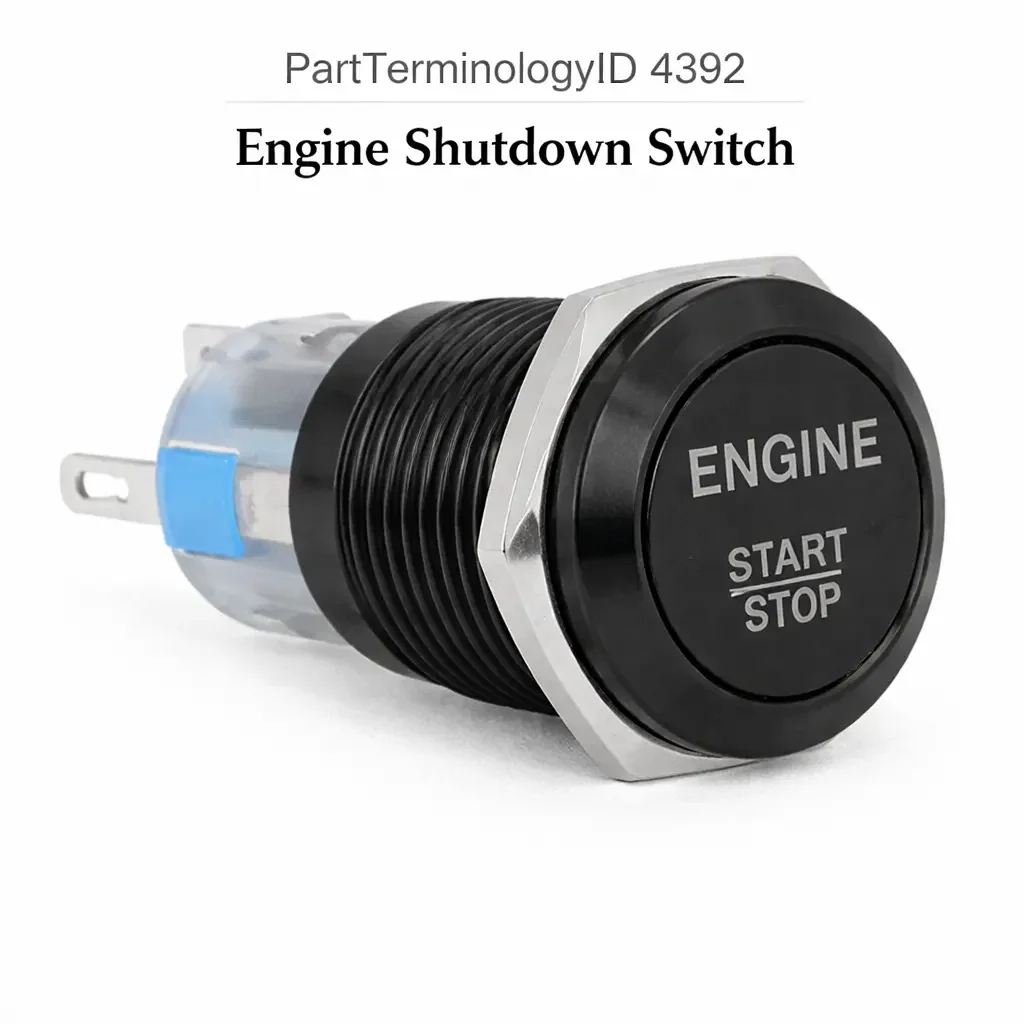
PartTerminologyID 4392, Engine Shutdown Switch, is the manually operated or automatically triggered switch that interrupts the engine's ignition circuit, fuel pump circuit, or ECU power supply circuit to stop engine operation, used in applications including emergency shutoff switches on racing and performance vehicles required by sanctioning body regulations, inertia-triggered fuel pump shutoff switches that interrupt the fuel pump circuit on collision impact to prevent post-crash fuel delivery, oil pressure safety switches that shut down the engine when oil pressure drops below a safe operating threshold, and driver-operated kill switches on motorcycles, off-road vehicles, and marine applications that provide a direct ignition cutoff independent of the main key switch. That definition covers the engine stopping function correctly and leaves unresolved every question that determines whether the replacement switch's contact configuration matches the original circuit's shutdown logic, whether the switch is a normally open type that closes to trigger shutdown or a normally closed type that opens to trigger shutdown depending on whether the circuit requires a positive trigger or a circuit interruption to stop the engine, whether the switch activation mechanism (manual, inertia, pressure, or automatic trigger) matches the original application, whether the switch reset method (manual reset requiring physical access to the switch, or automatic reset on power cycle) matches the system's intended post-shutdown behavior, whether the connector pin count and terminal assignment match the harness at the installation position, and whether the switch is rated for the circuit current it carries whether that is the full fuel pump current, the full ignition primary current, or only a low-current signal to the ECU's shutdown input.
It does not specify the contact configuration, activation mechanism, reset method, connector pin count, or circuit current rating. A listing under PartTerminologyID 4392 that states only year, make, and model or application type without contact configuration and reset method cannot be evaluated by a technician replacing a failed inertia fuel cutoff switch on a vehicle where the original switch required a manual reset by pressing the reset button on the switch body after a collision event, and the replacement is an automatic-reset type that restores fuel pump power on its own after the vehicle is moved or the ignition is cycled, eliminating the post-collision manual confirmation step that the switch was designed to require before fuel delivery is restored.
For sellers, PartTerminologyID 4392 is the safety-critical engine control PartTerminologyID where the reset method is as important as the contact configuration, because the post-shutdown reset behavior determines whether the engine restart after a safety event requires deliberate human action or occurs automatically. An automatic-reset inertia switch installed in a crash-shutoff application allows fuel pump power to restore without the driver or first responder confirming that the vehicle is safe to restart, which is the specific safety outcome the original manual-reset switch was designed to prevent. The reset method must be in the listing and must be the first attribute confirmed by any buyer replacing an inertia-triggered or safety-triggered engine shutdown switch.
What the Engine Shutdown Switch Does
Inertia-Triggered Fuel Pump Cutoff and the Manual Reset Requirement
The inertia fuel pump cutoff switch is the most common application of PartTerminologyID 4392 on passenger vehicles. The switch contains a steel ball resting in a conical seat inside the switch body. Under normal operating conditions, the ball remains in the seat and the switch maintains its normal circuit state. On a collision impact that produces a deceleration force above the switch's trigger threshold (typically 3 to 7 G depending on the application), the ball is displaced from its seat, changing the switch contact state and interrupting the fuel pump circuit.
The switch remains in its triggered state until the driver or a technician manually presses the reset button on the switch body, which forces the ball back into the conical seat and restores the normal circuit state. This manual reset requirement is intentional: it ensures that after a collision severe enough to trigger the switch, a person must physically access the switch and confirm the vehicle's condition before fuel delivery is restored. An automatic-reset version of the same switch body that returns to normal state when the vehicle is upright and stationary bypasses this confirmation step.
The installation position of the inertia switch affects its trigger sensitivity. A switch mounted vertically in the trunk or rear passenger area responds to longitudinal deceleration forces most reliably. A switch mounted at an angle may produce the intended trigger threshold at a different actual impact force than the specification states because the component of the deceleration force aligned with the switch's sensitivity axis is reduced by the cosine of the mounting angle. The installation position and orientation must match the original specification for the switch to trigger at the designed impact force.
Oil Pressure Safety Shutdown and the Low-Pressure Trigger Architecture
The oil pressure safety shutdown switch monitors engine oil pressure and triggers engine shutdown when the oil pressure drops below the safe operating minimum. On marine engines and some industrial and agricultural engine applications, the oil pressure safety switch is wired to interrupt the ignition circuit directly, stopping the engine before oil starvation causes bearing or camshaft damage. On automotive racing applications, the oil pressure safety switch may be wired to a kill relay that cuts both ignition and fuel simultaneously.
The oil pressure safety shutdown switch has a pressure threshold below which it changes state, and this threshold must match the specific engine's minimum operating oil pressure. A threshold set too high will trigger shutdown at oil pressures that are low but still within the acceptable operating range for the specific engine, causing unnecessary shutdowns during low-RPM idle or during cold-start oil delivery delay. A threshold set too low will fail to protect the engine during early bearing damage events where oil pressure has already dropped below the safe level but has not yet reached the dangerously low threshold of the mis-calibrated switch.
The contact configuration of an oil pressure safety switch must match the shutdown circuit architecture. A normally closed switch that opens on low pressure is used in circuits where the ignition or fuel circuit is completed through the switch and opening the switch stops the engine. A normally open switch that closes on low pressure is used in circuits where the switch closing grounds a shutdown input on the ECU or activates a shutdown relay.
Manual Kill Switch Architecture and Racing Sanctioning Body Requirements
Racing and performance vehicle kill switches interrupt the ignition primary circuit, the battery main circuit, or the ECU power supply circuit by direct contact switch action. Sanctioning bodies including FIA, NHRA, and SCCA specify minimum disconnect current ratings, accessibility requirements, and indicator marking standards for approved kill switches. A replacement kill switch for a racing application must meet the current rating specified by the applicable sanctioning body for the specific electrical system it interrupts.
The ignition primary circuit typically carries 3 to 8 amperes on a contact-points ignition or a low-current electronic ignition. The battery main circuit may carry 100 to 400 amperes on a vehicle with a high-output alternator and a large electrical load. A kill switch rated for ignition primary current installed in a battery main circuit position will arc across its contacts and weld them shut on the first switching event under full battery main current, leaving the switch permanently closed and the shutdown function permanently inoperative.
The kill switch contact rating, circuit position (ignition primary, fuel pump, or battery main), and current capacity must all be confirmed for racing applications where both driver safety and technical inspection compliance depend on the switch specifications.
ECU Shutdown Input Signal Architecture
On modern vehicles, the engine shutdown function may be implemented through an ECU input signal rather than a direct circuit interruption. The shutdown switch in this architecture sends a low-current signal to the ECU's shutdown input pin, and the ECU responds by disabling fuel injection and ignition output through its software. This architecture allows the ECU to perform a controlled shutdown (completing the current injection cycle, managing throttle position, and logging a shutdown event) rather than an abrupt circuit interruption.
A direct-circuit-interruption switch installed in an ECU shutdown input position will not produce the controlled shutdown the ECU is designed to perform, but will instead drop the ECU's supply voltage suddenly, which depending on the ECU's design may cause non-volatile memory corruption or throttle actuator position errors. The circuit architecture (direct interruption versus ECU signal input) must be confirmed before ordering.
Top Return Scenarios
Scenario 1: "Automatic-reset inertia switch in manual-reset application, fuel restores without post-collision confirmation"
The buyer replaces the inertia fuel cutoff switch after a minor collision that triggered the original switch. The listing covers the vehicle by year and model without specifying reset method. The delivered switch is an automatic-reset type. After installation, the first subsequent collision event triggers the switch and interrupts the fuel pump. When the vehicle comes to rest, the automatic-reset switch detects the upright stationary condition and restores fuel pump power within 30 seconds without any manual confirmation. A fuel leak at the collision damage point is re-pressurized by the restored fuel pump.
Prevention language: "Reset method: [manual reset by pressing switch body button / automatic reset on upright stationary condition]. This switch requires [manual / automatic] reset after a trigger event. Inertia fuel cutoff switches for post-collision fuel pump interruption must use manual reset to require human confirmation before fuel delivery is restored. An automatic-reset switch eliminates the confirmation step and restores fuel pump power at the collision site."
Scenario 2: "Normally closed switch in normally open shutdown circuit, engine cannot be started after replacement"
The buyer replaces the oil pressure safety shutdown switch. The replacement is normally closed. The shutdown circuit requires a normally open switch that closes on low pressure to ground the ECU shutdown input. After installation, the normally closed switch permanently grounds the ECU shutdown input, commanding the ECU to maintain shutdown state at all times. The engine cannot be started because the ECU receives a continuous shutdown signal regardless of oil pressure.
Prevention language: "Contact configuration: [normally open, closes on trigger condition / normally closed, opens on trigger condition]. Verify the contact configuration against the shutdown circuit design. A normally closed switch in a normally open shutdown input circuit produces a permanent shutdown signal, preventing engine start at any condition."
Scenario 3: "Kill switch rated for ignition primary current installed in battery main circuit, contacts weld on first shutdown"
The buyer installs a 10-ampere-rated ignition kill switch in the battery main circuit position on a racing vehicle. On the first activation during a practice session, the contacts weld shut under the 200-ampere battery main current. The kill switch cannot be opened manually with the lever. The vehicle's electrical system cannot be isolated and the post-session battery drain continues through the welded contacts until the battery is fully discharged.
Prevention language: "Circuit position: [ignition primary circuit, [X] ampere maximum / fuel pump circuit, [X] ampere maximum / battery main circuit, [X] ampere maximum]. Contact current rating: [X] amperes. A kill switch installed in a circuit carrying more current than its contact rating will arc and weld contacts shut on first operation. Verify the circuit's maximum current against the switch's contact rating before installation."
Scenario 4: "Pressure threshold too low, oil pressure safety switch fails to trigger before bearing damage at 8 psi"
The replacement oil pressure safety switch is calibrated to trigger at 4 psi. The engine's minimum safe operating oil pressure is 8 psi. During an oil leak event, the oil pressure drops from 40 psi to 5 psi over 90 seconds. The switch triggers at 4 psi when the engine is already operating in the bearing damage range below 8 psi. The engine sustains main bearing scoring during the 5 to 8 psi window before the switch triggers.
Prevention language: "Pressure trigger threshold: [X] psi. Verify the trigger threshold against the engine's minimum safe operating oil pressure specification. A threshold set below the engine's safe minimum allows the engine to operate in the bearing damage pressure range before the switch triggers."
Core Listing Attributes for PartTerminologyID 4392
PartTerminologyID: 4392
Component: Engine Shutdown Switch
Activation mechanism: inertia-triggered, oil pressure triggered, manual kill switch, or ECU signal input (mandatory, in title)
Contact configuration: normally open or normally closed (mandatory)
Reset method: manual reset or automatic reset (mandatory, in title for inertia-triggered types)
Trigger threshold: G-force for inertia types, psi for pressure types (mandatory)
Circuit position: ignition primary, fuel pump, battery main, or ECU signal input (mandatory)
Contact current rating in amperes (mandatory)
Connector pin count and terminal type (mandatory)
Mounting orientation requirement for inertia types (mandatory)
Sanctioning body compliance for racing applications (recommended)
Year/make/model or application type
Catalog Checklist for ACES/PIES Teams
PartTerminologyID = 4392
Require activation mechanism in title (mandatory)
Require reset method in title for inertia-triggered types (mandatory)
Require contact configuration (mandatory)
Require trigger threshold for inertia and pressure types (mandatory)
Require circuit position and contact current rating (mandatory)
Require connector pin count (mandatory)
Prevent reset method omission: an automatic-reset inertia switch in a manual-reset application restores fuel delivery without post-collision confirmation; reset method is safety-critical and must be in the title for all inertia-triggered switch listings
Prevent contact configuration omission: a normally closed switch in a normally open ECU shutdown circuit produces a permanent shutdown signal that prevents engine start; contact configuration must be confirmed for every listing
Prevent current rating omission: a kill switch rated below the circuit's maximum current welds its contacts on first operation; current rating and circuit position must both be stated and verified before installation
Prevent threshold omission: an oil pressure switch with a threshold below the engine's safe minimum allows bearing damage before trigger; threshold must be stated and verified against the engine specification
Differentiate from Ignition Switch (PartTerminologyID 4404 or similar): the ignition switch is the driver-operated key or button switch for normal engine start and stop; the engine shutdown switch is a safety device for emergency or automatic engine stopping independent of the ignition switch
Differentiate from Fuel Pump Relay (if cataloged): the fuel pump relay is the normal power switching device for the fuel pump circuit; the inertia shutdown switch interrupts the fuel pump relay coil circuit or the relay output circuit specifically on collision impact
FAQ (Buyer Language)
Why does the inertia fuel cutoff switch require manual reset and not automatic reset?
The manual reset requirement is a deliberate safety feature, not a design limitation. After a collision severe enough to trigger the switch, the vehicle may have a fuel leak, a damaged fuel line, or another post-collision fire risk. Requiring a person to physically access the switch and press the reset button before fuel delivery is restored ensures that someone has made contact with the vehicle and assessed its condition before the fuel system is re-pressurized. An automatic-reset switch that restores fuel delivery on its own bypasses this assessment step.
How do I reset the inertia fuel cutoff switch after it has been triggered?
On most inertia switch designs, the reset button is a rubber-capped button on the top or side of the switch body. Press the button firmly until it clicks to reseat the steel ball in the conical trigger seat. Confirm the button is fully depressed and clicks into position. On some designs a partial press that does not fully seat the ball will produce an intermittent contact that allows the fuel pump to run briefly before the ball displaces again. After resetting, turn the ignition to the on position without cranking and listen for the fuel pump prime cycle to confirm the circuit is restored before attempting to start the engine.
Can I use the inertia fuel cutoff switch as a theft deterrent by leaving it in the triggered state?
The inertia switch is not designed for repeated deliberate triggering and resetting as a theft deterrent function. The steel ball and conical seat are calibrated for reliable trigger response at the specified G-force and the number of deliberate trigger-and-reset cycles is not rated for daily use. Using the switch as a theft deterrent will shorten the switch's service life and may produce an unreliable trigger response at the rated G-force when a genuine collision occurs. A dedicated ignition immobilizer or fuel pump relay interrupt circuit is the appropriate theft deterrent approach.
Related PartTerminologyIDs
Ignition Switch (PartTerminologyID 4404 or similar): the driver-operated key or button switch for normal start and stop; the engine shutdown switch operates independently of and in addition to the ignition switch; both can interrupt the ignition circuit but for different purposes and through different mechanisms
Fuel Pump Relay (if cataloged): the normal power switching device in the fuel pump circuit; the inertia shutdown switch interrupts the fuel pump relay coil supply or the relay output rather than replacing the relay; both are in the fuel pump power path but at different positions
Oil Pressure Switch (PartTerminologyID 4268 or similar): the oil pressure warning switch activates an instrument cluster warning lamp; the oil pressure safety shutdown switch interrupts the engine circuit; both monitor oil pressure but through different output functions and at different pressure thresholds
Status in New Databases
PIES/PCdb: PartTerminologyID 4392, Engine Shutdown Switch
PIES 8.0 / PCdb 2.0: No change in PartTerminologyID or terminology label
Final Take for PartTerminologyID 4392
Engine Shutdown Switch (PartTerminologyID 4392) is the safety device PartTerminologyID where the reset method is the most consequential attribute for inertia-triggered applications, because an automatic-reset switch in a manual-reset position eliminates a deliberate human confirmation step before fuel delivery is restored after a collision. The contact configuration is equally critical for pressure-triggered and ECU-signal applications, because the wrong configuration either prevents engine start or allows the engine to operate without protection. The contact current rating governs whether the switch survives its first operation or welds its contacts shut.
State the activation mechanism in the title. State the reset method in the title for inertia types. State the contact configuration. State the trigger threshold. State the circuit position and contact current rating. For PartTerminologyID 4392, reset method, contact current rating, and trigger threshold are the three attributes that prevent the three most safety-critical return scenarios in the engine shutdown switch buyer population.