
Written by Arthur Simitian | PartsAdvisory
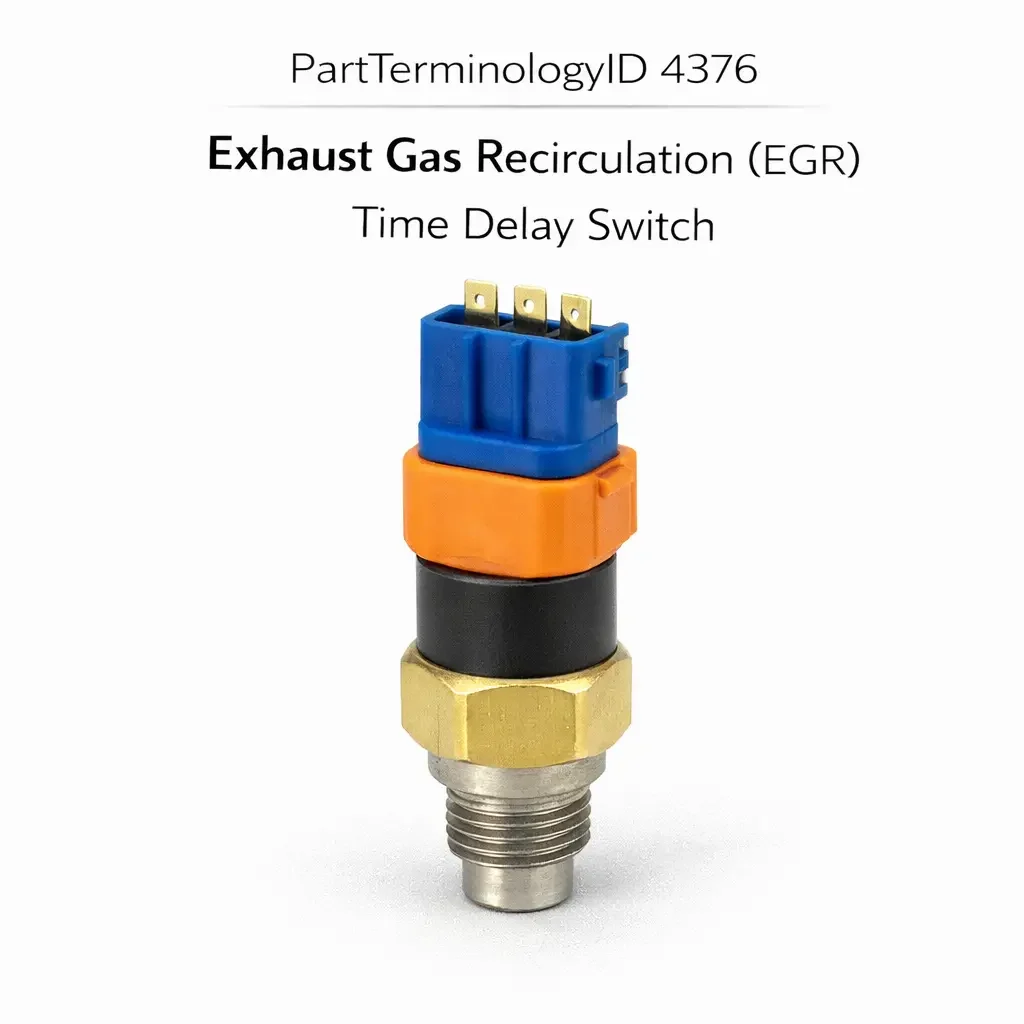
PartTerminologyID 4376, Exhaust Gas Recirculation (EGR) Time Delay Switch, is the time-delay relay or switch mounted in the EGR vacuum control circuit that inhibits vacuum delivery to the EGR valve for a fixed interval after the ignition is switched on, preventing EGR recirculation during the initial engine start and low-speed idle stabilization period before the engine has reached the operating condition where EGR recirculation does not degrade combustion stability, and then allows vacuum to reach the EGR valve after the delay interval expires so that EGR operation resumes under normal driving conditions where it reduces combustion temperature and NOx emissions. That definition covers the timed EGR inhibit function correctly and leaves unresolved every question that determines whether the replacement switch's delay interval matches the original calibration for the specific engine's stabilization period, whether the switch is a vacuum-switching type that opens or blocks a vacuum port after the delay or an electrical type that opens or closes a contact in the EGR solenoid control circuit, whether the contact or vacuum output configuration matches the original circuit design, whether the switch connector pin count matches the harness at the mounting position, and whether the switch is powered from an ignition-switched supply that resets the timer on every ignition cycle or from a keyed accessory supply that may maintain state across brief ignition interruptions.
It does not specify the delay interval, switch type (vacuum or electrical), output configuration, connector pin count, or power supply type. A listing under PartTerminologyID 4376 that states only year, make, and model without delay interval and switch type cannot be evaluated by a technician replacing a failed EGR time delay switch on a vehicle where the original switch provided a 35-second delay and the replacement provides a 20-second delay, allowing EGR recirculation to engage 15 seconds earlier in every cold start event before the engine has fully stabilized at idle, producing rough idle and elevated hydrocarbon emissions during that 15-second window on every ignition-on event.
For sellers, PartTerminologyID 4376 covers the same pre-OBD carbureted and early fuel-injected vehicle population as PartTerminologyIDs 4272, 4308, and 4372. The buyer arriving at this PartTerminologyID has confirmed that EGR is engaging too early after start (rough idle in the first 30 to 60 seconds) or not engaging at all (elevated NOx at cruise), and has traced the fault to the time delay switch. The delay interval and switch type are the two attributes that determine whether the replacement restores the correct EGR engagement timing, and neither is typically visible from a physical inspection of the switch body.
What the EGR Time Delay Switch Does
EGR Engagement Timing and the Post-Start Stabilization Requirement
The EGR system recirculates a portion of the exhaust gas back into the intake manifold to dilute the air-fuel charge and reduce peak combustion temperatures, which lowers the formation of NOx. However, EGR recirculation during low-load idle and immediately after cold start dilutes the air-fuel mixture below the combustion stability threshold, producing rough idle, misfires, and elevated hydrocarbon emissions from incomplete combustion events. The EGR time delay switch prevents EGR engagement during this vulnerable stabilization window.
The delay interval is calibrated to the engine's typical stabilization period from cold start: the time required for the idle speed to settle, the choke to open sufficiently, and the combustion to stabilize at the base air-fuel ratio before EGR dilution can be tolerated. A delay of 30 to 60 seconds covers most applications, but the specific interval is engine-specific. An interval too short engages EGR before stabilization is complete, producing rough idle. An interval too long delays EGR engagement past the point where NOx production is already elevated, increasing cumulative NOx emissions over the drive cycle.
Vacuum-Switching versus Electrical Contact Switch Types
The EGR time delay switch is produced in two functional types that differ in their circuit position. The vacuum-switching type is inserted in the vacuum line between the EGR vacuum control switch and the EGR valve. During the delay interval, the vacuum-switching type blocks vacuum from reaching the EGR valve regardless of what the upstream vacuum control switch is doing. After the delay interval expires, the switch opens the vacuum path and the EGR vacuum control switch governs whether vacuum is delivered based on coolant temperature and throttle position.
The electrical contact type is wired in the EGR solenoid control circuit or in the EGR vacuum solenoid power supply. During the delay interval, the contact remains open (for normally open types) or closed (for normally closed types), preventing the EGR solenoid from activating regardless of the EGR control switch output. After the delay interval, the contact changes state and allows the EGR solenoid to respond to its control inputs.
Installing a vacuum-switching type in an electrical contact position, or vice versa, produces a switch that is installed in the wrong circuit element and cannot perform the delay function for the specific circuit architecture. The switch type must be confirmed from the original circuit diagram before ordering.
Power Supply Type and Timer Reset Behavior
The delay timer in the EGR time delay switch is powered from either an ignition-switched supply (activates when the ignition is turned on, resets to zero on every ignition-off event) or a keyed accessory supply that may retain state across brief ignition interruptions. On most applications, the ignition-switched supply is correct: the delay timer resets on every ignition-on event so that EGR is inhibited for the full interval on every cold start. A switch powered from a supply that does not reset on ignition cycling will not provide the full delay interval on restart events following brief stops, potentially allowing EGR engagement earlier than intended after a hot restart.
Top Return Scenarios
Scenario 1: "Delay interval 15 seconds shorter than original, rough idle in first 20 seconds after every cold start"
The replacement provides a 20-second delay. The original provided 35 seconds. In the 20 to 35 second window after start, EGR engages before the engine has stabilized at idle. Rough idle and occasional stumble occur on every cold-start event during this window. The buyer attributes the rough idle to a carburetor or choke issue rather than a delay interval mismatch.
Prevention language: "Delay interval: [X] seconds from ignition-on to EGR vacuum or solenoid circuit activation. Verify the delay interval against the original switch specification. A shorter interval than the original allows EGR engagement before the engine stabilizes at idle, producing rough idle and elevated hydrocarbon emissions during the early post-start period."
Scenario 2: "Vacuum-switching type installed in electrical contact position, EGR solenoid circuit unaffected by timer"
The replacement is a vacuum-switching type. The application requires an electrical contact type in the EGR solenoid supply circuit. After installation, the vacuum-switching switch sits unused outside the circuit because there is no vacuum line connection at the solenoid circuit position. The EGR solenoid activates immediately on ignition-on with no delay, engaging EGR recirculation before idle stabilization on every start event.
Prevention language: "Switch type: [vacuum-switching / electrical contact in EGR solenoid circuit]. Verify the switch type against the circuit position in the vehicle's EGR control circuit diagram. Vacuum-switching and electrical contact types are not interchangeable. Installing the wrong type leaves the delay function absent for the specific circuit element the original switch was designed to control."
Scenario 3: "Delay interval 30 seconds longer than original, extended NOx elevation window on every drive"
The replacement provides a 90-second delay. The original provided 60 seconds. For the additional 30 seconds after the original delay would have expired, EGR recirculation is inhibited while the engine is at operating temperature and producing NOx at its highest rate. The vehicle fails the NOx portion of a loaded-mode emissions test for the initial warm-drive phase.
Prevention language: "Delay interval: [X] seconds. A delay interval longer than the original inhibits EGR engagement past the engine's stabilization point, leaving the EGR inactive during the initial warm operating phase where NOx production is highest. The extended NOx window increases cumulative NOx over the drive cycle and may produce an emissions test failure."
Core Listing Attributes for PartTerminologyID 4376
PartTerminologyID: 4376
Component: EGR Time Delay Switch
Delay interval in seconds from ignition-on to EGR circuit activation (mandatory, in title)
Switch type: vacuum-switching or electrical contact (mandatory, in title)
Contact configuration for electrical contact types: normally open or normally closed (mandatory)
Connector pin count and terminal assignment for electrical types (mandatory)
Power supply type: ignition-switched or keyed accessory (mandatory)
Vacuum port count and flow direction for vacuum-switching types (mandatory)
Year/make/model/engine
FAQ (Buyer Language)
How do I confirm the correct delay interval?
The delay interval is listed in the factory service manual under the EGR system specifications for the specific engine and model year. The original switch part number cross-reference provides the most reliable confirmation. On vehicles where the service manual is unavailable, the delay interval can be measured from the original switch by monitoring EGR valve operation from cold start with a vacuum gauge on the EGR valve port while timing from ignition-on.
My engine idles roughly for the first 30 seconds after every cold start. Could this be the EGR time delay switch?
Rough idle specifically in the first 30 to 60 seconds after cold start that resolves as the engine warms is the characteristic symptom of premature EGR engagement caused by a delay interval shorter than required for the engine's stabilization period. Confirm by temporarily blocking the EGR vacuum line at the valve during a cold start: if the rough idle is absent when EGR is blocked, the delay interval is insufficient and the time delay switch requires replacement with a correctly calibrated unit.
Related PartTerminologyIDs
Engine Coolant Temperature Vacuum Control Switch (PartTerminologyID 4308): gates EGR vacuum based on coolant temperature rather than elapsed time; both switches are in the EGR vacuum circuit but control different inhibit conditions; a correctly calibrated time delay switch with a failed temperature vacuum switch will still engage EGR at incorrect coolant temperatures
EGR Valve (PartTerminologyID 4218 or similar): the valve whose vacuum supply is timed by this switch; a functioning time delay switch with an EGR valve that does not respond to vacuum indicates a failed EGR valve diaphragm rather than a failed delay switch
Status in New Databases
PIES/PCdb: PartTerminologyID 4376, EGR Time Delay Switch
PIES 8.0 / PCdb 2.0: No change in PartTerminologyID or terminology label
Final Take for PartTerminologyID 4376
EGR Time Delay Switch (PartTerminologyID 4376) is the EGR circuit PartTerminologyID where the delay interval is the governing specification and a mismatch of 15 seconds produces rough idle on every cold start or elevated NOx during every initial warm-drive phase. State the delay interval in the title. State the switch type in the title. State the contact configuration for electrical types. State the connector pin count. State the power supply type. For PartTerminologyID 4376, delay interval, switch type, and power supply reset behavior are the three attributes that prevent the three most common return scenarios in the EGR time delay switch buyer population.