
Written by Arthur Simitian | PartsAdvisory
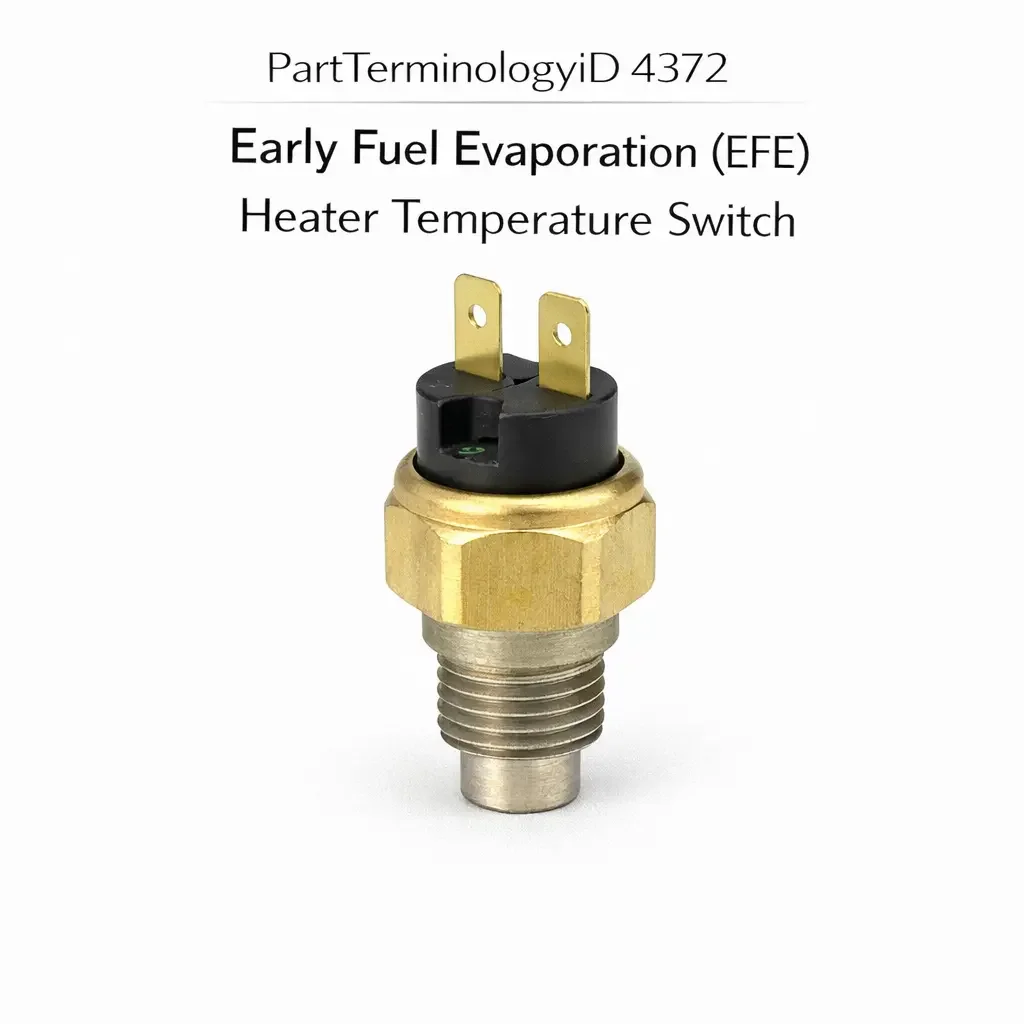
PartTerminologyID 4372, Early Fuel Evaporation (EFE) Heater Temperature Switch, is the thermostatic switch mounted in the engine coolant passage or intake manifold that monitors coolant temperature and controls the electrical circuit to the EFE heater element, which is a resistive heating grid installed in or beneath the carburetor or throttle body that warms the incoming air-fuel mixture during cold-start and warm-up operation to improve fuel vaporization, reduce hydrocarbon emissions from incompletely vaporized fuel droplets, and prevent throttle plate icing in humid conditions, deactivating the heater once the engine reaches the calibrated minimum operating temperature to prevent heat soak of the intake charge after warm-up. That definition covers the EFE heater control function correctly and leaves unresolved every question that determines whether the replacement switch's temperature deactivation threshold matches the original calibration for the specific engine's warm-up profile and the EFE heater element's power draw, whether the switch contact configuration matches the EFE heater relay circuit design, whether the thread specification matches the coolant passage port, and whether the switch contact current rating is sufficient for the heater element circuit or heater relay coil circuit at the installation position.
It does not specify the temperature threshold, contact configuration, thread specification, or contact current rating. A listing under PartTerminologyID 4372 that states only year, make, and model without temperature threshold and contact configuration cannot be evaluated by a technician replacing a failed EFE heater switch on a vehicle where the original switch deactivated the EFE heater below 60 degrees Celsius and the replacement is calibrated to deactivate at 40 degrees Celsius, causing the EFE heater to shut off 20 degrees earlier in the warm-up cycle before the intake manifold has reached a temperature sufficient for reliable fuel vaporization, producing lean stumble and elevated hydrocarbon emissions during the 40 to 60 degree Celsius warm-up window on every cold morning.
For sellers, PartTerminologyID 4372 covers carbureted and early throttle-body-injected engines from the late 1970s through the early 1990s where EFE heater systems were standard equipment for cold-start emissions compliance. The buyer arriving at this PartTerminologyID has diagnosed the EFE heater circuit and confirmed the switch as the failed component, and requires a replacement that restores the correct heater deactivation timing to pass a smog inspection and restore cold-start drivability.
What the EFE Heater Temperature Switch Does
Cold Start Fuel Vaporization and the Deactivation Threshold Function
The EFE heater element draws 100 to 300 watts of electrical power to heat the base of the carburetor or throttle body, raising the temperature of the incoming air-fuel mixture above the fuel's vaporization temperature threshold. On a cold engine at 10 to 20 degrees Celsius ambient, the throttle bore and carburetor base are cold enough to allow fuel droplets to condense on the intake manifold walls rather than remaining in vapor suspension, producing a lean condition at the cylinder head that results in rough idle, hesitation on throttle application, and elevated hydrocarbon emissions during the warm-up phase.
The EFE heater temperature switch deactivates the heater once the coolant reaches the threshold temperature indicating the engine is sufficiently warm for reliable fuel vaporization without supplemental heat. Above the threshold, the heater would overheat the intake charge, reducing charge density and power output, and would impose unnecessary electrical load on the charging system during normal operation. The deactivation threshold is calibrated to balance sufficient cold-start enrichment support against unnecessary warm-up extension of the heater cycle.
A replacement switch with a threshold too low deactivates the heater before the manifold is warm enough for reliable vaporization, reproducing the lean stumble that the EFE system was designed to prevent. A replacement with a threshold too high continues heating the intake charge beyond the point where it is beneficial, reducing power output and wasting alternator capacity during the extended heater cycle.
Contact Configuration and the EFE Heater Relay Circuit
The EFE heater switch is wired in two common circuit configurations. In the first, the switch is in series with the EFE heater relay coil circuit and is a normally closed type that keeps the relay energized (and the heater active) when the engine is cold (below the threshold) and opens to de-energize the relay when the threshold is reached. In the second configuration, the switch is a normally open type used as a temperature-sensing input that closes above the threshold to signal the PCM or a separate control module to deactivate the heater through a software output.
Installing a normally closed switch in a normally open relay circuit position, or vice versa, produces the exact opposite heater behavior: the heater runs continuously at operating temperature and is off during cold start, which eliminates the cold-start fuel vaporization benefit entirely while adding unnecessary heat soak during warm operation.
Thread Specification and Coolant Port Sealing
The EFE heater temperature switch threads into the same type of coolant passage port as the EGR vacuum control switch and the distributor thermal vacuum switch described in adjacent PartTerminologyIDs. The thread specification (diameter, pitch, thread form) and sealing method (crush washer for straight metric threads, thread sealant for NPT tapered threads) must match the specific coolant port. A metric straight thread switch in an NPT tapered port will not seal and will weep coolant at the switch base after the first heat cycle.
Top Return Scenarios
Scenario 1: "Threshold 20 degrees too low, EFE heater deactivates before manifold reaches vaporization temperature"
The replacement switch deactivates the heater at 40 degrees Celsius. The original was calibrated to 60 degrees. During the 40 to 60 degree warm-up window the EFE heater is off and the intake manifold temperature is below the fuel vaporization threshold. Lean stumble and hesitation occur on every throttle application during this window on cold mornings. The buyer attributes the hesitation to a fuel delivery fault rather than a switch threshold mismatch.
Prevention language: "Temperature deactivation threshold: [X] degrees Celsius. The EFE heater remains active below this threshold and deactivates above it. A threshold lower than the original deactivates the heater before the manifold reaches a temperature sufficient for reliable fuel vaporization. Verify the threshold against the original switch specification before ordering."
Scenario 2: "Normally open switch in normally closed relay circuit, heater off during cold start, on at operating temperature"
The replacement switch is normally open. The relay circuit requires normally closed. After installation, the heater relay is de-energized during cold operation (switch open, relay off, heater inactive) and energized at operating temperature (switch closed above threshold, relay on, heater active). Cold-start lean stumble is unchanged because the heater provides no warming during the cold start phase. The heater runs continuously at normal operating temperature, heating the intake charge unnecessarily.
Prevention language: "Contact configuration: [normally open / normally closed]. Verify the contact configuration against the EFE heater relay circuit design. A normally open switch in a normally closed relay circuit deactivates the heater during cold start and activates it at operating temperature, which is the exact opposite of the intended heating strategy."
Scenario 3: "Metric straight thread switch in NPT tapered port, coolant weep on first heat cycle"
The replacement uses M12 x 1.5 metric straight thread. The coolant port uses 3/8-18 NPT tapered thread. The straight thread switch does not seal through thread interference and weeps coolant at the switch base after the first heat cycle.
Prevention language: "Thread specification: [diameter x pitch, thread form: NPT tapered / metric straight with crush washer]. Verify thread form before installation. A metric straight thread switch will not seal in an NPT tapered coolant port at any torque."
Core Listing Attributes for PartTerminologyID 4372
PartTerminologyID: 4372
Component: Early Fuel Evaporation (EFE) Heater Temperature Switch
Temperature deactivation threshold in degrees Celsius (mandatory, in title)
Contact configuration: normally open or normally closed (mandatory)
Contact current rating in amperes (mandatory)
Thread specification: diameter, pitch, and thread form (mandatory)
Sealing method: crush washer, O-ring, or NPT thread sealant (mandatory)
Switch hex body size in mm or inches (mandatory)
Year/make/model/engine/carburetor or throttle body application
FAQ (Buyer Language)
How do I confirm the correct deactivation threshold?
The threshold is listed in the factory service manual under the EFE system specifications for the specific engine and model year. The original switch part number cross-reference is the most reliable confirmation when the service manual is unavailable. On vehicles with the underhood emissions label intact, some applications list the EFE switch threshold as part of the tune-up specification.
Can I test the original switch before replacing it?
Yes. Remove the switch and place the sensing tip in water heated to just above the rated threshold while monitoring temperature with a calibrated thermometer. Connect a continuity tester across the switch terminals. The switch should change state within a few degrees of the rated threshold. A switch that does not change state at the rated threshold or changes state significantly early has drifted from its calibration and requires replacement.
Related PartTerminologyIDs
Carburetor Temperature Switch (PartTerminologyID 4272): controls EGR and vacuum advance circuits during warm-up; the EFE heater switch controls the intake heating element; both are cold-start emissions control switches but govern different circuits; a cold-start drivability complaint requires confirming which circuit is misbehaving before ordering either switch
EFE Heater Element (if cataloged): the resistive heating grid the switch controls; a functioning switch that signals heater activation with no warming effect at the throttle base indicates a failed heater element or a failed heater relay rather than a failed switch; confirm heater element continuity before ordering a switch replacement
Status in New Databases
PIES/PCdb: PartTerminologyID 4372, Early Fuel Evaporation (EFE) Heater Temperature Switch
PIES 8.0 / PCdb 2.0: No change in PartTerminologyID or terminology label
Final Take for PartTerminologyID 4372
Early Fuel Evaporation (EFE) Heater Temperature Switch (PartTerminologyID 4372) is the cold-start emissions control PartTerminologyID where the deactivation threshold governs the exact window during the warm-up cycle when the EFE heater contributes to fuel vaporization, and a mismatch of 15 to 20 degrees produces a lean stumble or unnecessary heat soak on every cold morning. State the deactivation threshold in the title. State the contact configuration. State the contact current rating. State the thread specification with thread form. For PartTerminologyID 4372, deactivation threshold, contact configuration, and thread form are the three attributes that prevent the three most common return scenarios in the EFE heater temperature switch buyer population.