
Written by Arthur Simitian | PartsAdvisory
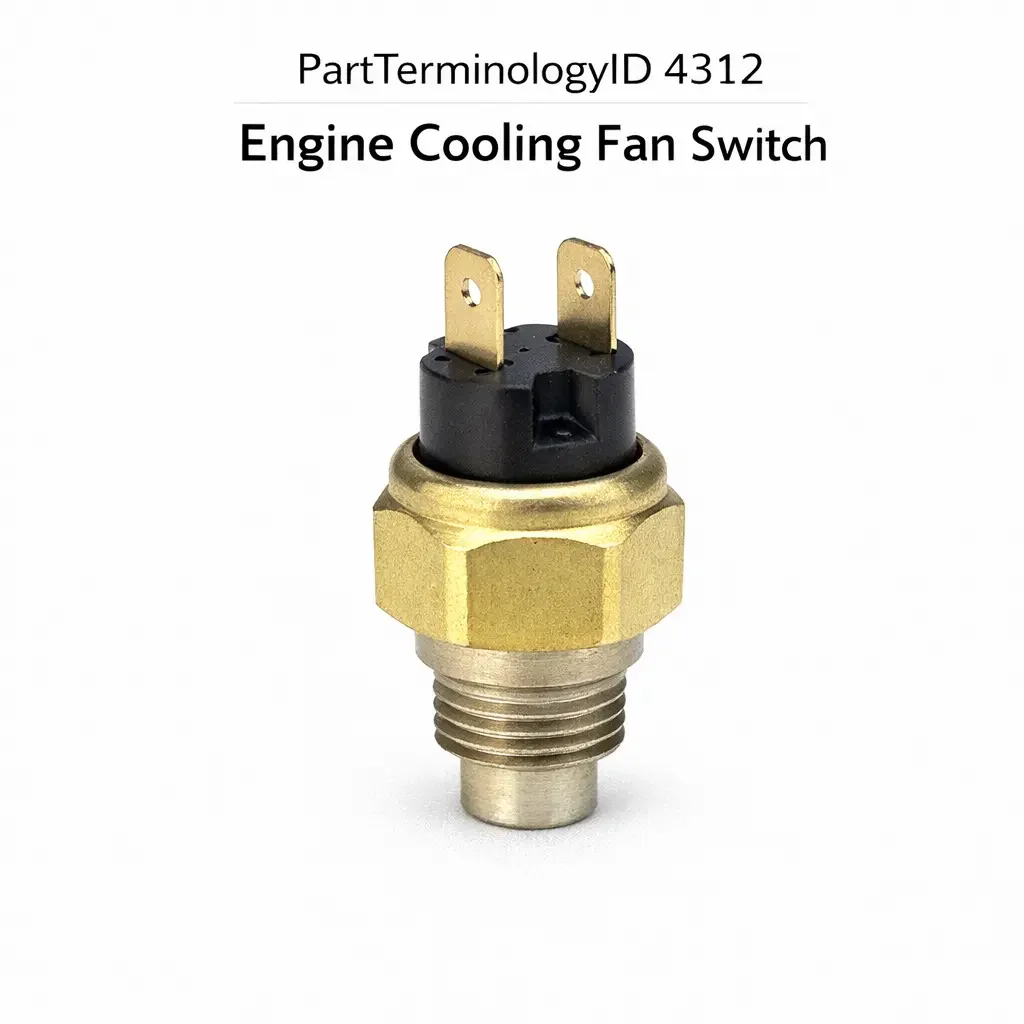
PartTerminologyID 4312, Engine Cooling Fan Switch, is the thermostatic switch mounted in the engine coolant passage, thermostat housing, or radiator tank that monitors coolant temperature and activates the engine cooling fan or fans at one or more calibrated temperature thresholds to maintain the coolant temperature within the designed operating range when vehicle speed alone is insufficient to provide adequate airflow through the radiator, most commonly used on vehicles with electric cooling fans to signal the fan relay or fan control module when to energize the fan motor, and in multi-speed fan systems to signal a second relay or a separate module output at a higher threshold to step the fan from low speed to high speed as the coolant temperature continues to rise. That definition covers the fan activation and speed staging function correctly and leaves unresolved every question that determines whether the replacement switch's activation threshold matches the original calibration for the specific engine's thermal management strategy, whether the switch is a single-stage type activating one fan speed or a two-stage type activating low speed at one threshold and high speed at a second threshold through a single switch body with multiple outputs, whether the switch is a normally open type that closes to signal fan activation or a normally closed type that opens to signal fan activation depending on the relay or module circuit design, whether the switch connector pin count covers all active outputs in the original harness including both speed stage outputs and a ground return, whether the thread specification matches the coolant passage port in diameter, pitch, and thread form, whether the switch includes a hysteresis band between activation and deactivation temperatures to prevent rapid fan cycling at the threshold temperature, whether the switch is rated for the coolant pressure and temperature at the installation position, and whether the replacement is compatible with the fan control module's input signal type on vehicles where the module expects a specific resistance output or voltage threshold rather than a simple contact closure.
It does not specify the activation threshold, speed stage configuration, contact configuration, connector pin count, thread specification, hysteresis band, coolant pressure rating, or fan control module signal compatibility. A listing under PartTerminologyID 4312 that states only year, make, and model without activation threshold and speed stage configuration cannot be evaluated by a technician replacing a failed two-stage fan switch on a vehicle where the original switch activated low-speed fan at 92 degrees Celsius and stepped to high-speed fan at 99 degrees Celsius through two separate output contacts in a three-pin connector, and the replacement is a single-stage switch with a single output contact in a two-pin connector that activates only one fan speed at a single threshold, leaving the high-speed fan stage permanently unactivated and the engine unable to recover from elevated coolant temperatures under high heat load conditions such as towing, climbing grades, or idling in heavy traffic on hot days.
For sellers, PartTerminologyID 4312 is the engine thermal management PartTerminologyID where a threshold mismatch or a speed stage omission does not produce an immediate or obvious failure but produces a progressive thermal management degradation that manifests only under the specific conditions that demand full cooling system capacity: sustained high-load operation, high ambient temperature, or extended idling with the A/C running. A single-stage switch delivered for a two-stage application operates the low-speed fan correctly on every normal drive but leaves the engine without high-speed fan protection during the specific conditions where the engine most needs it, and the consequence of insufficient cooling capacity during those events ranges from elevated coolant temperature warnings to sustained overheating that causes head gasket failure over multiple events.
What the Engine Cooling Fan Switch Does
Electric Cooling Fan Architecture and the Relay-Based Activation Circuit
The electric cooling fan system replaces the mechanically driven engine-speed-proportional fan of earlier vehicles with one or more electric fan motors that operate independently of engine speed, providing cooling airflow through the radiator when the coolant temperature exceeds the activation threshold regardless of vehicle speed. The cooling fan switch is the temperature-sensing component that signals the fan relay or fan control module to energize the fan motor circuit.
In a basic single-speed relay-based system, the cooling fan switch is wired in the relay control circuit. When the coolant temperature rises to the switch activation threshold, the switch closes its contact, completing the relay coil circuit and energizing the relay. The relay's power contacts close and deliver battery voltage to the fan motor, starting the fan. When the coolant temperature drops below the deactivation threshold (the activation threshold minus the hysteresis band), the switch opens its contact, de-energizing the relay coil, opening the power contacts, and stopping the fan. The hysteresis band prevents the fan from cycling on and off rapidly when the coolant temperature is oscillating near the threshold.
In a two-speed system, the fan switch includes two output contacts with two separate activation thresholds. The first contact activates the low-speed relay at the lower threshold (typically 88 to 95 degrees Celsius), engaging the fan at low speed through a series resistor or a separate low-speed winding. The second contact activates the high-speed relay at the higher threshold (typically 96 to 105 degrees Celsius), bypassing the series resistor or switching to the high-speed winding for maximum airflow. Between the two thresholds, only the low-speed stage is active. Above the high-speed threshold, both relays are active and the fan runs at full speed. A switch covering only one of the two thresholds leaves the other speed stage permanently inactive.
Single-Stage versus Two-Stage Switch Configurations
The single-stage switch contains one thermostatic contact element that changes state at a single threshold temperature. It has a two-pin connector covering one signal output and one ground return (or one supply and one switched output depending on the circuit design). It is appropriate for single-speed fan systems and for applications where the high-speed stage is controlled by a separate switch or a separate module output independent of the coolant temperature switch.
The two-stage switch contains two independent thermostatic contact elements in a single housing, each calibrated to a different threshold, sharing the same coolant sensing element but producing independent outputs. It requires a three-pin or four-pin connector covering the low-speed output, the high-speed output, a common ground or supply, and in some configurations a separate ground for each output. Installing a single-stage switch in a two-stage application connects only one of the two relay circuits, leaving the other speed stage relay with no activation signal and no fan speed transition above the first threshold.
The configuration mismatch between single-stage and two-stage switches is the most common return cause in this PartTerminologyID and is preventable only by stating the stage configuration and the connector pin count explicitly in the listing title and description.
Activation Threshold, Deactivation Threshold, and the Hysteresis Band
The activation threshold is the coolant temperature at which the switch closes (or opens, for normally closed types) to signal fan engagement. The deactivation threshold is the lower temperature at which the switch returns to its normal state and signals fan disengagement. The difference between these two temperatures is the hysteresis band.
A hysteresis band that is too narrow (less than 3 to 4 degrees Celsius) produces rapid fan cycling when the coolant temperature is near the threshold, because the cooling effect of the fan itself drops the coolant temperature below the deactivation threshold within seconds of fan engagement, which triggers disengagement, which allows the coolant to rise back to the activation threshold within seconds, which triggers engagement again. This rapid cycling is audible as a fan that switches on and off repeatedly every few seconds and accumulates relay contact wear and fan motor engagement wear at many times the normal rate.
A hysteresis band that is too wide (more than 8 to 10 degrees Celsius) allows the coolant temperature to drop further than necessary before the fan disengages, increasing the fraction of driving time the fan is running and reducing fuel economy marginally through the fan's electrical load on the charging system. The original hysteresis band is calibrated for the specific engine's thermal mass and the cooling system's response rate, and a replacement switch with a significantly different hysteresis band will produce either rapid cycling or unnecessarily extended fan operation.
The activation threshold, deactivation threshold, and hysteresis band must all be stated in the listing. A listing that states only the activation threshold omits the deactivation information that determines the cycling behavior, and a buyer who installs a switch with the correct activation threshold but an incorrect hysteresis band will receive a fan that either cycles rapidly or runs longer than the original, neither of which is obviously wrong at the time of installation.
Normally Open versus Normally Closed Contact Configuration
The contact configuration of the cooling fan switch must match the relay or fan control module circuit design at the installation position. A normally open switch has contacts that are open when the coolant is cold (below the threshold) and close when the coolant reaches the threshold, completing the relay coil circuit and energizing the fan. A normally closed switch has contacts that are closed when the coolant is cold and open when the coolant reaches the threshold.
Normally closed fan switches are used in relay circuits where the relay coil is energized continuously during normal operation and the switch interrupts the coil circuit to disengage the fan when the coolant is cold, which is a less common but valid circuit design used on some European and Japanese applications where the relay logic is inverted relative to the domestic convention. A normally open switch installed in a normally closed circuit position will result in the fan running continuously at all coolant temperatures below the threshold and not running at all above the threshold, which is the exact opposite of the intended thermal management behavior. The contact configuration is as important as the threshold calibration and must be stated in every listing.
Fan Control Module Signal Compatibility
On vehicles with electronic fan control modules rather than discrete relays, the cooling fan switch may send a resistance signal or a voltage threshold signal to the module's input rather than a direct contact closure in the relay coil circuit. The fan control module interprets this signal and drives the fan motor through an internal power transistor or MOSFET output stage, sometimes providing continuously variable fan speed rather than discrete speed steps.
A contact-closure switch installed in a module input circuit that expects a variable resistance signal will saturate the module input at the contact closure state and drive the fan to a fixed output level regardless of coolant temperature, rather than providing the variable speed control the module is designed to perform. A variable-resistance switch installed in a contact-closure relay circuit will present a resistance across the relay coil that is too high to energize the coil at most resistance values, effectively preventing the fan from engaging until the resistance drops to near-zero at the highest coolant temperature. Both mismatches disable the fan control module's intended operating strategy and must be prevented by stating the signal output type in the listing.
Installation Position, Coolant Pressure Rating, and Thermal Response Characteristics
The cooling fan switch installation position affects its thermal response characteristics. A switch mounted in the thermostat housing directly at the coolant outlet from the engine responds to the hottest coolant in the system and activates the fan at the earliest opportunity in the coolant temperature rise. A switch mounted in the lower radiator tank responds to the cooled coolant returning from the radiator and activates the fan based on the temperature after radiator cooling, which is lower than the engine outlet temperature and may produce a delayed fan activation relative to a thermostat housing installation at the same nominal threshold.
The coolant system operates at 12 to 16 psi above atmospheric pressure in a pressurized cooling system. The switch must be rated for the maximum coolant system pressure at the installation position. A switch with a maximum pressure rating below the system's operating pressure will weep coolant past the switch body seal under normal operating conditions, and the coolant weep will worsen as the seal material fatigues under repeated pressure cycles.
The thread specification, sealing method, and coolant pressure rating are all mandatory attributes for the installation position and must be confirmed against the specific coolant passage port before ordering. The most common thread specifications in this PartTerminologyID are M10 x 1.0, M12 x 1.5, and M14 x 1.5 on import applications, and 3/8-18 NPT on domestic applications, with the same tapered versus straight thread sealing distinctions described in adjacent PartTerminologyIDs covering coolant passage switches.
A/C System Integration and the Dual-Input Fan Activation Circuit
On many vehicles, the electric cooling fan is activated by two separate conditions: rising coolant temperature (controlled by the cooling fan switch) and A/C compressor engagement (controlled by a separate A/C relay or module output). When the A/C is running, the condenser is mounted in front of the radiator and the fan must run continuously to maintain adequate airflow through both the condenser and the radiator, regardless of coolant temperature. The A/C-on fan activation is wired in parallel with the cooling fan switch's relay activation, so the fan runs whenever either condition is present.
The cooling fan switch replacement does not affect the A/C-on fan activation circuit because that circuit bypasses the fan switch entirely. A buyer who reports that the fan runs when the A/C is on but does not run when the A/C is off and the coolant temperature is elevated has confirmed that the fan motor, relay, and wiring are functional and that the cooling fan switch is the failed component not providing its activation signal at elevated coolant temperature. This diagnostic pattern is specific enough to confirm the switch as the failed component before ordering the replacement.
Two-Stage Fan Systems, Threshold Spacing, and the Overheating Risk of Stage Omission
Why the high-speed stage is the critical protection stage
In a two-stage cooling fan system, the low-speed stage provides adequate cooling capacity for normal highway and moderate city driving conditions where the engine heat load is moderate and the ambient temperature is below the high-heat threshold. The high-speed stage is the reserve capacity that provides the additional airflow needed during the specific conditions that produce maximum heat load: towing at highway speed, climbing a long grade, idling in stop-and-go traffic on a 100-degree Fahrenheit day with the A/C running at maximum demand, or operating at sustained low vehicle speeds under high engine load.
A single-stage switch that provides only the low-speed activation leaves the engine without any reserve cooling capacity above the low-speed fan's airflow limit. Under the high-heat-load conditions listed above, the low-speed fan may be insufficient to prevent the coolant from rising above the high-speed threshold, and since the high-speed relay is never activated, the coolant continues to rise. The temperature warning lamp activates when the coolant reaches the warning threshold, and if the driver does not reduce load or stop immediately, the coolant reaches the boiling point and the system loses pressure, producing a head gasket failure over multiple such events if the overheating does not cause immediate component damage on the first event.
Threshold spacing and the transition zone behavior
The spacing between the low-speed and high-speed activation thresholds is calibrated by the vehicle manufacturer to define a transition zone where the low-speed fan is managing the cooling load adequately and the high-speed stage has not yet been needed. A typical threshold spacing is 6 to 10 degrees Celsius, providing a meaningful transition zone where the system can manage moderate elevated heat loads on low speed before committing to high speed.
A replacement two-stage switch with a narrower threshold spacing (3 degrees Celsius instead of 8 degrees Celsius, for example) will activate the high-speed fan almost immediately after the low-speed fan engages, providing little time for the low-speed stage to manage the heat load before transitioning. This produces more frequent high-speed fan operation than the original design intended, increasing the electrical load on the charging system and the noise level in the engine bay during normal operation. A replacement with wider threshold spacing than the original produces a longer transition zone where the low-speed fan must manage heat loads that the original design expected to be handled by the high-speed stage, increasing the risk of brief coolant temperature excursions above the high-speed threshold before the stage activates.
Why This Part Generates Returns
Buyers return engine cooling fan switches because the replacement is a single-stage type with a two-pin connector and the application requires a two-stage type with a three-pin connector, leaving the high-speed fan stage permanently inactive and the engine without reserve cooling capacity under high heat load; the activation threshold is 8 degrees below the original and the fan runs continuously on mild days when the coolant temperature during normal highway driving is only slightly above the lower threshold, increasing electrical load and fan noise without any cooling benefit; the contact configuration is normally closed and the relay circuit expects normally open, causing the fan to run continuously at all coolant temperatures below the threshold and not run at all above it; the thread is M14 x 1.5 and the thermostat housing port is M12 x 1.5, producing a partial thread engagement that weeps coolant under operating pressure at the first heat cycle; the switch produces a variable resistance output and the relay circuit expects a contact closure, presenting a resistance across the relay coil that is too high to energize the coil until the resistance drops near zero, preventing fan engagement until the coolant is near the maximum threshold; the hysteresis band is 2 degrees Celsius and the fan cycles on and off every 4 to 6 seconds when the coolant is near the threshold, accumulating relay contact wear and producing an audible rapid cycling pattern that the buyer misdiagnoses as a failed relay; the switch is not rated for the cooling system's 15 psi operating pressure and the switch body O-ring weeps coolant within three weeks of installation; and the replacement covers only the low-speed stage of a two-stage system where the low-speed and high-speed stages were covered by two separate single-stage switches at different thresholds, leaving the buyer who ordered one switch believing the high-speed stage is covered when it requires a separate switch.
Top Return Scenarios
Scenario 1: "Single-stage switch in two-stage application, high-speed fan never activates, engine overheats while towing"
The buyer's two-stage cooling fan switch has failed at the low-speed output contact, leaving only the high-speed stage occasionally active. The listing covers the vehicle by year and model without specifying stage configuration or connector pin count. The delivered switch is a single-stage type with a two-pin connector. The three-pin harness connector mates partially with the two-pin switch connector, leaving the high-speed output pin unconnected. After installation, the low-speed fan activates correctly at the lower threshold. The high-speed relay receives no signal at any coolant temperature. During a towing event on a hot day, the coolant temperature rises above the high-speed threshold, but the high-speed fan does not engage. The coolant temperature warning lamp activates. The engine is shut down to prevent damage.
Prevention language: "Speed stage configuration: [single-stage, one output / two-stage, low-speed output at [X] degrees Celsius and high-speed output at [X] degrees Celsius]. Connector pin count: [X] pins. This switch is the [single / two]-stage type. A single-stage switch in a two-stage application leaves the high-speed fan relay with no activation signal at any coolant temperature. Under high heat load conditions, the low-speed fan alone cannot prevent coolant temperature from rising above the high-speed threshold."
Scenario 2: "Activation threshold 8 degrees too low, fan runs continuously on mild days, charging system overloaded"
The replacement switch has an activation threshold 8 degrees below the original. On a mild day with an ambient temperature of 20 degrees Celsius, the coolant reaches 87 degrees Celsius during normal highway driving, which is above the replacement switch's 85-degree threshold but below the original 93-degree threshold. The fan runs continuously for the entire drive, drawing 15 to 20 amperes from the charging system continuously and producing elevated underhood noise. The battery charge voltage drops slightly during low-speed urban driving because the alternator output is partially consumed by the continuous fan load. The buyer attributes the discharge to a failing alternator before identifying the switch threshold as the cause.
Prevention language: "Activation threshold: [X] degrees Celsius. Deactivation threshold: [X] degrees Celsius. Hysteresis band: [X] degrees Celsius. Verify the activation threshold against the original switch specification. A threshold below the engine's normal operating temperature ceiling will activate the fan during normal operation, continuously loading the charging system and producing elevated fan noise without a cooling benefit."
Scenario 3: "Normally closed switch in normally open relay circuit, fan runs continuously below threshold and not at all above it"
The buyer's fan switch has failed open, leaving the fan inactive at elevated coolant temperatures. The listing covers the application without specifying contact configuration. The delivered switch is a normally closed type. After installation in a relay circuit designed for a normally open switch, the normally closed contacts are closed at all temperatures below the threshold, which the relay circuit interprets as a continuous activation signal. The fan runs continuously from engine start until the coolant reaches the threshold, at which point the normally closed contacts open, which the relay circuit interprets as a deactivation signal, and the fan stops precisely when the coolant temperature has risen to the point where cooling is most needed.
Prevention language: "Contact configuration: [normally open / normally closed]. Verify the contact configuration against the vehicle's fan relay circuit design. A normally closed switch in a normally open relay circuit runs the fan continuously below the threshold and stops the fan above the threshold, which is the exact opposite of the intended cooling strategy."
Scenario 4: "Hysteresis band 2 degrees Celsius, fan cycles every 4 seconds, relay contacts damaged within two weeks"
The buyer installs the replacement switch at the thermostat housing. The fan activates and the A/C system and cooling system both appear to function normally during the test drive. After two weeks, the buyer reports that the fan cycles on and off audibly every few seconds during idle. Inspection reveals the relay contacts are pitted from rapid cycling. The replacement switch has a 2-degree Celsius hysteresis band. The original switch had a 6-degree band. The cooling effect of the fan drops the coolant temperature below the 2-degree deactivation threshold within 4 seconds of fan engagement, triggering disengagement. The coolant rises back to the activation threshold within 4 seconds, triggering re-engagement.
Prevention language: "Hysteresis band: [X] degrees Celsius between activation and deactivation thresholds. A hysteresis band narrower than 4 degrees Celsius produces rapid fan cycling when the coolant temperature is near the threshold. Rapid cycling at the relay level accumulates contact wear that shortens relay service life. Verify the hysteresis band matches the original switch specification."
Scenario 5: "Variable resistance output switch in contact-closure relay circuit, fan does not engage until coolant near maximum threshold"
The buyer installs the replacement switch at the radiator tank port. The switch produces a variable resistance output that decreases from 3000 ohms at 70 degrees Celsius to near zero at 100 degrees Celsius. The relay coil requires approximately 200 ohms or less across its terminals to produce sufficient coil current for contact closure. The relay coil does not receive adequate current until the switch resistance drops to near zero at approximately 98 degrees Celsius, near the maximum safe coolant temperature. The fan does not engage until the coolant is near the overheating threshold on every drive.
Prevention language: "Switch output type: [contact closure / variable resistance, specify range / variable voltage, specify range]. Verify the output type against the fan relay or fan control module input circuit specification. A variable resistance switch in a contact-closure relay circuit will not provide sufficient relay coil current until the resistance drops near zero, preventing fan engagement until the coolant is near the maximum threshold."
Scenario 6: "Thread mismatch, coolant weep at thermostat housing, coolant loss and potential overheating"
The buyer replaces the cooling fan switch at the thermostat housing. The replacement thread is M14 x 1.5. The thermostat housing port is M12 x 1.5. The larger M14 thread partially engages the M12 port and binds after two turns. The technician applies additional torque attempting to seat the switch against the sealing washer, partially stripping the thermostat housing port thread. Coolant weeps from the switch base at operating pressure. The cooling system loses coolant gradually, eventually causing the coolant level to drop below the minimum and the engine to overheat before the weep is identified and the thermostat housing is replaced.
Prevention language: "Thread specification: [diameter x pitch]. Verify the thread specification against the thermostat housing or coolant passage port using a thread gauge before installation. A larger thread partially engaging a smaller port creates a coolant leak path under operating pressure. Thread damage to the thermostat housing or coolant crossover pipe requires component replacement beyond the switch."
Scenario 7: "Switch pressure rating below system operating pressure, O-ring extrudes past switch body, coolant loss at 3 weeks"
The buyer installs the replacement switch in a cooling system operating at 15 psi above atmospheric. The switch body O-ring is rated for 12 psi maximum. At normal operating temperature and pressure, the coolant system pressure exceeds the O-ring's design limit. The O-ring extrudes partially past the sealing groove within the first 20 thermal cycles. Coolant begins to weep past the extruded O-ring section at three weeks of operation, increasing progressively as the O-ring deforms further.
Prevention language: "Coolant system pressure rating: [X] psi. Verify the switch's pressure rating against the vehicle's cooling system operating pressure, typically 13 to 16 psi for pressurized systems. A switch with a pressure rating below the system operating pressure will allow the sealing element to extrude under coolant pressure, producing a coolant weep that worsens progressively with thermal cycling."
Scenario 8: "Two-stage system uses two separate single-stage switches, buyer orders one replacement, high-speed stage remains with original failed switch"
The buyer's vehicle uses two separate single-stage cooling fan switches at two different ports: one at the thermostat housing calibrated to 92 degrees Celsius for low-speed fan activation, and one at the upper radiator tank calibrated to 100 degrees Celsius for high-speed fan activation. The listing covers both switches under the same application but the buyer orders only one unit, replacing the thermostat housing low-speed switch. The upper radiator tank high-speed switch, which has also failed, remains in place. The low-speed fan activates correctly after the replacement. The high-speed fan never activates because the original high-speed switch at the upper radiator tank port is still failed.
Prevention language: "Switch count per vehicle: this application uses [X] separate cooling fan switches. Switch 1: [position, threshold, stage]. Switch 2: [position, threshold, stage]. Both switches should be inspected and replaced together when either fails. Replacing only one switch while the second remains failed will leave one fan speed stage permanently inactive."
Core Listing Attributes for PartTerminologyID 4312
PartTerminologyID: 4312
Component: Engine Cooling Fan Switch
Speed stage configuration: single-stage or two-stage with both thresholds (mandatory, in title)
Activation threshold in degrees Celsius (mandatory, in title)
Deactivation threshold in degrees Celsius (mandatory)
Hysteresis band in degrees Celsius (mandatory)
High-speed activation threshold for two-stage types (mandatory)
Contact configuration: normally open or normally closed (mandatory)
Switch output type: contact closure, variable resistance with range, or variable voltage with range (mandatory)
Connector pin count and terminal type (mandatory)
Thread specification: diameter, pitch, and thread form (mandatory)
Sealing method: crush washer, O-ring with pressure rating, or NPT thread sealant (mandatory)
Coolant system pressure rating in psi (mandatory)
Installation position: thermostat housing, radiator tank, coolant crossover pipe (mandatory)
Switch count per vehicle where multiple switches cover different stages at different positions (mandatory)
Fan control module signal compatibility note for module-based fan systems (mandatory)
Year/make/model/engine/cooling system configuration
Note for production date range where threshold or stage configuration changed
Note for engines offered in both naturally aspirated and turbocharged variants using different thresholds
Note for A/C-equipped vehicles where the A/C-on fan activation bypasses the switch
Catalog Checklist for ACES/PIES Teams
PartTerminologyID = 4312
Require speed stage configuration in title: single-stage or two-stage (mandatory)
Require activation threshold in title (mandatory)
Require deactivation threshold and hysteresis band (mandatory)
Require high-speed activation threshold for two-stage types (mandatory)
Require contact configuration: normally open or normally closed (mandatory)
Require switch output type with range for variable output types (mandatory)
Require connector pin count and terminal type (mandatory)
Require thread specification: diameter, pitch, thread form (mandatory)
Require sealing method with coolant pressure rating (mandatory)
Require installation position (mandatory)
Require switch count per vehicle for multi-switch applications (mandatory)
Prevent stage configuration omission: a single-stage switch in a two-stage application leaves the high-speed relay with no activation signal; stage configuration and connector pin count must be in the title for every listing without exception
Prevent threshold omission: an activation threshold below the engine's normal operating temperature ceiling activates the fan during normal driving and continuously loads the charging system; threshold must be stated and verified against the engine's normal operating temperature range
Prevent hysteresis band omission: a hysteresis band narrower than 4 degrees Celsius produces rapid fan cycling that accumulates relay contact wear; hysteresis band must be stated for every listing
Prevent contact configuration omission: a normally closed switch in a normally open relay circuit runs the fan when it should be off and stops it when it should run; contact configuration is safety-relevant for engine thermal management and must be in every listing
Prevent output type omission: a variable resistance switch in a contact-closure relay circuit prevents fan engagement until the coolant is near the maximum threshold; output type must be confirmed for all fan control module applications
Prevent pressure rating omission: a switch with a pressure rating below the cooling system operating pressure will allow the seal to extrude and produce a coolant weep; pressure rating must be stated and verified against the vehicle's cooling system pressure
Prevent switch count omission: a vehicle using two separate single-stage switches at two different positions requires both to be replaced when either fails; switch count per vehicle must be stated for all multi-switch applications
Differentiate from Engine Coolant Temperature Sensor (PartTerminologyID 4316 or similar): the coolant temperature sensor provides a continuous analog signal to the ECU for fuel mapping and diagnostics; the cooling fan switch provides a discrete contact output at a fixed threshold for fan relay activation; both monitor coolant temperature but through fundamentally different output types and for different circuit functions
Differentiate from Engine Coolant Temperature Vacuum Control Switch (PartTerminologyID 4308): the vacuum control switch routes engine vacuum to emissions-related devices at a cold-engine threshold; the cooling fan switch activates the electric cooling fan at a hot-engine threshold; both are coolant temperature switches but at opposite ends of the temperature range for opposite control purposes
Differentiate from A/C Clutch Cycle Switch (PartTerminologyID 4288): the A/C clutch cycle switch monitors refrigerant circuit low-side pressure to cycle the compressor for evaporator temperature control; the cooling fan switch monitors coolant temperature to activate the radiator fan; both affect vehicle thermal management but through different sensing parameters and different circuit activations
FAQ (Buyer Language)
How do I know if my vehicle uses a single-stage or two-stage cooling fan switch?
Count the pins on the harness connector at the fan switch mounting position. A two-pin connector indicates a single-stage switch covering one fan speed. A three-pin or four-pin connector indicates a two-stage switch covering both low-speed and high-speed fan activation. If the connector has three or more pins and the vehicle has a complaint of overheating only under high heat load while the fan runs at low speed, the high-speed stage is likely the failed output and the two-stage switch is the correct replacement.
Why does my fan run continuously even when the engine is cold?
A fan that runs continuously from engine start at all coolant temperatures indicates either a normally closed switch installed in a normally open relay circuit (the closed contacts continuously signal the relay to run the fan), a switch that has failed in the closed position, or a relay that has failed with its contacts welded closed. Confirm the contact configuration of the installed switch against the relay circuit design before replacing the relay.
My coolant temperature reaches the warning level during towing but not during normal driving. Is the fan switch the cause?
This symptom pattern is consistent with a missing or non-functional high-speed fan stage. Under normal driving conditions the low-speed fan provides adequate cooling. Under towing conditions the low-speed fan is insufficient and the high-speed stage is required but not activating. Confirm whether the high-speed fan relay activates when the coolant reaches the high-speed threshold. If the relay does not activate, the high-speed output contact of the two-stage switch is the likely failed component.
Can I use a switch with a lower activation threshold to make the fan run more proactively?
Lowering the activation threshold below the engine's normal maximum operating temperature causes the fan to run continuously during normal driving when the coolant is within the designed operating range, adding electrical load to the charging system and fan noise without providing any cooling benefit. The fan switch threshold should be set at or slightly above the normal maximum operating temperature so the fan activates only when the coolant has risen above normal and cooling assistance is genuinely needed. Using a threshold that is too low wastes energy and accelerates fan motor and relay wear without improving thermal protection.
My vehicle has two cooling fan switch ports at different positions. Do I need to replace both switches?
If the vehicle uses two separate single-stage switches to cover the low-speed and high-speed fan stages at separate positions, both switches should be tested and both should be replaced when either is found to have failed. Since both switches have the same service age and operate in the same thermal environment, a switch that fails at one position is likely to be near failure at the other position. Replacing only the failed switch while leaving the aged second switch in place risks a second return visit within months for the second switch's failure.
How do I test the cooling fan switch before removing it from the vehicle?
With the engine cold, check that the switch contact is in its normal state (open for normally open types, closed for normally closed types) using a continuity tester across the switch terminals. Start the engine and monitor coolant temperature. At the rated activation threshold the switch should change state. A switch that does not change state at the rated threshold (using a scan tool or a calibrated coolant thermometer probe at the switch location) has failed and requires replacement. A switch that changes state significantly below the rated threshold is also failed and will produce the continuous low-threshold fan running described in the return scenarios above.
Related PartTerminologyIDs
Engine Coolant Temperature Sensor (PartTerminologyID 4316 or similar): the analog temperature sensor providing the ECU with continuous coolant temperature data for fuel mapping, ignition timing, and diagnostics; on vehicles where the fan is activated by the ECU based on the coolant temperature sensor input rather than by a discrete fan switch, the sensor is the component to replace for a fan activation failure, not the switch
Engine Coolant Temperature Vacuum Control Switch (PartTerminologyID 4308): the vacuum routing switch that controls emissions-related devices at a cold-engine warm-up threshold; both are coolant passage switches but the vacuum control switch operates at the cold end of the temperature range while the fan switch operates at the hot end
Cooling Fan Relay (if cataloged): the relay the fan switch activates; a fan that does not run despite a functioning switch closing its contact at the correct threshold indicates a failed relay, a failed fan motor, or a wiring fault between the relay and the fan; test the relay independently before attributing a no-fan complaint to the switch
Cooling Fan Motor (if cataloged): the motor that the relay energizes on fan switch activation; a motor that does not run when the relay is energized indicates a failed motor rather than a failed switch; confirm by applying battery voltage directly to the fan motor before ordering a switch replacement
A/C Condenser Fan Switch (if cataloged separately): some vehicles use a separate switch specifically for the condenser cooling fan circuit that activates when the A/C compressor is engaged; this switch is distinct from the engine cooling fan switch in its activation trigger (A/C-on rather than coolant temperature) and its circuit position
Status in New Databases
PIES/PCdb: PartTerminologyID 4312, Engine Cooling Fan Switch
PIES 8.0 / PCdb 2.0: No change in PartTerminologyID or terminology label
Final Take for PartTerminologyID 4312
Engine Cooling Fan Switch (PartTerminologyID 4312) is the engine thermal management PartTerminologyID where the speed stage configuration is the most safety-consequential attribute because a single-stage switch delivered for a two-stage application provides adequate cooling under normal conditions while silently removing the high-speed cooling reserve that protects the engine during the specific high-heat-load events where overheating is most likely. The failure produced by this mismatch is not visible during a normal post-installation test drive and only manifests during a towing event, a long grade, or an extended idle on a hot day, at which point the consequence is a coolant temperature warning or a sustained overheating event that causes head gasket damage.
State the speed stage configuration in the title. State both the low-speed and high-speed thresholds for two-stage types. State the deactivation threshold and hysteresis band. State the contact configuration. State the output type for fan control module applications. State the connector pin count. State the thread specification with thread form and sealing method with pressure rating. State the switch count per vehicle for multi-switch applications. For PartTerminologyID 4312, speed stage configuration, hysteresis band, and switch count per vehicle are the three attributes beyond the activation threshold that prevent the three most consequential and least immediately visible return scenarios in the engine cooling fan switch buyer population.