
Written by Arthur Simitian | PartsAdvisory
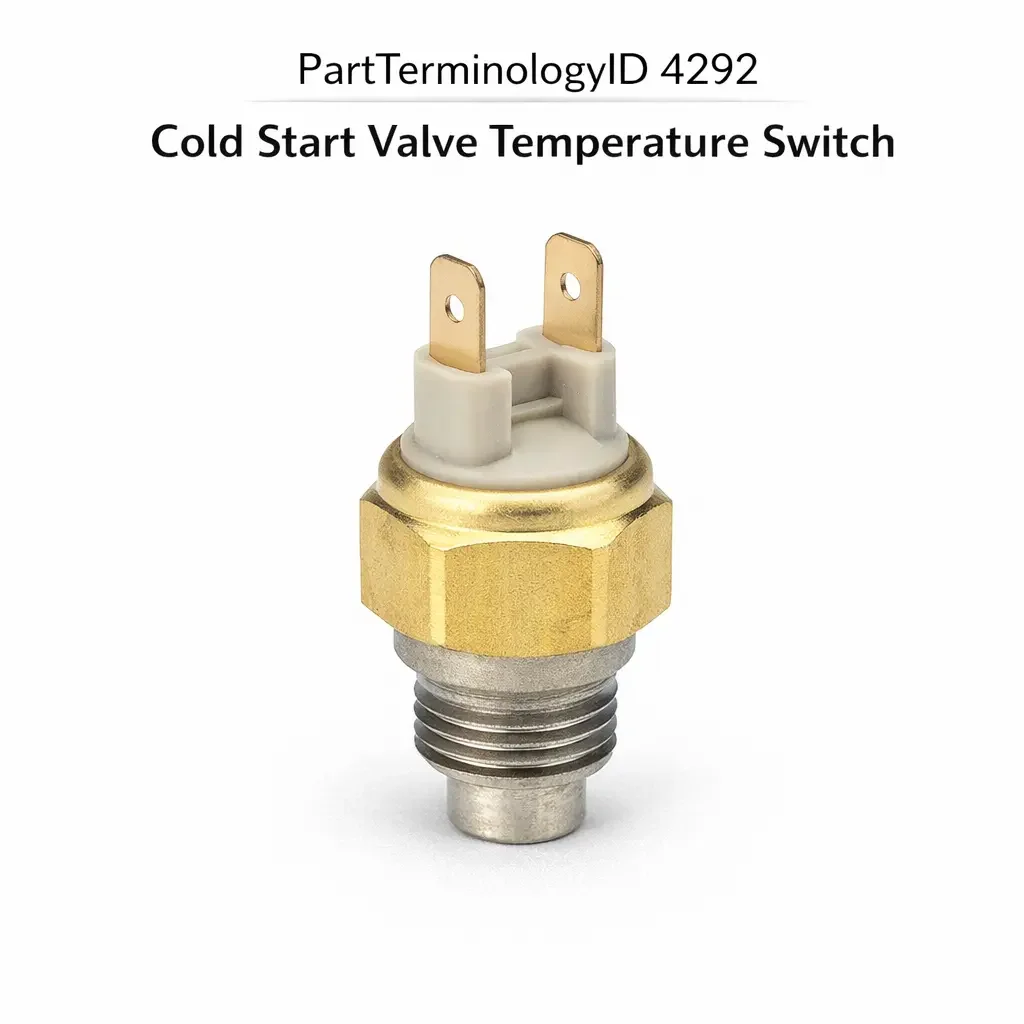
PartTerminologyID 4292, Cold Start Valve Temperature Switch, is the thermostatic switch mounted in the engine coolant passage or intake manifold that monitors coolant or intake temperature and controls the electrical circuit to the cold start valve (also called the cold start injector), allowing the cold start valve to inject additional fuel into the intake manifold during cranking only when the engine temperature is below the calibrated threshold, and preventing the cold start valve from injecting fuel during warm-engine start attempts where additional enrichment would flood the engine and prevent starting. That definition covers the cold start enrichment gating function correctly and leaves unresolved every question that determines whether the replacement switch's temperature threshold matches the original calibration for the specific engine's cold start fuel requirement, whether the switch thread specification matches the coolant passage port in diameter, pitch, and thread form, whether the switch is a normally open type that closes on cold and enables the cold start valve circuit or a normally closed type that opens on cold depending on the specific circuit design, whether the switch includes an integrated timer function that limits the cold start valve injection duration to prevent flooding on extended cranking events, and whether the switch sealing method matches the coolant passage port to prevent coolant weeping at the switch base after installation.
It does not specify the temperature threshold, thread specification, contact configuration, timer function, or sealing method. A listing under PartTerminologyID 4292 that states only year, make, and model without temperature threshold and contact configuration cannot be evaluated by a technician replacing a failed cold start switch on a vehicle where the original switch enabled the cold start circuit below 35 degrees Celsius and the replacement is calibrated for 20 degrees Celsius, causing the cold start valve to remain inactive during cool-weather starts between 20 and 35 degrees Celsius and producing a prolonged crank time or a no-start condition on cool mornings that the technician will misattribute to a failed cold start valve.
For sellers, PartTerminologyID 4292 covers port fuel injected engines from the late 1970s through the mid-1990s that used a dedicated cold start injector as part of the fuel enrichment strategy before fully mapped ECU cold start enrichment through the main injectors made the dedicated cold start valve obsolete. The buyer arriving at this PartTerminologyID is typically servicing a European or Japanese import engine from this era where cold start performance is critical for emissions compliance and drivability on cool mornings, and has already confirmed the cold start valve itself is functioning and the switch is the failed component preventing cold start enrichment.
What the Cold Start Valve Temperature Switch Does
Cold Start Enrichment Gating and the Temperature Threshold Function
The cold start valve injects a continuous fuel stream into the intake manifold during the cranking event to supplement the main injectors' cold start enrichment and provide the rich mixture required for reliable ignition on a cold engine. Without the cold start valve's additional fuel, a cold-soaked engine at low ambient temperature may not receive sufficient fuel from the main injectors alone to achieve ignition within the first few crank revolutions, requiring extended cranking that stresses the starter and battery.
The cold start valve temperature switch prevents the cold start valve from activating on a warm engine start, where the additional fuel would over-enrich the mixture and cause flooding. It does this by monitoring the coolant temperature and keeping the cold start valve circuit open (or closed, depending on the contact configuration) when the engine is above the calibrated threshold. Only below the threshold does the switch change state and allow the cold start valve to receive the cranking signal.
The threshold calibration is specific to the engine's fuel requirement at different temperatures. An engine requiring cold start enrichment below 35 degrees Celsius uses a switch calibrated to 35 degrees. A replacement calibrated to 20 degrees will not activate the cold start circuit between 20 and 35 degrees Celsius, producing a hard start or extended crank time in cool weather that is not cold enough to trigger the lower-threshold switch but is still cold enough to require supplemental enrichment. A replacement calibrated to 50 degrees will activate the cold start circuit on a warm engine start, flooding the engine and preventing starting until the excess fuel is cleared.
Integrated Timer Function and Flooding Prevention
Some cold start valve temperature switches include an integrated timer circuit (typically a bimetallic strip or an RC timing element inside the switch body) that limits the duration of the cold start valve's injection event on any single cranking attempt to a fixed interval, typically 1 to 8 seconds depending on the application. The timer prevents the cold start valve from injecting continuously throughout an extended cranking event that might last 10 to 15 seconds on a very cold engine, which would deposit excessive fuel in the intake manifold and flood the engine.
A replacement switch without the integrated timer function in an application that requires one will allow the cold start valve to inject throughout the entire cranking event, increasing the risk of flooding on very cold starts where multiple extended cranking attempts are made before ignition. A replacement with a timer calibrated for a shorter duration than the original will reduce the cold start enrichment on very cold starts below the level needed for reliable ignition on the first crank attempt. The timer duration must be confirmed from the original part specification before ordering a switch with an integrated timer function.
Thread Specification, Sealing Method, and Coolant Passage Port Compatibility
The cold start valve temperature switch is mounted in a coolant passage port and is in contact with engine coolant at operating pressure and temperature. The thread specification (diameter, pitch, and thread form) must match the port exactly. The most common thread specifications on import applications are M10 x 1.0, M12 x 1.5, and M14 x 1.5 metric straight threads with a sealing washer. Domestic applications from the same era may use 3/8-18 NPT tapered pipe thread. A tapered pipe thread switch in a straight thread port will not seal against the coolant passage at any torque. A straight thread switch in a tapered pipe thread port will not seal without a sealing washer and may not develop sufficient thread engagement to hold against coolant system pressure.
The sealing method must also be confirmed. Straight thread ports use a copper or aluminum crush washer or an O-ring to seal at the thread shoulder. Tapered pipe thread ports seal through thread interference and thread sealant. A switch supplied without a crush washer for a straight thread port will weep coolant at the switch base under operating pressure within the first heat cycle.
Top Return Scenarios
Scenario 1: "Threshold too low, cold start valve inactive between 20 and 35 degrees Celsius, extended crank on cool mornings"
The replacement switch is calibrated to 20 degrees Celsius. The original was calibrated to 35 degrees. On cool mornings between 20 and 35 degrees Celsius the cold start circuit remains inactive. The engine requires extended cranking before ignition and occasionally fails to start on the first attempt. The buyer attributes the hard start to a failed cold start valve, which tests functional.
Prevention language: "Temperature threshold: [X] degrees Celsius. The cold start valve circuit activates below this threshold only. A threshold lower than the original leaves the cold start circuit inactive at temperatures where the engine still requires supplemental enrichment. Verify the threshold against original switch specification before ordering."
Scenario 2: "No integrated timer, cold start valve injects throughout extended cranking, engine floods on very cold start"
The replacement switch has the correct temperature threshold but does not include the integrated timer circuit required by the application. On a very cold start requiring three extended cranking attempts, the cold start valve injects continuously throughout each cranking event. The intake manifold accumulates excess fuel. The engine floods and will not start until the excess fuel is cleared by cranking with the throttle fully open.
Prevention language: "Timer function: [integrated bimetallic timer, [X] second maximum injection duration / no integrated timer]. Verify whether the application requires a timed switch. A switch without the integrated timer in an application that requires one allows the cold start valve to inject throughout extended cranking events, increasing flooding risk on very cold starts."
Scenario 3: "Metric straight thread switch in NPT tapered port, coolant weep at switch base after first heat cycle"
The replacement uses an M12 x 1.5 metric straight thread. The coolant port uses 3/8-18 NPT tapered thread. The straight thread switch does not develop the interference seal required by the tapered port. Coolant weeps past the switch base after the first heat cycle expands the coolant passage casting.
Prevention language: "Thread specification: [diameter x pitch, thread form: NPT tapered / metric straight with crush washer]. Verify thread form against the coolant passage port. A metric straight thread switch will not seal in an NPT tapered port at any torque or sealant application."
Core Listing Attributes for PartTerminologyID 4292
PartTerminologyID: 4292
Component: Cold Start Valve Temperature Switch
Temperature threshold in degrees Celsius (mandatory, in title)
Contact configuration: normally open or normally closed (mandatory)
Integrated timer function: present with duration in seconds, or absent (mandatory)
Thread specification: diameter, pitch, and thread form (mandatory)
Sealing method: crush washer, O-ring, or NPT thread sealant (mandatory)
Switch hex body size in mm or inches (mandatory)
Year/make/model/engine
FAQ (Buyer Language)
How do I confirm the correct temperature threshold?
The threshold is listed in the factory service manual for the specific engine under the cold start system specifications. The original switch part number cross-reference from the vehicle manufacturer is the most reliable confirmation. On European import engines the threshold is commonly 35 degrees Celsius but varies by engine family and model year.
Can I test the switch before replacing it?
Yes. Remove the switch and place the sensing tip in water heated to just above the rated threshold temperature while monitoring the water temperature with a calibrated thermometer. Connect a continuity tester across the terminals. The switch should change state within a few degrees of the rated threshold. A switch that does not change state at the rated temperature requires replacement.
Related PartTerminologyIDs
Cold Start Valve (if cataloged): the injector the switch controls; a functioning switch with a failed cold start valve produces the same hard cold start symptom; confirm cold start valve function by applying battery voltage directly to the valve during cranking before replacing the switch
Engine Coolant Temperature Sensor (PartTerminologyID 4316 or similar): the continuous analog temperature sensor that the ECU uses for fuel map adjustments; distinct from the cold start valve temperature switch, which is a discrete on or off contact device rather than an analog signal source
Status in New Databases
PIES/PCdb: PartTerminologyID 4292, Cold Start Valve Temperature Switch
PIES 8.0 / PCdb 2.0: No change in PartTerminologyID or terminology label
Final Take for PartTerminologyID 4292
Cold Start Valve Temperature Switch (PartTerminologyID 4292) is the cold start enrichment PartTerminologyID where a threshold mismatch of 15 degrees Celsius produces a hard start or no-start condition on every cool morning within that temperature gap, and a missing timer function produces an engine flooding risk on every very cold start requiring extended cranking. State the temperature threshold in the title. State the contact configuration. State the integrated timer function and duration. State the thread specification with thread form. For PartTerminologyID 4292, temperature threshold, integrated timer function, and thread form are the three attributes that prevent the three most common return scenarios in the cold start valve temperature switch buyer population.