
Written by Arthur Simitian | PartsAdvisory
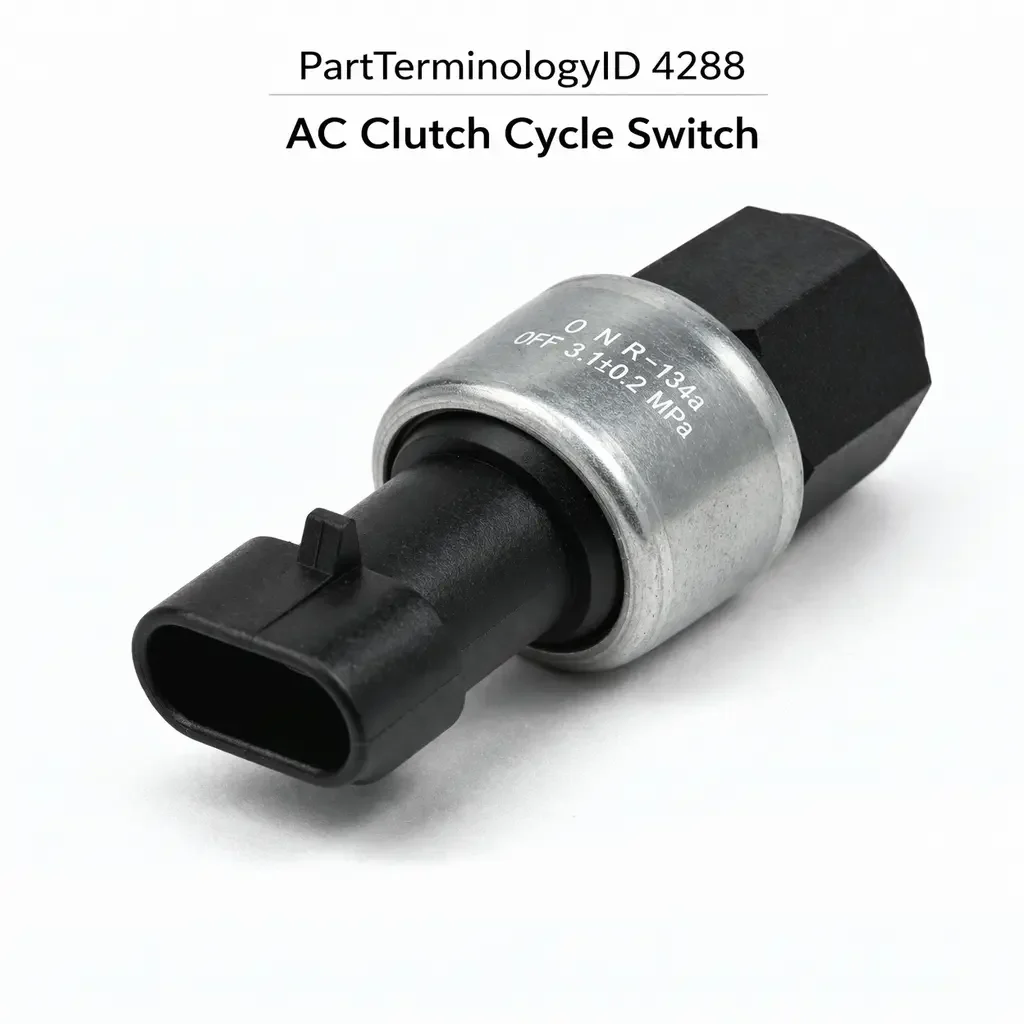
PartTerminologyID 4288, A/C Clutch Cycle Switch, is the pressure-sensing switch mounted in the low-side refrigerant circuit that controls the on and off cycling of the A/C compressor clutch on fixed-displacement compressor systems by engaging the clutch when the low-side pressure rises above the upper cycling threshold and disengaging the clutch when the low-side pressure drops below the lower cycling threshold, maintaining the evaporator temperature within the range needed for effective dehumidification and cooling without allowing the evaporator to cool below the freezing point of the condensate forming on the evaporator fins. That definition covers the cycling control function correctly and leaves unresolved every question that determines whether the replacement switch's engagement and disengagement thresholds match the original calibration for the specific refrigerant type and evaporator temperature design point of the vehicle's A/C system, whether the hysteresis band between the two thresholds is wide enough to prevent rapid clutch cycling that accumulates engagement wear on the clutch friction disc, whether the switch is compatible with the low-side port fitting type at the installation position (Schrader valve, O-ring face seal, or threaded port with separate seal), whether the switch connector pin count and terminal type match the harness at the accumulator or low-side line position, whether the switch thread specification matches the port in diameter, pitch, and thread form, whether the replacement is calibrated for R-134a low-side operating pressures or R-1234yf pressures or legacy R-12 pressures on a retrofitted system, and whether the switch is appropriate for the specific fixed-displacement compressor application and must not be installed on a variable-displacement compressor system where the compressor modulates its own output and the cycling function causes unnecessary clutch wear.
It does not specify the engagement threshold, disengagement threshold, hysteresis band width, port fitting type, connector pin count, thread specification, refrigerant type calibration, or compressor type compatibility. A listing under PartTerminologyID 4288 that states only year, make, and model without engagement and disengagement thresholds and refrigerant type cannot be evaluated by a technician replacing a failed cycling switch on a system that has been retrofitted from R-12 to R-134a, because the R-12 cycling switch disengagement threshold of approximately 8 to 12 psi is below the normal R-134a low-side operating pressure, causing the R-12 calibrated switch to never disengage the compressor on an R-134a system and allowing the evaporator to freeze over on every extended A/C operation event.
For sellers, PartTerminologyID 4288 is distinct from PartTerminologyID 4284 in a specific and important way: where 4284 covers all A/C clutch switch types including high-pressure cutout, low-pressure cutout, dual-function, and trinary types under one PartTerminologyID, 4288 is specific to the cycling function only. The buyer arriving at PartTerminologyID 4288 has already identified the cycling switch as the specific component required and is looking for a replacement that restores the correct evaporator temperature regulation behavior. The most common diagnostic path to this PartTerminologyID is an evaporator freeze-up complaint (ice on the evaporator fins blocking airflow and causing a gradual loss of cooling on humid days) or a rapid clutch cycling complaint (the compressor clutch engaging and disengaging every few seconds rather than the normal 5 to 15 second cycle). Both symptoms trace directly to a cycling switch threshold mismatch, and the replacement must match both the engagement and disengagement thresholds of the original to restore normal cycling behavior.
What the A/C Clutch Cycle Switch Does
Fixed-Displacement Compressor Operation and the Evaporator Temperature Regulation Function
A fixed-displacement compressor pumps refrigerant at a constant volumetric flow rate whenever the clutch is engaged, regardless of the cooling demand at the evaporator. It has no mechanism to reduce its pumping output when the evaporator reaches the target temperature. Without external regulation, a fixed-displacement compressor operating continuously on a cool day with low cabin heat load would cool the evaporator below the freezing point of the condensate accumulating on the fins, causing the fins to ice over and blocking the airflow through the evaporator core entirely.
The cycling switch provides this external regulation by monitoring the low-side pressure, which correlates directly to evaporator temperature through the refrigerant's pressure-temperature relationship. At R-134a pressures, a low-side pressure of approximately 25 to 30 psi corresponds to an evaporator temperature of roughly 32 to 40 degrees Fahrenheit, which is the lower boundary of the safe operating range for condensate drainage without freeze-up. When the low-side pressure drops to the disengagement threshold, the cycling switch opens its contact and disengages the compressor clutch, stopping refrigerant flow into the evaporator and allowing the evaporator temperature to rise. When the low-side pressure rises to the engagement threshold as the evaporator warms, the cycling switch closes its contact and re-engages the clutch.
This on-off cycling pattern maintains the evaporator in a temperature band above the freeze point while providing continuous dehumidification and cooling. The width of this temperature band is determined by the hysteresis band between the two thresholds: a wider hysteresis band produces longer on-cycles and longer off-cycles, while a narrow hysteresis band produces short rapid cycles. The original calibration balances dehumidification effectiveness against clutch engagement wear, and a replacement that does not match the original hysteresis band will shift this balance in one direction or the other.
Engagement Threshold, Disengagement Threshold, and the Hysteresis Band
The engagement threshold is the low-side pressure at which the cycling switch closes its contact and re-engages the compressor clutch after an off-cycle. For R-134a systems, the engagement threshold is typically in the range of 40 to 55 psi depending on the application's evaporator design point and the ambient temperature range the system is calibrated for. A higher engagement threshold means the compressor re-engages sooner after an off-cycle (when the evaporator is still relatively cool), producing shorter off-cycles and more frequent engagement events. A lower engagement threshold means the compressor remains disengaged until the evaporator has warmed further, producing longer off-cycles and less frequent engagement events.
The disengagement threshold is the low-side pressure at which the cycling switch opens its contact and disengages the clutch at the end of an on-cycle. For R-134a systems, the disengagement threshold is typically in the range of 22 to 28 psi, corresponding to an evaporator temperature just above the condensate freeze point. A lower disengagement threshold allows the evaporator to cool closer to the freeze point before the compressor cycles off, which maximizes dehumidification but increases the risk of evaporator freeze-up on humid days when condensate accumulation on the fins is at its highest. A higher disengagement threshold cycles the compressor off earlier, reducing dehumidification effectiveness but providing more margin against freeze-up.
The hysteresis band is the pressure differential between the engagement threshold and the disengagement threshold. A replacement switch with a hysteresis band narrower than the original produces more frequent cycling because the evaporator pressure swings through the narrow band more quickly. Rapid clutch cycling (engagement events more frequent than approximately one per five seconds) accumulates clutch friction disc wear at a rate that can shorten the clutch service life significantly within a single season of A/C use. A replacement switch with a hysteresis band wider than the original produces less frequent cycling with longer off-cycles during which the evaporator temperature rises higher than the original calibration intended, reducing cooling and dehumidification effectiveness. Both threshold values and the hysteresis band must be stated in every cycling switch listing.
Refrigerant Type and Pressure-Temperature Relationship
The cycling switch thresholds are calibrated to specific low-side pressures that correspond to specific evaporator temperatures through the refrigerant's pressure-temperature relationship. R-134a, R-1234yf, and R-12 have different pressure-temperature curves, meaning that the same evaporator temperature corresponds to different low-side pressures for each refrigerant. A cycling switch calibrated for R-134a with a disengagement threshold of 25 psi corresponds to an evaporator temperature of approximately 35 degrees Fahrenheit. The same evaporator temperature in an R-1234yf system corresponds to a slightly different low-side pressure because R-1234yf's saturation curve differs from R-134a's.
The consequence of a refrigerant type mismatch in a cycling switch is more serious than in a high-pressure cutout switch because the cycling switch governs a continuous regulation function rather than an emergency protection function. An R-12 calibrated cycling switch installed in an R-134a system has a disengagement threshold in the 8 to 12 psi range. In an R-134a system, this pressure corresponds to an evaporator temperature well below the condensate freeze point. The R-12 calibrated switch will never disengage the compressor on an R-134a system during normal operation because the R-134a low-side pressure never drops to 8 to 12 psi under normal conditions. The compressor runs continuously, cools the evaporator far below the freeze point, and the evaporator ices over on every extended A/C operation event. The refrigerant type must be confirmed and the switch must be calibrated for the refrigerant currently in the system.
Accumulator Mounting Position and the Thermal Influence on Switch Readings
The cycling switch on most domestic A/C systems is mounted at the accumulator, which is the low-side component that separates the vapor and liquid refrigerant returning from the evaporator before the vapor enters the compressor suction port. The accumulator is mounted in the low-side refrigerant line, typically near the firewall or the inner fender, and the cycling switch threads into a port in the accumulator body or in the low-side service fitting adjacent to the accumulator.
The accumulator's thermal mass and its proximity to underhood heat sources can influence the temperature of the refrigerant at the switch sensing point relative to the evaporator outlet temperature. On some applications, the accumulator is positioned close enough to the exhaust system or the radiator that underhood heat absorption into the accumulator body raises the refrigerant temperature and pressure at the switch position above the actual evaporator outlet condition. This means the cycling switch on these applications may be calibrated with a slightly lower disengagement threshold than would be needed if the switch were mounted directly at the evaporator outlet, compensating for the underhood heat input. A replacement switch calibrated to a standard threshold without accounting for this position-specific heat influence will disengage the compressor later than intended, increasing the risk of evaporator freeze-up on the specific application.
The listing must note any application-specific accumulator position thermal influence that affects the threshold calibration, and must prevent a standard-calibration switch from being ordered for an application that requires a position-compensated calibration.
Variable-Displacement Compressor Incompatibility
The cycling switch is designed exclusively for fixed-displacement compressor systems. A variable-displacement compressor regulates evaporator temperature by modulating its own piston stroke and pumping capacity in response to demand signals from the HVAC control module, maintaining a steady low-side pressure without cycling the clutch. The steady-state low-side pressure that the variable-displacement compressor maintains falls within the hysteresis band of a typical cycling switch. If a cycling switch is installed on a variable-displacement compressor system, the switch will cycle the clutch every time the low-side pressure drifts across the switch thresholds during the variable-displacement compressor's normal output modulation, producing clutch engagement events at a rate far higher than the clutch is designed for and accumulating friction disc wear that shortens the clutch service life from years to months.
This incompatibility is a catalog prevention requirement: any listing for PartTerminologyID 4288 that covers a platform where both fixed-displacement and variable-displacement compressors were used must explicitly state the compressor type and must prevent the cycling switch from being ordered for the variable-displacement application. The consequence of installing a cycling switch on a variable-displacement application is not an immediate failure but a progressive wear accumulation that produces a clutch failure within one to two seasons of A/C use.
Why This Part Generates Returns
Buyers return A/C clutch cycle switches because the disengagement threshold is 5 psi lower than the original and the evaporator ices over on the first humid day of use, producing a progressive cooling loss that recovers after the compressor is off for 20 minutes; the engagement threshold is 10 psi higher than the original and the compressor re-engages within two seconds of disengagement, producing a rapid clicking from the clutch that the buyer attributes to a failed clutch rather than a threshold mismatch; the switch is calibrated for R-12 pressures and the system has been retrofitted to R-134a, causing the disengagement threshold to never be reached and the evaporator to freeze on every extended drive; the switch thread is 3/8-24 UNF and the accumulator port is M10 x 1.0 metric, producing a partial engagement that begins leaking refrigerant before the mismatch is identified; the switch sealing method is an O-ring face seal and the accumulator port is a Schrader valve fitting, leaving the Schrader core closed and the switch isolated from refrigerant circuit pressure, reading near-zero pressure and engaging the compressor continuously; the switch is installed on a variable-displacement compressor application and causes the clutch to cycle every three to four seconds during normal A/C operation, accumulating a season's worth of clutch wear within six weeks; and the connector is a single-blade terminal and the harness at the accumulator position is a two-blade Metri-Pack housing, preventing full mating and leaving the cycling circuit open.
Top Return Scenarios
Scenario 1: "Disengagement threshold too low, evaporator ices over on first humid day"
The buyer installs the replacement cycling switch. In dry conditions the A/C operates normally and the clutch cycles at the expected rate. On the first humid day the evaporator accumulates condensate rapidly on the fins. The replacement switch's disengagement threshold is 5 psi lower than the original, allowing the evaporator to cool 3 to 4 degrees Fahrenheit further than the original calibration before the compressor cycles off. The condensate on the fins begins to freeze at the lower evaporator temperature. After 25 minutes of A/C operation on the humid day the evaporator fins are partially iced, airflow is reduced by 40 percent, and the cabin temperature rises despite the compressor running. The buyer attributes the failure to the A/C system rather than the switch threshold.
Prevention language: "Disengagement threshold: [X] psi corresponding to approximately [X] degrees Fahrenheit evaporator temperature at R-134a saturation. A disengagement threshold lower than the original allows the evaporator to approach the condensate freeze point more closely. On humid days with high condensate accumulation rates, a threshold 4 to 6 psi below the original is sufficient to produce evaporator freeze-up during extended A/C operation."
Scenario 2: "Engagement threshold too high, rapid clutch cycling, clutch noise attributed to failed clutch"
The buyer installs the replacement cycling switch. The compressor clutch engages and disengages every 2 to 3 seconds rather than the normal 8 to 12 second cycle. The rapid cycling produces a repetitive clicking sound from the compressor position that the buyer and a subsequent shop diagnose as a worn or slipping clutch friction disc. The clutch is replaced at significant cost. After clutch replacement the rapid cycling continues because the cycling switch engagement threshold is 10 psi above the original, causing the switch to re-engage the compressor before the evaporator pressure has risen far enough from the disengagement point to provide a meaningful off-cycle.
Prevention language: "Engagement threshold: [X] psi. Disengagement threshold: [X] psi. Hysteresis band: [X] psi. A hysteresis band narrower than the original produces more frequent clutch cycling. A normal cycle rate is approximately one engagement per 5 to 15 seconds at moderate ambient temperature. Cycle rates faster than one per 5 seconds indicate insufficient hysteresis and will accumulate clutch friction disc wear faster than the clutch is designed for."
Scenario 3: "R-12 calibrated switch in R-134a system, disengagement threshold never reached, evaporator freezes on every extended drive"
The buyer's vehicle was retrofitted from R-12 to R-134a by a previous owner. The cycling switch was not replaced during the retrofit. The original R-12 cycling switch fails and the buyer orders a replacement by year and model without confirming the refrigerant type. The delivered switch is an R-12 calibration with a disengagement threshold of 10 psi. The R-134a system's low-side pressure during normal operation ranges from 25 to 55 psi and never drops to 10 psi under any normal operating condition. The compressor runs continuously without cycling. The evaporator temperature drops well below the condensate freeze point within 15 minutes of A/C operation and the evaporator ices over on every drive.
Prevention language: "Refrigerant type calibration: [R-134a / R-1234yf / R-12]. This switch is calibrated for [refrigerant type] low-side operating pressures. R-12 and R-134a low-side operating pressure ranges differ significantly. An R-12 calibrated switch in an R-134a system will never reach its disengagement threshold during normal operation, causing the compressor to run continuously and the evaporator to freeze. Confirm the refrigerant type currently in the system before ordering."
Scenario 4: "O-ring face seal switch at Schrader valve port, core remains closed, compressor engages continuously"
The buyer installs the replacement switch at the accumulator's Schrader valve service port. The replacement uses an O-ring face seal and does not include a Schrader depressor pin. After threading the switch in, the Schrader valve core remains closed. The switch sensing element is isolated from the refrigerant circuit pressure and reads atmospheric pressure. The low-side pressure reading at the switch is effectively zero. The cycling switch's engagement threshold is above zero, so the switch contact closes immediately and remains closed regardless of actual refrigerant circuit conditions. The compressor engages and runs continuously, the evaporator ices over within 20 minutes, and the system loses cooling.
Prevention language: "Sealing method: [O-ring face seal / Schrader with depressor pin]. Installation port type: [O-ring face seal port / Schrader valve port]. A switch without a Schrader depressor pin at a Schrader valve port leaves the valve core closed and isolates the switch from circuit pressure. The switch will read near-zero pressure, close its contact immediately, and engage the compressor continuously regardless of actual low-side pressure conditions."
Scenario 5: "Cycling switch installed on variable-displacement compressor, clutch cycling every 3 seconds, disc wear in six weeks"
The buyer replaces the low-side switch on a variable-displacement compressor application. The listing covers the application without specifying compressor type. The variable-displacement compressor modulates its output to hold a steady 32 psi low-side pressure. The replacement cycling switch has an engagement threshold of 40 psi and a disengagement threshold of 26 psi. The 32 psi steady-state pressure falls between the two thresholds, causing the clutch to cycle every 3 to 4 seconds as the variable-displacement compressor's output modulation causes the low-side pressure to drift across the narrow 14 psi hysteresis band. Within six weeks the clutch friction disc is worn to the point of slipping and the compressor no longer engages reliably.
Prevention language: "Compressor type compatibility: fixed-displacement compressor only. Do not install this cycling switch on a variable-displacement compressor application. Variable-displacement compressors maintain a steady low-side pressure that falls within the cycling switch hysteresis band. The cycling switch will engage and disengage the clutch continuously at the compressor's normal output modulation rate, accumulating clutch friction disc wear that shortens clutch service life from years to weeks."
Scenario 6: "Thread mismatch, refrigerant leak at partial engagement under installation torque"
The buyer installs the replacement cycling switch at the accumulator port. The replacement thread is 3/8-24 UNF. The accumulator port is M10 x 1.0 metric. The UNF thread engages approximately two turns before the thread forms bind. The technician applies additional torque attempting to seat the switch against the O-ring or Schrader port. The partial engagement produces a refrigerant leak path at the thread form mismatch zone. Low-side refrigerant escapes before the mismatch is identified. The system must be evacuated, the correct switch installed, and the system recharged, adding refrigerant recovery and recharge cost to the switch replacement.
Prevention language: "Thread specification: [diameter x pitch, thread form: UNF / metric]. Verify thread specification before installation using a thread gauge on the accumulator port. A UNF switch will engage partially in a metric port before binding. Applying torque to a partially engaged mismatched thread creates a refrigerant leak path. Low-side refrigerant release requires system evacuation and recharge after the correct switch is installed."
Core Listing Attributes for PartTerminologyID 4288
PartTerminologyID: 4288
Component: A/C Clutch Cycle Switch
Engagement threshold in psi (mandatory, in listing)
Disengagement threshold in psi (mandatory, in listing)
Hysteresis band in psi (mandatory)
Corresponding evaporator temperature range in degrees Fahrenheit at stated refrigerant saturation (recommended)
Refrigerant type calibration: R-134a, R-1234yf, or R-12 (mandatory, in title)
Compressor type compatibility: fixed-displacement only (mandatory)
Port fitting type: Schrader valve with depressor pin, O-ring face seal, or threaded port with separate seal (mandatory)
Thread specification: diameter, pitch, and thread form (mandatory)
Connector type and terminal count (mandatory)
Switch body hex size in mm or inches (mandatory)
Accumulator mounting position thermal influence note where applicable (mandatory for affected applications)
Year/make/model/engine/A/C system configuration
Note for vehicles retrofitted from R-12 to R-134a requiring R-134a calibrated thresholds
Note for variable-displacement compressor applications where cycling switch must not be used
Note for accumulator positions with underhood heat influence requiring position-compensated calibration
Catalog Checklist for ACES/PIES Teams
PartTerminologyID = 4288
Require engagement and disengagement thresholds in psi in listing (mandatory)
Require hysteresis band in psi (mandatory)
Require refrigerant type calibration in title (mandatory)
Require compressor type compatibility statement: fixed-displacement only (mandatory)
Require port fitting type with Schrader depressor note (mandatory)
Require thread specification: diameter, pitch, thread form (mandatory)
Require connector type and terminal count (mandatory)
Prevent refrigerant type omission: an R-12 calibrated switch in an R-134a system never reaches its disengagement threshold and causes continuous compressor operation and evaporator freeze-up; refrigerant type calibration must be stated and confirmed for every listing
Prevent threshold omission: a disengagement threshold 4 to 6 psi below the original causes evaporator freeze-up on humid days; both engagement and disengagement thresholds must be stated for every cycling switch listing without exception
Prevent hysteresis band omission: a hysteresis band narrower than the original produces rapid clutch cycling that accumulates friction disc wear faster than the clutch is designed for; hysteresis band must be stated and verified against original specification
Prevent variable-displacement compressor installation: the cycling switch causes continuous clutch cycling at the variable-displacement compressor's steady-state operating pressure; compressor type must be confirmed and the fixed-displacement only restriction must appear in every listing
Prevent Schrader port and O-ring face seal conflation: a switch without a Schrader depressor in a Schrader port reads near-zero pressure and engages the compressor continuously; port fitting type and sealing method must be confirmed before ordering
Prevent thread form mismatch: a UNF switch partially engaging a metric port under installation torque creates a refrigerant leak path requiring system evacuation and recharge; thread specification must be stated and verified with a thread gauge before installation
Differentiate from A/C Clutch Switch (PartTerminologyID 4284): PartTerminologyID 4284 covers all A/C clutch switch types including high-pressure cutout, low-pressure cutout, dual-function, and trinary types; PartTerminologyID 4288 is specific to the cycling function only; both monitor refrigerant pressure and control the compressor clutch but at different circuit positions with different threshold calibrations for different control purposes
Differentiate from Low-Pressure Cutout Switch (within PartTerminologyID 4284): both the cycling switch and the low-pressure cutout switch monitor low-side pressure; the cutout switch has a single threshold that disengages the clutch on low charge and does not re-engage until the charge is restored; the cycling switch has two thresholds that continuously cycle the clutch for evaporator temperature regulation during normal operation
FAQ (Buyer Language)
How does the A/C clutch cycle switch differ from a low-pressure cutout switch?
The low-pressure cutout switch has a single threshold that disengages the compressor clutch when the refrigerant charge drops below the minimum safe level for compressor lubrication, and the clutch remains disengaged until the charge is restored. The cycling switch has two thresholds (engagement and disengagement) that continuously cycle the clutch on and off during normal A/C operation to regulate evaporator temperature on fixed-displacement compressor systems. Both monitor low-side pressure but for fundamentally different control purposes.
Why does my A/C lose cooling gradually and then recover after the compressor sits idle?
Gradual cooling loss over 20 to 40 minutes of A/C operation followed by recovery is the characteristic symptom of evaporator freeze-up. The evaporator fins accumulate ice that progressively blocks airflow through the evaporator core, reducing the cooling effect delivered to the cabin. When the compressor cycles off or the vehicle is parked, the ice melts and airflow is restored. Evaporator freeze-up is caused by a disengagement threshold that is too low, allowing the evaporator to cool below the condensate freeze point before the cycling switch cuts the compressor. Confirm the cycling switch disengagement threshold against the original specification before replacing any other component.
Can I use my old R-12 cycling switch after a refrigerant retrofit to R-134a?
No. The R-12 cycling switch disengagement threshold (typically 8 to 12 psi) is far below the normal R-134a low-side operating pressure range (25 to 55 psi under normal operating conditions). The R-12 calibrated switch will never disengage the compressor on an R-134a system during normal operation, causing the compressor to run continuously and the evaporator to freeze over on every extended A/C use. Replace the cycling switch with an R-134a calibrated unit as part of any R-12 to R-134a retrofit.
What cycle rate should I expect from a correctly calibrated switch?
On a moderate ambient temperature day (75 to 85 degrees Fahrenheit) with moderate cabin heat load, a correctly calibrated cycling switch will produce approximately one clutch engagement every 5 to 15 seconds, with the exact rate depending on the ambient temperature, the cabin heat load, and the evaporator design point. Cycle rates faster than one engagement per 5 seconds indicate insufficient hysteresis between the engagement and disengagement thresholds. Cycle rates slower than one per 30 seconds may indicate a high ambient temperature condition that is keeping the low-side pressure above the disengagement threshold or a refrigerant overcharge condition.
How do I confirm the correct thread specification for my accumulator port?
Remove the original switch and measure the thread diameter and pitch with a thread gauge. Confirm the thread form by determining whether the pitch is expressed in threads per inch (UNF) or millimeters (metric). Do not attempt to verify compatibility by starting the replacement switch in the port by hand. Partial engagement before binding is the exact mechanism that produces a refrigerant leak when torque is applied to a mismatched thread.
Related PartTerminologyIDs
A/C Clutch Switch (PartTerminologyID 4284): covers all A/C clutch switch types including high-pressure cutout, low-pressure cutout, dual-function, and trinary types; when a low-pressure cutout function is needed rather than a cycling function, source from PartTerminologyID 4284 to confirm the correct single-threshold cutout type is supplied rather than a cycling switch
A/C Compressor Clutch (PartTerminologyID 4279 or similar): the electromagnetic clutch whose engagement frequency is governed by the cycling switch; a clutch showing premature friction disc wear on a variable-displacement compressor application should prompt inspection of the cycling switch installation before clutch replacement, as the cycling switch may be the cause of the accelerated wear
A/C Accumulator (PartTerminologyID 4285 or similar): the low-side component at which the cycling switch is most commonly mounted; when the cycling switch requires replacement due to accumulator port corrosion or thread damage, inspect the accumulator body condition and replace the accumulator if the port integrity is compromised
A/C Pressure Transducer (if cataloged): the analog pressure sensor used on variable-displacement compressor systems in place of the cycling switch; if the application has a variable-displacement compressor, the correct component is a pressure transducer rather than a cycling switch; both mount at the low-side circuit but serve fundamentally different control functions
Status in New Databases
PIES/PCdb: PartTerminologyID 4288, A/C Clutch Cycle Switch
PIES 8.0 / PCdb 2.0: No change in PartTerminologyID or terminology label
Final Take for PartTerminologyID 4288
A/C Clutch Cycle Switch (PartTerminologyID 4288) is the refrigerant system PartTerminologyID where both thresholds and the hysteresis band between them must match the original calibration, because a mismatch at either threshold produces a systematic fault that repeats on every drive cycle: evaporator freeze-up from a disengagement threshold that is too low, rapid clutch cycling wear from a hysteresis band that is too narrow, continuous compressor operation from an R-12 calibrated switch in an R-134a system, or accelerated clutch wear from a cycling switch installed on a variable-displacement compressor. None of these outcomes produces an obvious installation error at the time of installation. All four manifest as recurring performance or durability complaints that are traced back to the switch calibration only after the symptom pattern is recognized.
State the engagement threshold. State the disengagement threshold. State the hysteresis band. State the refrigerant type calibration in the title. State the fixed-displacement compressor only restriction. State the port fitting type with the Schrader depressor note. State the thread specification. For PartTerminologyID 4288, engagement and disengagement threshold pair, refrigerant type calibration, and compressor type compatibility are the three attributes beyond the standard fitment checklist that prevent the three most consequential and least immediately visible return scenarios in the A/C clutch cycle switch buyer population.