
Written by Arthur Simitian | PartsAdvisory
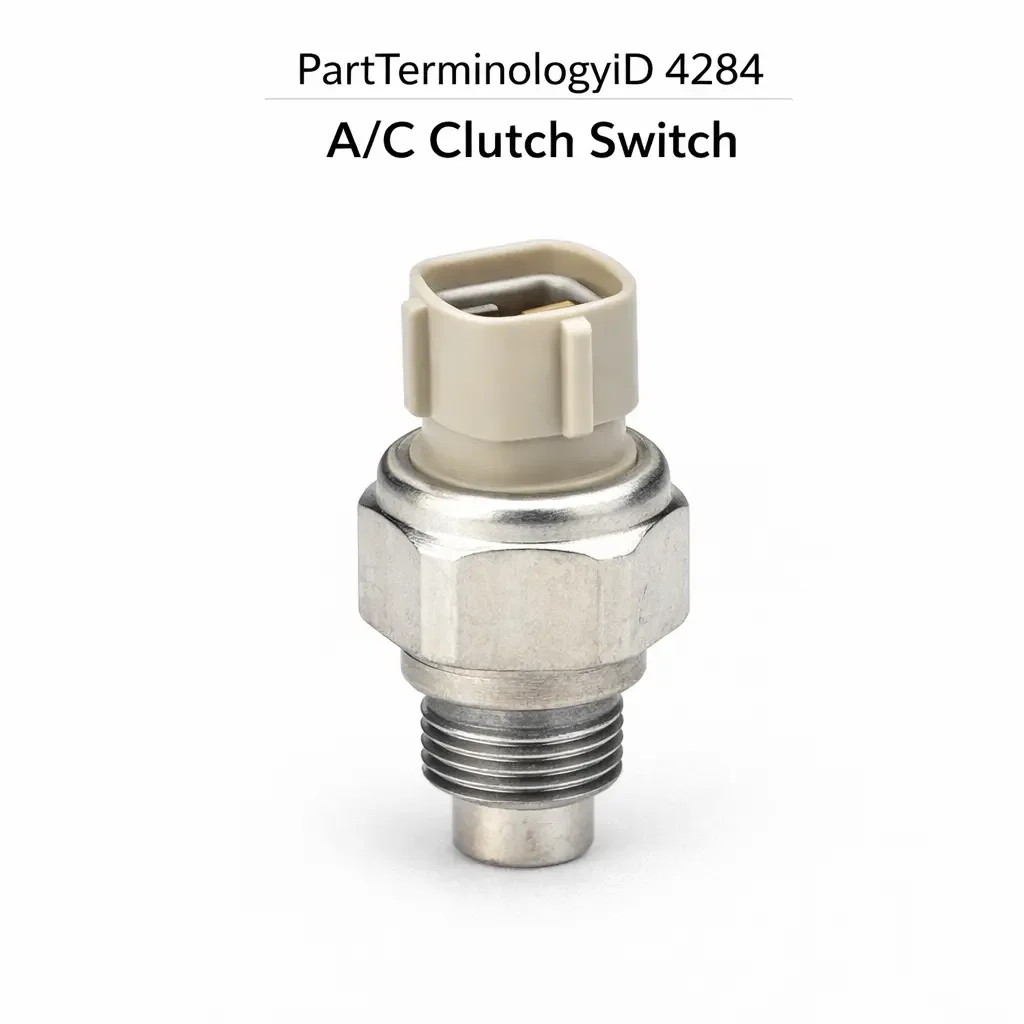
PartTerminologyID 4284, A/C Clutch Switch, is the pressure-sensing or temperature-sensing switch that monitors a critical operating parameter in the refrigerant circuit and opens or closes an electrical contact to engage or disengage the A/C compressor clutch based on whether the monitored condition is within the safe and effective operating range for the compressor, most commonly sensing high-side refrigerant pressure to disengage the clutch on high-pressure overload or low-side pressure to disengage the clutch when refrigerant charge is too low to provide adequate compressor lubrication, and in some configurations sensing both high and low pressure through a dual-function switch body to provide both protections through a single installation point. That definition covers the clutch engagement control and compressor protection function correctly and leaves unresolved every question that determines whether the replacement switch's pressure activation and deactivation thresholds match the original calibration for the specific refrigerant type and compressor model in the system, whether the switch is a high-pressure cutout type, a low-pressure cutout type, a cycling switch type that modulates compressor engagement to regulate evaporator temperature, a dual-function type covering both high and low pressure, or a trinary switch type adding a third threshold for condenser fan activation, whether the switch connector type and pin count match the harness at the mounting position, whether the thread specification matches the service port or Schrader valve fitting where the switch installs, whether the switch is calibrated for R-134a operating pressures or R-1234yf operating pressures or the legacy R-12 pressures on a vintage system, whether the switch body sealing method (O-ring, flare, or Schrader depressor) matches the fitting at the installation point, and whether the replacement is compatible with a fixed-displacement compressor that relies on the cycling switch to regulate evaporator temperature or a variable-displacement compressor that modulates its own output and requires only high and low pressure protection without a cycling function.
It does not specify the pressure threshold calibration, switch function type, connector pin count, thread specification, refrigerant type compatibility, sealing method, or compressor displacement type compatibility. A listing under PartTerminologyID 4284 that states only year, make, and model without switch function type and pressure threshold cannot be evaluated by a technician replacing a failed low-pressure cutout switch on a vehicle where the system has been retrofitted from R-12 to R-134a and the low-side operating pressure range has shifted from the R-12 baseline, requiring a switch calibrated for R-134a low-side pressures rather than the R-12 calibration that will cut out the compressor at a low-side pressure that is normal and safe for R-134a operation.
For sellers, PartTerminologyID 4284 is the A/C system PartTerminologyID with the widest range of switch function types sharing a single PartTerminologyID designation, because high-pressure cutout switches, low-pressure cutout switches, cycling switches, dual-function switches, and trinary switches all serve the A/C clutch engagement circuit and are all cataloged under the same PartTerminologyID despite having fundamentally different pressure threshold calibrations, connector configurations, and circuit functions. A buyer who receives a cycling switch when the application requires a high-pressure cutout switch will find that the compressor cycles on and off at normal operating pressures rather than running continuously until a high-pressure fault occurs, producing an A/C system that appears to operate intermittently rather than protecting the compressor from overpressure. The function type must be in the title and must be the first attribute confirmed before any other fitment check.
What the A/C Clutch Switch Does
High-Pressure Cutout Switch Function and Compressor Overload Protection
The high-pressure cutout switch monitors the refrigerant pressure on the high side of the A/C circuit (between the compressor discharge port and the expansion device inlet) and opens its electrical contact to disengage the compressor clutch when the high-side pressure exceeds the upper safety threshold. High-side pressure rises above normal operating range when airflow across the condenser is blocked (a failed condenser fan, a debris-clogged condenser face, or a vehicle stopped in traffic on a hot day with the A/C running at maximum demand), when the system is overcharged with refrigerant, or when non-condensable gases (air) are present in the refrigerant circuit. All three conditions produce abnormally high compressor discharge pressures that, if sustained, can exceed the mechanical pressure rating of the compressor housing, the condenser, or the high-side hose fittings.
The high-pressure cutout switch threshold is calibrated to open the clutch circuit at a pressure above the normal maximum operating pressure but below the mechanical failure pressure of the system components. For R-134a systems, the normal high-side operating pressure range is approximately 150 to 250 psi on a properly charged system at moderate ambient temperature, and the high-pressure cutout threshold is typically set between 375 and 450 psi. A replacement switch calibrated at 300 psi will cut out the compressor during normal high-demand operation on a hot day, producing an intermittent A/C complaint on the hottest days when the system is working hardest. A replacement calibrated at 500 psi will not protect the system components from overpressure events that the original 400 psi switch was designed to catch.
Low-Pressure Cutout Switch Function and Compressor Lubrication Protection
The low-pressure cutout switch monitors the refrigerant pressure on the low side of the A/C circuit (between the evaporator outlet and the compressor suction port) and opens its electrical contact to disengage the compressor clutch when the low-side pressure drops below the minimum threshold. Low-side pressure falls below normal operating range when the refrigerant charge is low due to a leak in the system. Refrigerant and compressor oil circulate together through the A/C circuit, so a low refrigerant charge also means reduced oil delivery to the compressor's internal bearing surfaces and valve plate. A compressor operating with insufficient oil delivery will experience accelerated wear at the reed valves, the piston bores, and the main bearing within minutes, and catastrophic compressor failure within hours if the low-charge condition is not corrected.
The low-pressure cutout threshold is calibrated to open the clutch circuit at a pressure that indicates insufficient refrigerant charge for safe compressor lubrication, typically 20 to 25 psi for R-134a systems. A replacement switch calibrated at 10 psi will allow the compressor to operate in a low-charge condition that the original 22 psi switch was designed to prevent, producing compressor damage that the buyer will attribute to other causes because the low-pressure protection that should have prevented it did not activate. The threshold must match the original calibration for the specific refrigerant type in the system.
Cycling Switch Function and Evaporator Temperature Regulation
The cycling switch is a specialized A/C clutch switch used exclusively with fixed-displacement compressors, where the compressor pumps at full capacity whenever the clutch is engaged and has no mechanism to reduce its output at low cooling demand. On a fixed-displacement system, evaporator temperature is regulated by cycling the compressor clutch on and off based on the low-side pressure, which correlates to the evaporator temperature through the refrigerant's pressure-temperature relationship. The cycling switch activates the compressor clutch when the low-side pressure rises above the upper cycling threshold (indicating the evaporator has warmed) and deactivates the clutch when the low-side pressure drops below the lower cycling threshold (indicating the evaporator has reached the minimum safe temperature, approaching the freezing point of condensate on the evaporator fins).
The cycling switch therefore has two calibrated thresholds: an engagement pressure and a disengagement pressure, with a hysteresis band between them that prevents rapid clutch cycling. A replacement cycling switch with a lower disengagement threshold than the original will allow the evaporator to cool further before cutting the compressor, risking evaporator freeze-up where condensate on the evaporator fins freezes and blocks airflow, producing a sudden loss of cooling followed by a gradual recovery as the ice melts. A replacement with a higher engagement threshold than the original will cycle the compressor on sooner, reducing the hysteresis band and potentially producing rapid clutch cycling that accumulates engagement wear on the clutch friction disc faster than the original calibration intended. The cycling switch thresholds must match the original calibration precisely, and the listing must distinguish the cycling switch from the low-pressure cutout switch because both monitor low-side pressure but at different threshold ranges and for different control purposes.
Trinary Switch Function and Condenser Fan Control Integration
The trinary switch combines three threshold functions in a single switch body: a low-pressure cutout that disengages the compressor clutch at minimum safe charge pressure, a high-pressure cutout that disengages the clutch at maximum safe discharge pressure, and an intermediate high-pressure threshold that activates the condenser cooling fan before the high-pressure cutout threshold is reached, providing a preventive fan activation that reduces high-side pressure before it reaches the cutout level. The trinary switch requires a three-wire connector to carry the three separate circuit outputs, and a replacement dual-function switch (covering only low and high pressure cutout) in a trinary switch application will leave the condenser fan activation output unconnected, disabling the preventive fan activation that protects the system on hot days.
The condenser fan activation threshold is typically set between 200 and 250 psi on R-134a systems, well below the high-pressure cutout threshold of 375 to 450 psi. On a hot day with the condenser fan non-functional because the trinary fan output is unconnected, the high-side pressure will climb from the fan activation threshold directly toward the cutout threshold without the fan intervention that would normally arrest the pressure rise, and the high-pressure cutout will operate more frequently than it would with the fan circuit intact. The buyer will report an intermittent A/C cutout on hot days that is actually a cascade effect of the missing fan activation output rather than a faulty high-pressure switch threshold.
Refrigerant Type and Pressure Threshold Calibration
R-134a and R-1234yf have different operating pressure profiles at the same ambient and evaporator temperatures, and switches calibrated for one refrigerant are not interchangeable with switches calibrated for the other without recalibrating the engagement and disengagement thresholds. R-1234yf operating pressures are slightly lower than R-134a at equivalent temperatures, and a switch calibrated for R-134a cutout thresholds installed in an R-1234yf system will activate the low-pressure cutout at a normal R-1234yf low-side operating pressure, disengaging the compressor during normal operation. Legacy R-12 systems converted to R-134a have an additional complication: the R-12 operating pressure range differs from R-134a, and a switch calibrated for R-12 pressures that was not replaced during the retrofit may now activate the compressor protection at pressures that are normal and safe for R-134a operation.
The refrigerant type is a mandatory attribute for every A/C clutch switch listing, and the buyer must confirm the refrigerant type currently in the system before ordering. On a vehicle with an unknown service history, the refrigerant type should be confirmed with an identifier tool before the switch is ordered, because installing an R-134a calibrated switch in an R-1234yf system will produce systematic compressor protection activation during normal operation.
Variable-Displacement Compressor Compatibility and the Cycling Switch Exclusion
Variable-displacement compressors modulate their own piston stroke and pumping output in response to system demand signals from the HVAC control module, maintaining a more consistent low-side pressure without cycling the clutch on and off. On a variable-displacement system, the cycling switch is not used because the compressor itself performs the evaporator temperature regulation function. The A/C clutch on a variable-displacement system is engaged at system startup and remains engaged for the duration of A/C operation; only the high-pressure and low-pressure cutout protection functions are needed. Installing a cycling switch on a variable-displacement compressor system will cause the cycling switch's lower disengagement threshold to cut out the clutch at a low-side pressure that the variable-displacement compressor's output modulation would have maintained safely, producing unnecessary clutch cycling that accumulates engagement wear and generates a complaint of intermittent A/C operation.
The compressor type (fixed-displacement or variable-displacement) is a mandatory attribute for any listing that includes a cycling switch, because the cycling switch is only appropriate for fixed-displacement systems and is actively harmful to variable-displacement compressor longevity if installed on the wrong application.
Sealing Method, Thread Specification, and Schrader Valve Compatibility
O-ring, flare, and Schrader depressor sealing configurations
The A/C clutch switch installs at a dedicated switch port or at a Schrader valve fitting in the refrigerant circuit. The sealing method at the installation point determines which switch body configuration is required. An O-ring port uses a machined flat-face fitting with an O-ring groove that seals against the switch body's flat face under thread torque. A flare fitting uses a conical seat that seals against the switch's flare nose under torque. A Schrader valve port uses the same valve core arrangement as a tire valve, and the switch body includes a Schrader depressor pin that pushes the valve core open as the switch is threaded in, allowing the switch sensing element to contact the refrigerant pressure without removing the Schrader core.
A switch with an O-ring sealing face installed in a Schrader port will not depress the Schrader valve core and will not contact the refrigerant pressure, making the switch non-functional while appearing fully installed. A switch without a Schrader depressor installed in a Schrader port will also not depress the core and will read ambient atmospheric pressure rather than refrigerant circuit pressure, activating the low-pressure cutout immediately on every system start. The sealing method must be confirmed against the installation port type before ordering.
Thread specification and the refrigerant circuit port compatibility
A/C clutch switch threads on domestic vehicles are most commonly 3/8-24 UNF or 7/16-20 UNF for O-ring face seal ports, and metric threads (M10 x 1.0 or M12 x 1.5) on import and late-model domestic applications. The thread pitch confirmation is critical because the refrigerant circuit operates at pressures that will produce a refrigerant leak at any thread mismatch that prevents full seating, and a refrigerant release in a shop environment is both an environmental violation and a shop safety concern. The replacement switch must be confirmed to the exact thread specification of the port, not merely the diameter, because a thread diameter match with a pitch mismatch will begin engagement before binding.
Why This Part Generates Returns
Buyers return A/C clutch switches because the switch is a cycling type and the application requires a high-pressure cutout type, causing the compressor to cycle on and off at normal operating pressures rather than running continuously; the pressure threshold is calibrated for R-134a and the system contains R-1234yf, activating the low-pressure cutout during normal R-1234yf operation; the switch is a dual-function type and the application requires a trinary type, leaving the condenser fan activation output unconnected and producing intermittent high-pressure cutout events on hot days from the non-activated fan; the thread is 3/8-24 UNF and the service port is M10 x 1.0 metric, producing a partial engagement that begins leaking refrigerant before the technician recognizes the thread mismatch; the switch connector is a two-pin Metri-Pack and the harness at the mounting position is a three-pin connector for the trinary fan output, preventing full mating; the sealing method is an O-ring face seal and the installation port is a Schrader valve fitting, leaving the Schrader core closed and the switch non-functional after installation; the cycling switch disengagement threshold is 5 psi lower than the original and the evaporator freezes over during extended A/C operation on humid days; the switch is specified for a fixed-displacement compressor application and the vehicle has a variable-displacement compressor where the cycling function causes unnecessary clutch engagement wear; and the switch high-pressure cutout threshold is 50 psi lower than the original and the compressor cuts out on every hot afternoon drive when the high-side pressure is within the normal elevated range for ambient conditions.
Top Return Scenarios
Scenario 1: "Cycling switch delivered for high-pressure cutout application, compressor cycles at normal operating pressure"
The buyer's high-pressure cutout switch has failed open, causing the compressor to run continuously regardless of high-side pressure. The listing covers the vehicle without specifying switch function type. The delivered switch is a cycling switch calibrated to disengage the compressor clutch at 25 psi low-side pressure. After installation in the high-pressure port position, the cycling switch monitors high-side pressure rather than low-side pressure, and its 25 psi disengagement threshold is never reached at any high-side pressure, leaving the compressor running at all times. However, the cycling switch's engagement threshold of 45 psi also does not correspond to high-side pressures, and the control logic produces unpredictable compressor engagement behavior. The A/C system operates abnormally on every drive.
Prevention language: "Switch function type: [high-pressure cutout / low-pressure cutout / cycling switch / dual-function / trinary]. This switch is the [function type]. Verify the function type against the original switch. High-pressure cutout, low-pressure cutout, and cycling switches all mount in the refrigerant circuit but monitor different pressures at different thresholds for different control purposes and are not interchangeable."
Scenario 2: "R-134a calibrated switch in R-1234yf system, low-pressure cutout activates during normal operation"
The buyer's vehicle is a 2019 model year with an R-1234yf factory charge. The listing covers the vehicle by year and model without specifying refrigerant type. The delivered switch is calibrated for R-134a low-side pressure thresholds. The R-1234yf low-side operating pressure at normal ambient temperature is within the range that the R-134a switch interprets as a low-charge condition. The low-pressure cutout activates during normal A/C operation, cutting the compressor on every drive above 85 degrees Fahrenheit ambient.
Prevention language: "Refrigerant type compatibility: [R-134a / R-1234yf / R-12]. This switch is calibrated for [refrigerant type] operating pressures. R-134a and R-1234yf have different pressure profiles at the same temperatures. Verify the refrigerant type currently in the system before ordering. A switch calibrated for R-134a installed in an R-1234yf system will activate the low-pressure cutout during normal operating conditions."
Scenario 3: "Dual-function switch installed in trinary application, condenser fan activation circuit unconnected, cascade high-pressure events on hot days"
The buyer's trinary switch has a failed high-pressure output. The listing covers the application without distinguishing switch function type. The delivered switch is a dual-function high and low pressure type with a two-pin connector. The trinary switch position uses a three-pin connector. The two-pin connector mates partially with the three-pin housing. After installation, the high and low pressure cutout functions operate correctly but the condenser fan activation output is unconnected. On hot days the condenser fan does not activate at the intermediate threshold, high-side pressure climbs to the cutout threshold, and the high-pressure cutout disengages the compressor every 15 to 20 minutes until the condenser cools passively. The buyer reports intermittent A/C loss on hot days.
Prevention language: "Switch function type: [trinary: low-pressure cutout, high-pressure cutout, and condenser fan activation]. Connector pin count: [3 pins]. This application requires a trinary switch. A dual-function switch in a trinary application leaves the condenser fan activation output unconnected. Without preventive fan activation, high-side pressure climbs to the cutout threshold on hot days, producing intermittent compressor cutout."
Scenario 4: "Schrader port requires depressor, O-ring face seal switch installed, Schrader core remains closed, switch reads zero pressure"
The buyer installs the replacement switch at a Schrader valve port on the low-side service fitting. The replacement switch uses an O-ring face seal and does not include a Schrader depressor pin. After installation, the Schrader valve core remains closed. The switch sensing element is isolated from the refrigerant circuit pressure and reads the ambient pressure trapped between the switch face and the closed Schrader core. The low-pressure cutout activates immediately on every compressor engagement attempt because the switch reads near-zero pressure. The compressor cannot be engaged.
Prevention language: "Sealing method: [O-ring face seal / flare / Schrader with depressor pin]. Installation port type: [O-ring face seal port / Schrader valve port]. A switch without a Schrader depressor pin installed at a Schrader valve port leaves the valve core closed and isolates the switch from refrigerant circuit pressure. The switch will read near-zero pressure and activate the low-pressure cutout on every engagement attempt."
Scenario 5: "Cycling switch disengagement threshold 5 psi too low, evaporator freeze-up on humid days"
The buyer installs a replacement cycling switch. In dry conditions the A/C operates normally. On humid days the evaporator inlet temperature approaches the freezing point of the condensate forming on the fins before the cycling switch disengages the compressor at the lower threshold. The evaporator fins accumulate ice that blocks airflow progressively over a 30 to 45 minute drive, producing a gradual loss of cooling followed by recovery after the compressor cycles off and the ice melts. The buyer reports intermittent cooling loss on humid days only.
Prevention language: "Cycling switch disengagement threshold: [X] psi. Engagement threshold: [X] psi. Hysteresis band: [X] psi. A disengagement threshold lower than the original allows the evaporator to cool further before the compressor cycles off, risking evaporator freeze-up on humid days when condensate accumulation on the evaporator fins is highest."
Scenario 6: "Cycling switch installed on variable-displacement compressor, unnecessary clutch cycling accumulates engagement wear"
The buyer replaces the low-pressure protection switch on a variable-displacement compressor application. The listing covers the application without specifying compressor type. The delivered switch is a cycling switch with a 25 to 45 psi engagement and disengagement range. The variable-displacement compressor modulates its own output to maintain a steady low-side pressure of approximately 28 to 32 psi. The cycling switch's engagement and disengagement thresholds bracket the steady-state pressure maintained by the variable-displacement compressor, causing the clutch to cycle every 2 to 4 minutes during A/C operation. The clutch friction disc accumulates the engagement wear of hundreds of unnecessary cycling events per driving hour.
Prevention language: "Compressor type compatibility: [fixed-displacement compressor only / variable-displacement compressor, high and low pressure cutout without cycling function]. Cycling switches are not appropriate for variable-displacement compressor applications. The variable-displacement compressor modulates its own output to regulate evaporator temperature. A cycling switch will cycle the clutch at the compressor's steady-state operating pressure, accumulating unnecessary engagement wear."
Scenario 7: "High-pressure cutout threshold 50 psi too low, compressor cuts out on every hot afternoon drive"
The buyer replaces the high-pressure cutout switch on a vehicle that operates in a hot climate. The replacement switch is calibrated to cut out at 350 psi. The original switch cut out at 400 psi. On hot afternoons when ambient temperature exceeds 100 degrees Fahrenheit, the high-side pressure on a fully charged, properly functioning system reaches 320 to 360 psi under maximum A/C demand. The replacement switch activates the cutout at 350 psi during normal high-demand operation, disengaging the compressor every 10 to 15 minutes on the hottest days. The buyer reports intermittent A/C loss that is specific to hot weather and attributes it to a refrigerant overcharge rather than a switch threshold mismatch.
Prevention language: "High-pressure cutout threshold: [X] psi. Verify against original switch specification and the expected high-side operating pressure range for the ambient temperature conditions where the vehicle operates. A cutout threshold below the normal high-demand operating pressure for the climate will produce compressor cutout during normal operation on hot days."
Scenario 8: "Thread mismatch, refrigerant leak at partial engagement, environmental violation in shop"
The buyer installs the replacement switch at the high-pressure service port. The replacement thread is 3/8-24 UNF. The service port is M10 x 1.0 metric. The UNF thread engages two turns before binding. The technician applies torque attempting to seat the switch. The partial engagement produces a leak path at the thread form mismatch. Refrigerant escapes from the high-side circuit before the mismatch is identified. The refrigerant release in the shop environment requires documentation under EPA Section 608 and the high-side circuit must be recovered and recharged after the correct switch is installed.
Prevention language: "Thread specification: [diameter x pitch, thread form: UNF / metric]. Verify thread specification before installation. A UNF switch will engage partially in a metric port before binding. Applying torque to a partially engaged mismatched thread produces a refrigerant leak path. Refrigerant release in a shop environment is subject to EPA Section 608 reporting requirements."
Core Listing Attributes for PartTerminologyID 4284
PartTerminologyID: 4284
Component: A/C Clutch Switch
Switch function type: high-pressure cutout, low-pressure cutout, cycling switch, dual-function, or trinary (mandatory, in title)
Pressure activation threshold in psi and bar for cutout types (mandatory)
Engagement and disengagement thresholds with hysteresis band for cycling switch types (mandatory)
Condenser fan activation threshold for trinary types (mandatory)
Refrigerant type compatibility: R-134a, R-1234yf, or R-12 (mandatory)
Compressor type compatibility: fixed-displacement or variable-displacement (mandatory for cycling switch listings)
Connector type and pin count (mandatory)
Thread specification: diameter, pitch, and thread form (mandatory)
Sealing method: O-ring face seal, flare, or Schrader with depressor pin (mandatory)
Switch body hex size in mm or inches (mandatory)
Year/make/model/engine/A/C system configuration
Note for vehicles retrofitted from R-12 to R-134a requiring R-134a calibrated thresholds
Note for variable-displacement compressor applications excluding cycling switch type
Note for trinary switch applications requiring three-pin connector and condenser fan output
Note for production date range where refrigerant type changed from R-134a to R-1234yf
Catalog Checklist for ACES/PIES Teams
PartTerminologyID = 4284
Require switch function type in title: high-pressure cutout, low-pressure cutout, cycling, dual-function, or trinary (mandatory)
Require pressure thresholds in psi and bar for all cutout and cycling switch types (mandatory)
Require refrigerant type compatibility (mandatory)
Require compressor type compatibility for cycling switch listings (mandatory)
Require connector type and pin count (mandatory)
Require thread specification: diameter, pitch, thread form (mandatory)
Require sealing method with Schrader depressor note where applicable (mandatory)
Prevent switch function type omission: cycling, high-pressure cutout, and low-pressure cutout switches all mount in the refrigerant circuit but are not interchangeable; function type must be in the title for every listing without exception
Prevent refrigerant type omission: R-134a and R-1234yf switches have different pressure threshold calibrations; refrigerant type must be stated and confirmed before ordering on any 2017 and newer application where R-1234yf is standard
Prevent trinary and dual-function conflation: a dual-function switch in a trinary application leaves the condenser fan activation output unconnected; function type and pin count must both be confirmed on trinary applications
Prevent Schrader port and O-ring face seal conflation: a switch without a Schrader depressor in a Schrader port leaves the valve core closed and produces an immediate low-pressure cutout on every engagement attempt; sealing method must be confirmed against the port type
Prevent cycling switch installation on variable-displacement compressor: the cycling function causes unnecessary clutch cycling at the compressor's steady-state operating pressure; compressor type must be confirmed before ordering any cycling switch listing
Prevent threshold tolerance conflation: a high-pressure cutout threshold 50 psi below the original will cut out the compressor during normal high-demand operation on hot days; threshold must be stated and verified against the original specification and the expected ambient operating temperature range
Differentiate from A/C Pressure Transducer (if in catalog): the pressure transducer provides a continuous analog pressure signal to the HVAC control module for system monitoring and variable-displacement compressor control; the A/C clutch switch provides a discrete on or off contact output for clutch engagement control; both monitor refrigerant pressure but through fundamentally different output types and circuit functions
Differentiate from Thermostatic Expansion Valve (TXV): the TXV is the refrigerant metering device that controls refrigerant flow into the evaporator; the A/C clutch switch controls compressor engagement; both affect evaporator temperature but through different mechanisms
FAQ (Buyer Language)
How do I know which type of A/C clutch switch my vehicle uses?
The switch type is determined by the switch mounting position and the connector pin count. A switch at the high-side service fitting or high-side line is a high-pressure cutout or the high-pressure element of a dual-function or trinary type. A switch at the low-side service fitting or accumulator is a low-pressure cutout or cycling switch. A three-pin connector indicates a trinary switch. Confirming the switch function type from the original part number is the most reliable method before ordering a replacement.
My A/C cuts out on hot days. Is the high-pressure switch failing?
A high-pressure cutout that activates on hot days may indicate a genuine high-pressure condition (blocked condenser airflow, failed condenser fan, or overcharge) or a switch threshold that is below the normal high-demand operating pressure for the ambient temperature. Before replacing the switch, confirm that the condenser fan is operating, the condenser face is clean, and the refrigerant charge is within specification. If all three are correct and the high-side pressure at the time of cutout is within the expected range for ambient conditions, a switch with an incorrectly low cutout threshold is the likely cause.
Can I use a dual-function switch to replace a trinary switch?
No. A dual-function switch covers the high-pressure cutout and low-pressure cutout functions but does not include the condenser fan activation output. Installing a dual-function switch in a trinary application leaves the condenser fan activation circuit unconnected. Without preventive fan activation, high-side pressure climbs to the cutout threshold on hot days before the fan is activated, producing more frequent high-pressure cutout events and accelerated compressor wear from repeated high-pressure cycling.
Does it matter which refrigerant is in the system when I order the switch?
Yes. R-134a and R-1234yf have different pressure-temperature relationships and different normal operating pressure ranges. A switch calibrated for R-134a thresholds will activate the low-pressure cutout during normal R-1234yf operation because R-1234yf's normal low-side operating pressure is within the range the R-134a switch interprets as a low-charge condition. Confirm the refrigerant type with an identifier tool before ordering on any 2017 or newer vehicle, and confirm it on any older vehicle with an unknown service history.
What happens if I install a cycling switch on a variable-displacement compressor?
The variable-displacement compressor modulates its pumping output to maintain a steady low-side pressure, typically in a range that brackets the cycling switch's engagement and disengagement thresholds. The clutch will cycle repeatedly as the steady-state low-side pressure crosses the switch thresholds, accumulating clutch engagement wear at many times the rate intended by the original design. Variable-displacement compressor systems require only high-pressure and low-pressure cutout protection, not a cycling function.
How do I confirm the thread specification before ordering?
Remove the original switch and measure the thread diameter and pitch with a thread gauge. Compare the thread form (UNF versus metric) by confirming whether the pitch measurement is in threads per inch (UNF) or millimeters (metric). Do not attempt to confirm compatibility by starting the replacement switch in the port by hand, as partial engagement before binding is the mechanism that produces refrigerant leaks when torque is applied to a mismatched thread.
Related PartTerminologyIDs
A/C Pressure Transducer (if cataloged separately): provides a continuous analog pressure signal to the HVAC control module; used on variable-displacement compressor systems and modern automatic climate control systems; distinguished from the A/C clutch switch by its analog output type and multi-pin connector rather than a discrete contact output
A/C Compressor Clutch (PartTerminologyID 4279 or similar): the electromagnetic clutch that the switch engages and disengages; a clutch that fails to engage despite a functioning switch signal indicates a failed clutch coil, a failed clutch relay, or a failed HVAC control module output rather than a switch failure
A/C Condenser Fan Motor (if cataloged): the fan whose activation is controlled by the trinary switch's intermediate threshold; a condenser fan that runs continuously regardless of high-side pressure indicates the fan control circuit is bypassing the trinary switch output; a fan that never activates on a trinary switch application indicates the fan activation output is unconnected or the trinary switch has failed at the intermediate threshold
A/C Accumulator (PartTerminologyID 4285 or similar): the low-side component at which the low-pressure cutout or cycling switch is often mounted; when replacing the A/C clutch switch at the accumulator fitting, confirm the accumulator's condition and replace it if the system has been open for moisture contamination
Status in New Databases
PIES/PCdb: PartTerminologyID 4284, A/C Clutch Switch
PIES 8.0 / PCdb 2.0: No change in PartTerminologyID or terminology label
Final Take for PartTerminologyID 4284
A/C Clutch Switch (PartTerminologyID 4284) is the refrigerant system PartTerminologyID where the widest range of switch function types share a single PartTerminologyID designation, and a function type mismatch does not produce an obvious installation error but produces a systematic operating fault that repeats on every drive cycle: compressor cycling at normal pressure, low-pressure cutout during normal R-1234yf operation, condenser fan non-activation on the hottest days, or clutch cycling wear on a variable-displacement compressor. All four outcomes are preventable with the function type in the title and the pressure thresholds and refrigerant type in the listing body.
State the switch function type in the title. State the pressure thresholds for cutout types and both engagement and disengagement thresholds for cycling types. State the refrigerant type compatibility. State the compressor type compatibility for cycling switch listings. State the connector pin count. State the thread specification with thread form. State the sealing method with the Schrader depressor note. For PartTerminologyID 4284, switch function type, refrigerant type compatibility, and sealing method are the three attributes beyond the standard fitment checklist that prevent the three most consequential and least obvious return scenarios in the A/C clutch switch buyer population.