
Written by Arthur Simitian | PartsAdvisory
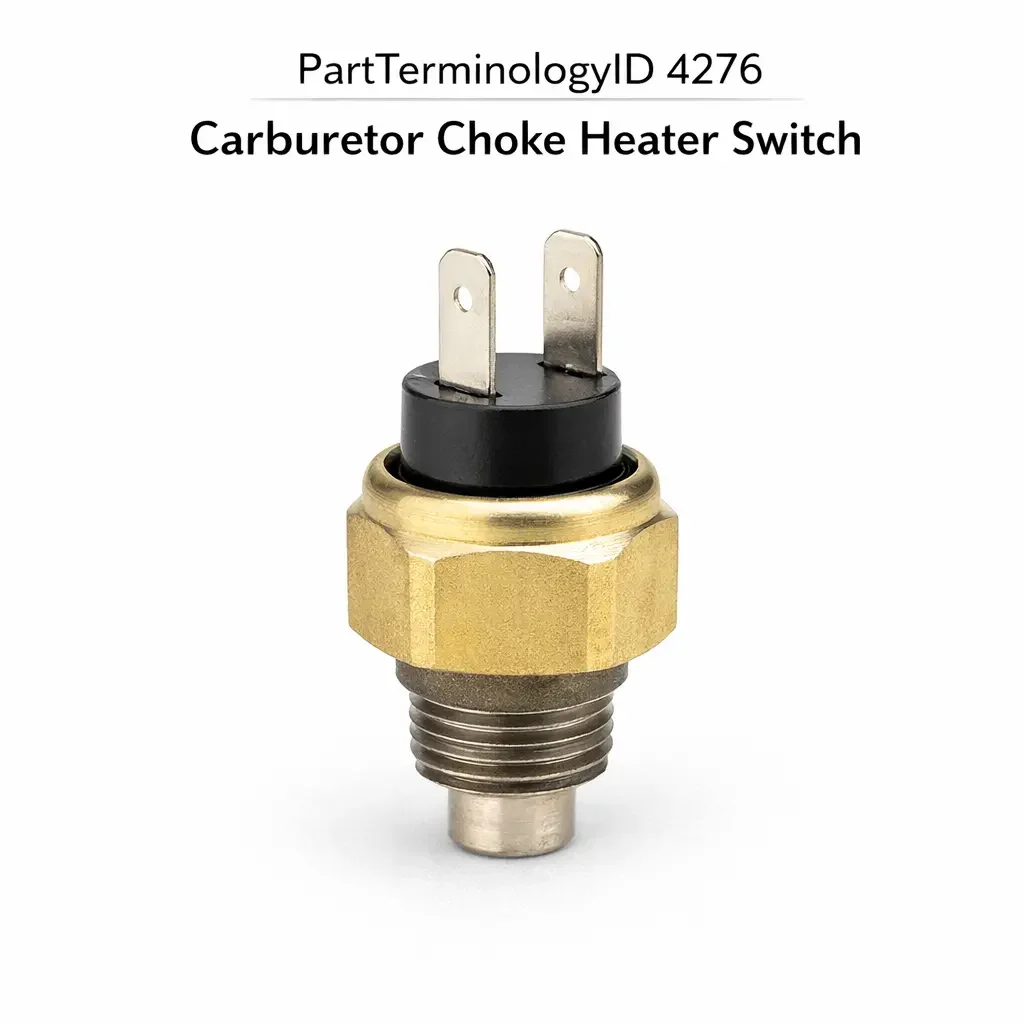
PartTerminologyID 4276, Carburetor Choke Heater Switch, is the thermostatic or bimetallic switch that controls the electric choke heater element mounted in or adjacent to the carburetor's automatic choke assembly, activating the heater circuit when the engine is running and deactivating it when the choke has reached the temperature at which the bimetallic choke spring has fully relaxed and the choke plate has opened to the fully warm-running position, preventing the heater element from continuing to draw current after the choke function is no longer needed and protecting the choke bimetallic spring from overheating that would distort the spring and alter the choke opening rate calibration. That definition covers the heater control function correctly and leaves unresolved every question that determines whether the replacement switch's temperature deactivation threshold matches the original calibration for the specific carburetor's choke spring opening rate, whether the switch is a coolant-temperature-sensing type mounted in the intake manifold coolant passage or an air-temperature-sensing type mounted in the air cleaner housing or carburetor throat, whether the switch circuit voltage and current rating match the choke heater element's power draw, whether the thread or mounting specification matches the port or bracket at the installation position, and whether the switch is compatible with a divorced choke assembly (where the bimetallic spring is mounted remotely on the intake manifold) or an integral choke assembly (where the bimetallic spring is housed directly on the carburetor).
It does not specify the deactivation temperature threshold, sensing type, circuit voltage, current rating, thread or mounting specification, or choke assembly configuration. A listing under PartTerminologyID 4276 that states only year, make, and model without sensing type and temperature threshold cannot be evaluated by a technician replacing a failed choke heater switch on a vehicle where the intake manifold uses a coolant-sensing switch port and the replacement offered under the same fitment is an air-sensing type designed for mounting in the air cleaner housing, because the two types are not interchangeable at the mounting position and the coolant-sensing type responds to a different thermal signal than the air-sensing type, producing a different choke opening timing even if both are physically installed in their respective positions.
For sellers, PartTerminologyID 4276 covers the same carbureted vehicle population as PartTerminologyID 4272, and the buyer arriving at this PartTerminologyID has diagnosed a choke-related cold-start performance complaint: the engine idles roughly after warm-up because the choke heater circuit is not deactivating the choke at the correct temperature, or the engine floods on cold start because the heater circuit is activating prematurely and opening the choke before the engine has produced enough heat to sustain a lean mixture. Both symptoms are directly traceable to a switch threshold mismatch, and the replacement must match the original calibration to restore the correct choke opening sequence.
What the Carburetor Choke Heater Switch Does
Choke Heater Circuit Control and the Bimetallic Spring Protection Function
The automatic choke on a carbureted engine uses a bimetallic spring that is stiff and coiled tightly at cold temperatures, holding the choke plate closed or partially closed to enrich the fuel mixture for cold-start operation. As the engine warms, the bimetallic spring relaxes and allows the choke plate to open progressively. The electric choke heater element accelerates this opening process by applying direct heat to the bimetallic spring, reducing the time the engine operates on an enriched mixture and reducing the hydrocarbon emissions associated with prolonged cold-start enrichment.
The choke heater switch's role is to control when the heater element is energized and when it is deactivated. It must activate the heater once the engine is running and producing heat, and must deactivate the heater before the bimetallic spring reaches a temperature that would distort it permanently. A switch that deactivates too late allows the heater to continue applying heat after the spring has fully relaxed, pushing the spring beyond its designed temperature range and permanently altering its tension calibration. A spring with reduced tension from overheating will open the choke earlier on subsequent cold starts than the carburetor's calibration intends, producing a lean stumble on cold mornings because the choke opens before the engine is warm enough to sustain the leaner mixture.
Coolant-Sensing versus Air-Sensing Switch Types
The choke heater switch is produced in two sensing types that measure different thermal signals and install at different positions on the engine. The coolant-sensing type threads into a port in the intake manifold coolant passage and monitors engine coolant temperature directly. It deactivates the choke heater circuit when the coolant temperature reaches the calibrated threshold, typically 60 to 75 degrees Celsius depending on the application. The air-sensing type mounts in the air cleaner housing or carburetor air horn and monitors the temperature of the incoming air charge. It deactivates the heater circuit when the air temperature at the carburetor inlet reaches the threshold, which occurs later in the warm-up cycle than the coolant threshold because the intake air heats more slowly than the coolant.
These two sensing types produce different choke opening timing even on the same engine, and they are not interchangeable. A coolant-sensing switch installed in a system designed for air-sensing will open the choke earlier (when the coolant is warm but the intake air is still cool), which may produce a lean stumble during warm-up. An air-sensing switch in a coolant-sensing port physically cannot sample intake air and will respond to coolant temperature regardless of the sensing element design, producing unpredictable choke timing.
Circuit Voltage, Current Rating, and Heater Element Compatibility
The choke heater element draws a fixed current at operating voltage, typically 2 to 4 amperes at 12 volts. The switch must be rated for the heater element's current draw at the circuit voltage. A switch with contacts rated for 2 amperes installed on a heater element drawing 3.5 amperes will experience accelerated contact arc erosion at the deactivation event, shortening the switch service life to a fraction of the original. The circuit voltage must also be confirmed on vehicles with voltage-reducing resistors in the choke heater circuit on some applications, where the heater element operates at 7 to 9 volts rather than full battery voltage.
Top Return Scenarios
Scenario 1: "Deactivation threshold too high, bimetallic spring overheated, choke opens early on subsequent cold starts"
The replacement switch deactivates the heater 20 degrees above the original threshold. The heater element continues to apply heat past the point where the bimetallic spring has fully relaxed, permanently reducing the spring's tension. On subsequent cold mornings the choke opens earlier than intended, producing a lean stumble during the first two minutes of operation.
Prevention language: "Temperature deactivation threshold: [X] degrees Celsius. Verify against original switch specification. A threshold higher than the original allows the heater to overheat the bimetallic spring, permanently altering choke opening calibration on subsequent cold starts."
Scenario 2: "Air-sensing switch installed in coolant-sensing port, choke opens early, lean stumble during warm-up"
The replacement is an air-sensing type. The intake manifold port requires a coolant-sensing type. The air-sensing element is submerged in coolant and responds to coolant temperature rather than air temperature, but its calibration is set for air temperature response. The choke deactivates at an incorrect temperature relative to the engine's actual warm-up state, producing a lean stumble during warm-up.
Prevention language: "Sensing type: [coolant-sensing, intake manifold port / air-sensing, air cleaner or carburetor throat mount]. Verify sensing type against installation position. Coolant-sensing and air-sensing types are not interchangeable and produce different choke opening timing on the same engine."
Scenario 3: "Contact current rating insufficient, arc erosion at deactivation contact, intermittent choke heater circuit within two months"
The replacement switch contacts are rated for 2 amperes. The choke heater element draws 3.5 amperes. The deactivation contact erodes through accelerated arc events at each warm-up cycle. Within two months the contact produces intermittent choke heater circuit activation, causing inconsistent choke opening from one cold start to the next.
Prevention language: "Contact current rating: [X] amperes at [X] volts. Verify against the choke heater element's current draw at circuit voltage. An undersized contact rating produces accelerated arc erosion at the deactivation event and intermittent heater circuit control within a fraction of the expected service interval."
Core Listing Attributes for PartTerminologyID 4276
PartTerminologyID: 4276
Component: Carburetor Choke Heater Switch
Temperature deactivation threshold in degrees Celsius (mandatory, in title)
Sensing type: coolant-sensing or air-sensing (mandatory, in title)
Circuit voltage: 12 volt or reduced voltage with resistor (mandatory)
Contact current rating in amperes (mandatory)
Thread specification for coolant-sensing types: diameter, pitch, thread form (mandatory)
Mounting specification for air-sensing types: bracket type or air cleaner housing clip (mandatory)
Choke assembly configuration: integral or divorced (recommended)
Year/make/model/engine/carburetor application
FAQ (Buyer Language)
How do I know if my choke heater switch is coolant-sensing or air-sensing?
A coolant-sensing switch is threaded into the intake manifold and has a wire leading from the switch body to the choke heater element. An air-sensing switch is clipped or bracketed in the air cleaner housing or carburetor air horn and has no coolant contact. If the original switch has a threaded base with coolant residue on the threads, it is a coolant-sensing type.
Can a failed choke heater switch cause the engine to flood on cold start?
Yes. A switch that fails closed (contact permanently closed) keeps the heater element energized before the engine is started if the circuit is powered at ignition-on rather than only when the engine is running. This pre-heats the bimetallic spring before the first crank event, partially opening the choke and leaning the cold-start mixture below the level needed for reliable starting on very cold mornings.
Related PartTerminologyIDs
Carburetor Temperature Switch (PartTerminologyID 4272): controls the EGR and vacuum advance circuits during warm-up; both switches are in the cold-start emissions control architecture but govern different circuits; a warm-up performance complaint should identify which circuit is misbehaving before ordering either switch
Carburetor Choke Pull-Off (if cataloged): the vacuum-actuated device that cracks the choke plate open immediately after start to prevent flooding; a failed pull-off produces a flooding symptom similar to a failed choke heater switch; confirm pull-off function before attributing a cold-start flooding complaint to the heater switch
Status in New Databases
PIES/PCdb: PartTerminologyID 4276, Carburetor Choke Heater Switch
PIES 8.0 / PCdb 2.0: No change in PartTerminologyID or terminology label
Final Take for PartTerminologyID 4276
Carburetor Choke Heater Switch (PartTerminologyID 4276) is the cold-start emissions control PartTerminologyID where a deactivation threshold mismatch produces a consequence that is not immediately visible but accumulates across every subsequent cold start: a permanently altered bimetallic spring calibration that causes the choke to open earlier than intended on every future cold morning. State the deactivation threshold in the title. State the sensing type in the title. State the contact current rating. State the full thread or mounting specification. For PartTerminologyID 4276, deactivation threshold, sensing type, and contact current rating are the three attributes that prevent the three most common return scenarios in the carburetor choke heater switch buyer population.