
Written by Arthur Simitian | PartsAdvisory
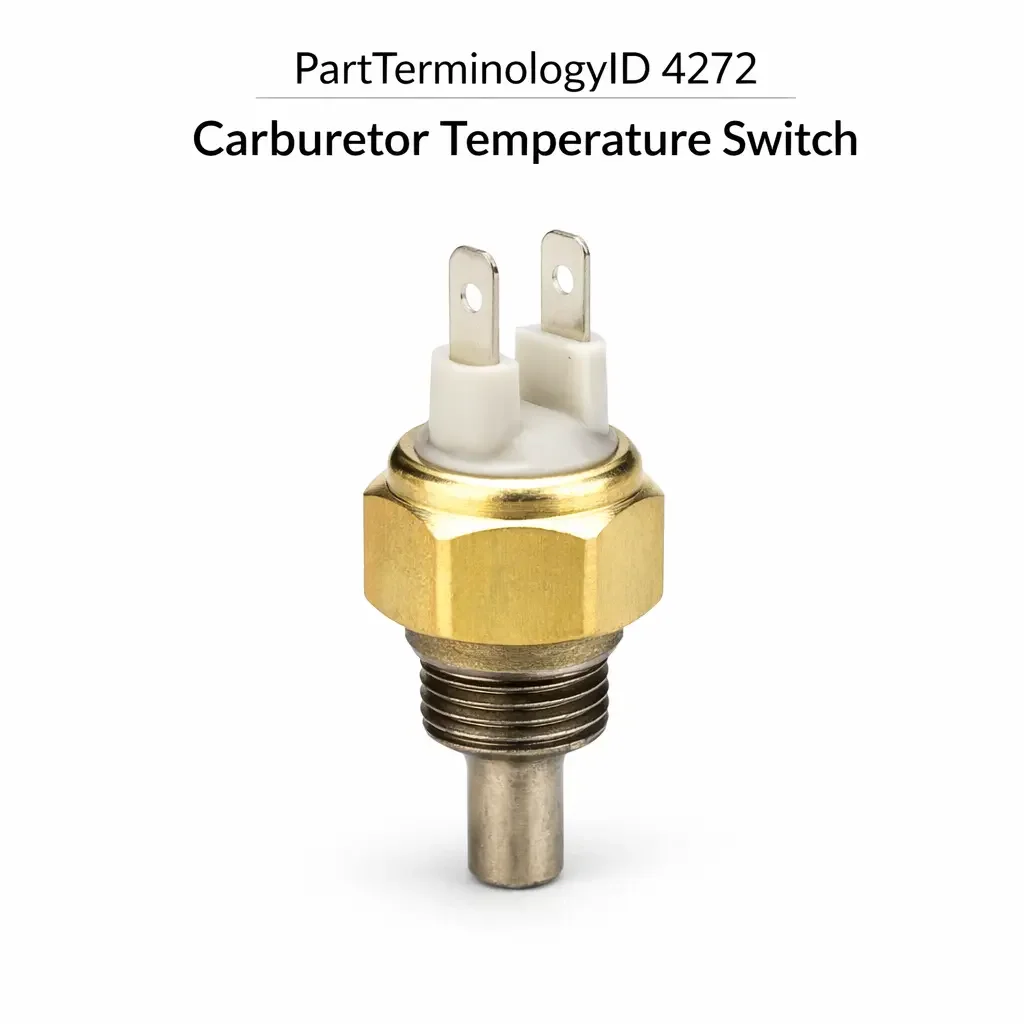
PartTerminologyID 4272, Carburetor Temperature Switch, is the thermostatic switch mounted in the carburetor body or the intake manifold adjacent to the carburetor that monitors fuel mixture temperature and opens or closes an electrical contact at a calibrated temperature threshold to control the carburetor's emissions-related secondary circuits, most commonly the exhaust gas recirculation (EGR) vacuum solenoid circuit, the idle speed control solenoid, or the distributor vacuum advance solenoid, preventing these circuits from activating until the engine reaches a minimum operating temperature and ensuring the emissions control strategy does not engage during cold start enrichment when engagement would increase hydrocarbon emissions or cause rough idle. That definition covers the temperature-switching function and the emissions circuit control role correctly and leaves unresolved every question that determines whether the replacement switch's temperature activation threshold matches the original calibration for the specific engine's warm-up profile, whether the thread specification matches the carburetor body or intake manifold port, whether the switch is a normally open type that closes on reaching temperature or a normally closed type that opens on reaching temperature depending on the specific emissions circuit design, and whether the switch body hex size and overall length match the carburetor port depth to prevent bottoming in a shallow port or leaving the sensing element underimmersed in a deep port.
It does not specify the temperature activation threshold, thread specification, contact configuration, hex size, or sensing element immersion depth. A listing under PartTerminologyID 4272 that states only year, make, and model without temperature threshold and contact configuration cannot be evaluated by a technician replacing a failed EGR control switch on a vehicle where the original switch opened the EGR vacuum circuit at 60 degrees Celsius and the replacement is calibrated to open at 80 degrees Celsius, causing the EGR system to engage 20 degrees earlier in the warm-up cycle than the original calibration intended and producing rough idle during warm-up on cold mornings.
For sellers, PartTerminologyID 4272 covers a declining but still actively serviced vehicle population of carbureted engines from the late 1970s through the early 1990s where emissions system integrity is required for smog inspection in states that test pre-OBD vehicles. A failed carburetor temperature switch that causes the EGR system to engage during cold start will produce a rough idle and elevated hydrocarbon emissions that fail the loaded-mode emissions test. The buyer replacing this switch has typically already diagnosed the emissions circuit and confirmed the switch as the failed component, and has a low tolerance for a replacement that activates at the wrong temperature threshold.
What the Carburetor Temperature Switch Does
Temperature Threshold Calibration and the Emissions Circuit Control Function
The carburetor temperature switch is one of several cold-start inhibit devices in the emissions control architecture of carbureted engines. Its role is to prevent vacuum from reaching the EGR valve, the distributor vacuum advance, or the idle speed control solenoid until the engine coolant or fuel mixture temperature reaches the calibrated minimum. Below the threshold, the switch holds the vacuum circuit open or closed (depending on the contact configuration) and the controlled device remains in its cold-start state. At the threshold, the switch changes state and allows the emissions control device to activate.
The temperature threshold is specific to the engine's calibrated warm-up profile. An engine calibrated for EGR engagement at 60 degrees Celsius uses a switch with a 60-degree opening point. Installing a switch with an 80-degree opening point on this engine delays EGR engagement, which increases NOx emissions during the warm-up period and may cause the vehicle to fail the NOx portion of an emissions test even though the EGR valve itself is functional. The threshold must be confirmed from the original part number or the vehicle's emissions tune-up specification before ordering.
Thread Specification, Contact Configuration, and Immersion Depth
The switch threads into a port in the carburetor body or intake manifold. Thread specification includes diameter, pitch, and thread form. The most common specifications in this PartTerminologyID are 3/8-18 NPT (tapered pipe thread used on many domestic carburetors), 1/8-27 NPT (used on smaller port applications), and metric straight thread with a sealing washer on some imported carburetor applications. A tapered pipe thread switch cannot be installed in a straight thread port without risking a hydraulic leak of coolant or fuel mixture past the seat, and a straight thread switch will not seal in a tapered pipe thread port regardless of torque applied.
The contact configuration (normally open or normally closed) determines how the switch interacts with the emissions circuit downstream. A normally open switch used to control an EGR vacuum solenoid keeps the solenoid de-energized during cold start and energizes it when the temperature threshold is reached. A normally closed switch in the same circuit position would energize the solenoid during cold start and de-energize it at threshold. The circuit design is fixed by the vehicle manufacturer and the switch contact configuration must match it. The listing must state both the threshold temperature and the contact configuration for every carburetor temperature switch listing.
Top Return Scenarios
Scenario 1: "Wrong temperature threshold, EGR engages during cold start, rough idle on cold mornings"
The replacement switch is calibrated 20 degrees higher than the original. The EGR system engages earlier in the warm-up cycle, producing rough idle and elevated hydrocarbon emissions during cold-morning warm-up. The buyer returns the switch as defective. The switch activates at its stated threshold correctly. The threshold does not match the application.
Prevention language: "Temperature activation threshold: [X] degrees Celsius. Verify against original switch specification or vehicle emissions tune-up data. A threshold higher or lower than the original will engage or inhibit the emissions circuit at a different point in the warm-up cycle than the calibration intends."
Scenario 2: "NPT tapered thread switch installed in straight thread port, coolant seep at switch base"
The carburetor port uses a metric straight thread with a sealing washer. The replacement uses a 3/8-18 NPT tapered thread. The tapered thread does not seal against the straight port walls regardless of torque applied. Coolant seeps past the thread engagement zone at operating temperature.
Prevention language: "Thread specification: [diameter x pitch, thread form: NPT tapered / straight with sealing washer]. Verify thread form against the carburetor or intake manifold port. A tapered pipe thread switch will not seal in a straight thread port at any torque."
Scenario 3: "Normally closed switch in normally open circuit, EGR active during cold start, fails emissions test"
The replacement switch is normally closed. The circuit requires normally open. The EGR system activates during cold start, increasing hydrocarbon emissions during the loaded-mode test phase and producing a test failure.
Prevention language: "Contact configuration: [normally open / normally closed]. Verify against the vehicle's emissions circuit design. Installing the wrong contact configuration activates the controlled emissions device during cold start when inhibition is required."
Core Listing Attributes for PartTerminologyID 4272
PartTerminologyID: 4272
Component: Carburetor Temperature Switch
Temperature activation threshold in degrees Celsius (mandatory, in title)
Contact configuration: normally open or normally closed (mandatory)
Thread specification: diameter, pitch, and thread form (mandatory)
Controlled circuit: EGR vacuum, distributor vacuum advance, or idle speed control (recommended)
Switch hex body size in mm or inches (mandatory)
Sensing element immersion depth for port depth verification (recommended)
Year/make/model/engine/carburetor application
FAQ (Buyer Language)
How do I confirm the correct temperature threshold?
The threshold is listed in the vehicle's emissions tune-up specification sheet, which is typically found on the underhood emissions label or in the factory service manual for the specific engine and carburetor combination. The original switch part number cross-reference is the most reliable confirmation method when the emissions label is missing or illegible.
Can I test the original switch before replacing it?
Yes. Remove the switch and place the sensing end in a container of water heated on a hot plate. Monitor the water temperature with a calibrated thermometer and connect a continuity tester across the switch terminals. The switch should change state (open to closed or closed to open) within a few degrees of the rated threshold. A switch that changes state significantly below or above the rated threshold has drifted from its calibration and requires replacement.
Related PartTerminologyIDs
EGR Valve (PartTerminologyID 4218 or similar): the device the carburetor temperature switch inhibits during cold start; a functioning switch with a failed EGR valve produces the same rough idle symptom; confirm EGR valve function before replacing the switch on a rough idle complaint
Distributor Vacuum Advance Unit (if applicable): the vacuum-operated timing advance that the switch inhibits during cold start on some applications; a switch that fails open allows vacuum advance during cold start, producing pinging on a cold engine
Status in New Databases
PIES/PCdb: PartTerminologyID 4272, Carburetor Temperature Switch
PIES 8.0 / PCdb 2.0: No change in PartTerminologyID or terminology label
Final Take for PartTerminologyID 4272
Carburetor Temperature Switch (PartTerminologyID 4272) is the emissions control PartTerminologyID where the temperature activation threshold is the primary specification and a mismatch of even 15 to 20 degrees produces measurable emissions test consequences on pre-OBD vehicles in active smog-check states. State the temperature threshold in the title. State the contact configuration. State the full thread specification with thread form. For PartTerminologyID 4272, temperature threshold, contact configuration, and thread form are the three attributes that prevent the three most common return scenarios in the carburetor temperature switch buyer population.