
Back Up Light Switch (PartTerminologyID 4240): Where Circuit Validation and Transmission Position Diagnosis Prevent Switch Replacement
Written by Arthur Simitian | PartsAdvisory
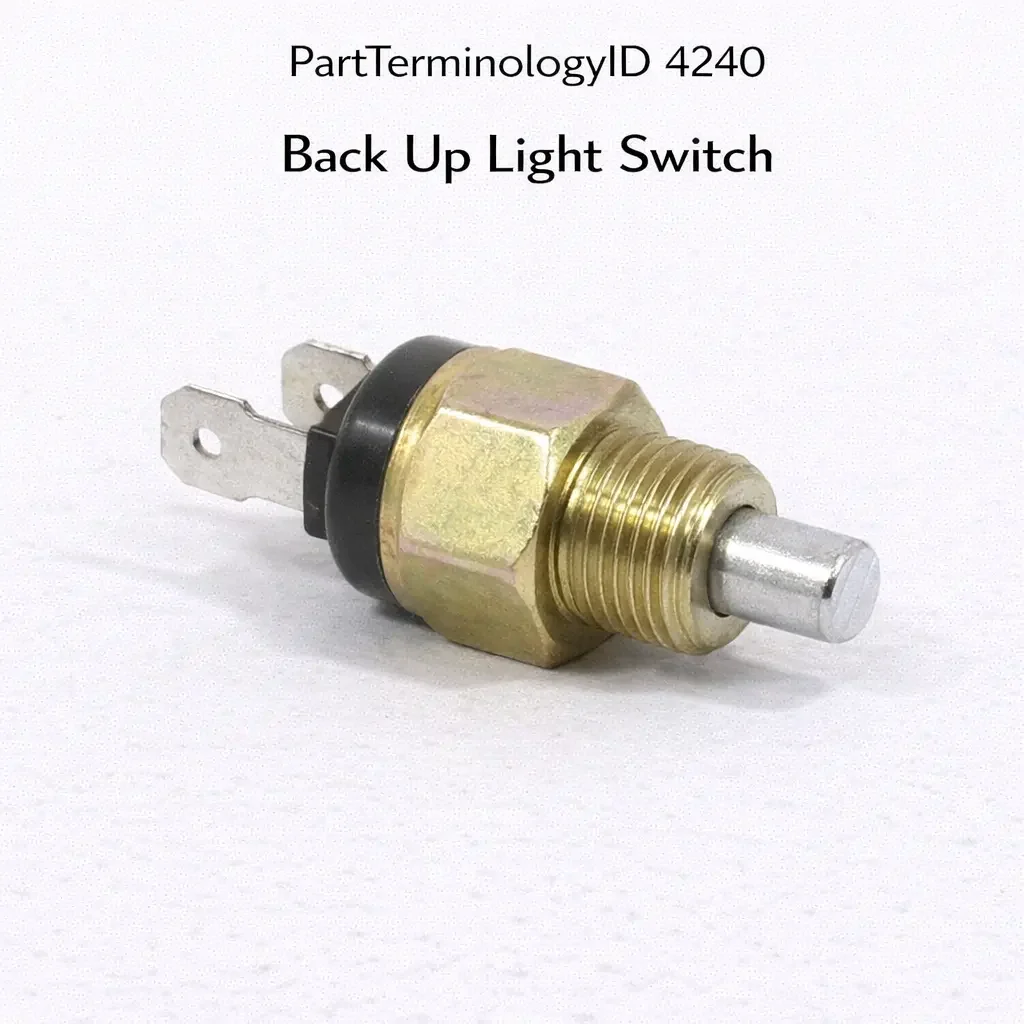
PartTerminologyID 4240, Back Up Light Switch, is the switch that completes the backup light circuit when the transmission or transaxle is placed in the reverse gear position, delivering switched power to the backup light sockets to illuminate the reverse lamps and alert pedestrians and following traffic that the vehicle is moving or about to move rearward. That definition covers the backup light switch function correctly and leaves unresolved whether the switch is a dedicated standalone switch that serves the backup light circuit only, mounted at the transmission side cover, shift rail, or selector shaft, a multi-function transmission range sensor or neutral safety switch that provides the backup light circuit output alongside starter inhibit, transmission position indicator, and other outputs through a single multi-pin connector assembly, whether the switch is mechanical with a plunger or ball detent that is physically displaced by the shift mechanism when reverse is selected, or an electronic position sensor that detects reverse position through a magnetic or Hall-effect sensing element, whether the switch is externally accessible for replacement without transmission disassembly or is internal to the transmission requiring transmission removal and partial disassembly for service, whether the backup light circuit on this vehicle is a simple direct-switched circuit from the switch to the backup light sockets or is a BCM-managed circuit where the switch provides a reverse position input to the BCM which then activates the backup light output, and whether a failed switch produces backup lights that are permanently dark, permanently illuminated, or intermittently operating depending on the failure mode.
For sellers, PartTerminologyID 4240 is the backup light switch where the neutral safety switch or transmission range sensor overlap is the most return-generating attribute, because many vehicles do not use a dedicated backup light switch but instead incorporate the backup light output into a multi-function transmission range sensor or neutral safety switch that also controls starter circuit inhibition, transmission position display in the instrument cluster, and shift indicator signals. A buyer who orders a dedicated backup light switch for a vehicle that uses a multi-function range sensor will receive a part that does not match the connector or mounting geometry on their transmission. Conversely, a buyer who orders a neutral safety switch replacement when the backup light circuit is the only failed function may receive a more expensive complete range sensor assembly when a dedicated backup light switch is the correct part for the specific fault.
What the Back Up Light Switch Does
Standalone switch versus multi-function range sensor and the fitment distinction
Standalone backup light switches are most common on manual transmission applications where the transmission does not have a transmission range sensor for automatic gear selection management. The switch is typically mounted in the transmission case or side cover where a plunger or ball detent is displaced by the shift mechanism when reverse gear is selected. Manual transmission backup light switches have two terminals that directly connect or disconnect the backup light circuit supply when reverse is engaged or disengaged.
Multi-function transmission range sensors are standard on automatic transmission applications where the sensor monitors the full range of gear selector positions including park, reverse, neutral, drive, and manual gear positions. The range sensor provides multiple outputs simultaneously: a reverse position signal for the backup lights, a park and neutral inhibit signal for the starter relay, a gear position signal for the instrument cluster PRNDL display, and a transmission control module input for shift scheduling. Replacing the backup light output portion of a range sensor requires replacing the complete range sensor assembly, as the individual output functions are not separately serviceable within the sensor.
The fitment distinction between a standalone backup light switch and a multi-function range sensor under the same symptom of dark backup lights requires confirming which component provides the backup light circuit before ordering. A listing that identifies the switch as a standalone manual transmission switch prevents it from being ordered for an automatic transmission range sensor application.
Mechanical plunger switch versus electronic position sensor
Mechanical plunger switches use a spring-loaded plunger that is depressed by a cam or shift rail when reverse is selected, closing the switch contacts and completing the backup light circuit. These switches are durable and simple to test: with the transmission in reverse, the plunger should be depressed and continuity confirmed through the switch. With the transmission in any forward gear or neutral, the plunger should be extended and the switch should show open circuit. A mechanical switch that shows continuous continuity regardless of gear position has a failed spring or welded contact. A switch that shows open circuit in all positions has a failed contact or a plunger that is not being displaced by the shift mechanism.
Electronic position sensors use a magnetic field or Hall-effect element to detect the position of a target on the shift shaft or selector without physical contact. These sensors typically output a voltage signal rather than a simple switch closure. Testing an electronic position sensor requires confirming the output voltage is at the specified level for the reverse position and at a different level for non-reverse positions. A sensor that outputs the same voltage regardless of selector position has a failed sensing element. A sensor that outputs correct voltage levels but produces no backup light activation may have a fault in the BCM processing of the sensor signal rather than a sensor fault.
BCM-managed backup light circuit and the activation chain
On BCM-managed backup light circuits the switch provides a position input to the BCM rather than directly completing the backup light supply circuit. The BCM reads the switch input, confirms the reverse position, and activates the backup light supply through a BCM output driver. A BCM output driver fault prevents backup light activation regardless of switch condition, because the switch correctly signals the reverse position but the BCM does not respond with the backup light output.
A buyer who finds the backup lights dark in reverse on a BCM-managed application has either a failed switch providing no reverse signal to the BCM, a BCM output driver fault preventing backup light activation despite receiving a correct reverse signal, or a failed backup light socket or bulb. Confirming the BCM is receiving the reverse position signal by observing the reverse gear indicator on the instrument cluster or through a scan tool separates a switch fault from a BCM output fault. If the reverse indicator on the cluster illuminates correctly when reverse is selected but the backup lights remain dark, the BCM reverse position input is confirmed functional and the fault is in the BCM backup light output or the backup light circuit downstream.
Why This Part Generates Returns
Buyers return backup light switches because the vehicle uses a multi-function transmission range sensor and the standalone backup light switch ordered does not fit the multi-pin range sensor connector, the BCM has a backup light output fault and the switch is correctly signaling reverse position, the backup light bulbs have failed and the backup light circuit supply is functioning correctly from the switch, the backup light circuit fuse has blown and the switch is delivering a correct switched output to an open fuse circuit, the shift mechanism is not fully engaging reverse and the switch plunger is not being displaced to the closing position, and the switch is an internal transmission component that requires transmission removal to access and the buyer was not prepared for the service scope.
Status in New Databases
PartTerminologyID 4240 is cataloged in PIES/PCdb as Back Up Light Switch. Under PIES 8.0 and PCdb 2.0 there is no change to the terminology or classification for this PartTerminologyID.
Top Return Scenarios
Scenario 1: "Multi-function range sensor application, standalone backup light switch ordered, does not fit"
The buyer's backup lights are dark in reverse. The vehicle has an automatic transmission with a multi-function range sensor. The buyer orders a standalone backup light switch. The switch connector does not match the range sensor connector on the transmission. No installation point exists. The buyer returns the switch as incorrect.
Prevention language: "Transmission type confirmation: Automatic transmissions on this application use a multi-function transmission range sensor rather than a standalone backup light switch. The range sensor provides the backup light output alongside multiple other transmission position functions through a single multi-pin connector. A standalone backup light switch does not apply to this application. The correct replacement is the transmission range sensor assembly."
Scenario 2: "BCM backup light output fault, switch correctly signals reverse, backup lights remain dark"
The backup lights are dark when reverse is selected. The instrument cluster reverse gear indicator illuminates correctly when reverse is selected, confirming the BCM is receiving the reverse position signal from the switch. The BCM output driver for the backup light circuit has failed. The buyer replaces the backup light switch. The BCM output fault remains. The backup lights remain dark despite the new switch correctly signaling reverse position.
Prevention language: "BCM output validation: On BCM-managed backup light circuits confirm the BCM is activating the backup light output by checking whether the reverse gear indicator illuminates correctly in the instrument cluster when reverse is selected. A correctly illuminated reverse indicator confirms the BCM is receiving the reverse position signal. If the indicator illuminates but the backup lights remain dark, the fault is in the BCM backup light output circuit rather than the switch. Switch replacement will not restore backup lights when the BCM output driver has failed."
Scenario 3: "Backup light fuse blown, switch delivers correct output to open fuse circuit, switch replaced with no change"
The backup lights are dark. The backup light circuit fuse has blown from a wiring short. The backup light switch correctly closes when reverse is selected. The closed switch delivers supply voltage to the backup light circuit up to the blown fuse. No current flows to the backup light sockets. The buyer replaces the switch. The blown fuse remains. The replacement switch also delivers correct output to the same open fuse circuit. No change.
Prevention language: "Backup light fuse check: Before replacing the backup light switch, confirm the backup light circuit fuse is intact. Probe the backup light supply circuit for voltage with the vehicle in reverse. No supply voltage at the backup light socket supply terminals indicates either a blown fuse, an open circuit upstream of the switch, or a BCM output fault. Check the fuse before diagnosing the switch."
Scenario 4: "Shift mechanism not fully engaging reverse, switch plunger not displaced, switch replaced with no change"
The backup lights illuminate intermittently when reverse is selected. Sometimes the lights work and sometimes they do not. The shift mechanism has worn detent components that do not always fully seat in the reverse gear position. When the shift mechanism does not fully seat, the switch plunger is not fully displaced and the switch contacts do not fully close. The buyer replaces the switch. The worn shift mechanism detent remains. The replacement switch experiences the same intermittent plunger displacement. The backup lights continue to work intermittently.
Prevention language: "Shift mechanism engagement check: Intermittent backup light operation that correlates with reverse gear engagement may reflect a shift mechanism that does not fully seat in the reverse position rather than a switch fault. Confirm the transmission shifts fully into reverse and the gear selector moves firmly to the reverse detent before diagnosing an intermittent switch. A switch that closes intermittently from incomplete gear engagement requires shift mechanism service rather than switch replacement."
Scenario 5: "Failed backup light bulbs, switch functional, backup lights dark despite correct switch operation"
The backup lights are dark in reverse. The backup light switch is confirmed closing correctly in reverse. Supply voltage is confirmed at the backup light socket supply terminals in reverse. The backup light bulbs have failed filaments. The buyer replaces the switch. The new switch delivers the same supply voltage to the same failed bulbs. No change.
Prevention language: "Backup light bulb pre-check: Before replacing the backup light switch, confirm supply voltage is present at the backup light socket supply terminals with the vehicle in reverse. If supply voltage is present at the sockets but the lights do not illuminate, the backup light bulbs have failed filaments and bulb replacement resolves the dark backup light condition. Switch replacement is not required when supply voltage is confirmed at the socket terminals."
Listing Requirements
PartTerminologyID: 4240
Switch type: standalone or multi-function range sensor (mandatory)
Transmission type: manual or automatic (mandatory)
Sensing type: mechanical plunger or electronic position sensor (mandatory)
Circuit architecture: direct-switched or BCM-managed (mandatory)
Accessibility: external or internal transmission (mandatory)
Multi-function range sensor note where applicable (mandatory)
BCM output validation note on BCM-managed applications (mandatory)
Fuse check note (mandatory)
Shift mechanism engagement note (mandatory)
Bulb pre-check note (mandatory)
OEM part number cross-reference (mandatory)
Catalog Checklist for ACES/PIES Teams
PartTerminologyID = 4240
Require switch type: standalone or range sensor (mandatory)
Require transmission type: manual or automatic (mandatory)
Require sensing type: mechanical or electronic (mandatory)
Require circuit architecture: direct or BCM-managed (mandatory)
Prevent range sensor application mismatch: automatic transmission applications use multi-function range sensors; standalone switch does not apply; transmission type must be confirmed before assigning
Prevent BCM output fault return: reverse indicator illumination confirms switch function on BCM-managed applications; BCM output validation must precede switch replacement
Prevent fuse fault return: supply voltage at socket confirms switch function; fuse check must precede switch diagnosis
Prevent shift mechanism return: intermittent backup lights require shift mechanism engagement confirmation before switch diagnosis
FAQ (Buyer Language)
My backup lights do not work when I select reverse. Is it the switch?
Before diagnosing the switch, confirm the backup light fuse is intact and that supply voltage is present at the backup light socket supply terminals with the vehicle in reverse. If supply voltage is present at the sockets but the lights do not illuminate, the bulbs have failed. If no supply voltage is present at the sockets, probe the backup light switch output terminal for voltage with the vehicle in reverse to confirm whether the switch is closing correctly.
How do I test the backup light switch?
For a mechanical plunger switch, disconnect the connector and measure continuity through the switch with the vehicle in reverse. The switch should show continuity in reverse and open circuit in all other gear positions. For an electronic sensor, measure the output voltage at the sensor terminal with the selector in reverse and compare to the specified voltage for the reverse position.
My backup lights work sometimes but not always. What causes intermittent backup lights?
Intermittent backup light operation with an otherwise correctly functioning switch most commonly indicates a shift mechanism that does not consistently fully engage the reverse detent position, an intermittent switch contact from early wear, or a corroded switch connector that introduces variable resistance in the circuit. Confirm the transmission shifts firmly and consistently into the reverse detent before replacing the switch on an intermittent complaint.
My vehicle has an automatic transmission. Do I need a backup light switch or a transmission range sensor?
Automatic transmission vehicles use a multi-function transmission range sensor that provides the backup light output alongside other transmission position outputs. A standalone backup light switch does not apply to automatic transmission applications. Confirm the correct replacement is the transmission range sensor assembly for your specific automatic transmission application.
How do I know if the BCM is receiving the reverse signal from the switch?
Observe the reverse gear indicator in the instrument cluster when the selector is placed in reverse. If the cluster indicator illuminates correctly, the BCM is receiving the reverse position signal from the switch and the switch is confirmed functional for that input. If the cluster indicator does not illuminate and the backup lights are also dark, the switch or shift mechanism is the likely fault source. If the indicator illuminates but the backup lights remain dark, the fault is in the BCM backup light output circuit.
What Sellers Get Wrong About PartTerminologyID 4240
The most common error is omitting the multi-function range sensor identification for automatic transmission applications. A standalone backup light switch ordered for an automatic transmission application has no installation point on the multi-pin range sensor connector. Without the range sensor identification note buyers on automatic transmission applications order the wrong part and return it immediately as incorrect. This is the highest-volume return under this PartTerminologyID by a significant margin and is entirely preventable with one sentence identifying the correct part type for automatic transmission applications.
The second error is omitting the BCM output validation note for BCM-managed backup light circuits. A BCM output fault producing dark backup lights despite a correctly functioning switch is indistinguishable from a switch fault without confirming whether the cluster reverse indicator illuminates. Without the BCM output validation note buyers replace the switch and find the backup lights remain dark because the BCM output fault was never addressed.
The third error is omitting the fuse check note. A blown backup light fuse produces dark backup lights with a correctly operating switch. Without the fuse check note buyers replace the switch and find the backup lights remain dark because the blown fuse was not replaced.
The fourth error is omitting the shift mechanism engagement note for intermittent backup light complaints. A shift mechanism that does not consistently fully seat in the reverse detent position produces intermittent backup light operation from incomplete switch plunger displacement. Without the shift mechanism note buyers replace the switch on a shift mechanism fault and find the backup lights continue to operate intermittently.
Cross-Sell Logic
Transmission Range Sensor: for buyers on automatic transmission applications where the backup light output is provided by a multi-function range sensor rather than a standalone switch, and where the range sensor backup light output has failed requiring complete range sensor replacement.
BCM: for buyers where the cluster reverse indicator confirms the BCM is receiving the reverse position signal correctly but the BCM is not activating the backup light output, indicating a BCM backup light output driver fault.
Backup Light Bulb: for buyers where the switch is confirmed closing in reverse, supply voltage is confirmed at the backup light socket terminals, but the backup lights remain dark, indicating failed bulb filaments rather than a switch fault.
Backup Light Fuse: for buyers where no supply voltage is present at the backup light socket terminals in reverse and the fault traces to a blown backup light circuit fuse rather than a switch or BCM fault.
Transmission Shift Mechanism Components: for buyers where intermittent backup light operation traces to a shift mechanism that does not consistently fully engage the reverse detent, requiring shift mechanism service rather than switch replacement.
Why Catalog Data Quality Matters for PartTerminologyID 4240
Backup light switch returns cluster around four scenarios that are fully preventable with listing language: the multi-function range sensor mismatch on automatic transmission applications, the BCM output fault misdiagnosis, the blown fuse misdiagnosis, and the intermittent shift mechanism misdiagnosis. The multi-function range sensor mismatch generates the highest return volume because automatic transmission applications represent the majority of the current vehicle population and standalone backup light switches do not apply to these applications. The BCM output fault misdiagnosis, fuse misdiagnosis, and shift mechanism misdiagnosis each generate a meaningful share of returns that are preventable with one to two sentences of listing guidance.
The multi-function range sensor note is the single highest-impact attribute for this PartTerminologyID. Without it the majority of automatic transmission application buyers order the wrong part type and return it immediately. Every listing for a standalone backup light switch must explicitly confirm the application is a manual transmission and not an automatic transmission range sensor application before any buyer completes the purchase.
Application Range and Fitment Guidance for PartTerminologyID 4240
Standalone backup light switch applications are concentrated in manual transmission vehicles where the switch is a discrete component that can be replaced without affecting other transmission position control functions. Manual transmission backup light switches are common across domestic, European, and Asian vehicle platforms from the 1960s through the present, with the switch typically mounted in an accessible external position on the transmission case.
Automatic transmission applications from the 1980s onward almost universally use multi-function transmission range sensors that incorporate the backup light output as one of several position outputs. Dedicated standalone backup light switches on automatic transmissions are found primarily on older domestic vehicles from the 1960s and 1970s where the automatic transmission used a dedicated reverse switch separate from the neutral safety switch, and on some simple automatic transmissions where the reverse gear is identified by a single separate switch rather than a full range sensor.
Electronic position sensor backup light switches became common on manual transmissions from the mid-1990s onward as manufacturers moved away from mechanical plunger switches toward more durable non-contact sensing. These electronic sensors are vehicle-specific and may look similar across different applications but have different connector pinouts and output voltage specifications. Fitment claims must confirm connector geometry, sensing type, and output specification for electronic sensor applications rather than relying on visual similarity.
Final Take for PartTerminologyID 4240
Back Up Light Switch (PartTerminologyID 4240) is the reverse position detection component where multi-function range sensor identification, BCM output validation, fuse check guidance, and shift mechanism engagement verification are the four attributes that prevent the four most common return scenarios. Every listing without range sensor identification generates returns from automatic transmission buyers who receive the wrong part type. Every listing without BCM output validation generates returns from buyers whose BCM output fault was not identified before switch replacement. Every listing without fuse check guidance generates returns from buyers who replaced a functional switch on a blown fuse circuit. Every listing without shift mechanism engagement guidance generates returns from buyers whose intermittent backup lights traced to an incomplete reverse gear engagement rather than a switch fault.
Together these four attributes make every listing under this PartTerminologyID complete.