
Written by Arthur Simitian | PartsAdvisory
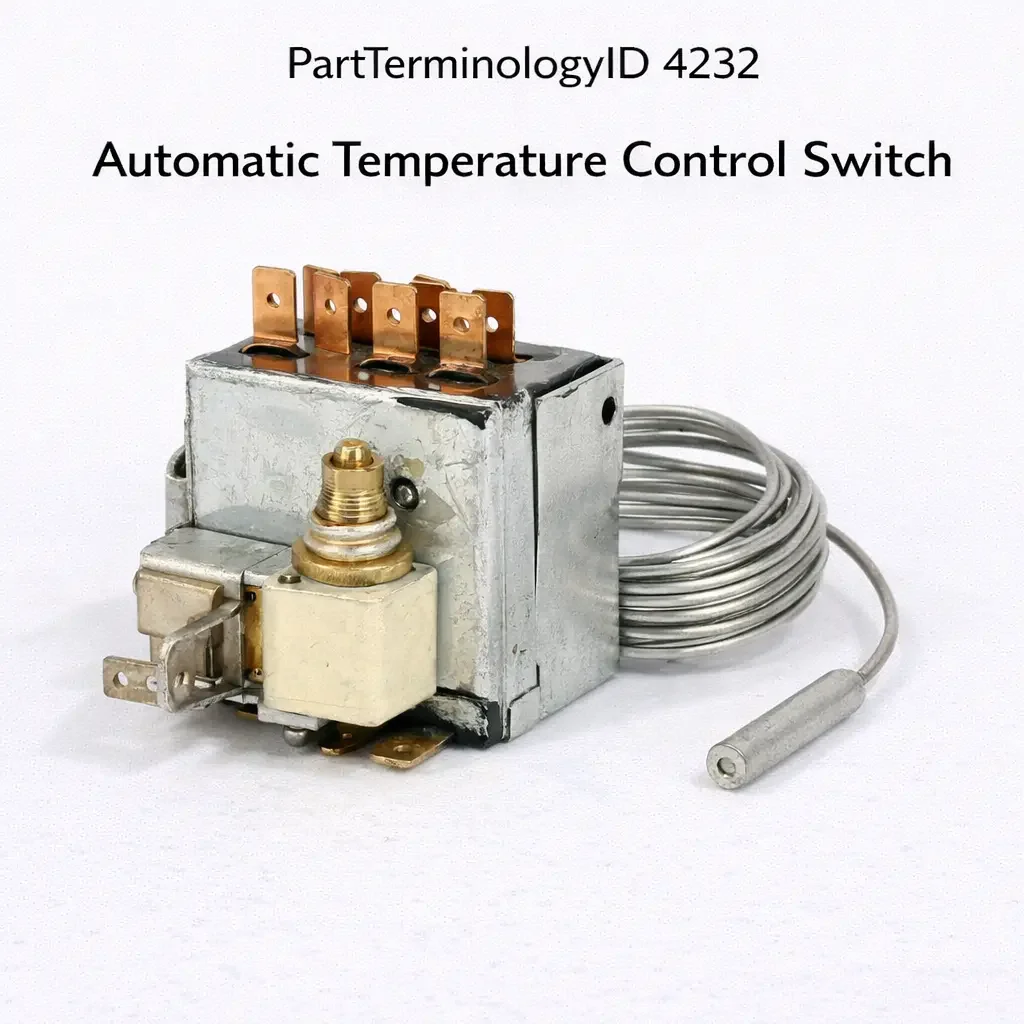
PartTerminologyID 4232, Automatic Temperature Control Switch, is the operator interface component specific to automatic climate control systems through which the driver sets a desired cabin temperature setpoint, enabling the automatic temperature control module to calculate and manage the required blend door position, blower motor speed, compressor state, and air distribution mode to achieve and maintain the selected temperature without further driver input. That definition covers the automatic temperature control switch function correctly and leaves unresolved whether the switch is a rotary encoder that transmits a digital pulse count to the ATC module as the driver turns a dial, a resistive potentiometer that produces a variable voltage proportional to dial position that the ATC module reads as a temperature setpoint, a set of discrete pushbuttons for temperature increment and decrement that each generate a discrete digital signal, a capacitive touch interface on the climate control display panel, or a voice command interface on systems where the driver requests a temperature verbally and the voice recognition module translates the request to an ATC module input, whether the switch communicates with the ATC module through a direct-wired signal, a LIN bus, a CAN bus, or a proprietary climate control data network, whether the switch assembly is a discrete temperature knob or button set replaceable independently of the full climate control head unit, or whether the temperature selection function is integrated into a single climate control panel assembly that cannot be serviced at the individual switch level, and whether a failed temperature control switch produces a system that defaults to a fixed temperature, a system that cannot be adjusted from its current setpoint, or a system that receives random or erroneous temperature requests from a corrupted switch signal.
For sellers, PartTerminologyID 4232 is the automatic temperature control switch where ATC module sensor input validation is the most return-generating attribute, because the ATC module manages cabin temperature by comparing the driver's setpoint from the switch to the actual cabin temperature measured by the in-cabin temperature sensor, the evaporator temperature sensor, and the ambient temperature sensor. A system where the cabin temperature does not reach the setpoint may have a failed in-cabin sensor that reports incorrect cabin temperature to the ATC module, causing the module to undershoot or overshoot the target without the switch being at fault. A system where the temperature control does not respond to switch adjustment may have an ATC module that is receiving a corrupted setpoint signal from a different fault in the switch circuit rather than a failed switch contact. The ATC module cannot distinguish between a correctly adjusted switch sending an incorrect signal from electrical noise and a failed switch contact sending no signal, and both produce the same non-responsive ATC system symptom.
What the Automatic Temperature Control Switch Does
Setpoint signal generation and the ATC module response
The automatic temperature control switch generates a setpoint signal that tells the ATC module what cabin temperature the driver desires. The module compares this setpoint to the measured cabin temperature from the in-cabin aspirated temperature sensor and calculates the required system adjustments. If the cabin temperature is below the setpoint the module moves the blend door toward maximum heat, increases blower speed, and may activate the compressor off to allow faster heating. If the cabin temperature is above the setpoint the module moves the blend door toward maximum cool, activates the compressor, and adjusts blower speed for the required cooling rate.
A switch that is generating an incorrect setpoint signal will cause the ATC module to drive the system toward an incorrect target. A resistive potentiometer switch with a worn resistance track may generate a setpoint signal that jumps erratically as the dial is turned, causing the module to oscillate between heating and cooling modes. A rotary encoder switch with a failed contact may generate a setpoint that does not change when the dial is turned, leaving the system at the last valid setpoint until the dial is moved to a position where the encoder contact functions correctly.
The setpoint signal must be tested at the ATC module input terminal, not at the switch connector alone, to confirm both the switch output and the signal path integrity between the switch and the module are correct. A switch that generates a correct output at its own connector but is connected to the module through a high-resistance or intermittent connector will deliver a degraded signal that the module cannot interpret correctly.
In-cabin temperature sensor and ambient sensor as ATC module inputs that simulate switch faults
The in-cabin aspirated temperature sensor is mounted in the instrument panel and draws a small amount of cabin air across a thermistor through a motorized or aspirated flow path. The thermistor resistance changes with air temperature and the ATC module reads this resistance to determine the current cabin temperature. A failed in-cabin sensor that reports an incorrect cabin temperature causes the module to calculate an incorrect temperature error and drive the system toward the wrong target.
A buyer whose automatic climate control consistently maintains the cabin at a temperature different from the setpoint may have a failed in-cabin temperature sensor reporting incorrect cabin temperature to the module rather than a switch that is generating an incorrect setpoint. Both faults produce a climate control system that does not maintain the desired temperature, and the driver adjusts the setpoint dial trying to compensate, which looks like a switch non-responsiveness complaint.
The ambient temperature sensor reports outdoor temperature to the ATC module and affects the module's calculation of the required system capacity. A failed ambient sensor reporting an incorrect outdoor temperature can cause the module to provide insufficient cooling on a hot day or insufficient heating on a cold day, producing a comfort complaint that appears as a switch non-responsiveness issue when the switch is correctly setting the driver's desired temperature.
ATC module architecture and the setpoint processing fault
The ATC module processes the setpoint signal from the temperature control switch alongside multiple sensor inputs through its control algorithm to produce output commands for the blend door actuator, blower motor, compressor relay, and air distribution mode. A module with a failed algorithm section may receive a correct setpoint signal but produce incorrect output commands that do not correspond to the setpoint.
On current vehicles the ATC module is often integrated with other body electronic modules such as the BCM or the infotainment controller. A module that has developed a software fault may require recalibration or reprogramming rather than physical replacement. A buyer who replaces the temperature control switch on a module programming fault will find the new switch sends the same correct setpoint signal to the same module programming fault with no improvement in ATC system response.
Why This Part Generates Returns
Buyers return automatic temperature control switches because the in-cabin temperature sensor has failed and the ATC module is driving the system toward an incorrect temperature based on a false sensor reading rather than an incorrect switch setpoint, the ATC module has a logic fault that prevents correct setpoint processing regardless of switch condition, the switch signal path between the switch and the module has a high-resistance connection that corrupts the setpoint signal at the module input, the switch is integrated into a climate control head unit that cannot be serviced at the individual switch level and the complete head unit requires replacement, the blend door actuator has failed and does not respond to the temperature commands generated by the module regardless of setpoint, and the refrigerant system is undercharged and the ATC system cannot achieve cooling setpoints regardless of switch command accuracy.
Status in New Databases
PartTerminologyID 4232 is cataloged in PIES/PCdb as Automatic Temperature Control Switch. Under PIES 8.0 and PCdb 2.0 there is no change to the terminology or classification for this PartTerminologyID.
Top Return Scenarios
Scenario 1: "In-cabin sensor failed, ATC module driving system to incorrect temperature, switch replaced with no change"
The buyer's automatic climate control consistently maintains the cabin temperature 8 degrees warmer than the selected setpoint. The in-cabin aspirated temperature sensor has a failed thermistor that reads 8 degrees below actual cabin temperature. The ATC module adds heat to bring the measured cabin temperature up to the setpoint, but since the measured temperature is already 8 degrees below actual, the cabin reaches 8 degrees above the setpoint before the module stops adding heat. The buyer adjusts the setpoint dial and concludes the switch is not responding correctly. The buyer replaces the switch. The in-cabin sensor fault remains. The ATC system continues to overheat the cabin by 8 degrees.
Prevention language: "In-cabin temperature sensor validation: Before replacing the temperature control switch, confirm the in-cabin aspirated temperature sensor is reading correctly. An ATC system that consistently over-heats or under-cools by a fixed margin regardless of setpoint adjustment may have a failed in-cabin sensor that reports incorrect cabin temperature to the module. The module drives the system to an incorrect temperature from the sensor error, not from a switch fault. Measure the in-cabin sensor resistance and compare to the temperature-resistance specification before diagnosing the switch."
Scenario 2: "ATC module logic fault, correct setpoint received but incorrect outputs produced"
A scan tool confirms the ATC module is receiving the correct temperature setpoint from the switch when the driver adjusts the dial. The module registers the setpoint change correctly. However, the module does not produce the corresponding blend door actuator and blower speed output adjustments. A module logic fault is preventing setpoint-to-output translation. The buyer replaces the temperature control switch. The module fault remains. The new switch sends the same correct setpoint to the same logic fault with no improvement.
Prevention language: "ATC module setpoint reception check: On automatic climate control systems confirm with a scan tool that the ATC module is registering the correct setpoint change when the temperature dial is adjusted. If the module registers correct setpoint changes but does not produce corresponding actuator and blower speed adjustments, the fault is in the ATC module logic rather than the switch. Switch replacement will not restore ATC system response when the module is receiving correct setpoints but not producing corresponding outputs."
Scenario 3: "High-resistance signal path, setpoint corrupted at module input, erratic ATC response"
The temperature control switch generates a correct setpoint signal at its own connector. The signal path between the switch connector and the ATC module input terminal has a corroded connector pin that introduces variable resistance into the setpoint signal wire. The ATC module receives a corrupted setpoint that varies erratically with connector resistance changes from vibration. The ATC system oscillates between heating and cooling modes from the erratic setpoint. The buyer replaces the switch. The corroded connector pin remains. The new switch signal is corrupted by the same connector resistance fault.
Prevention language: "Setpoint signal path validation: Confirm the temperature setpoint signal is correct at the ATC module input terminal, not only at the switch output connector. A high-resistance or intermittent connector in the signal path between the switch and the module corrupts the setpoint before it reaches the module input. Measure signal voltage or resistance at the module input terminal and compare to the switch output to confirm the signal path is intact before ordering a switch replacement."
Scenario 4: "Blend door actuator failed, temperature output fixed, buyer adjusts setpoint expecting change but finds none"
The blend door actuator has failed in the mid-range position. The ATC module correctly adjusts the blend door command in response to setpoint changes from the switch, but the actuator cannot move from its failed position. The cabin temperature remains at the fixed blend door position temperature regardless of setpoint. The buyer concludes the temperature dial is non-functional and replaces the switch. The actuator fault remains. No change in cabin temperature response.
Prevention language: "Blend door actuator response check: Before replacing the temperature control switch, confirm the blend door actuator is responding to temperature commands. Listen near the HVAC housing when changing the temperature setpoint from the minimum cold to maximum hot position. A functioning actuator produces a motor sound as the blend door moves across its full range. No motor sound with setpoint changes from an extreme cold to extreme hot position indicates a blend door actuator fault rather than a switch fault."
Listing Requirements
PartTerminologyID: 4232
Switch type: rotary encoder, potentiometer, or pushbutton (mandatory)
Communication type: direct-wired, LIN bus, CAN bus, or proprietary network (mandatory)
Serviceability: discrete replaceable switch or integrated head unit (mandatory)
In-cabin sensor validation note (mandatory)
ATC module setpoint reception check note (mandatory)
Setpoint signal path validation note (mandatory)
Blend door actuator response check note (mandatory)
Refrigerant charge check note where applicable (mandatory)
OEM part number cross-reference (mandatory)
Catalog Checklist for ACES/PIES Teams
PartTerminologyID = 4232
Require switch type: encoder, potentiometer, or pushbutton (mandatory)
Require communication type (mandatory)
Require serviceability: discrete or integrated head unit (mandatory)
Prevent in-cabin sensor return: consistent temperature offset from setpoint is a sensor fault; in-cabin sensor validation must precede switch diagnosis
Prevent ATC module return: scan tool setpoint reception confirmation must precede switch replacement on ATC non-response complaints
Prevent signal path corruption return: setpoint signal must be confirmed at module input terminal, not only at switch connector
Prevent blend actuator return: actuator motor sound check must confirm actuator responds to temperature setpoint extremes before switch diagnosis
FAQ (Buyer Language)
My automatic climate control always runs warmer than the temperature I set. Is it the switch?
A consistent temperature offset above or below the setpoint is more commonly caused by a failed in-cabin aspirated temperature sensor than a failed switch. The sensor reports incorrect cabin temperature to the ATC module, causing the module to over-heat or under-cool the cabin by the amount of the sensor error. Measure the in-cabin sensor resistance and compare to the temperature-resistance chart for your application before replacing the switch.
How do I confirm the ATC module is receiving my temperature switch input?
Connect a scan tool with climate control system access and read the ATC module live data while adjusting the temperature dial. The module should register a changing setpoint value when the dial is turned. If the module shows the setpoint changing correctly but the system does not respond accordingly, the module is the fault source. If the module shows no setpoint change when the dial is turned, the switch or signal path is the fault.
My temperature control does not change the cabin temperature regardless of what I set. Is the switch broken?
Before diagnosing the switch, listen near the HVAC housing when you move the temperature dial from the coldest to hottest setting. A functional blend door actuator produces a motor sound across the full range change. If you hear no motor sound and the cabin temperature is fixed regardless of setpoint, the blend door actuator has likely failed rather than the switch. Also confirm the refrigerant system is charged and the compressor is activating for cooling requests.
How do I test the temperature switch signal at the ATC module input?
For a potentiometer switch, measure DC voltage between the signal wire at the ATC module input connector and ground while rotating the temperature dial from cold to hot. The voltage should change smoothly from one extreme to the other as the dial is turned. A voltage that does not change or that jumps erratically indicates either a switch contact fault or a signal path resistance fault between the switch and the module.
What Sellers Get Wrong About PartTerminologyID 4232
The most common error is omitting the in-cabin temperature sensor validation note. The in-cabin sensor is the primary input that the ATC module uses to evaluate whether the cabin has reached the driver's setpoint. A failed sensor produces an offset temperature behavior that buyers interpret as a non-responsive switch because adjusting the setpoint does not produce the expected cabin temperature. Without the sensor validation note buyers replace the switch and find the cabin temperature offset persists because the sensor fault remains.
The second error is omitting the ATC module setpoint reception check note. A module logic fault that prevents setpoint-to-output translation is indistinguishable from a switch fault from the driver's perspective. Without the scan tool setpoint reception check note buyers replace a functional switch and return it when the module continues to not respond to the new switch's setpoints identically to the original.
The third error is omitting the setpoint signal path validation note. A corroded connector in the signal path between the switch and the module corrupts the setpoint signal before it reaches the module, producing erratic ATC behavior from a functional switch. Without the signal path validation note buyers replace the switch and return it when the corroded connector continues to corrupt the new switch's signal.
The fourth error is omitting the blend door actuator check note. A fixed cabin temperature despite correct setpoint changes is a blend door actuator fault in a significant share of cases. Without the actuator check note buyers replace the temperature switch on an actuator fault and return it when the temperature remains fixed.
Cross-Sell Logic
In-Cabin Aspirated Temperature Sensor: for buyers where the ATC system consistently over-heats or under-cools by a consistent margin regardless of setpoint, indicating a failed in-cabin sensor reporting incorrect cabin temperature to the module.
Blend Door Actuator: for buyers where the temperature setpoint is confirmed reaching the ATC module correctly but the cabin temperature does not change from a fixed output, and no blend door actuator motor sound is heard across the full setpoint range.
ATC or Climate Control Module: for buyers where a scan tool confirms the module is receiving correct setpoint changes from the switch but the module is not producing corresponding blend door and blower output adjustments, indicating a module logic fault.
Ambient Temperature Sensor: for buyers where the ATC system performs correctly on mild weather days but struggles to achieve setpoints on very hot or very cold days, indicating an ambient sensor fault affecting the module's capacity calculations.
Climate Control Head Unit: for buyers where the temperature control switch is integrated into a head unit assembly that cannot be serviced at the individual switch component level, requiring complete head unit replacement to restore the temperature control function.
Final Take for PartTerminologyID 4232
Automatic Temperature Control Switch (PartTerminologyID 4232) is the setpoint input component where in-cabin sensor validation, ATC module setpoint reception confirmation, signal path integrity check, and blend door actuator response verification are the four attributes that prevent the four most common return scenarios. Every listing without in-cabin sensor validation generates returns from buyers whose consistent temperature offset traced to a sensor fault rather than a switch fault. Every listing without module setpoint reception confirmation generates returns from buyers whose module logic fault prevented setpoint processing regardless of switch condition. Every listing without signal path validation generates returns from buyers whose corroded signal path connector corrupted the switch signal before it reached the module. Every listing without blend door actuator response verification generates returns from buyers whose fixed temperature output traced to an actuator fault rather than the switch.
Together these four attributes make every listing under this PartTerminologyID complete.