
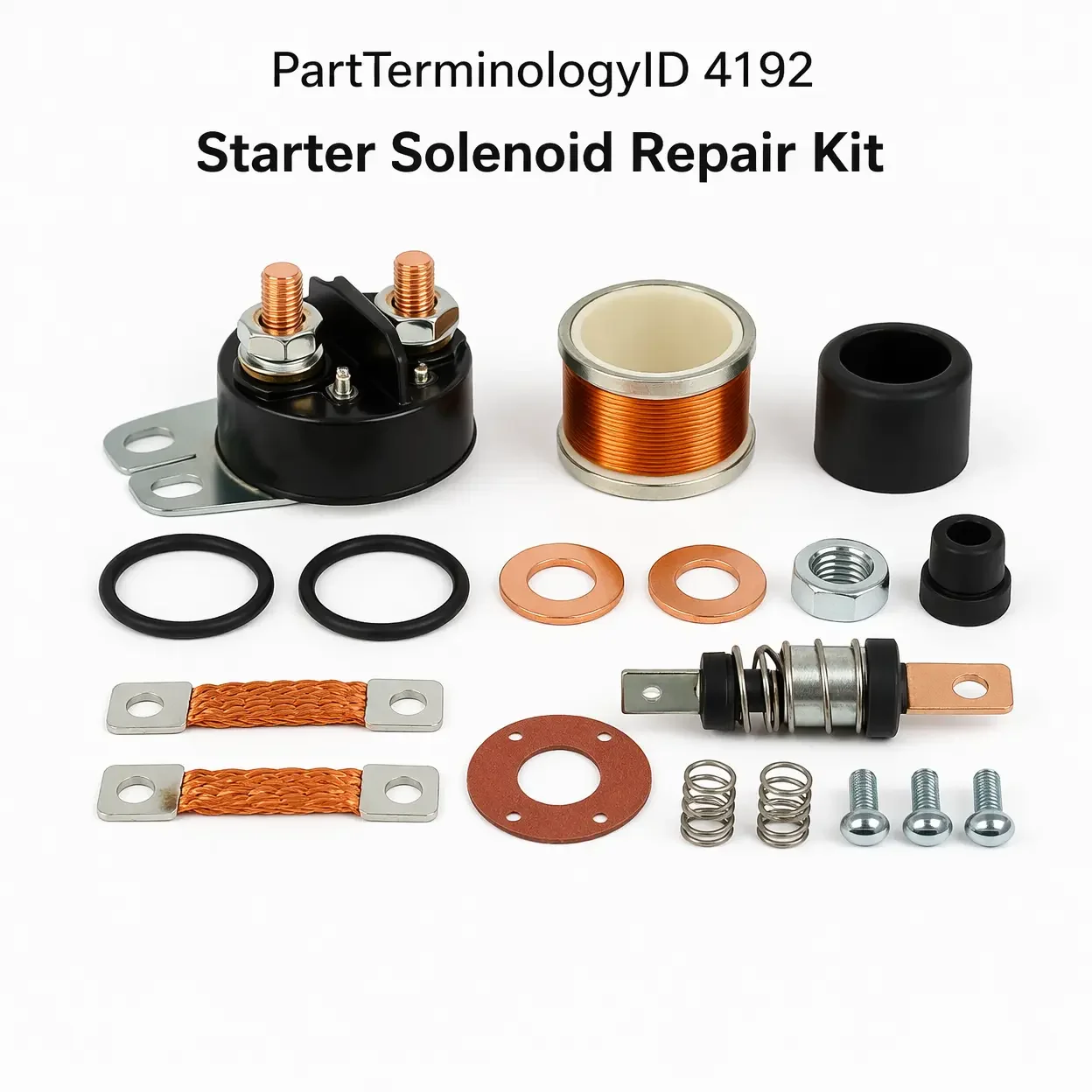
PartTerminologyID 4192, Starter Solenoid Repair Kit, is the service kit containing the internal wear components of the starter solenoid assembly that restore the solenoid's ability to close the high-current starter circuit and engage the starter drive pinion with the ring gear on every ignition key or push-button crank event, including the contact disc, the contact posts or terminal washers, the plunger return spring, the plunger seal or boot, and in some kit configurations the solenoid plunger itself, allowing a technician to rebuild the existing solenoid housing rather than replace the complete starter assembly. That definition covers the rebuild function and the component content correctly and leaves unresolved every question that determines whether the kit's contact disc material matches the current and thermal demands of the specific starter motor's inrush load, whether the contact disc diameter and thickness match the original solenoid's contact chamber geometry, whether the plunger seal material is rated for the underhood thermal environment at the starter mounting position, whether the plunger return spring free length and spring rate match the original to ensure full contact disc engagement and full pinion disengagement at the end of the crank event, whether the terminal post hardware included in the kit covers the correct thread size and torque specification for the battery cable and motor lead terminals, whether the kit is intended for a direct-drive starter solenoid or a gear-reduction starter solenoid where the contact geometry differs, whether the solenoid is an integral unit mounted on the starter body or a remote-mounted solenoid on the inner fender or firewall, and whether the vehicle's charging system voltage is 12 volt or 24 volt because the contact disc and spring specifications differ between the two system voltages.
It does not specify the contact disc material grade, disc diameter, disc thickness, plunger seal material rating, plunger return spring rate, terminal post thread size, starter type compatibility, solenoid mounting configuration, or system voltage. A listing under PartTerminologyID 4192 that states only year, make, and model without starter type and solenoid configuration cannot be evaluated by a technician rebuilding the solenoid on a gear-reduction starter where the contact disc is smaller in diameter and sits in a recessed contact chamber that requires a disc with a tighter diameter tolerance than the disc used in a direct-drive solenoid on the same vehicle platform, because the manufacturer used both starter types across the production run and the solenoid contact chamber geometry is not interchangeable between them.
For sellers, PartTerminologyID 4192 occupies a specific position in the starter system service market that direct starter replacement does not. A complete starter replacement resolves a solenoid failure but discards a functional starter motor armature, commutator, brushes, and drive assembly that may have significant remaining service life. A solenoid repair kit that restores the contact disc and plunger function at a fraction of the complete starter replacement cost is the correct repair for a solenoid that has failed due to contact disc erosion or plunger seal degradation while the motor itself remains serviceable. The buyer population for PartTerminologyID 4192 skews toward professional technicians and experienced owner-operators who have diagnosed the solenoid as the specific failed component rather than replacing the complete assembly on a no-start complaint. These buyers are performing a precise repair and have a low tolerance for kit components that do not match the original solenoid's dimensional and material specifications.
What the Starter Solenoid Repair Kit Restores
Starter Solenoid Function and the High-Current Contact Circuit
The starter solenoid performs two simultaneous functions on every ignition crank event. The first is the engagement function: the solenoid's pull-in winding draws the plunger inward when the ignition switch closes the control circuit, and the plunger's mechanical linkage pushes the starter drive pinion along the armature shaft to mesh with the ring gear on the flywheel or flex plate. The second is the switching function: as the plunger reaches the end of its inward travel, the contact disc mounted on the plunger end bridges the two high-current terminal posts inside the solenoid, closing the main starter circuit between the battery cable terminal and the motor terminal and delivering full battery voltage to the starter motor.
The contact disc is the component at the center of the solenoid repair kit because it is the only component in the starter circuit that carries the full starter inrush current through a mechanical contact interface rather than a permanent soldered or welded connection. Starter inrush current on a cold engine cranking event ranges from 150 amperes on a small displacement four-cylinder to over 400 amperes on a large displacement diesel, with the peak inrush lasting the first 50 to 100 milliseconds before the motor reaches operating speed and current draw drops to the steady-state cranking value. The contact disc carries this inrush current across two small contact faces where the disc surface meets the terminal post faces, and the cumulative effect of hundreds or thousands of these high-current make-and-break cycles erodes the contact surfaces progressively through arc erosion and resistive heating at the contact interface.
Contact Disc Erosion, Voltage Drop, and Hard-Start Progression
Contact disc erosion does not produce a single-event failure. It produces a progressive deterioration that manifests as an increasingly difficult start over dozens or hundreds of crank events before the contact resistance rises high enough to prevent cranking entirely. The first symptom is a slightly extended crank duration before the engine fires: the eroded contact surface produces a higher resistance at the disc-to-post interface, which drops the voltage delivered to the starter motor terminals below the full battery voltage available at the battery posts. A motor receiving 10.5 volts instead of 12.4 volts at its terminals produces proportionally less torque and cranks the engine more slowly, requiring more crank cycles to achieve ignition.
The second symptom is a single click or a rapid clicking with no motor rotation: the contact resistance has risen high enough that the voltage drop across the contact interface reduces motor terminal voltage below the minimum required for armature rotation, but the solenoid control circuit still draws the plunger fully inward and the disc contacts the posts, producing the audible click. At this stage, a voltage drop test across the solenoid contact circuit (measuring the voltage differential between the battery cable terminal post and the motor terminal post with the ignition in the crank position) will show a drop significantly above the 0.2 volt maximum allowable for a serviceable contact circuit, confirming contact disc erosion as the failure mode and identifying the solenoid rebuild as the correct repair rather than a battery or starter motor replacement.
Plunger Seal Degradation and Contamination Ingress
The plunger seal or boot at the rear of the solenoid housing prevents moisture, oil mist, and particulate contamination from entering the solenoid contact chamber through the plunger shaft passage. A degraded plunger seal admits contamination that deposits on the contact disc surface and the terminal post faces between crank events. Contamination on the contact surfaces increases contact resistance independently of mechanical erosion, accelerating the voltage drop progression described above. Contamination that includes engine oil mist produces a carbonized deposit on the contact surfaces after repeated high-current arc events, because the arc temperature carbonizes the oil residue and the carbon deposit is itself conductive but has substantially higher resistivity than the clean copper or copper-alloy contact surface.
The repair kit's plunger seal must be rated for the underhood temperature at the starter mounting position and must be compatible with the oil mist and fuel vapor environment of the engine bay. A seal material rated for 120 degrees Celsius that installs in a starter position adjacent to the exhaust manifold where underhood temperatures reach 150 degrees Celsius will harden and crack within one to two thermal cycles, restoring contamination ingress and producing the same failure mode as the degraded original seal within months of the rebuild.
Plunger Return Spring Rate and the Pinion Disengagement Requirement
The plunger return spring performs the disengagement function at the end of the crank event: when the ignition switch opens the control circuit, the return spring pushes the plunger back to its rest position, withdrawing the contact disc from the terminal posts to open the main starter circuit and simultaneously retracting the drive pinion from engagement with the ring gear. A return spring with a lower-than-original spring rate produces incomplete pinion disengagement: the pinion remains partially engaged with the ring gear after the engine starts, and if the driver releases the ignition key slowly rather than immediately, the now-running engine's ring gear drives the still-engaged pinion at engine speed, which is far higher than the starter armature's rated speed. Over-speed armature rotation can destroy the starter drive in a single event.
A return spring with a higher-than-original spring rate produces premature contact disc separation during the hold-in phase of a cranking event on vehicles where the battery voltage is marginal: the increased spring force requires the hold-in winding to develop more magnetic force to maintain plunger position against the spring, and at low battery voltage the hold-in winding may not sustain sufficient force to hold the disc fully against the posts throughout the crank event, producing intermittent contact loss mid-crank. The spring rate must match the original specification precisely, not merely fall within a general automotive solenoid spring range.
Contact Disc Material, Current Rating, and Why the Wrong Grade Fails Faster Than the Original
Copper versus copper-alloy contact disc materials and the current density requirement
Starter solenoid contact discs are manufactured from copper or copper alloy materials in grades selected for their combination of electrical conductivity, arc erosion resistance, and hardness at elevated temperature. A pure copper disc provides maximum electrical conductivity and minimum contact resistance but has lower arc erosion resistance than a copper-tungsten or copper-chromium alloy disc, because the arc events at contact make and break ablate the softer pure copper surface more rapidly than the harder alloy. A copper-tungsten disc provides substantially better arc erosion resistance but slightly higher contact resistance than pure copper, which is acceptable on starter circuits where the contact resistance contribution of a new disc is negligible relative to the total circuit resistance.
The failure mode of an undergraded contact disc (a disc with lower arc erosion resistance than the original) is accelerated contact surface erosion that reproduces the original hard-start symptom within a fraction of the original service interval. A buyer who installs a repair kit with a pure copper disc in a solenoid originally equipped with a copper-tungsten disc will find that the rebuilt solenoid begins showing voltage drop symptoms after a significantly shorter service period than the original, concluding that the rebuild was not effective when the actual cause is the disc material mismatch. The listing must specify the contact disc material grade and must match it to the original solenoid specification for the application.
Contact disc diameter and thickness tolerance and the contact chamber geometry requirement
The contact disc must match the internal geometry of the solenoid contact chamber in diameter and thickness. A disc with a smaller diameter than the contact chamber bore will rock or tilt under the plunger spring load, producing uneven contact pressure across the disc face and concentrating the contact current through a reduced contact area. Concentrated current through a reduced contact area produces higher current density at the contact zone, which increases arc erosion rate and thermal stress at the contact face. A disc with a larger diameter than the chamber bore cannot enter the chamber and will prevent plunger travel to the full contact position.
A disc with a smaller thickness than the original will produce a contact gap at full plunger travel that is larger than the original design, because the disc does not reach the terminal post faces at the designed plunger travel endpoint. This effectively reduces the contact force at the disc-to-post interface, increasing contact resistance. A disc with a larger thickness than the original will contact the terminal posts before the plunger reaches full inward travel, preventing complete pinion engagement with the ring gear and producing a partial mesh condition that damages both the pinion teeth and the ring gear teeth under starter cranking torque.
Terminal post hardware and the torque specification requirement
The terminal post hardware included in the repair kit (the nut, washer, and in some kits the terminal post stud itself) must be installed to the torque specification for the solenoid's terminal post thread size. Undertorqued terminal post hardware produces a high-resistance joint at the battery cable lug and motor lead lug connection that adds to the total circuit resistance independently of the contact disc condition. A terminal post nut torqued to 5 Newton-meters on a post requiring 12 Newton-meters produces a joint that passes the full starter inrush current through a partially compressed lug-to-post contact interface, heating the joint and the cable lug during every crank event. Repeated thermal cycling of an undertorqued joint progressively relaxes the joint further as the copper lug anneals under the repeated heating, worsening the resistance with each crank event.
Overtorqued terminal post hardware on brass or aluminum terminal posts strips the thread and destroys the post, requiring complete solenoid housing replacement rather than the repair the kit was intended to perform. The listing must state the terminal post thread size and the torque specification for every terminal hardware configuration in the kit, and must note the consequence of undertorque and overtorque at the terminal posts explicitly.
Direct-Drive versus Gear-Reduction Starter Solenoid Configurations
Why the same vehicle platform may use two different solenoid internal geometries
Many vehicle platforms were produced with both direct-drive starter motors and gear-reduction starter motors across the production run, with the changeover occurring mid-production-year or at a model year boundary. The direct-drive starter uses a solenoid with a longer plunger stroke and a larger contact chamber to accommodate the greater mechanical travel required to engage the drive pinion directly with the ring gear through the plunger linkage. The gear-reduction starter uses a solenoid with a shorter plunger stroke and a smaller contact chamber because the gear reduction mechanism moves the pinion engagement through a separate shift fork actuated by the solenoid plunger, requiring less plunger travel than the direct-drive configuration.
A repair kit specified for the direct-drive solenoid and installed in a gear-reduction solenoid housing will include a contact disc with a larger diameter than the gear-reduction chamber bore, preventing the disc from entering the chamber. A kit specified for the gear-reduction solenoid installed in a direct-drive housing will include a contact disc with a smaller diameter than the direct-drive chamber bore, producing the tilting and uneven contact pressure described above. The starter type (direct-drive or gear-reduction) is a mandatory attribute for every repair kit listing covering platforms where both types were used in the same model year range.
Integral solenoid versus remote-mounted solenoid configurations
Some vehicle platforms use a solenoid mounted remotely on the inner fender or firewall rather than integrally on the starter motor body. The remote solenoid performs only the switching function (closing the main starter circuit between the battery and the starter motor) and does not perform the mechanical engagement function, because the starter drive engagement on these platforms is handled by a separate engagement relay or by an integral engagement mechanism within the starter motor. The remote solenoid's contact disc and plunger geometry differ from an integral solenoid's because the remote solenoid has no plunger linkage to the drive pinion and uses a shorter plunger stroke sized only for contact disc travel rather than pinion engagement travel.
A repair kit specified for an integral starter-mounted solenoid will include a plunger return spring designed for the longer stroke and higher spring force required to retract the drive pinion through the mechanical linkage. Installing this spring in a remote solenoid compresses the return spring force against only the contact disc mass and produces a contact separation speed and force that exceeds the remote solenoid's design parameters, potentially causing the contact disc to bounce on contact make and produce arc events that accelerate erosion. The solenoid mounting configuration (integral or remote) is a mandatory attribute for every repair kit listing.
Why This Part Generates Returns
Buyers return starter solenoid repair kits because the contact disc diameter is correct for the direct-drive solenoid and the buyer has a gear-reduction solenoid where the chamber bore is smaller, preventing the disc from seating in the contact chamber; the plunger return spring free length is longer than the original and the solenoid housing cover cannot be reinstalled without compressing the spring beyond its designed preload, requiring more force than the plunger hold-in winding can overcome at low battery voltage; the terminal post hardware thread is metric M8 and the solenoid uses a SAE 5/16-18 thread, preventing the nut from engaging; the plunger seal is a rubber formulation rated for 120 degrees Celsius and installs adjacent to the exhaust manifold where the underhood temperature exceeds this rating, hardening and cracking within the first month; the kit is specified for the 12-volt system and the vehicle is a medium-duty truck with a 24-volt charging system where the contact disc and spring specifications differ; the solenoid is the remote fender-mounted type and the kit includes a plunger assembly dimensioned for an integral starter-mounted solenoid with a longer stroke; the contact disc material is pure copper and the original was copper-tungsten, producing accelerated erosion that reproduces the hard-start symptom within one third of the expected service interval; and the kit does not include a torque specification for the terminal post hardware and the technician undertorques the battery cable terminal nut, producing a high-resistance joint that generates the same voltage drop symptom as the eroded contact disc the kit was installed to repair.
Top Return Scenarios
Scenario 1: "Contact disc too large for gear-reduction solenoid chamber, plunger travel blocked"
The buyer's vehicle has a gear-reduction starter. The listing covers the vehicle by year, make, and model without specifying starter type. The delivered kit includes the contact disc sized for the direct-drive solenoid, which uses a contact chamber bore 2mm larger in diameter than the gear-reduction solenoid. The technician cannot seat the disc in the contact chamber. The plunger cannot travel to the full contact position. The solenoid cannot close the starter circuit. The vehicle does not crank after the rebuild.
Prevention language: "Starter type: [direct-drive / gear-reduction]. Contact disc diameter: [X] mm. This kit is specified for the [direct-drive / gear-reduction] solenoid. Verify the starter type before ordering. The direct-drive and gear-reduction solenoid contact chamber bores differ in diameter and are not interchangeable. Installing the wrong disc diameter blocks plunger travel and prevents the solenoid from closing the starter circuit."
Scenario 2: "Return spring too long, solenoid housing cover cannot be reinstalled without exceeding spring preload"
The buyer installs the contact disc and seats the plunger in the solenoid housing. The replacement return spring is 4mm longer at free length than the original. The solenoid housing cover cannot be pressed to the housing lip without compressing the spring beyond its designed installation preload. The technician applies force sufficient to compress the spring and install the cover retaining ring. On the first cold-start crank event, the hold-in winding cannot maintain the plunger against the excess spring preload at the degraded battery voltage of a cold morning, and the contact disc separates from the terminal posts mid-crank, producing a single loud click and no motor rotation.
Prevention language: "Return spring free length: [X] mm. Spring rate: [X] N/mm. This kit includes a spring matched to the original specification. Verify the spring free length against the original before installation. A spring longer than the original prevents housing cover installation without excess preload. Excess preload prevents the hold-in winding from maintaining contact at low battery voltage."
Scenario 3: "Metric terminal hardware installed on SAE-thread terminal posts, nut does not engage"
The buyer's solenoid has corroded terminal post hardware that requires replacement as part of the rebuild. The kit includes M8 metric nuts and washers. The solenoid terminal posts use a SAE 5/16-18 thread. The M8 nut will not start on the SAE post thread. The buyer attempts to seat the nut by force and cross-threads the post, destroying the terminal post thread and requiring complete solenoid housing replacement.
Prevention language: "Terminal post hardware thread: [metric M8 / SAE 5/16-18 / SAE 3/8-16]. Verify the solenoid terminal post thread before installing hardware from the kit. An M8 nut will not engage a SAE 5/16-18 post and cannot be forced to seat without destroying the post thread. Thread mismatch requires complete solenoid housing replacement."
Scenario 4: "Plunger seal rated for 120 degrees Celsius installed adjacent to exhaust manifold, cracks within four weeks"
The buyer rebuilds the starter solenoid on a four-cylinder engine where the starter mounts on the transmission bell housing directly below the exhaust manifold. The replacement plunger seal in the kit is a standard rubber formulation rated for 120 degrees Celsius. The underhood temperature at the starter position on this engine reaches 145 to 155 degrees Celsius after a hot-soak period. The seal hardens within the first month of operation and cracks during a cold-morning contraction cycle, reopening the plunger shaft passage to oil mist ingress. The contact surface carbonizes within sixty days of the rebuild and the hard-start symptom returns.
Prevention language: "Plunger seal material: [standard rubber, rated to 120 degrees Celsius / high-temperature silicone, rated to 175 degrees Celsius]. Verify the underhood temperature at the starter mounting position before ordering. Starter positions adjacent to or below exhaust manifolds regularly exceed 120 degrees Celsius. A standard rubber seal in a high-temperature starter position will harden and crack within the first thermal cycles."
Scenario 5: "12-volt kit installed in 24-volt system, contact disc and spring specifications insufficient for 24-volt inrush current"
The buyer services a medium-duty truck with a 24-volt electrical system. The listing covers the engine family without distinguishing system voltage. The delivered kit is specified for the 12-volt variant of the starter. The 24-volt system produces a higher inrush current at the contact disc because the motor draws higher current at 24 volts to produce the torque required to crank the larger diesel engine. The contact disc material in the 12-volt kit is undergraded for the 24-volt arc energy at contact make and break. The disc erodes to the hard-start threshold within half the expected service interval.
Prevention language: "System voltage: [12 volt / 24 volt]. This kit is specified for the [12-volt / 24-volt] starter solenoid. The 24-volt solenoid uses a contact disc with higher arc erosion resistance than the 12-volt solenoid to handle the higher inrush current and arc energy at contact make. Verify the vehicle's charging system voltage before ordering."
Scenario 6: "Remote fender-mounted solenoid, integral starter kit installed, plunger stroke mismatch"
The buyer's vehicle uses a remote solenoid mounted on the inner fender. The listing covers the vehicle by year and model without distinguishing solenoid mounting configuration. The delivered kit includes a plunger dimensioned for an integral starter-mounted solenoid with a stroke length 12mm longer than the remote solenoid's travel. The plunger bottoms on the housing end cap before the contact disc reaches full engagement with the terminal posts, leaving a residual gap that limits contact pressure and produces elevated contact resistance on every crank event.
Prevention language: "Solenoid mounting configuration: [integral starter-mounted / remote fender or firewall-mounted]. Plunger stroke: [X] mm. This kit is specified for the [integral / remote] solenoid configuration. The integral and remote solenoid plunger stroke lengths differ by application. A plunger sized for the integral solenoid bottoms on the remote housing end cap before full disc engagement."
Scenario 7: "Contact disc material is pure copper, original was copper-tungsten, hard-start returns within eight months"
The buyer rebuilds the solenoid on a fleet vehicle that makes fifty or more cold starts per day. The kit includes a pure copper contact disc. The original solenoid used a copper-tungsten disc selected for high duty cycle operation. After eight months of service, the rebuilt solenoid develops the hard-start symptom again. A voltage drop test confirms contact surface erosion. The disc has eroded to the failure threshold in less than one third of the service interval the original disc achieved, because pure copper has a fraction of the arc erosion resistance of copper-tungsten under high duty cycle inrush current events.
Prevention language: "Contact disc material: [pure copper / copper-tungsten / copper-chromium]. For high duty cycle applications (fleet vehicles, delivery vehicles, frequent cold starts), specify the copper-tungsten or copper-chromium disc. Pure copper provides maximum conductivity but lowest arc erosion resistance. A pure copper disc in a high duty cycle application will reach the voltage drop failure threshold significantly sooner than a copper-tungsten disc at the same contact geometry and current load."
Scenario 8: "Terminal post nut undertorqued, battery cable joint resistance generates same voltage drop symptom as disc erosion"
The buyer completes the solenoid rebuild and installs the battery cable lug on the battery terminal post, tightening the nut by hand and then a quarter turn with a wrench rather than torquing to specification. The terminal post specification is 12 Newton-meters. The actual installation torque is approximately 4 Newton-meters. The battery cable lug is not fully compressed against the post face. On cold-start crank events, the full inrush current passes through the partially compressed lug-to-post contact, heating the joint. After thirty days, the buyer returns with the original complaint: extended crank duration and occasional single-click no-start. A voltage drop test shows the drop is now across the battery terminal post joint rather than the contact disc, confirming undertorque rather than disc failure as the cause.
Prevention language: "Battery terminal post torque specification: [X] Newton-meters. Motor terminal post torque specification: [X] Newton-meters. Undertorqued terminal hardware produces a high-resistance joint that generates the same voltage drop symptom as contact disc erosion. Use a calibrated torque wrench for all terminal post hardware. Do not estimate torque by feel on starter circuit terminal posts."
Core Listing Attributes for PartTerminologyID 4192
PartTerminologyID: 4192
Component: Starter Solenoid Repair Kit
Kit content list: contact disc, terminal post hardware, plunger return spring, plunger seal or boot, plunger (if included) (mandatory)
Contact disc material grade: pure copper, copper-tungsten, or copper-chromium (mandatory)
Contact disc diameter in mm with tolerance (mandatory)
Contact disc thickness in mm with tolerance (mandatory)
Plunger return spring free length in mm (mandatory)
Plunger return spring rate in N/mm (mandatory)
Plunger seal material and maximum temperature rating in degrees Celsius (mandatory)
Terminal post hardware thread size: metric or SAE with pitch or thread count (mandatory)
Terminal post torque specification in Newton-meters for each terminal (mandatory)
Starter type: direct-drive or gear-reduction (mandatory)
Solenoid mounting configuration: integral starter-mounted or remote fender or firewall-mounted (mandatory)
System voltage: 12 volt or 24 volt (mandatory)
Current rating: maximum continuous and inrush current capacity of the contact disc in amperes (mandatory)
High duty cycle suitability note for fleet or frequent cold-start applications (recommended)
Year/make/model/submodel/trim
Note for production date range where starter type changed mid-year
Note for engine displacement or trim level variants using different starter configurations
Note for exhaust-adjacent starter positions requiring high-temperature plunger seal
Catalog Checklist for ACES/PIES Teams
PartTerminologyID = 4192
Require kit content list in listing (mandatory)
Require contact disc material grade in listing (mandatory)
Require contact disc diameter and thickness with tolerance (mandatory)
Require plunger return spring free length and spring rate (mandatory)
Require plunger seal material and temperature rating (mandatory)
Require terminal post hardware thread size and torque specification (mandatory)
Require starter type: direct-drive or gear-reduction (mandatory)
Require solenoid mounting configuration: integral or remote (mandatory)
Require system voltage: 12 volt or 24 volt (mandatory)
Prevent contact disc diameter omission: the direct-drive and gear-reduction solenoid contact chamber bores differ; a disc sized for the wrong solenoid type prevents plunger travel and must be stated for every listing without exception
Prevent spring free length omission: a spring longer than the original prevents housing cover installation and excess preload prevents hold-in winding from maintaining contact at low battery voltage; spring free length must be in every listing
Prevent plunger seal temperature rating omission: a seal underrated for the installation position temperature hardens and cracks within the first thermal cycles and produces contamination ingress recurrence; temperature rating must be verified against installation position before purchase
Prevent terminal thread size omission: an M8 nut on a SAE post or a SAE nut on an M8 post will not engage and cannot be forced without destroying the post thread; thread size must be stated for every kit including terminal hardware
Prevent torque specification omission: undertorqued terminal hardware generates the same voltage drop symptom as contact disc erosion; torque specification must be stated for every terminal post in every kit listing
Prevent starter type conflation: direct-drive and gear-reduction solenoids are cataloged on the same platform across production date ranges; starter type must be required as an attribute on all applications covering platforms with mixed production
Prevent system voltage omission: 12-volt and 24-volt solenoid contact disc and spring specifications differ; system voltage must be confirmed before ordering on any application covering both commercial and passenger vehicle variants of the same engine
Differentiate from Starter Solenoid (PartTerminologyID 4191 or similar): the complete solenoid assembly replaces the entire solenoid housing, plunger, contact disc, and terminal posts as a unit; the repair kit restores only the internal wear components of the existing housing; both resolve contact disc failure but the repair kit is appropriate only when the solenoid housing and terminal posts are undamaged
Differentiate from Starter (PartTerminologyID 4188 or similar): the complete starter assembly includes the motor, drive, and solenoid; the repair kit addresses solenoid contact failure while leaving a serviceable motor and drive in place; complete starter replacement is appropriate when the motor, brushes, or drive has also failed
FAQ (Buyer Language)
What is in a starter solenoid repair kit and what does it fix?
A starter solenoid repair kit contains the internal wear components of the solenoid: the contact disc, the terminal post hardware, the plunger return spring, and the plunger seal or boot, with some kits also including the plunger itself. It fixes contact disc erosion (the progressive hard-start and single-click no-start condition produced by high-current arc erosion at the disc-to-post contact faces) and plunger seal degradation (the contamination ingress condition that carbonizes the contact surfaces). It allows the technician to rebuild the existing solenoid housing rather than replacing the complete starter assembly.
How do I know if my solenoid needs the repair kit or if I need a complete starter?
Perform a voltage drop test across the solenoid contact circuit with the ignition in the crank position. Connect a voltmeter between the battery cable terminal post and the motor terminal post on the solenoid. A reading above 0.2 volts indicates excessive contact resistance at the disc-to-post interface, confirming the solenoid as the failed component. If the voltage drop is within specification but the motor cranks weakly or slowly, the motor itself may be the cause and a complete starter replacement is more appropriate than a solenoid rebuild.
What causes the starter solenoid contact disc to wear out?
Every ignition crank event passes the full starter inrush current (150 to over 400 amperes depending on engine size and temperature) through the contact disc at contact make and opens it again at contact break. The arc formed at the contact interface on each make-and-break cycle ablates a small amount of material from the contact disc surface. After hundreds or thousands of crank events, the cumulative erosion reduces the effective contact face area and increases the contact resistance at the disc-to-post interface to the point where the voltage drop prevents normal cranking.
Can I reuse the original plunger and only replace the contact disc?
It depends on the plunger's condition. If the plunger shaft shows no visible scoring, the plunger seal groove is undamaged, and the plunger nose that contacts the disc shows no deformation, the original plunger can be reused with the new disc. If the plunger shaft is scored from seal degradation and contamination ingress, or if the plunger nose shows deformation from off-center disc loading, replacing the plunger is recommended to ensure the new disc is loaded evenly across its full face.
Does the kit work for both 12-volt and 24-volt systems?
No. The 12-volt and 24-volt solenoid repair kits use different contact disc material grades and different spring specifications because the 24-volt system produces higher inrush current and higher arc energy at contact make and break. Installing a 12-volt kit in a 24-volt solenoid will produce accelerated contact disc erosion that reproduces the hard-start symptom in a significantly shorter service interval than the original disc. Confirm the vehicle's system voltage before ordering.
What torque do I use for the terminal post nuts after the rebuild?
The torque specification is specific to the terminal post thread size and must be followed with a calibrated torque wrench. Undertorquing the battery cable or motor lead terminal nuts produces a high-resistance joint at the lug-to-post interface that generates the same voltage drop symptom as contact disc erosion. The listing must state the torque specification for each terminal post. If you cannot find the torque specification in the listing, do not proceed until you have confirmed it from the manufacturer's service data.
Related PartTerminologyIDs
Starter Solenoid (PartTerminologyID 4191 or similar): the complete solenoid assembly replacing the housing, plunger, contact disc, and posts as a unit; appropriate when the solenoid housing is cracked, the terminal posts are stripped, or the rebuild has already been attempted and the housing is damaged; the repair kit is preferred when the housing and posts are undamaged and the motor is still serviceable
Starter (PartTerminologyID 4188 or similar): the complete starter assembly including the motor, drive, and solenoid; appropriate when voltage drop testing confirms the motor, brushes, or drive is also failed in addition to the solenoid contact condition; replacing the complete assembly when only the solenoid is failed discards a serviceable motor
Battery Cable (PartTerminologyID 4044 or similar): the high-current cable connecting the battery positive terminal to the solenoid battery terminal post; a corroded or undersized battery cable generates voltage drop at the cable junction independently of the solenoid contact condition; perform a full circuit voltage drop test including the battery cable before concluding the solenoid is the sole cause of a hard-start complaint
Starter Drive (PartTerminologyID 4189 or similar): the one-way clutch and pinion assembly that engages the ring gear during cranking; a failed starter drive produces a spinning motor with no cranking action rather than the single-click or extended-crank symptom of contact disc erosion; distinguish the failure mode before selecting the repair kit versus the drive replacement
Status in New Databases
PIES/PCdb: PartTerminologyID 4192, Starter Solenoid Repair Kit
PIES 8.0 / PCdb 2.0: No change in PartTerminologyID or terminology label
Final Take for PartTerminologyID 4192
Starter Solenoid Repair Kit (PartTerminologyID 4192) is the engine electrical PartTerminologyID where dimensional precision and material specification matter more than in almost any other repair kit category, because the contact disc and plunger spring must match the original solenoid's geometry and load characteristics exactly or the rebuild will fail in a different mode than the original failure. The technician replacing a worn contact disc needs the disc diameter and material grade to avoid seating the wrong disc in the contact chamber and to ensure the new disc has the arc erosion resistance for the application's duty cycle. The shop working on an exhaust-adjacent starter needs the plunger seal temperature rating to avoid a seal that hardens and cracks before the next oil change. The fleet operator rebuilding solenoids on high-duty-cycle vehicles needs the contact disc material grade to specify copper-tungsten rather than pure copper and extend the service interval to match the original.
State the contact disc material grade in the listing. State the disc diameter and thickness with tolerance. State the plunger return spring free length and spring rate. State the plunger seal material and temperature rating. State the terminal post hardware thread size and torque specification. State the starter type and the solenoid mounting configuration. State the system voltage. For PartTerminologyID 4192, contact disc material grade, plunger seal temperature rating, and terminal post torque specification are the three attributes beyond the standard fitment checklist that prevent the three most costly and least obvious return scenarios in the starter solenoid repair kit buyer population.