
Written by Arthur Simitian | PartsAdvisory
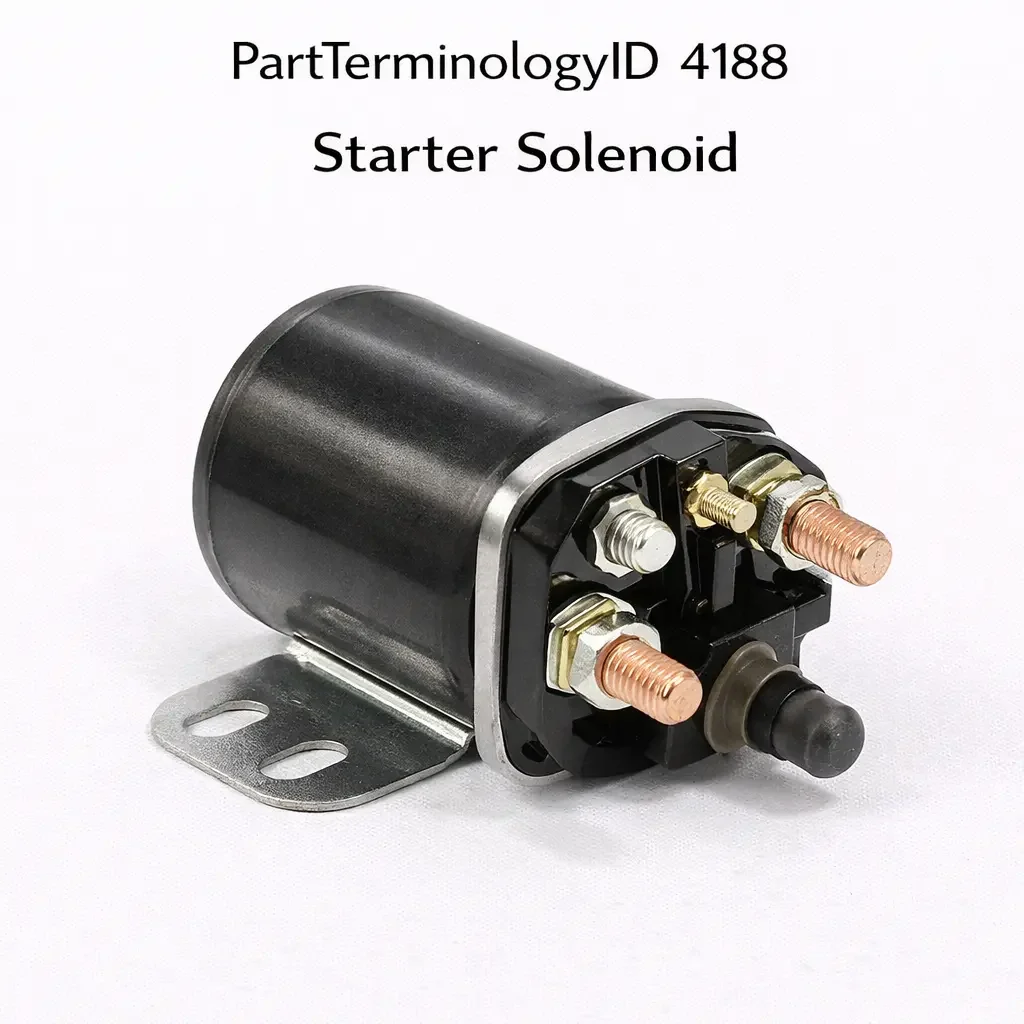
PartTerminologyID 4188, Starter Solenoid, is the electromechanical switching assembly that serves two simultaneous functions when the ignition switch activates the start circuit: it mechanically shifts the starter drive pinion into mesh with the engine ring gear through a plunger-actuated shift fork, and it electrically closes the main high-current contacts that connect the battery to the starter motor armature circuit, enabling the motor to develop cranking torque after the pinion is positioned for ring gear engagement. That definition covers the starter solenoid function correctly and leaves unresolved whether the solenoid is a cap-mounted integrated unit that mounts directly on the starter motor housing as a single replaceable assembly, a remote firewall-mounted or inner-fender-mounted solenoid that is physically separate from the starter motor and connected to the motor by a heavy-gauge cable, whether the solenoid uses a two-coil design with a pull-in coil and a hold-in coil or a single-coil design on some older applications, the pull-in coil resistance and hold-in coil resistance that must fall within the BCM or ignition switch driver output's current capacity, whether the solenoid includes the starter motor mounting hardware and shift lever as a complete assembly or supplies only the solenoid cap and contact components, and whether the solenoid main contacts are replaceable individually as a contact kit under a separate PartTerminologyID or are serviceable only as part of the complete solenoid assembly replacement.
For sellers, PartTerminologyID 4188 is the starter solenoid where control circuit validation is the most return-generating attribute, because the solenoid coil must receive adequate control voltage at its pull-in terminal to develop the magnetic force required to shift the plunger. A control circuit with a failed neutral safety switch, a failed ignition switch start contact, a failed starter relay, or a high-resistance connector in the control wiring will deliver insufficient voltage to the pull-in coil, producing either no solenoid activation or a chattering activation that does not hold the plunger in the engaged position long enough for the motor to reach cranking speed. Both conditions produce a no-crank or intermittent-crank symptom that the buyer attributes to the solenoid when the control circuit is the fault source.
What the Starter Solenoid Does
Pull-in coil and hold-in coil function and the two-coil activation sequence
The pull-in coil generates the initial high magnetic force required to overcome the plunger return spring and shift the plunger from its rest position to the fully engaged position. The pull-in coil is wound with heavier gauge wire and has lower resistance than the hold-in coil, drawing higher current during the initial plunger movement. The pull-in coil is grounded through the motor armature when the main contacts are open, so its current path exists only before the main contacts close.
When the plunger reaches the fully engaged position and the main contacts close, the pull-in coil's ground path through the motor is now shorted by the main contact closure, effectively disconnecting the pull-in coil from the circuit. The hold-in coil, wound with finer wire and higher resistance, continues to hold the plunger in the engaged position by maintaining magnetic field with lower current draw after the main contacts close. This two-coil design reduces steady-state solenoid current draw after engagement while maintaining the holding force required to keep the pinion in mesh throughout the cranking event.
A failed pull-in coil prevents the plunger from advancing to the engaged position. A failed hold-in coil produces initial engagement that drops out as soon as the main contacts close because the hold-in coil can no longer maintain the plunger position. The drop-out produces a rapid chattering sequence: pull-in coil energizes, plunger advances, main contacts close, pull-in coil loses ground and disconnects, hold-in coil fails to hold, plunger retracts, main contacts open, pull-in coil reconnects and energizes again. This produces the characteristic rapid clicking that buyers associate with a dead battery but which may also indicate a failed hold-in coil or insufficient battery voltage to maintain the hold-in current.
Remote solenoid versus cap-mounted solenoid and the fitment distinction
Remote solenoids are mounted on the firewall or inner fender and serve as a high-current relay switch between the battery and the starter motor without providing the mechanical shift function. Remote solenoid applications use inertia-drive starters where the pinion is shifted by armature acceleration rather than by solenoid mechanical action. The remote solenoid has three or four terminals: a large battery positive input, a large motor output, a small ignition switch control input, and on some designs a small motor-sensing terminal used for pull-in coil grounding. Remote solenoids are replaced as standalone units without disturbing the starter motor.
Cap-mounted solenoids are integral to the starter motor assembly and include the mechanical shift plunger that actuates the shift lever. Replacing a cap-mounted solenoid requires removing the starter from the engine, disassembling the solenoid from the motor housing, transferring the shift lever and drive assembly to the replacement solenoid, and reassembling the motor before reinstallation. The fitment distinction between remote and cap-mounted solenoids is fundamental: a remote solenoid replacement ordered for a cap-mounted application has no installation point on the motor and returns immediately.
Main contact set condition and the solenoid contact failure mode
The solenoid main contacts are the high-current switch elements that complete the battery-to-motor circuit during cranking. The contacts consist of a movable disc that is mechanically linked to the solenoid plunger and two fixed terminal studs that carry the battery positive and motor armature current. When the plunger advances, the disc contacts both terminal studs simultaneously, completing the circuit.
Contact wear from arc erosion at each contact closure is a normal wear mechanism. Severe contact pitting increases contact resistance, reducing motor terminal voltage and cranking torque. A contact disc that welds to one or both terminal studs from a high-current arc event holds the motor circuit closed after the ignition key is released, running the motor continuously until the battery is discharged or the solenoid is physically disconnected. These two conditions, high contact resistance producing weak cranking and welded contacts producing continuous motor operation, are the two solenoid main contact failure modes that require either solenoid replacement or main contact set replacement.
Why This Part Generates Returns
Buyers return starter solenoids because the control circuit has a failed neutral safety switch, ignition switch start contact, or starter relay that prevents control voltage from reaching the pull-in terminal, the battery is discharged or has insufficient cranking capacity and the pull-in coil receives adequate voltage but the hold-in coil loses voltage when the battery collapses under motor load, the solenoid is a cap-mounted type and the buyer ordered a remote solenoid, the main contact set is the specific failed component and a contact kit replacement is the correct repair rather than complete solenoid replacement, the solenoid mounting hardware or shift lever geometry on the replacement does not match the starter motor housing it is being installed on, and the plunger stroke on the replacement solenoid is calibrated for a different starter drive travel than the application requires.
Status in New Databases
PartTerminologyID 4188 is cataloged in PIES/PCdb as Starter Solenoid. Under PIES 8.0 and PCdb 2.0 there is no change to the terminology or classification for this PartTerminologyID.
Top Return Scenarios
Scenario 1: "Failed neutral safety switch, no control voltage at pull-in terminal, solenoid replaced with no change"
The vehicle does not crank and produces no click when the ignition is turned to start. No control voltage is present at the solenoid pull-in terminal during key-to-start events. The neutral safety switch has failed open and is preventing the control circuit from completing. The buyer replaces the solenoid. The neutral safety switch fault remains. The replacement solenoid also receives no control voltage. No change in cranking behavior.
Prevention language: "Control circuit validation: Confirm control voltage is present at the solenoid pull-in terminal with the ignition key held in the start position before replacing the solenoid. No voltage at the pull-in terminal indicates a failed neutral safety switch, a failed ignition switch start contact, a failed starter relay, or an open circuit in the control wiring rather than a solenoid fault. A solenoid that receives no control voltage is functioning correctly."
Scenario 2: "Battery voltage collapses under load, hold-in coil loses voltage after main contacts close, rapid chattering"
The vehicle produces rapid clicking when the ignition is turned to start. The battery shows 12.4 volts no-load but collapses to 8.2 volts under solenoid activation and motor starting current. The pull-in coil energizes at 8.2 volts with sufficient force to advance the plunger initially. When the main contacts close and the motor draws full cranking current, the battery collapses further to 6.8 volts. The hold-in coil at 6.8 volts cannot maintain the magnetic force to hold the plunger. The plunger drops, the main contacts open, battery voltage recovers slightly, the pull-in coil re-energizes, and the cycle repeats rapidly producing the clicking sound. The buyer replaces the solenoid. The battery fault remains. The replacement solenoid chatters from the same insufficient hold-in voltage.
Prevention language: "Battery voltage under load: Rapid clicking that stops cranking indicates the battery voltage is collapsing below the hold-in coil minimum voltage under motor current demand. Have the battery load-tested before replacing the solenoid. A battery that passes a no-load voltage test but fails under cranking current demand produces chattering from hold-in coil voltage dropout rather than a solenoid fault. Replace the battery before the solenoid on a rapid-clicking no-crank complaint."
Scenario 3: "Cap-mounted solenoid application, remote solenoid ordered, no installation point"
The vehicle uses a gear reduction starter with a cap-mounted solenoid that includes the mechanical shift plunger. The buyer orders a remote firewall-mounted solenoid from the listing. The remote solenoid has no shift plunger and no mounting provision on the starter motor housing. No installation point exists. The buyer returns it as incorrect.
Prevention language: "Solenoid type confirmation: Confirm whether your application uses a cap-mounted solenoid integrated into the starter motor housing or a remote solenoid mounted separately on the firewall or fender. Cap-mounted solenoids include the mechanical shift plunger and mount directly on the starter motor. Remote solenoids are standalone switch assemblies with no shift function. These two solenoid types are not interchangeable."
Scenario 4: "Welded solenoid contacts, continuous motor operation, contact kit correct repair, complete solenoid ordered"
The starter motor continues running after the ignition key is released. The solenoid main contact disc is welded to both terminal studs from a high-current arc event. The motor circuit remains closed continuously. The buyer disconnects the battery to stop the motor and orders a complete replacement solenoid. The main contact set within the solenoid was the specific failed component and a contact kit replacement would have restored the solenoid without replacing the complete assembly. The complete solenoid is returned as an over-repair after the buyer discovers the contact kit availability.
Prevention language: "Main contact set serviceability: On this solenoid design the main contact disc and terminal contact surfaces are serviceable as individual components under the solenoid contact kit. Before ordering the complete solenoid assembly, confirm whether the main contact set is available as a separate repair kit. A welded contact disc or pitted terminal surface repaired with the contact kit restores solenoid function at lower cost than complete solenoid replacement when the coil windings and plunger are confirmed functional."
Scenario 5: "Plunger stroke mismatch on replacement solenoid, incomplete drive engagement or over-travel"
The replacement solenoid is a compatible mounting fit for the starter motor housing but has a plunger stroke that is 3mm longer than the original. When the solenoid activates, the shift lever advances the drive beyond the designed engagement position, driving the pinion too deeply into the ring gear and causing binding. The buyer returns the solenoid as causing drive binding when the stroke specification mismatch is the fault.
Prevention language: "Plunger stroke specification: Confirm the replacement solenoid plunger stroke matches the original specification for this starter motor application. A plunger stroke that is longer than the original over-advances the drive collar and pinion beyond the designed engagement position. A stroke that is shorter produces incomplete pinion engagement. Plunger stroke specification is a mandatory fitment attribute for cap-mounted solenoid applications."
Listing Requirements
PartTerminologyID: 4188
Solenoid type: cap-mounted or remote (mandatory)
Coil configuration: two-coil pull-in and hold-in, or single-coil (mandatory)
Pull-in coil resistance (mandatory)
Hold-in coil resistance (mandatory)
Plunger stroke for cap-mounted applications (mandatory)
Main contact set serviceability note (mandatory)
Control circuit validation note (mandatory)
Battery voltage under load note (mandatory)
Solenoid type confirmation note (mandatory)
Terminal configuration: large battery, large motor, small control (mandatory)
OEM part number cross-reference (mandatory)
Catalog Checklist for ACES/PIES Teams
PartTerminologyID = 4188
Require solenoid type: cap-mounted or remote (mandatory)
Require coil resistance values: pull-in and hold-in (mandatory)
Require plunger stroke for cap-mounted (mandatory)
Require terminal configuration (mandatory)
Prevent control circuit misdiagnosis: control voltage confirmation at pull-in terminal must precede solenoid diagnosis
Prevent battery collapse chattering misdiagnosis: battery load test must precede solenoid replacement on rapid-clicking complaints
Prevent type mismatch return: cap-mounted and remote solenoids are not interchangeable; type confirmation must precede order
Prevent over-repair of welded contacts: main contact kit availability must be identified where applicable to prevent complete solenoid replacement when contact set repair is sufficient
FAQ (Buyer Language)
My starter clicks once but does not crank. Is it the solenoid?
A single loud click without motor rotation indicates the solenoid is activating but the main contacts are not closing or the motor circuit has a fault. Confirm control voltage is present at the pull-in terminal. If present, the solenoid coil is receiving the activation signal. Check whether the main contacts are closing by probing the large motor terminal for voltage when the solenoid is activated. If no voltage appears at the motor terminal despite the click and confirmed pull-in voltage, the main contact set has failed and requires contact kit or solenoid replacement.
My starter chatters rapidly but does not crank. Is it the solenoid?
Rapid chattering is most commonly caused by a battery that cannot maintain sufficient voltage under the combined solenoid and motor starting current demand. The pull-in coil energizes with adequate voltage, the plunger advances, the main contacts close and the motor draws cranking current, the battery voltage collapses, the hold-in coil loses sufficient voltage to maintain the plunger, the contacts open and the cycle repeats. Have the battery load-tested before replacing the solenoid.
How do I confirm control voltage is reaching the solenoid?
With the ignition key held in the start position, probe the small pull-in terminal on the solenoid with a test light or multimeter. The test light should illuminate or the meter should show battery voltage at the pull-in terminal. No voltage indicates the control circuit is open upstream of the solenoid pull-in terminal. The neutral safety switch, ignition switch start contact, starter relay, and control wiring between these components are the diagnostic focus when no pull-in voltage is present.
How do I test the solenoid coils before replacing the solenoid?
With the solenoid removed from the motor or accessible with connectors disconnected, measure resistance from the pull-in terminal to the motor terminal stud with an ohmmeter. Compare to the pull-in coil resistance specification. Measure from the hold-in terminal to the solenoid housing ground connection. Compare to the hold-in coil resistance specification. A reading significantly above specification indicates an open or high-resistance coil winding. A reading of zero or near zero indicates a shorted coil. Both faults confirm solenoid replacement.
My starter keeps running after I release the ignition key. What is the cause?
Continuous motor operation after key release indicates the solenoid main contacts are welded in the closed position. Disconnect the battery immediately to stop the motor and prevent thermal damage to the armature windings. Determine whether the main contact set is available as a separate repair kit for this solenoid design before ordering the complete solenoid assembly. A contact kit replacement at lower cost restores solenoid function when only the contact disc and terminal surfaces have been damaged by the welding event.
What Sellers Get Wrong About PartTerminologyID 4188
The most common error is omitting the control circuit validation note. The solenoid is the last component in the cranking control chain, and every component upstream of the solenoid pull-in terminal can produce a no-activation symptom that is indistinguishable from a failed solenoid at the pull-in terminal level. Without the control circuit validation note buyers replace the solenoid on neutral safety switch faults, ignition switch faults, and starter relay faults, find no change, and return the solenoid. The control circuit validation note with the pull-in terminal voltage check separates every upstream fault from a solenoid fault in one measurement.
The second error is omitting the battery voltage under load note for rapid-clicking complaints. Rapid chattering is the most characteristic symptom of a battery that cannot sustain solenoid hold-in voltage under motor starting current, and it is the most commonly misdiagnosed symptom leading to unnecessary solenoid replacement. The battery load test is the correct first step on a chattering complaint and the note converts a solenoid return into a battery replacement.
The third error is omitting the solenoid type confirmation note. Cap-mounted and remote solenoids are listed under the same PartTerminologyID and serve the same fundamental switching function but are physically incompatible with each other's mounting application. Without the type confirmation note buyers order the wrong type and return it as having no installation point.
The fourth error is omitting the main contact set serviceability note. A welded contact solenoid that can be repaired with a contact kit generates an unnecessary complete solenoid replacement when the contact kit availability is not disclosed. The over-repair return is entirely preventable with one sentence identifying the contact set as separately serviceable where applicable.
Cross-Sell Logic
Starter Solenoid Contact Kit: for buyers where the solenoid coil resistances are within specification but the main contact disc is welded or severely pitted, indicating contact set replacement is the correct repair rather than complete solenoid replacement.
Battery: for buyers where the rapid-clicking complaint traces to a battery that collapses below hold-in coil minimum voltage under starting current demand, indicating battery replacement resolves the chattering without solenoid replacement.
Neutral Safety Switch: for buyers where no control voltage is present at the solenoid pull-in terminal during key-to-start events and the control circuit fault traces to a failed neutral safety switch that is not completing the start circuit in park or neutral.
Starter Relay: for buyers where no control voltage is present at the solenoid pull-in terminal and the fault traces to a failed starter relay contact that is not delivering battery voltage to the control wiring during key-to-start events.
Starter (PartTerminologyID 4152): for buyers on cap-mounted solenoid applications where the solenoid is confirmed functional but the starter motor armature, brushes, or drive have additional faults that make complete starter assembly replacement more cost-effective than individual component service.
Why Catalog Data Quality Matters for PartTerminologyID 4188
Starter solenoid returns cluster around four scenarios that are fully preventable with listing language: control circuit misdiagnosis, battery collapse chattering misdiagnosis, solenoid type mismatch, and welded contact over-repair. The control circuit misdiagnosis generates the largest share of solenoid returns because the upstream control circuit components fail more commonly than the solenoid itself and their faults produce identical no-activation symptoms at the solenoid pull-in terminal. The battery collapse chattering misdiagnosis generates returns from buyers who replace the solenoid on the most common battery fault symptom pattern in the entire cranking system. The solenoid type mismatch generates immediate no-installation-point returns from buyers who receive a remote solenoid for a cap-mounted application. The welded contact over-repair generates returns from buyers who ordered a complete solenoid when a contact kit was the sufficient repair.
The control circuit validation note and the battery voltage under load note together address the two scenarios that generate the highest return volume under this PartTerminologyID. The solenoid type confirmation note and the main contact set serviceability note address two scenarios that are specific to solenoid architecture and are entirely preventable with two sentences of listing content.
Together these four notes make every listing under this PartTerminologyID complete and give every buyer the diagnostic path that identifies the correct fault source before the solenoid is removed.
Application Range and Fitment Guidance for PartTerminologyID 4188
Remote solenoid applications are concentrated in domestic vehicles from the 1960s through the early 1990s that used inertia-drive starters, particularly Ford and Chrysler products where a firewall-mounted solenoid was a design feature through multiple model generations. These remote solenoids are simple high-current relay switches with three or four terminals and no shift function, making them straightforward to diagnose and replace without starter motor removal.
Cap-mounted solenoid applications became universal from the 1980s onward as pre-engaged starter designs with integrated solenoid shift mechanisms replaced inertia-drive starters across all domestic and imported vehicle platforms. Cap-mounted solenoids vary significantly in plunger stroke, mounting bolt pattern, terminal configuration, and coil resistance specifications across starter motor manufacturers and application families. A solenoid that fits the physical mounting on one starter family will not necessarily have the correct plunger stroke for another family even if the mounting dimensions appear similar.
Stop-start system starter solenoids on current-generation vehicles with engine auto-stop at idle experience significantly higher contact closure frequency than conventional starters, potentially reaching tens of thousands of contact closures over vehicle lifetime compared to hundreds of thousands for conventional starters. Stop-start solenoids are designed with heavier contact material and higher-endurance coil winding insulation to accommodate the elevated duty cycle. A conventional solenoid installed in a stop-start application will experience accelerated contact wear from the elevated contact frequency.
Final Take for PartTerminologyID 4188
Starter Solenoid (PartTerminologyID 4188) is the dual-function cranking activation component where control circuit validation, battery voltage under load confirmation, solenoid type identification, and main contact set serviceability disclosure are the four attributes that prevent the four most common return scenarios. Every listing without control circuit validation sends buyers through a solenoid replacement on upstream control faults. Every listing without battery collapse guidance sends buyers replacing a solenoid on the most common battery fault symptom. Every listing without solenoid type confirmation generates immediate type-mismatch returns. Every listing without contact set serviceability disclosure generates over-repair returns from complete solenoid replacement when a contact kit was sufficient.
Together these four attributes make every listing under this PartTerminologyID complete.