
Written by Arthur Simitian | PartsAdvisory
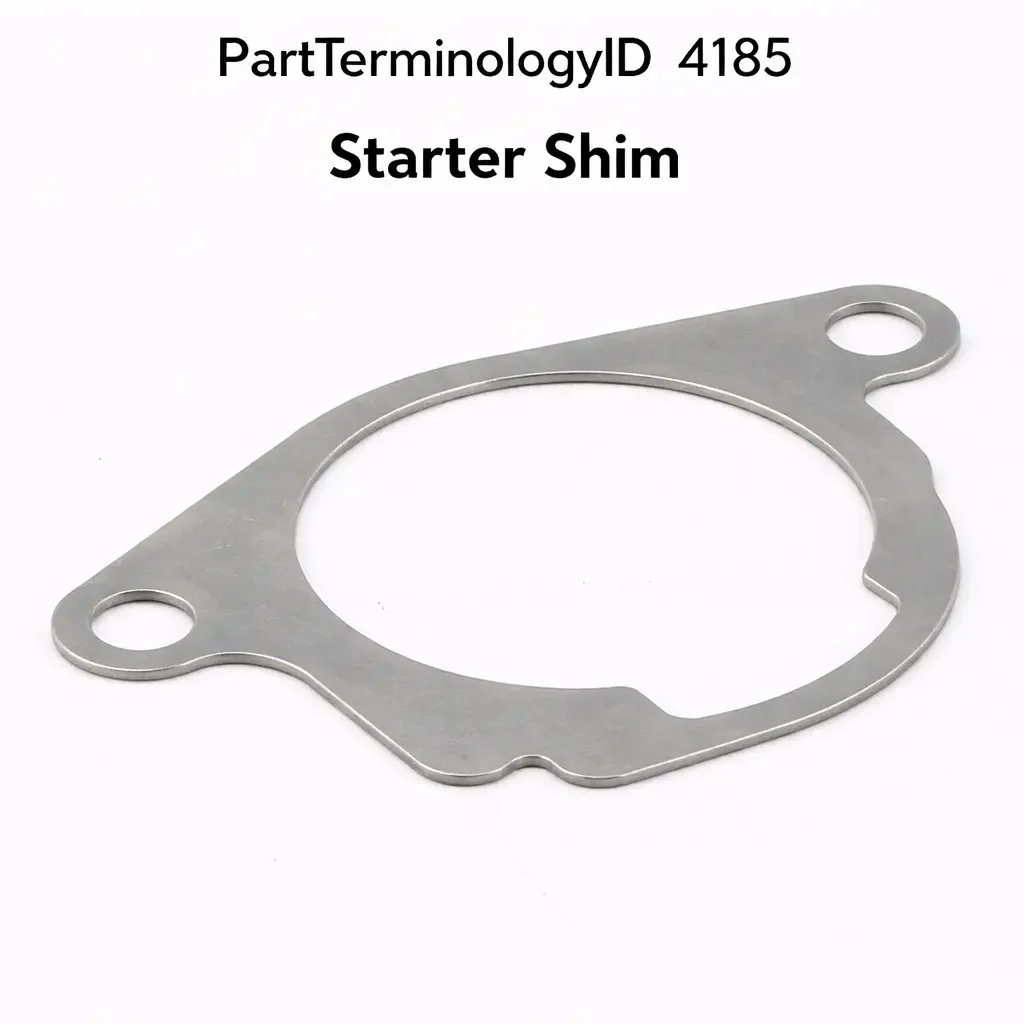
PartTerminologyID 4185, Starter Shim, is the precision spacer placed between the starter motor mounting flange and the engine block mounting pad to adjust the radial distance between the starter pinion gear and the engine flywheel or flexplate ring gear, setting the pinion-to-ring-gear clearance within the specification required for clean mesh engagement, quiet operation, and prevention of excessive pinion and ring gear tooth wear. That definition covers the starter shim function correctly and leaves unresolved whether the shim is a full-circumference flat washer-style spacer that covers the complete starter mounting flange face, a partial-arc shim that covers only one side of the mounting flange to apply an angular correction to the starter nose position rather than a purely radial adjustment, the material the shim is made from including steel, aluminum, or fiber composite, the thickness increments available in the shim selection set and how to determine which combination of shims produces the correct pinion-to-ring-gear clearance for a given installation, whether the shim is used on both mounting bolt positions simultaneously or on only one position to apply a cocked-angle correction to the starter nose axis, and whether the shim requirement applies to the original equipment installation or arises specifically from a starter replacement where the replacement starter nose housing has a different length than the original.
For sellers, PartTerminologyID 4185 is the starter shim where clearance measurement before shim selection is the most return-generating attribute, because a buyer who orders a shim without measuring the actual pinion-to-ring-gear clearance on the installed replacement starter has no basis for selecting the correct shim thickness. A shim that is too thick increases the clearance beyond the maximum specification, producing a ratcheting noise from the pinion not fully meshing with the ring gear. A shim that is too thin reduces the clearance below the minimum specification, causing the pinion to bind in the ring gear during engagement and producing the same binding and heat damage that occurs from an incorrectly specified starter nose housing. Both conditions produce starter or ring gear damage and a return of the shim as the wrong thickness when the clearance measurement was the missing step.
What the Starter Shim Does
Pinion-to-ring-gear clearance specification and the measurement method
The correct pinion-to-ring-gear clearance places the pinion teeth in proper mesh depth with the ring gear teeth when the solenoid is activated and the pinion is advanced to the fully engaged position. The clearance is measured with feeler gauges between the face of the pinion gear and the face of the ring gear with the solenoid activated to hold the pinion in the engaged position but with the battery disconnected so the motor does not turn. Most domestic V8 applications specify a clearance of 0.5 to 1.5mm at the pinion-to-ring-gear face gap in this activated-but-not-running position.
Clearance below the minimum specification causes the pinion to press against the ring gear face with residual force when the solenoid is fully energized, producing binding during engagement initiation and potentially preventing the pinion from clearing the ring gear when the engine fires and the solenoid releases. Clearance above the maximum specification allows the pinion to enter only the outer portion of the ring gear tooth height rather than the full designed mesh depth, concentrating tooth contact stress on the outer tooth edges and accelerating tooth wear.
The measurement is made with the solenoid battery terminal energized through a jumper wire to activate the solenoid without turning the motor. The pinion is held in the engaged position by the solenoid hold-in coil and the feeler gauge is inserted between the pinion face and the ring gear face. The reading confirms whether shim addition, shim removal, or no shim change is required to bring the clearance into the specification range.
Shim thickness selection and the incremental adjustment process
Starter shims are typically available in 0.4mm and 0.8mm thickness increments, with some applications offering 0.2mm increments for finer adjustment. The total shim thickness installed determines the offset of the starter mounting flange from the block mounting pad, which directly changes the radial distance between the pinion centerline and the ring gear centerline. Adding 0.4mm of shim thickness reduces the pinion-to-ring-gear clearance by approximately 0.4mm. Removing 0.4mm of shim thickness increases the clearance by approximately 0.4mm.
The shim selection process starts with a clearance measurement on the installed starter without any shim. If the measured clearance exceeds the maximum specification, shims are added in 0.4mm increments until the clearance falls within the range. If the measured clearance is below the minimum specification, shims are removed or a starter with a shorter nose housing is required. Shims can only add clearance by moving the starter mounting flange away from the ring gear; they cannot reduce clearance below what the bare mounting flange produces. A starter that produces below-minimum clearance without any shim requires a different starter nose housing length rather than shim selection.
Angular correction versus radial correction shims
Full-circumference flat shims move the starter nose radially away from the ring gear uniformly around the full mounting flange. This is the correct shim type when the clearance is uniform around the full ring gear circumference and only the radial distance requires adjustment.
Partial-arc or wedge shims apply a larger offset on one side of the mounting flange than the other, cocking the starter nose slightly to correct an angular misalignment where the clearance is correct at one angular position around the ring gear but is outside specification at another angular position. Angular misalignment is most common after engine replacement or flywheel replacement where the replacement components have dimensional tolerances that accumulate differently than the original assembly. A buyer who installs a flat shim to correct a clearance fault that is actually an angular misalignment will correct the clearance at one position while worsening it at another position.
Why This Part Generates Returns
Buyers return starter shims because the shim was selected without measuring clearance and the selected thickness produces out-of-specification clearance after installation, the shim type ordered is a flat radial correction shim when the fault is an angular misalignment requiring a wedge shim, the shim material is incompatible with the mounting surface and the shim deforms under the bolt clamping load changing the effective thickness below the selected value, the clearance was within specification without any shim and the shim was ordered based on assumption rather than measurement, and the starter nose housing length is below the minimum for the ring gear position and no thickness of shim can reduce clearance to the required range because the starter needs a longer nose housing rather than a shim.
Status in New Databases
PartTerminologyID 4185 is cataloged in PIES/PCdb as Starter Shim. Under PIES 8.0 and PCdb 2.0 there is no change to the terminology or classification for this PartTerminologyID.
Top Return Scenarios
Scenario 1: "Shim ordered without clearance measurement, incorrect thickness, ratcheting noise after installation"
The buyer replaces the starter and the replacement produces a ratcheting engagement noise. The buyer orders a 0.4mm shim based on a general recommendation without measuring the actual clearance. The actual clearance without any shim is 1.2mm, which is within the 0.5 to 1.5mm specification. Adding the 0.4mm shim increases the clearance to 1.6mm, which is above the maximum specification and produces the same ratcheting noise from insufficient mesh depth. The buyer returns the shim as the wrong thickness when no shim was required.
Prevention language: "Clearance measurement before shim selection: Measure the pinion-to-ring-gear clearance with the solenoid activated and motor circuit disconnected before ordering a shim. Insert a feeler gauge between the pinion face and ring gear face with the solenoid energized. A clearance within the specification range of [X to Y mm] requires no shim. Order a shim only when the measured clearance exceeds the maximum specification. Adding a shim to a clearance that is already within specification will move it out of range."
Scenario 2: "Angular misalignment, flat shim corrects one side and worsens opposite side, noise persists"
The replacement starter produces a ratcheting noise that varies around the ring gear circumference, louder at one position and quieter at another. The clearance measured at the position of greatest noise is 2.2mm, above the maximum specification. The clearance at the opposite ring gear position is 0.6mm, within specification. The fault is angular misalignment. The buyer installs a flat 0.8mm shim. The clearance at the noisy position improves to 1.4mm within specification, but the clearance at the opposite position deteriorates to below specification. The engagement noise shifts from one position to another rather than resolving.
Prevention language: "Clearance uniformity check: Measure pinion-to-ring-gear clearance at multiple positions around the ring gear circumference by slowly rotating the crankshaft while checking clearance with the solenoid activated. A clearance that varies by more than 0.5mm between ring gear positions indicates angular misalignment that requires a wedge shim or starter repositioning rather than a flat radial shim. A flat shim on an angular misalignment fault will correct one position while worsening another."
Scenario 3: "No shim required, starter clearance within specification, shim ordered on assumption"
The buyer replaces the starter and installs a 0.4mm shim on the assumption that replacement starters always require shimming. The clearance with the shim installed is 1.8mm, above the maximum specification. The engagement produces a ratcheting noise from insufficient mesh depth. The buyer returns the shim as the wrong thickness when no shim was required.
Prevention language: "Shim requirement confirmation: Not all starter replacements require shims. Replacement starters with the same nose housing length as the original will produce the same clearance as the original without any shim change. Measure the clearance before deciding whether a shim is required. A clearance within specification without any shim requires no shim and adding a shim will move the clearance out of range."
Listing Requirements
PartTerminologyID: 4185
Shim type: flat full-circumference or partial-arc wedge (mandatory)
Shim material: steel, aluminum, or fiber composite (mandatory)
Shim thickness and available increment sizes (mandatory)
Pinion-to-ring-gear clearance specification range (mandatory)
Clearance measurement procedure note (mandatory)
Angular misalignment identification note (mandatory)
Shim requirement confirmation note (mandatory)
OEM part number cross-reference (mandatory)
Catalog Checklist for ACES/PIES Teams
PartTerminologyID = 4185
Require shim type: flat or wedge (mandatory)
Require shim material and thickness (mandatory)
Require clearance specification range (mandatory)
Prevent unneeded shim installation: clearance measurement must confirm out-of-specification clearance before any shim is ordered; shim on within-specification clearance moves clearance out of range
Prevent flat shim on angular misalignment: clearance uniformity check around ring gear circumference must precede shim type selection; varying clearance requires wedge shim or repositioning
Prevent incorrect thickness selection: shim thickness must be selected to move clearance from measured value to within-specification range; feeler gauge measurement is mandatory before thickness selection
FAQ (Buyer Language)
How do I measure starter pinion-to-ring-gear clearance?
Disconnect the battery ground cable. Connect a jumper wire from battery positive to the solenoid battery terminal to activate the solenoid without running the motor. With the solenoid energized and the pinion held in the advanced position, insert a feeler gauge between the face of the pinion and the face of the ring gear. The reading in millimeters is the pinion-to-ring-gear clearance. Compare to the specification for the application, typically 0.5 to 1.5mm for most domestic applications.
How do I know which shim thickness to order?
Subtract the maximum specification clearance from the measured clearance to determine how much clearance reduction is needed. Select the shim thickness closest to this value from the available increments. For example, if the measured clearance is 2.0mm and the maximum specification is 1.5mm, you need to reduce clearance by 0.5mm, so a 0.4mm or 0.8mm shim is the appropriate selection depending on how close to the center of the specification range you want to land.
Does a replacement starter always need shims?
No. If the replacement starter has the same nose housing length as the original and the engine has not been changed, the clearance should be the same as the original and no shim change is needed. Measure the clearance before deciding whether a shim is required. Adding a shim when the clearance is already within specification will move it out of range and cause ratcheting noise.
My starter makes a ratcheting sound at one spot on the ring gear but is quiet at others. What is the cause?
A ratcheting noise that varies around the ring gear circumference indicates angular misalignment rather than a uniform clearance fault. A flat shim will not resolve this and may worsen the noise at one ring gear position while reducing it at another. Measure clearance at multiple ring gear positions and confirm whether the variation exceeds 0.5mm before selecting shim type.
What Sellers Get Wrong About PartTerminologyID 4185
The most common error is omitting the clearance measurement procedure note. The correct shim thickness can only be determined after measuring the actual clearance on the installed starter. Without the measurement procedure buyers order shims based on assumption, often installing shims when none are needed or selecting incorrect thicknesses, and return them when engagement noise persists or develops after installation.
The second error is omitting the angular misalignment identification note. A flat radial shim applied to an angular misalignment fault produces a different engagement noise pattern rather than resolving the original noise. Without the angular misalignment note buyers install multiple flat shims trying to resolve a noise that only varies around the ring gear circumference and return each shim as the wrong type.
The third error is omitting the shim requirement confirmation note. Many starter replacements require no shim. Without an explicit note that shim installation is not universal, buyers install shims on correctly fitted starters and return them when the added shim moves the clearance out of specification.
Cross-Sell Logic
Starter (PartTerminologyID 4152): for buyers where the clearance is below the minimum specification without any shim, indicating the replacement starter nose housing is longer than required and a different starter with a shorter nose housing is needed rather than shim removal.
Flywheel or Flexplate: for buyers where the clearance measurement reveals angular misalignment that traces to a replacement flywheel or flexplate with dimensional tolerances that differ from the original, requiring flywheel repositioning or replacement rather than shim selection alone.
Feeler Gauge Set: as a complementary tool recommendation for buyers who need to measure pinion-to-ring-gear clearance, confirming the measurement tool is required before shim selection and ordering.
Final Take for PartTerminologyID 4185
Starter Shim (PartTerminologyID 4185) is the precision clearance adjustment component where clearance measurement procedure, angular misalignment identification, and shim requirement confirmation are the three attributes that prevent the three most common return scenarios. Every listing without clearance measurement guidance generates returns from shims installed without confirming the clearance condition. Every listing without angular misalignment identification generates returns from flat shims applied to angular faults. Every listing without shim requirement confirmation generates returns from shims installed on correctly fitted starters that needed no adjustment.
Together these three attributes make every listing under this PartTerminologyID complete and give every installer the measurement process needed to select the correct shim thickness before any fastener is tightened.